
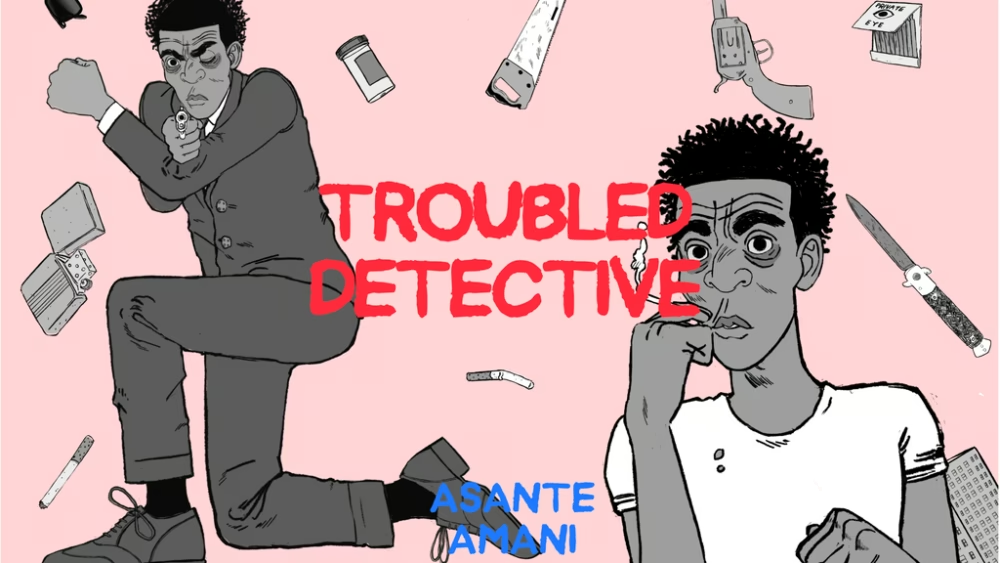
 Troubled Detective
Cartoonist: Asante Amani
Self-publishing through Kickstarter / $15
2026
When someone you care about goes missing, the cops aren’t going to help you. You can count on them showing up when you call and arresting somebody, but beyond that they’re going to leave you hanging. What you need is a private investigator like Joe Mallard, Asante Amani‘s Troubled Detective, who knows which questions to ask, and of whom. Someone who can follow a digital footprint. Someone who can handle a pistol as well as use it.
When you’re broken inside, you can still pick up on the tiny details that make and break a case going cold and you can give a mother grace but you’ll trample the vulnerability of your friends because you let yourself be unguarded around them and don’t know how to turn it off. You don’t really have friends, actually, though wherever you go everyone knows who you are. Who would be friends with you? Someone who has gone through hard times. Dead people.
I wouldn’t say this comic is about explaining any of that. Mostly we come to know the detective and his troubles through his actions rather than exposition, internal or otherwise. Mallard, which is to say Amani, will talk the reader through the thread as he follows it, like Dashiell Hammett’s Continental Op. The character clues Amani has us observe are a mixture of being motivated by a good heart, having the sense and/or lack of stability to always ask for what he’s worth, and knowing when a case is and isn’t closed. That last one can be where the stories get really good.
Mallard has the forthright approach I recognize more from novelists like Hammett and Chester Himes, though I do find Troubled Detective to visually be quite filmic. Is it the narcissism of the criminals or knowing who to talk to, the eager answers collaborators give a stranger? The pacing is in general a rejection of the contemporary love for Michael Mann’s Thief, Michael K Williams and Jonathan Banks, all the time waiting that a crime takes. Here, Amani shows you the important parts only, each link of chain as it connects the investigation to its conclusion. Told in a variety of ways and tones, but all at a comfortable clip that for me reads pulp.
I also think a lot of contemporary grey-area stories that attempt to separate law and crime from good and bad end up falling back on everyone having a code of some kind. Rules they make since reality has none. And I don’t get that in Troubled Detective. Mallard will cross lines. An Antonioni interest in people who are willing to do anything.
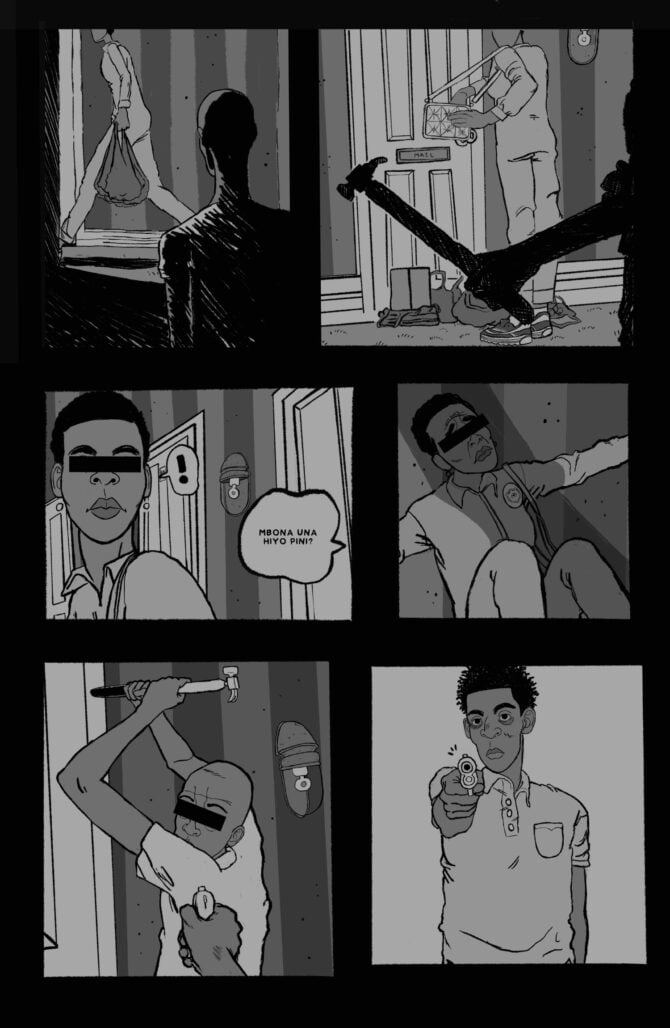
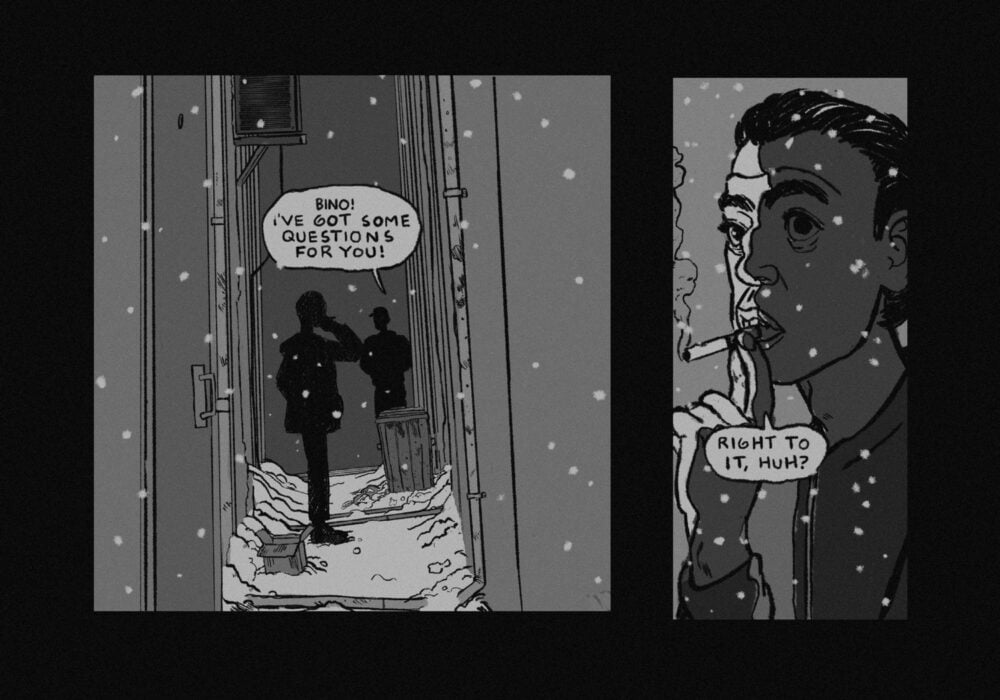 Amani strikes an approachable balance between precise, relatively spare drawing and loosening up for dramatic purposes. There’s lots of black in the panels and on/as the page’s negative space. Tight with panels, but in a nice open style that allows for uncluttered panels and little details enlivening things both. Penchant for silhouettes. Creative perspectives that recall “impossible” camera placement in movies; a shot from beneath, through the bottom of a box, with its contents between us and the characters searching through it. (I’m a sucker for using a multiplane effect in comics.) Troubled Detective‘s facial expressions radiate emotion. The girl who tries to set him up does not look happy in prison. But there’s something in Mallard himself, a lack of expression that’s unable to hide the restlessness beneath. An actor would be described as still, but this is static art. Amani is great at capturing presence.
In addition to pages gutters in black, a grey tone covers the art. I imagine it is like a lens filter or a film stock, a layer of manipulating the image’s tone, yet I keep thinking of the veneer of a specialty paper, used for a magazine or gallery show’s catalog. Historically, shading tones designed for industrial use have been utilized by cartoonists of color exploring visual representation outside of caricature, then cast away as comics art movements formed and matured outside of commerical circles (and, of course, are codified again by post-postmodern artists). Even though everyone has tone in Troubled Detective, there are definitely white people.
The omnipresence of a shade doesn’t feel like a political decision, but it is changing the typical rules of comics presentation by eliminating all whiteness. Conscious of the fact that I am reading right now despite being absorbed by the story, not unlike how the audience can perk up to cool cinematography without being taken out of the movie. An appreciation for how the story is told in the midst of its telling.
The appreciation for “lighting” stylistically reminds me more of Euro comics than indie stuff, a feeling probably reinforced by the page texture the omnipresent grey makes me imagine. Fantagraphics’ Ignatz Series, maybe? A shadow across an intentionally under-lit face is a level of embracing monochrome saturation that evokes yet another movie, The Pawnbroker, Sidney Lumet directing with Boris Kaufman (Dziga Vertov’s little brother!) doing the cinematography. A man takes a step back, aghast, plunging his face into darkness, but you can still see the lights reflecting off the tears in his eyes.
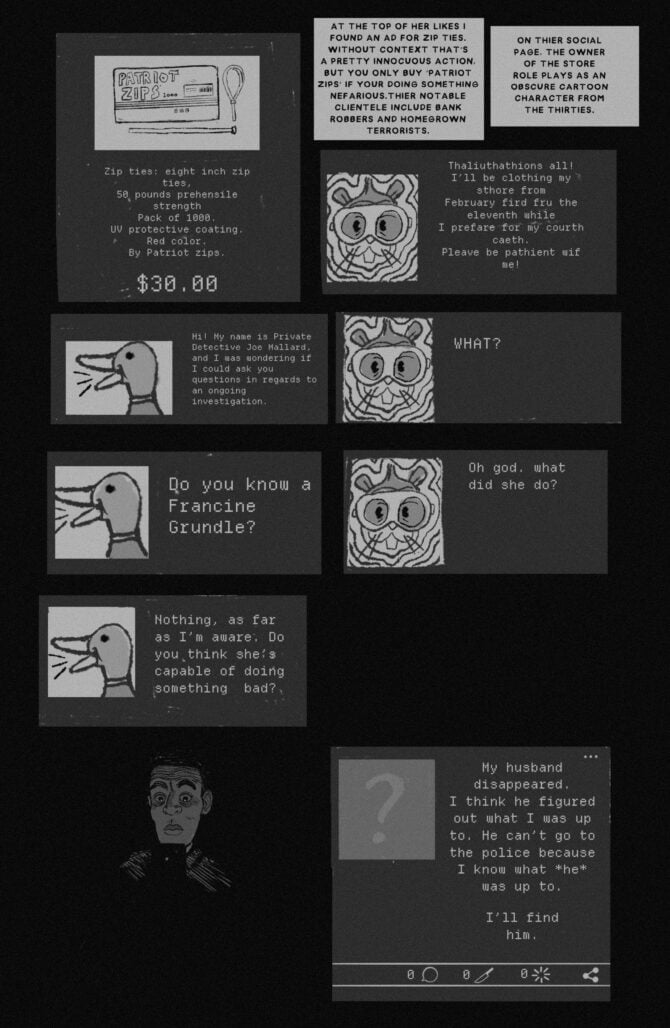 The internet is a problem: a recurring theme. Amani loads the stories with recognizable digital tipping points for people. How to print a gun. AI training your gambling bot pit fighter with real videos of atrocity. Slipping into a scrolling torpor and fucking your job up. All that reads now. Thankfully, Amani isn’t trying to make the art look like what I see on my phone when Mallard is on his, also probably too much. The social media has retrofuture aesthetics and a lack of framing/visual context/app clutter where you can instantly identify what it is even though it’s off-brand, and the comic looks better for it.
Asante Amani understands what works in a story. I am a stick in the mud about calling a work by one person in one installment an anthology. But I have to give it to Troubled Detective, the variety of ways the stories are told is strong enough that there is an appreciable difference between each. Knows how to give you the right pieces to see, knows how to switch effortlessly from one type of storytelling perspective to another, and back again. David Brothers put me on this comic by talking about how Amani understands montages and yeah, definitely. They’re so perfectly folded into sequential art’s pacing I’d only realize I was in one after it had begun. But that’s everywhere, the cartoonist guiding the reader. Mallard lining them up for us to knock down.
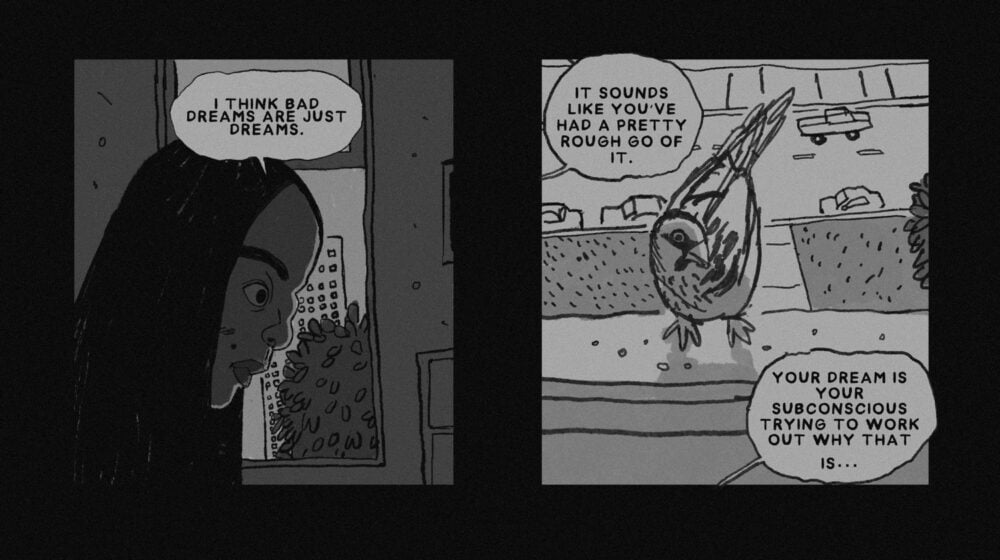
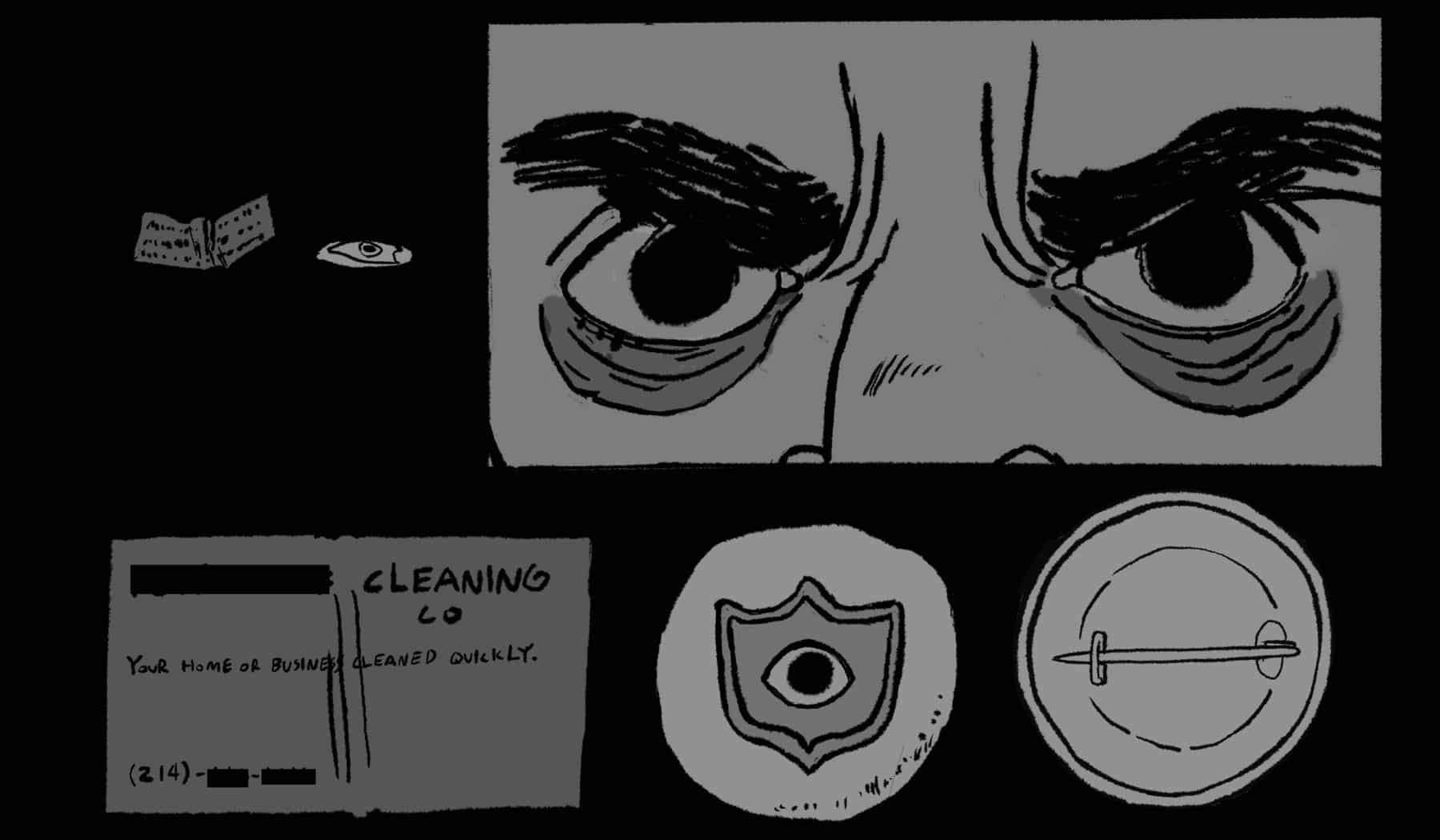
One story was filmic in a different way than the others. When you watch a movie again and, now that you know where it’s headed, you can see how many things were pointing in that direction already. I guess, just as Amani is able to arrest us, so too can he whisk us along. Talk about a maelstrom behind the eyes. In another stylistic switch, this one’s got curatorial panels for the reader. We have seen what Mallard is seeing, getting to share in the experience of his work by singling out what it is he detects. In this episode, Mallard doesn’t see them because he’s not looking, but we are shown the clues.
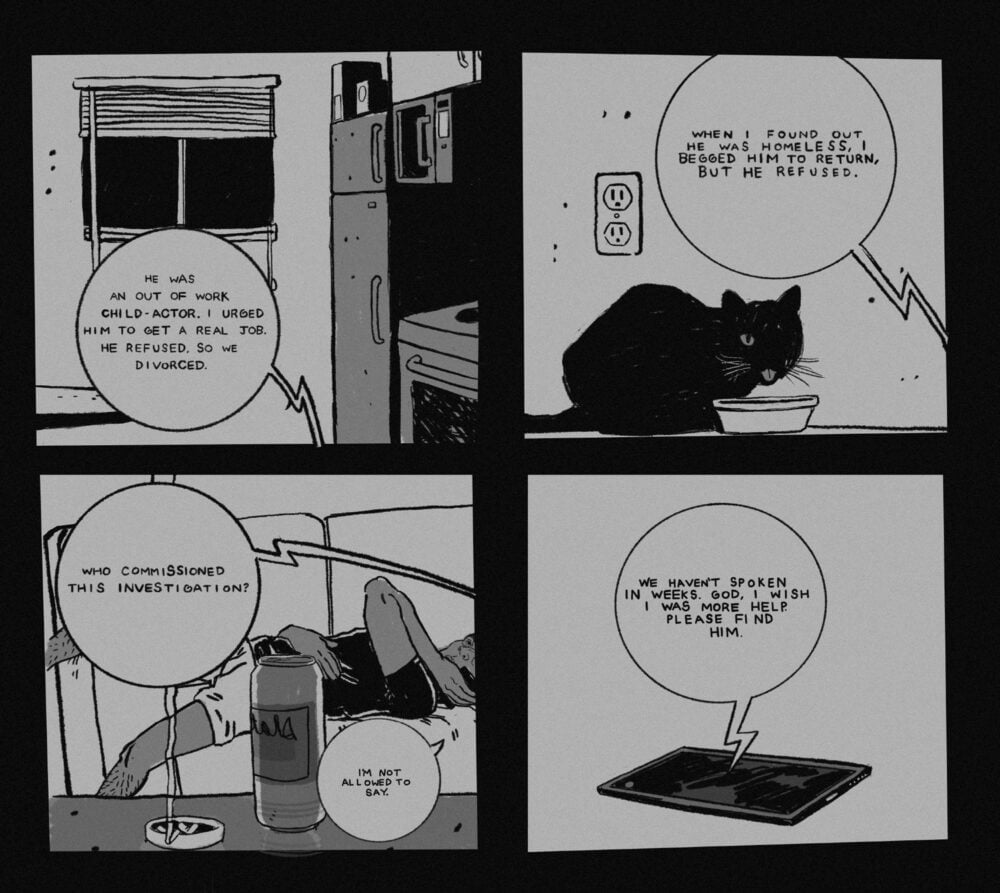
Hints masked by the storytelling style. There’s a lot of conversations, or what constitutes conversation for a detective. Mallard makes a statement, or asks a question, and the person he’s with goes off on a long, rambling one. Amani doesn’t let the camera rest, so to speak, eschewing the speaker’s depiction for capturing details from around the room (presumably through the eyes of Mallard), or retreating into the memories the monologue recalls (seeing through the mind’s eye of Mallard?). So I didn’t realize what I was looking at, that I was being shown things at all, until the sudden gravity of the situation came roaring to life.
Troubled Detective is open for pre-orders on Kickstarter through May 1st.