


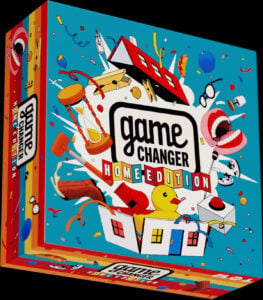
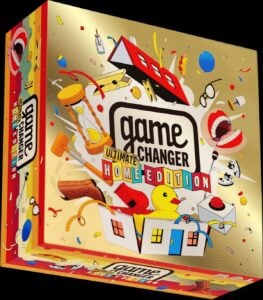
On Tuesday, Dropout launched its first-ever Kickstarter campaign for Game Changer: Home Edition, a tabletop edition of the iconic game show hosted by the streaming service’s CEO, Sam Reich. Just two hours in, fans have raised more than $1 million, far surpassing the initial $40 thousand goal.
At the top of each episode of the fan-favorite series, Reich declares, “This is Game Changer, the only game show where the game changes every show.” After introducing himself and his contestants—typically three, but sometimes more—he reveals the core premise: “Our contestants have no idea what game it is they’re about to play. The only way to learn is by playing, the only way to win is by learning, and the only way to begin is by beginning. So without further ado, let’s begin.”
Game Changer: Home Edition adapts three of the show’s most beloved games for 4-8 players, split into at least two teams, to compete in a series of challenges for the most possible points. Warren James Tabletop Lead Joshua Balvin worked closely with Reich to develop the adaptation, and the result is a party game experience that captures the essence of its source material. It’s packed with Easter eggs for diehard Dropout fans, but still super approachable for those who have never watched an episode of Game Changer in their lives.
After playing an early Home Edition prototype to familiarize myself with the mechanics of each mini-game, I spoke Balvin about the development process, his working relationship with Reich, his love for Dropout, and more.
Samantha Puc for The Beat: The screen edition of Game Changer is so chaotic and so different from episode to episode. How do you capture that feeling in a tabletop party game?
Joshua Balvin: I started by going through every episode. Sam and I are both game creators in different senses, and this isn’t going to be the last time we collaborate. He works more in the theatrical sense of game design and I work more in the tabletop sense. When I went through each Game Changer episode, I asked, “What are the games that could be adapted? What makes sense? What’s modular? How can this change every time?”
We wanted to create something that truly is in the spirit of Game Changer, that does change every time you play. It’s a big game. It’s a big experience.
Why did you go for the three mini-games “Bingo,” “Name a Number,” and “Sam Says”?
Balvin: I wanted “Sam Says” because it’s iconic. I think that when people think of Game Changer, they think of “Sam Says.” “Bingo” was one I wanted to do because I love the meta of the episode where you’re second-guessing other players. That’s the kind of gameplay I really like. [Editor’s Note: In the “Bingo” episode of Game Changer, in addition to the three contestants playing a regular game of Bingo with Reich, there are three additional players off-screen filling their own Bingo boards with predictions about how the on-camera contestants will behave.] “Name a Number” is most true to its episode.
We tried to get a mixture of things in here. Importantly, we wanted to make sure Home Edition wouldn’t be alienating to people who don’t know the show. We wanted to create a game that anyone could appreciate. There are nods for people who love the show, but if someone comes in and has no idea, they’re not going to be confused by any moment of it. That was also part of the mini-game selection process.
Also, I didn’t want to include anything that’s super performative, like, “You need to speak with this accent and do this.” That’s going to be very intimidating for players who don’t do that. It could also be embarrassing if they don’t know how to do that.
How did you go about making Game Changer: Home Edition approachable for all players?
Balvin: I’m very lucky that I have a very large community of play testers and people who are very excited to just try new things. I actually made it a point for about the first six months of development to not play with people who knew the show, and to make sure that they were having fun.
There were other other episodes that I tried and they ended up being a little bit too niche. Some of them have kernels that are interesting and I might circle back to them at some point. But for this game, it was super important that people who don’t know the show were smiling, engaged, laughing, having fun. Once we had that, we were like, “OK, these are the three mini-games.”
How did things change during the play testing process? Did any reactions or feedback surprise you?
Balvin: More than anything, it’s simplified. I’ve been doing this for quite a while now and I like to overcomplicate things. Then I get it in the room and start to strip off the layers and bring a game down to its core components. Game Changer: Home Edition is not the simplest party game. There are complexities in it, but I tried to make sure that all of the rules are super clear. Every rule is there for a reason.
I’ve never had a bad play test of this. From the very beginning, every play test has gone very well. That doesn’t ever happen. Seeing how well received it’s been in every play test makes me the most excited to see this out in the world and get it in front of people. This is Sam’s and my baby! We’re obviously very excited about this. I know that Sam has been wanting to get this made for a very long time. I can’t wait for people to actually get to play it.
This is your first party game. Does developing an IP game with an established audience make things easier, or does it add pressure?
Balvin: A little bit of both. There’s definitely pressure because I love Game Changer and I love Dropout. I really wanted to make sure this landed very well for the audience and that I did it justice. Game Changer is one of my favorite shows. I’ve seen comments online like, “How do you do a Game Changer board game?” When it was first brought to me about a year and a half ago, that was the first problem to be solved.
Luckily, Sam is so great to work with and he wanted to be very involved. He’s a gamer and he’s very good at problem solving. Whenever I need to run something by him, he is so responsive. Sam has wanted to do this for a long time but he didn’t want to rush into it. The fact that we’re here and that it’s actually happening is so thrilling.
I think we nailed it. I think expectations will be exceeded when people actually get to play it. It’s hard to imagine what it is until you play it. Even when I explain the rules, it seems like it’s one thing, but there are meta layers that emerge as you play. There’s a moment around round two or three of every mini-game when people say, “Oh, this is how this is going to go.” That’s how Game Changer is as well—even though in this version, you do know the rules, you still kind of don’t.
Are there plans for expansion in the future?
Balvin: We’d love to do more, but we want to see how this one does and go from there.
Is there anything else you’d like to add?
Balvin: This is just such a passion project between myself and Sam. We’ve been on this journey for about a year and a half and it’s such a good pairing. The powers he has and the powers I have complement each other so well. That’s why this is happening now, and I think why it didn’t happen before.
Sam is so excited about it, which is incredible for me, and I’m so excited about it. Probably the biggest thing is just how much heart went into this, which I think will be very visible in the final product. This isn’t just some game that’s being released, it’s something Sam really believes in.
Game Changer: Home Edition is now live on Kickstarter until June 5. Stretch goals will be unlocked through a series of community challenges, detailed on the page. See the Smosh Games cast play the game on May 10, and the Parlor Room cast play on May 14.
Game Changer Season 8 debuts May 19 on Dropout, with new episodes releasing on a bi-weekly schedule.