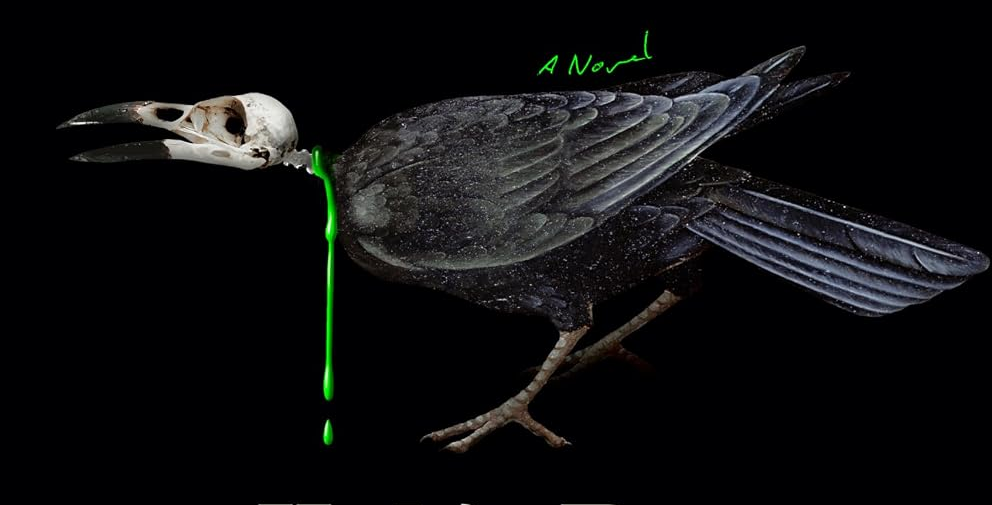

Eli Lamp is a shell of a man. An ex-detective and recovering substance abuser, he’s spent over a decade grieving his blind daughter, Hannah, who disappeared as a teenager after entering a van at night, alone. He tore his previous life apart looking for her, and the blood on his hands can’t be erased from his mind. Now indebted to The Crooked Wheel, a local drug cartel and gang, he works as an enforcer, desperately searching for any clues about what happened to Hannah. When the son of The Crooked Wheel’s boss is found killed and maimed, Eli is presented with a chance to clear his debts and confront his past all at once. Yet, things aren’t quite what they seem, and plunging headfirst into the darkness tends to leave one forever in it’s shadow.
The latest novel from hit horror author Keith Rosson, Crone sees Rosson at his most gutwrenching yet as we follow one man’s endless search for answers that sees him face-to-face with the very dregs of his world, as well as forces from worlds outside of our own that may just provide the resolution Eli desperately searches for. In the afterword, Rosson explains the very personal and tragically real inspiration for the novel, the January 27th, 1995 disappearence of teenagers Jennifer Esson and Kara Leas in Agate Beach, Oregon, who were later found deceased. No culprit has ever been found. Rosson, an Oregon native, knew them both and describes numerous attempts over decades to ‘exorcise’ the feelings brought on by what happened to them. As Rosson states:
They lived and breathed and had high hopes for themselves and probably couldn’t even imagine being as old as i am now.

In that sense, it should come as no surprise that Crone is brutally tragic and at times, unrelenting in its gutwrenching quality. That’s not to say there’s no hope here, that would be a lie, but this is a story whose characters push themselves past the very limits of what a person can mentally handle without sacrificing something deep within themselves. In that regard, it’s similar to Rosson’s previous novel Coffin Moon, but it plunges the reader even further into the depths of its characters’ despair.
Yet, in spite of the fear and anguish, it’s often beautiful. It celebrates the power of love ever-lasting in the form of grief, whilst maintaining a grounded, realistic perspective on things. You would think this would impede the novel’s readability, but no, Crone is absolutely thrilling from start to finish. It’s a tightly wound, brilliantly paced crime / horror hybrid novel, where each chapter sends the reader further into the helical mystery thrusting the plot itself foreword. This deeply personal foundation lays the groundwork for what is one of the best horror novels of the decade so far, and the best novel of Rosson’s career yet.
As mentioned previously, the novels’ main plot follows Eli Lamp, an enforcer living in a rundown trailer and earnestly trying to survive each day as it comes. He is heavily indebted to local kingpin Trying Dave Novak, and the closest thing he has to a friend is fellow enforcer Terry Bishop, Novak’s primary gunman.
Crone kicks off with the death of Novak’s son Anton, who is found shredded into pieces and left in a ditch in Salt Point, Oregon. Trying Dave, attempting to take advantage of Eli’s history as a semi-successful detective, offers him a chance to clear all of his debts by finding out who killed Anton. Meanwhile, Avery Bryant, Hannah Lamp’s childhood best friend, returns to Salt Point years after abandoning Hannah on her own on the night of her abduction. She dreams of Hannah, and feels compelled to a homecoming, despite her mounting drug debts, including money stolen from her lover and dealer Nico. All the while, something old and dark lurks in the woods, approaching our characters with the fluttering of wings. As Eli and Avery’s lives slowly entangle once more, Crone explores what the power of grief, the throes of addiction, and the extent to which someone will go to look after those they love.
Eli Lamp is a brilliantly written protagonist for this story. Heavily paying homage to and subverting classical noir character archetypes, Eli is dominated by his own fear and paranoia, which infects every action he takes throughout the story. He met Melanie, a bartender, in his youth and the two fell in love, before Melanie died in childbirth. With Hannah’s disappearence, Eli becomes a man stripped away of everything he loves most in mere moments. Yet, there’s something not entirely right with him, and Rosson affords the reader with the chance to truly know Eli, for good and for bad. He’s a violent man, blind to his own mistakes, overwhelmed by his own personal demons which prevent him from seeing the truth even when it’s apparent to everyone around him. He’s still sympathetic throughout, but it’s truly phenomenal character work, which allows Crone’s central narrative to feel riveting and complex, as its protagonist is pulled between his destructive urges and his profound longing for a world that stopped existing years ago. He’s also pretty cool, and is allowed plenty of moments to serve as a badass, compelling psuedo-detective, whilst never sacrificing the complicated core of his character in service of pure fanservice.
He was sick to death of storming through doorways. Hurting people, making demands of them. He’d had a lifetimes fill of it.

Crone’s other central narrative figure is Avery, who serves as both an inverse and parallel character to Eli. Whereas Eli places guilt on himself for Hannah’s fate that is at times unwarranted, Avery is directly responsible for Hannah being left alone on the night of her disappearence and must reconcile with her mistake. It costs her everything, and at the time of the narrative she’s a shattered waste of a woman, no future and a broken past. Yet in contrast to Eli’s desperate search for answers, she’s more dejected, cynically accepting her circumstances most of the time.
Avery is a fascinating character here, at once a victim of societal standards around young women and their behavior (included being permanently punished for something that a young man would face little-to-no feedback for) but a flawed, realistic victim in that she perpetuates harm unto others and doesn’t help herself iat times. It’s fantastic, and helps flesh out Hannah’s character by positioning her in contrast to Avery. Hannah, economically impoverished and living with a visibility defect, and Avery, raised in a wealthy household and able-bodied. Her story is possibly the most gutwrenching, as she lacks some of the same battle capability as Eli, so she often has to find more creative ways to get out of the brutal situations she finds herself in.
Crone’s final major perspective character is Vicki, who earns a living selling love-potions, and had a fondness for Eli Lamp a lifetime ago. Her life is turned upside down by Anton’s murder, as she finds a human heart left by itself on the rural Oregon coastline. Vicki is our connection to the supernatural elements of this story, as she has more of an understanding of worlds other than our own, especially when compared to Eli and Avery. She knows about the history of Salt Point, and some of the colorful individuals that have called it home. She communicates with spirits through a radio. She’s a wonderful character, and provides a fun counterbalance to Avery and Eli, with her chapters both being more outwardly terrifying, and yet not as unrelentingly bleak as she remains unbroken and sure of her morals and convictions. The novel would be far worse off for not having her in it, with each of her chapters a massive highlight, especially for those who enjoy supernatural horror, and want to see how an author like Keith Rosson explores some of those classical folkloric horror elements.
Crone is a novel jam-packed with compelling, nuanced and entertaining characters, so it’s difficult to choose who to highlight and who to exclude. I found Adam Kingston, a beat cop who effectively replaced Eli Lamp as the local detective, to be fascinating in his supporting role and a very realistic character. Trying Dave Novak is terrifying and impossible not to focus attention to whenever he pops up on the page, as is rival drug lord Amos Grey. Howie, the ephemeral spirit who speaks in riddles and confounding sentiments, is a total scene stealer, and there’s also the mysterious titular crone, who lurks in the shadows, watching and stalking…
Everything he did that night he meant to do. Every damn bit of it.
However, the most compelling of the characters with less screen presence is quite possibly Hannah Lamp, who we see fragmentary glimpses of through drug-fueled memories and supernatural happenings. Her perspective as a character emotionally impacted by living with a disability, whilst also dealing with a substance-abusing father and a flaky, inconsiderate best friend, is painfully real and sympathetic, and she occupies an almost Laura Palmer-like space in the narrative, haunting every character and bleeding through every moment. No matter how gnarly the book gets, caught up in violent crime and supernatural carnage, it never loses track of Hannah as the central point, perhaps due to the novel’s personal elements and very real inspiration. In portraying Hannah as complicated, multifaceted and mysterious, even through the memories of others, the book is deeply enriched and adopts a new layer of depth and nuance that makes it masterful. Rosson does not hesitate to give ugly answers to hard questions, and yet knows exactly when to leave things ambiguous, and leave it to the reader to fill in the blanks. It’s spectacular stuff.

Rosson’s writing itself is absolutely excellent throughout, adopting a slick, effortless noir feel whilst also using post-modern techniques to allow the more emotive, surreal and supernatural moments to absolutely flourish. His narrative voice is so distinct, and I just adore it – I’ve read four books and counting of it and will absolutely devour more in the years to come. The supernatural horror elements here are handled brilliantly as well; in keeping with how Fever House tackled zombies, and Coffin Moon ventured into vampires, Crone hexes you with it’s unconventional approach to folk horror and in particular, witchcraft. It’s incredibly well handled, paying homage to classic witch stories and the essential tropes of that particular subgenre, but also doesn’t feel defined by them. The best aspect to how Rosson explores the notion of witches is how he thematically ties it to the narrative itself. I won’t spoil how it happens, but I will say that it’s expertly handled, in a series of chapters that are amongst the best Rosson has ever written, and had me softly crying as I read them. Very few novels have made me cry. Even fewer horror novels.
Thematically, Crone is about love. It’s about grief as an embodiment of love, rage borne out of a foundation of love, and how we stop acting rationally when love is involved. People make reckless, silly decisions in this novel, but it always works from a plotting standpoint, because it always feels like the most realistic, human decision in that moment. We are fallible and emotional and this novel has a great sense of how to portray that. It’s also a novel about hate. It’s about self-hatred, something Eli and Avery both grapple with, in the form of drugs and violence and reckless abandon. There’s also hatred for others, for those who you perceived as having wronged you, and whether or not that perception is correct or not. There’s also the dichotomy of living in the past and suffering in the present, to which almost every character in the novel deals with. They are living in the shadows of their prior mistakes, and enveloped by the darkness that follows. Lastly, there’s the notion of what is just. At what point is retributive violence just senseless and selfish? Conversely, at what point does it become potentially justifiable? These are universal themes portrayed in a deeply interesting way. When combined with characters that are all so human, so flawed and so multifaceted, it adds so many wrinkles and layers to the narrative. It invites further analysis and reading in the way I can’t do justice here, and that’s what the best horror novels are capable of. It’s a work of literature, of art, that uses the disgusting bloodshed and supernatural horrors to convey it’s themes and strengthen its portrayal of said themes. Horror literature can be just as meaningful, if not more so, than what is perceived as ‘real’ literature, and Crone is a brilliant example of that.
In conclusion, Crone is an absolute must-read. Keith Rosson continues to tell radical, brutal horror stories that explore the grimiest depths of human nature, whilst never sacrificing their enjoyability or readability. In his most personal, most real novel yet, he pushes the envelope even further, crafting a world full of such deeply lived in character perspectives that you feel like you’re right alongside Eli, Avery and Vicki, in the forests and fog of Salt Point. By thrusting us into the darkest, most nightmarish places in-between the tragically, gutwrenchingly real and the paranormal, Crone emerges as a genuinely masterful horror novel, a story about love and hate and all of their shades, with severed hearts and heads and talking radios and bile vomiting, winged creatures. If you only read one novel this year, let it be this one; it’s a rarity that a novel feels so achingly tender and so brutal at the same time, beautifully and brilliantly written by an author who is perfecting his craft. Get down in the mud with Avery Bryant and Eli Lamp for a little while, and trudge your way into the realm beyond with them.