

Traditionally, film noir views cities as places that are hostile by nature. The people that venture out into them risk either witnessing a crime or becoming the victim of one, especially at night. Men have to blend in, seem as dangerous as the criminals that are prowling about to survive. It’s a vicious cycle that establishes and maintains a dark status quo. Men turn rough because men have made the city a rough place. Unsurprisingly, it’s women who pay the harshest price for it.
John Parker’s 1955 Dementia hangs on tight to the last part of this genre formulation. Women are confronted with an unwelcoming and cruel world in most, if not all, noir films and it’s the men’s fault things are as they are. It’s an argument Parker subscribes to, only he injects a healthy dose of expressionistic horror into it to drive the point home even harder.
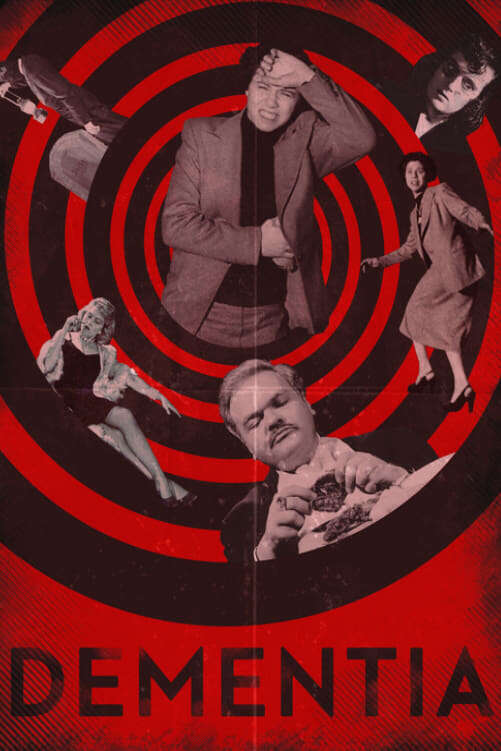
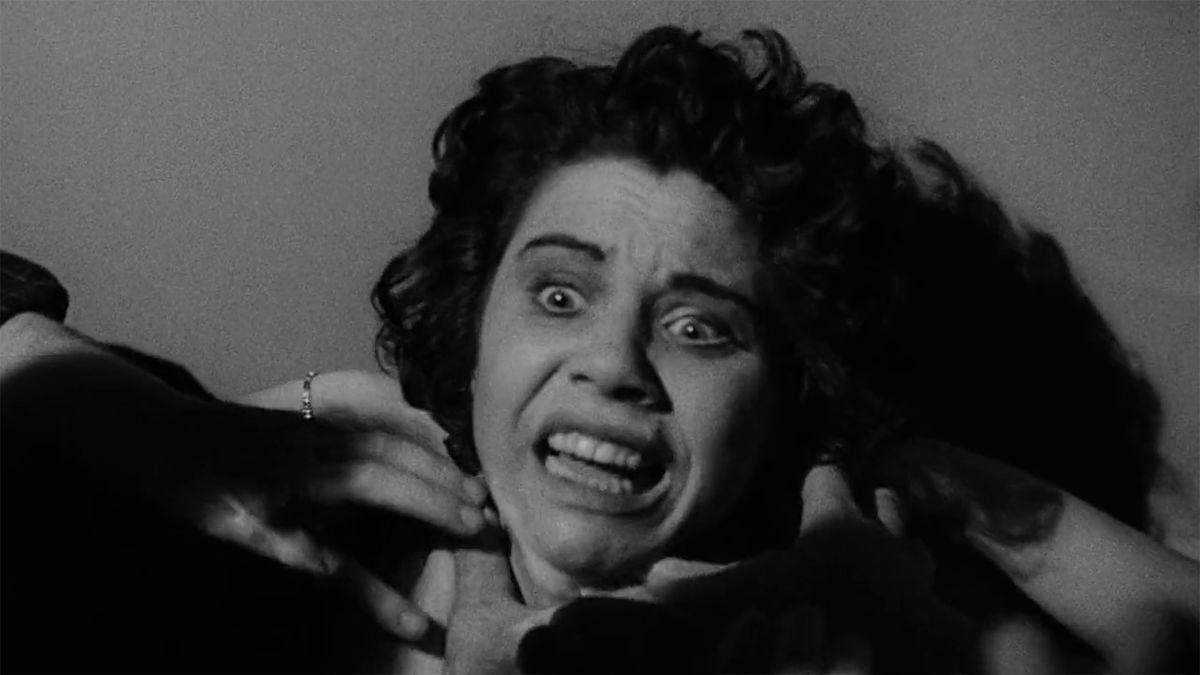
Dementia (also called Daughter of Terror) focuses on a singular woman (Adrienne Barrett) that hits the streets of Los Angeles late at night after a disturbing nightmare shocks her awake in her hotel room. Never uttering a word throughout the film’s entire runtime, the woman is met with violence the minute she steps outside.
She meets a small person that’s selling newspapers with an ominous headline that reads “Mysterious stabbing,” which coupled with the nightmare hints at the woman being involved in the crime. A homeless man assaults her soon after. A police officer saves her by giving the man a beatdown with the butt of his revolver. The cop laughs maniacally in enjoyment. The woman joins in on the laughter.
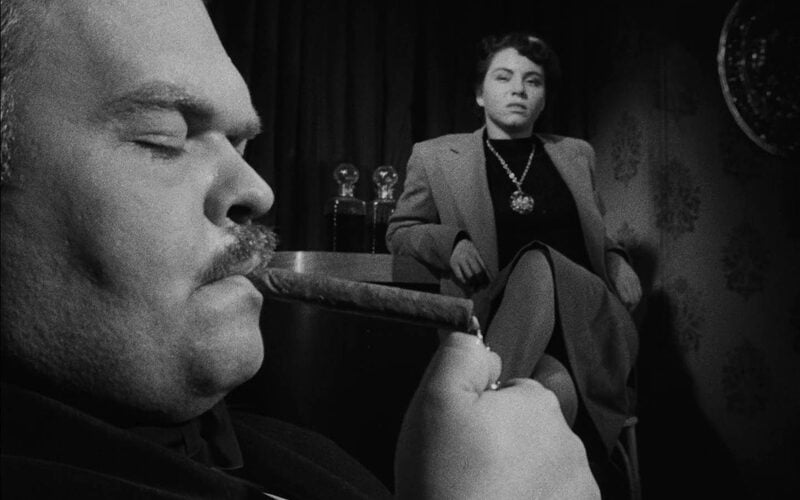
Shortly after, she meets a pimp that entices her to serve as an escort to a rich fat man (Bruno Ve Sota) that acts like an entitled child who sees women as playthings. Things get weirder from there on.
The movie goes for a dream-like feel that views the city and its people as absolute expressions of moral corruption (something that noir has always had the market cornered on). It imbues the story with a gothic sensibility that not only heightens the level of danger in every scene, but also makes each location come across as haunted. Los Angeles is as much a home to crime as it is to the ghosts that continue acting as witnesses to it.
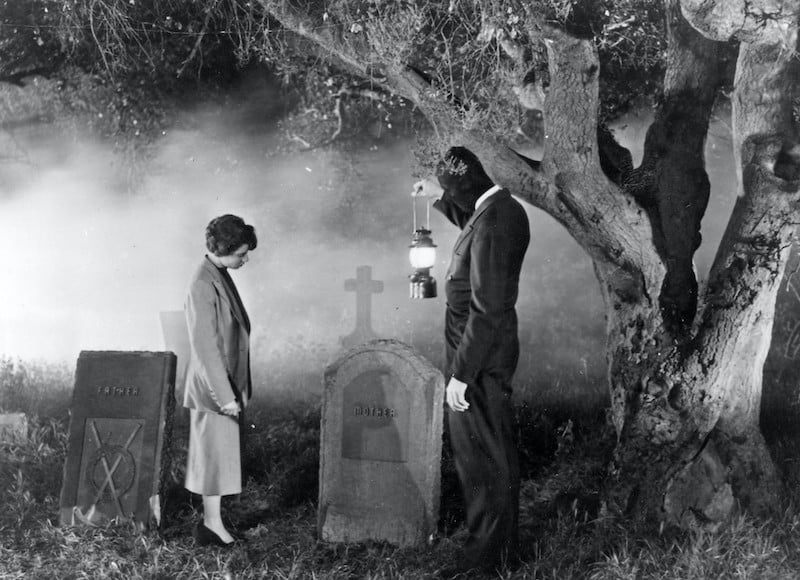
Firmly in horror territory here, Dementia dives deeper into its nightmare scenario by approaching the woman’s backstory via supernaturally tinged sequences. The woman’s childhood memories, for instance, play out in front of her parents’ graves in a cemetery. It produces an eerie effect that entertains madness as the driving force behind the woman’s late-night outing. At another point, she encounters phantom people with black masks covering their entire heads, as if the men and women of Los Angeles had all decided to collectively haunt her.
As the woman’s night becomes stranger, it also becomes more macabre as certain details about the mysterious stabbing start coming to light. Each reveal asks the viewer to consider not whether the crime happened but how it’s warped the woman’s psyche. Actress Adrienne Barrett gives an intricately expressive performance that guards some of the character’s secrets while not making her look helpless. Like the men of noir, she comes across as hardened and ready. She’s no victim. The city’s hostile, sure, but she proves to be capable of navigating it and reflecting some of its own darkness back at it.
Dementia’s score, composed by George Antheil and vocalized by Marni Nixon, bolsters the woman’s trek through the seedier parts of LA. It consists of a relentless wailing that sounds like it was emitted by a demented Greek chorus. It doesn’t evoke lamentation or fear. Rather, it points to the titular state of mind and how the woman’s very existence represents a kind of torment that can easily lead to madness.
When we speak of horror noir, we tend to gravitate towards example that have clear-cut elements of the supernatural and the monstrous mixed into the crime-heavy genre. There are some of good examples of it, too, with Lord of Illusions and Angel Heart among them. Dementia, though, gets its horror from ideas that are already embedded in noir (much like Charles Laughton’s The Night of the Hunter does in this regard). It’s an experimental film that challenges audiences to piece together a woman’s psyche by engaging with the weird. In doing so, the woman emerges as a force that can be as dangerous as any man.