
I realize the title of this piece is provocative, but it’s not an isolated opinion given that the newest film from one of the internet’s bigger cult figures/punching bags is resting firmly in the teens on sites like Metacritic. But that does nothing to soothe the pain that comes with delivering this message.
I am a fan of Zack Snyder as a person. He’s a genuinely nice guy; he’s very open with his fans, and anytime he gives an interview, as mush-mouthed as they are, you can feel the passion for what he’s working on pouring out of his very core. This is a guy, like Tom Cruise, who loves movies and loves making them. I’m reminded of a quote I heard once from a pal: “You gotta be crazy to want to make movies.” It’s hard, grueling work. So to have somebody pushing through everything he’s been through- the personal loss, the professional embarrassments- and to still be in the industry because he feels like he has stories he MUST tell. How can you not admire that?
I’m known as a picky critic among my colleagues. But I have enjoyed a number of Snyder’s past efforts. I remember distinctly when Dawn of the Dead came out in 2004; I turned 21 as the clock struck midnight, and I spent those first couple of hours of that landmark in a theater watching Snyder help usher in a new wave of zombie fiction. I’ve revisited that movie a few times, and while I don’t think it’s held up well, I still hold that memory close to my heart. I think his adaptation of Watchmen, while not even within spitting distance of the comic, has its merits, sincere devotion to the source (up to a point) being one of them. And his DC movies are hit and miss, but I maintain that his cut of Justice League is still one of the strongest superhero films of the era. I am unwavering in this.
That’s my Zack Snyder pedigree. Despite how unwatchable I’ve found his recent Netflix efforts (the dull return to zombie action in Army of the Dead, which failed to spawn a franchise despite the streamer’s best effort, and the woefully bad Star Wars pitch retrofitted into the Rebel Moon duo), when one hears that the man was independently producing and shooting a long-gestating passion project and then dropping it right in the middle of one of the industry’s biggest film festivals, it’s hard not to want to see what that’s all about.
The first I ever heard about The Last Photograph was that it was one of these projects that Snyder loved to bring up every once in a while in the midst of the peak of his powers. Back in those nascent days right after “the gayest movie ever made” (his words) 300 broke him into the big time and he wrangled the long unadaptable beast Watchmen into something that you could take your parents to see at the multiplex. We were all blown away by that Smashing Pumpkins-backed trailer in front of The Dark Knight, don’t pretend like you weren’t.
For the kids playing along at home, Snyder was emerging as a “big effing deal” (Joe Biden voice intended there), to the point where actors as prominent as Christian Bale and Sean Penn were going to star in one of the earlier versions of whatever The Last Photograph was going to be (albeit with Snyder just producing at that point). While Snyder was also playing footsie with the idea of adapting Ayn Rand’s “The Fountainhead”, The Last Photograph always seemed emergent as his first foray into non-genre filmmaking given how much further ahead it appeared to be on the pre-production assembly.
It never happened. The superhero machine ate everything pre-COVID, including Snyder’s time and resources (and some would argue, his talent). So it was with a feeling approaching the surreal when I sat down in what was basically a retrofitted theater inside a convention hall in Toronto to watch Zack Snyder’s The Last Photograph. A real movie, with real actors, no distribution, and basically self-funded along with a few production partners.
And it’s absolutely terrible.
It opens with a guy taking a photo of a butterfly while having sex right outside of a kid’s birthday party. And then moments later, one of those kids get full bore shot in the face by an intruder. You know what you’re getting right away, at least.
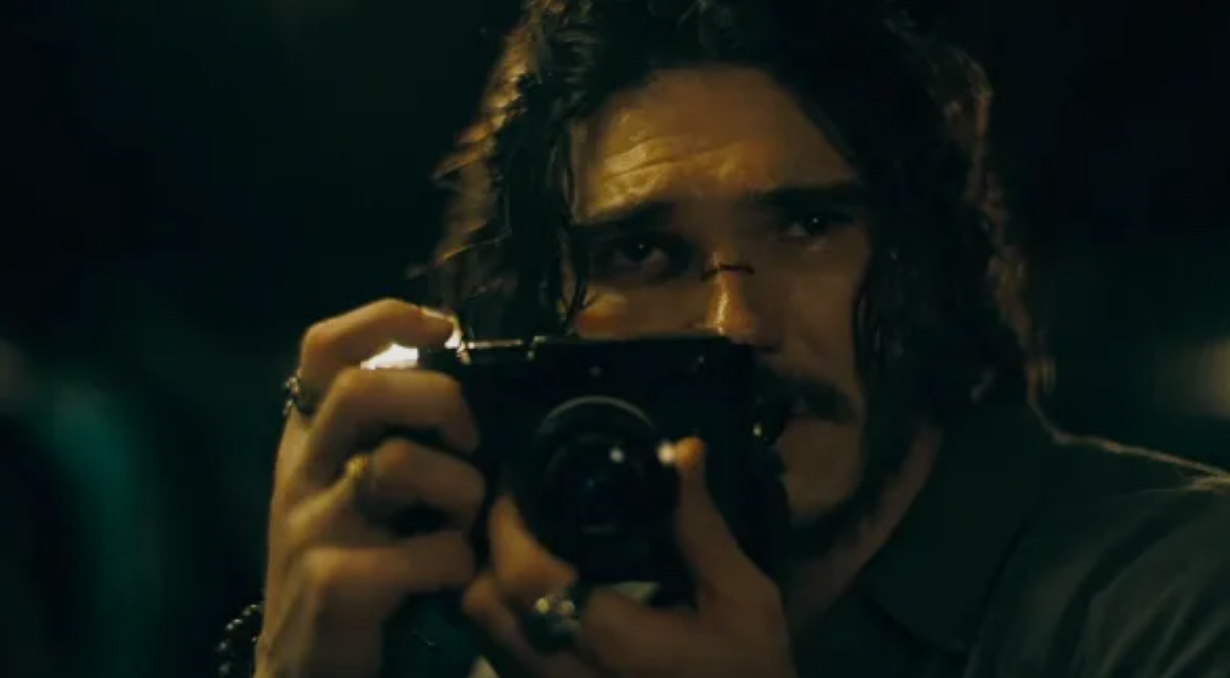
The plot, in as much as one can make sense of it, is put into motion by these events. The massacre at this birthday party leads to a kidnapping of a pair of children and our photographer friend (named “Joe Wallace” played by Fra Fee, here a poor man’s Kit Harrington) captures pictures of the shooter in the act, including one that identifies him. Days later, a very muscular sheepherder, Ethan Black (Stuart Martin aka Dollarstore Hugh Jackman) hears of the massacre in his local paper. This tragedy occurred at the home of his brother and his sister-in-law, who Ethan also had an affair with. And so, a now angry muscular sheepherder seeks out Joe, the photographer, because he is the lone person who can identify the killer and in turn uncover where the kidnapped children are.
To go further into plot descriptors would be in err. It’s basically a descent for this duo into various South American off-the-radar locales. A boat here, a brothel there run by the worst parody of a trans character I’ve seen this side of a Daily Wire production, the home of a pedophile criminal; the journey becomes a laundry list of some of the most offensive takes on Latin America that I can recall in some time. That’s not even getting into the tribal aspect, which is where the script continuously is built up towards, that plays like something out of a 70’s exploitation film with a leader who is dressed like the old WWE stalwart Papa Shango.
I’m not one that needs the films I see to ascribe to my own social and political sensibilities. I grew up in the south. I’m used to some ugly things. But the further along The Last Photograph went, the more my discomfort grew. To add to that, the presentation of South American culture is almost matched by how badly its scant female characters are treated. In this movie, women are largely just chattel, to either add some additional skin to the proceedings or multiply the body count when the bullets start flying. The one character of note, the above-mentioned sister-in-law (Constanza Andrade) exists as a motivating force for Ethan. She also gives him a tit pic at the beginning of the movie that we get to see frequently. Value added, I guess.
Based on everything heretofore discussed, one wouldn’t blame you if you at least thought this was Snyder doing something at least action-packed and pulpy. There’s plenty of action movies that have spurious relationships with race and sex, what’s one more? Except this is also Snyder bringing to bear his full-throated Terrence Malick influence, for whatever reason. He wants to remind you that he is indeed an artist with a capital “A.” Thusly, we’re treated to long, laborious shots of these beautiful, muscular men staring at butterflies, and nature, and eventually the chaos that is wrought around them. While Man of Steel flirted with this on occasion, “wheat touching” sequences and the like, this is where Snyder really wants you to know he saw and absorbed The Thin Red Line and The Tree of Life. But for all his flaws as a storyteller, Malick’s films still maintain some sense of the human condition and are soulful in ways that The Last Photograph has left aside, taking on purely the aesthetic value devoid of all meaning. In short, it makes what could be an offensively dumb movie, that could at least be fun to watch in a trashy way, a chore to get through.
At a pure nuts and bolts level, it also just doesn’t make much sense. Given what we eventually learn about Ethan, Joe is told his companion is “death incarnate,” the idea that this photographer even needs to accompany him on this death march doesn’t hold up to any scrutiny at all. Though, his weaving in and out of scenes of Ethan and others shooting guys up with his camera, which Snyder lenses like he’s equating the camera to a gun, creates unintentionally funny imagery. But as the revelations pile up, core reasons of the film’s existence narratively lead to nothing but further confusion, even down to why the opening slaughter occurred in the first place. And the more you learn about Ethan’s past, the more ludicrious it all becomes. I’m loathe to tell you about how he acquires what are basically superpowers.
When the credits rolled, Snyder, his production team and lead actors all came out for a Q&A afterward. You could tell from the look on his face that he knew it didn’t go well. I’m sure the laughter at scenes not intended to elicit them was the lead indicator, but the room practically emptying out before the post-film questions began was probably the final kicker. Snyder looked like a man truly defeated. Both I and my partner came away heartbroken for the guy. Given everything, a project with this much personal investment from a director for whom everyone who works with him has nothing but glowing things to say, by all accounts, you just want him to have a win.
But in The Last Photograph, it’s simply not to be. It’s not just a bad film- he’s got a number of those- it’s downright repellent, and easily the worst thing he’s ever made. And typing that just now, I’m bummed out all over again.