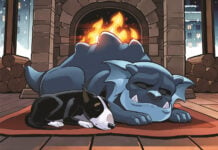
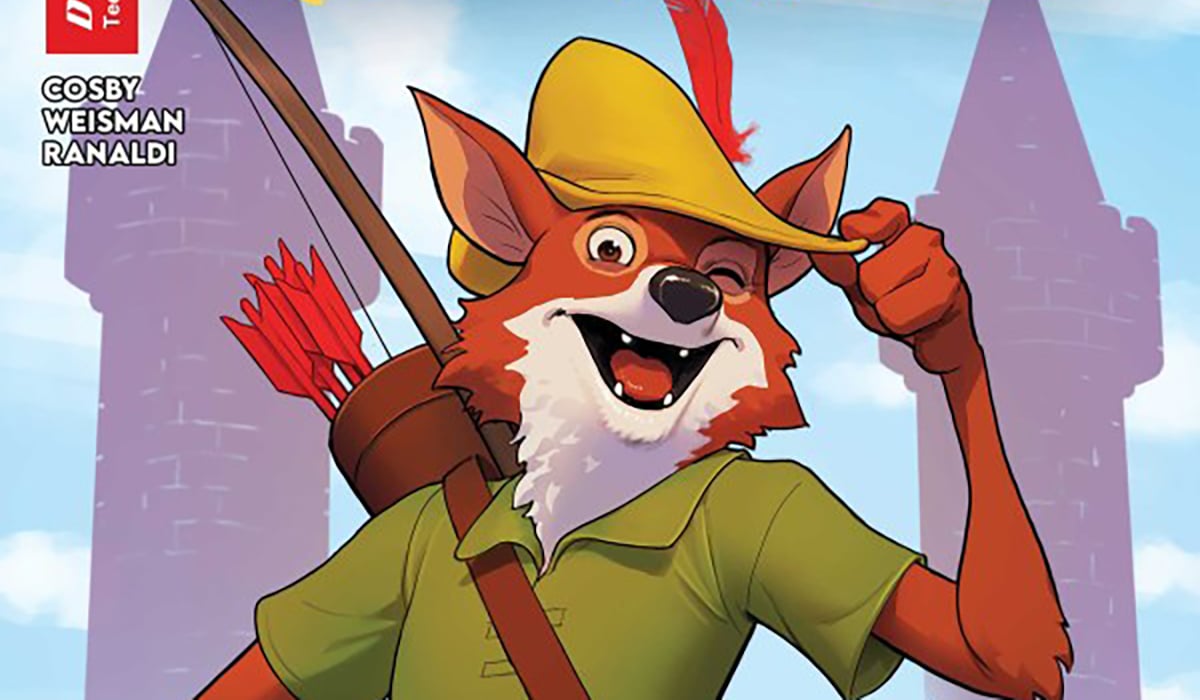

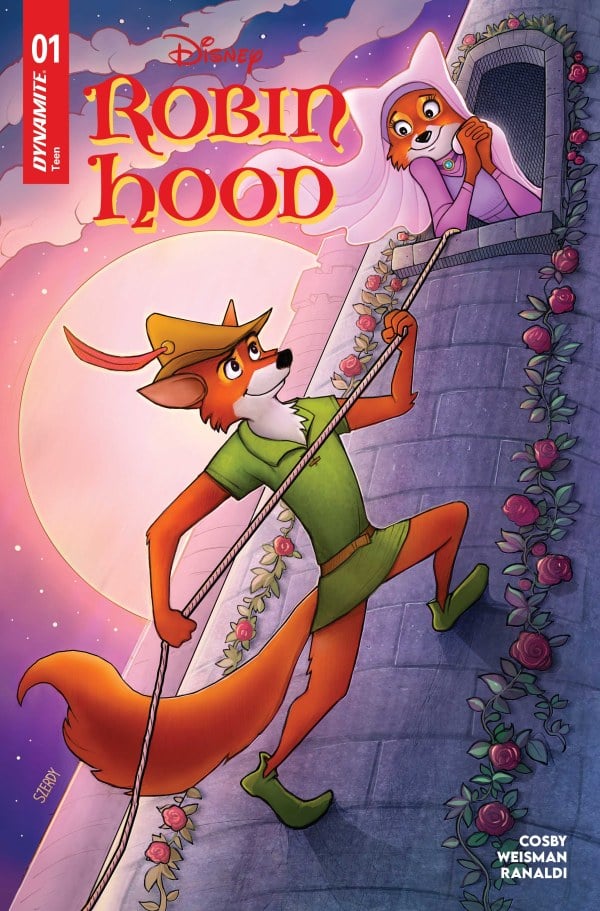
The beloved fox of Disney’s version of Sherwood Forest is back in Dynamite’s upcoming Robin Hood series. Marking the first comic iteration of the character in more than 50 years, the title is scripted by Eisner-nominated writer Nate Cosby (Cheetara: Worldbreaker) and plotted by Cosby and legendary Gargoyles creator Greg Weisman. Alessandro Ranaldi (Zootopia, Disney Villains: Hades) illustrates the book debuting this November.
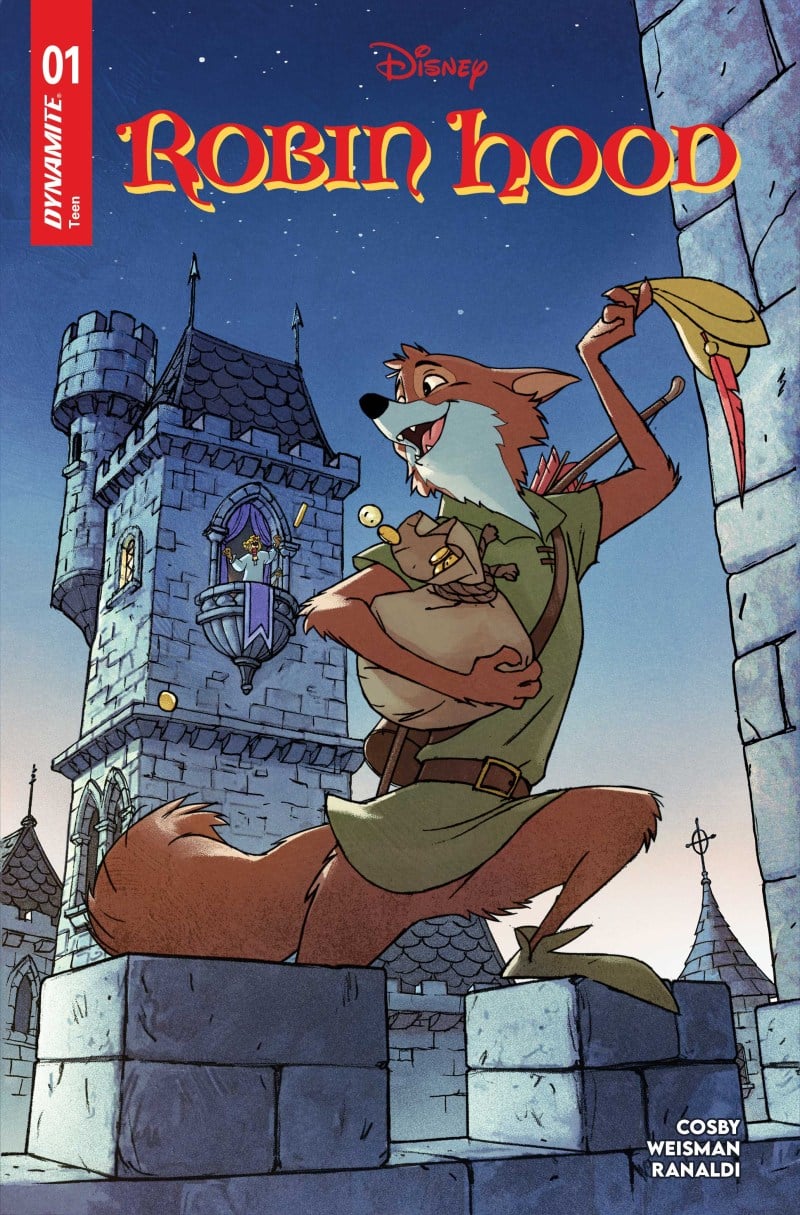
I chatted with Cosby and Weisman about the comic.
DEANNA DESTITO: This is kind of an underrated Disney movie. Why do you think this one has such a following that people are already responding to it?
GREG WEISMAN: I think it’s a ton of fun. I mean, the characters are great. They all stand out. I mean, obviously you have to have seen it. And there’s a whole generation who probably hasn’t. And I get that. But if you take a look at it on Disney+, it’s hard not to fall in love with it. Fantastic characters, great rollicking adventure, romance, great songs, and Baloo playing Little John.
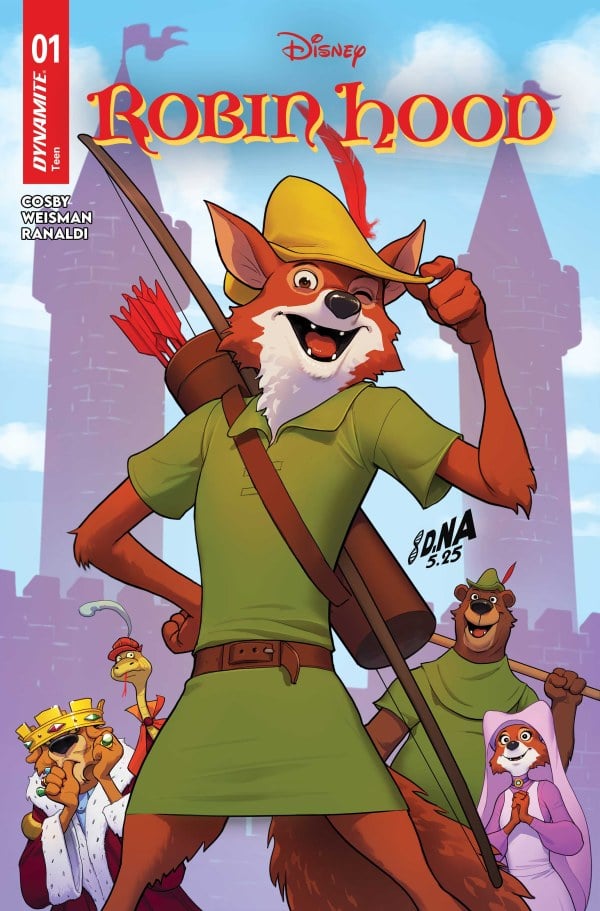
DESTITO: As a child, I always assumed they were the same actor. Is the comic based on that story? Is it your own version? How are we fitting this into the film versus how is it updated?
NATE COSBY: So the movie begins with the opening of The Legend of Robin Hood, right? Then Alan-A-Dale takes over as the narrator. He’s like, nah, don’t worry about this book. I’m actually going to tell you the real story, the one from the animals’ point of view. So our idea was basically, you only get told a handful of chapters from that book, which is the movie. We have an entire book, an entire huge novel, of untold chapters that we can tell. We don’t really see the beginning of Robin Hood. We do see the end, when he weds Maid Marian, but everything in between is not an A-to-B-to-C-to-D plot. It’s a circuitous route all the way through Sherwood Forest. The thing that I love so much about the film is that it’s just a good hang. You want to spend time hanging out with these people in these beautiful, lush, painted environments.
And so that’s kind of what we’re going to do. There is going to be a plot that drives things along, but mainly our idea is just like, let’s just take our time and get to know everybody, you know?
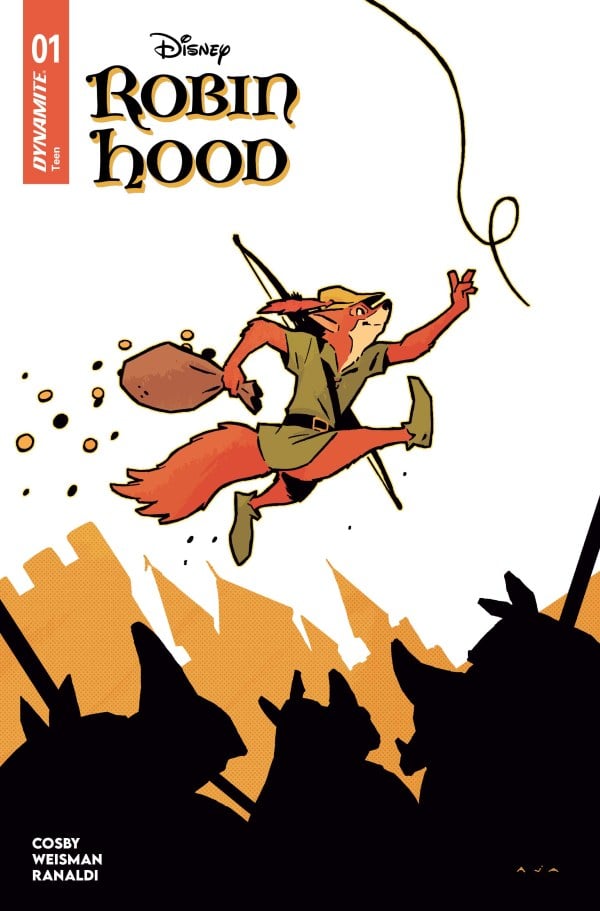
COSBY: That speaks to the idea of each issue kind of centering a different character each time. First issue’s Robin, second issue’s Marian, third issue’s John. And then I won’t spoil which issue, but at some point my favorite, Lady Kluck, is gonna take the center.
There’s so much texture that the actors really bring, and just the warmth of the animation. It feels a little hand-drawn. I mean, very hand-drawn. It feels touchable, tangible in a way that not every single animated film does.
DESTITO: Are you introducing any new characters?
COSBY: I’ll let Greg talk as soon as I say that we cannot reveal the exact characters that we may or may not be introducing, but there are a lot of characters in Robin Hood lore. Greg, you can take it from there.
WEISMAN: Well, you just tied my hands.
COSBY: Yes, I did.
WEISMAN: There is one specific new character I’m very excited about that is not new to the Robin Hood lore but was not shown in the movie.
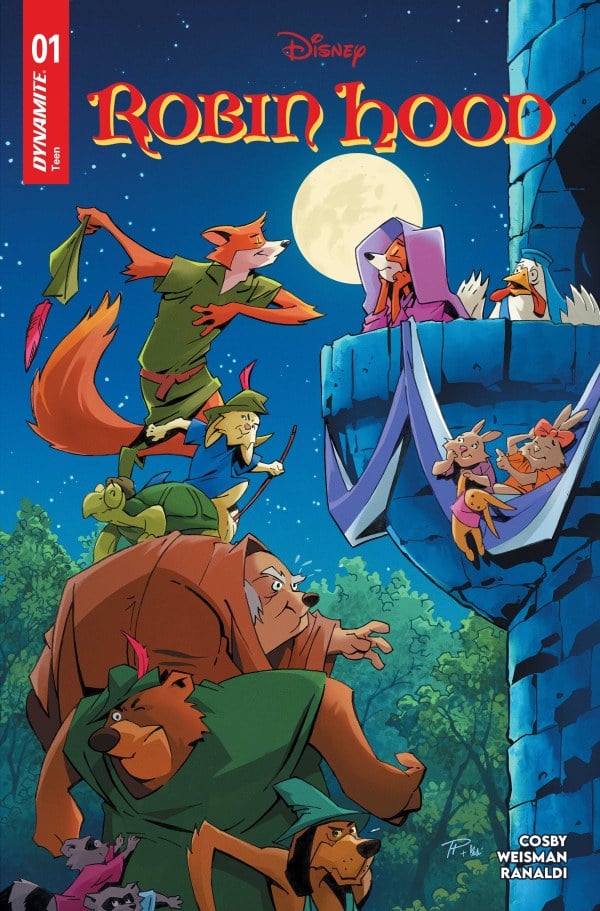
WEISMAN: That character that I’m not allowed to say for some reason I don’t really understand, we’re gonna show that character in the comic that always felt a little bit like the one missing piece to me from the Robin Hood lore. The one character that, I’m like, how can you do Robin Hood and not include this character? Now we are, and that makes me happy.
DESTITO: That kind of narrows it down, huh?
WEISMAN: It does if you’re a Robin Hood scholar, yeah.
COSBY: The interesting thing that makes Disney’s Robin Hood an outlier, other than it being all animals, of course, is the idea that there’s not really a band of Merry Men in the forest. It’s like there’s Robin, there’s Little John, there’s Friar Tuck, but everybody else is— they’re kind of civilians.
WEISMAN: And even Friar Tuck isn’t really shown as a Merry Man in the movie. He’s got the church. Later, a lot of people have to go to the forest for safety. But you don’t get a sense of the Merry Men. And we want to sort of bring that back to the property.
COSBY: The movie pulls a lot from original Robin Hood lore. There are some things, like, I mean, for instance, Lady Kluck playing football, but American football. But so much of that stuff- the idea of Robin being in costumes constantly, sneaking around, hiding in the forest, you know, pining for Marian and them having an unrequited love from their youth- like, that’s all there in the old lore. So we’re going to be pulling a lot from [that]— the same way that so many classic Disney movies do pull from folklore, old tales, Lion King, Cinderella, all that kind of stuff.
DESTITO: So let’s talk about the creative team. So who is making up the full creative team for this series? It’s an ongoing series, or is it limited?
COSBY: It’s ongoing. Greg, I would describe him as the grandest of all Grand Poobahs. He is the sounding board of all sounding boards. As the one writing the scripts, and I’m the editor as well, I needed a strong authorial voice to tell me that sucks.
WEISMAN: Absolutely.
COSBY: Which I respect and appreciate. And only the creator of Gargoyles is somebody that I’m going to listen to and respect. We break down the story, and then I write the scripts. But to me, this begins, continues, and ends with Alessandro Ranaldi.
I worked with him originally on some superhero stuff, but, uh, brought him on for Disney Villains: Hades, and then later Zootopia. I’ve just seen the evolution of his work, and Robin Hood was on the docket of things to do, but there was no big driving deadline. But Zootopia just happens to have Fox as one of the main stars. And I just saw it and was like—
WEISMAN: You can definitely feel or see how Zootopia is a descendant of Robin Hood.
COSBY: For sure. Because of that, not just the characters, but also that lived-in environment. Like, Zootopia itself is as much a character as any of the characters themselves. So I just reached out to him, and it’s like, hey, you know, there’s some really crabby, exacting writers that are working on Robin Hood right now that are gonna annoy you with tons and tons of backstory and ideas. Do you want to do this? And he instantly, immediately took to it. But not just that, he’s gonna be coloring himself for the first time.
Because he paints his own covers, but he really wanted to bring an illustrated iteration to the interiors. He’s doing a new process that I’ve never— I’m sure it’s done before, but he actually explained it–that he colors the characters first and then he colors the background in a completely different way. It adds a depth and a texture to it. I was blown away by it. The pages so far have been great.
Also, Jeff Eckleberry is someone that I’m also making miserable because Alessandro actually wanted to letter it at one point himself. And I was like, absolutely not, because again, you’re working with writers who are going to rewrite and make your life miserable. I’d rather make Jeff’s life miserable too. Our idea is to actually take the lettering style that Don Rosa did on The Life and Times of Scrooge McDuck, and it’s kind of a cloudy— they almost kind of look like thought balloons, but with lines coming out of them. And then they are much wider than they are tall. So it’s a very organic way of reading. It’s really easy to read in almost like a novelistic kind of way.
DESTITO: Nate, as someone who does a lot of the editing for Dynamite, to have somebody else editing you–you’re usually the guy who gives the feedback. Now you’re getting that feedback from Greg.
COSBY: As I joked about it earlier, but I really mean it, if you’re not gonna listen and heed the advice of the creative Gargoyles, who are you going to listen to? As an editor, I’m already editing myself in my head before it even gets to the page, which makes it a painful, excruciating process because editor Nate is much meaner than writer Nate. But as an editor, I know that it can be a very vulnerable experience for somebody to script and give it to somebody and say, what do you think? So I don’t do that a lot. I don’t write nearly as much as I edit. It’s actually kind of been a joy to give it to Greg. It’s like, hey man, can you tell me what you think? I’m fortunate that most of it has been like, yeah, this is good. But I also really appreciate when it comes back, it’s like, I don’t get it or you’re doing too much, or I don’t connect the dots. And then I explain, and if I explain the dots and he still doesn’t get the dots, then it’s my fault, you know? It’s really, really helpful. I really like the process. And he and I have been working— I mean, obviously I’ve been editing him on Gargoyles for a really long time, but him being kind and gracious enough to allow us to work together on the Gargoyles Winter Specials really opened up an organic development process between the two of us where he’s not shy about letting me know when I’ve done something wrong. And I’m as open as I can possibly be to listening to the feedback.
WEISMAN: But I think the one area that’s different, obviously, is that, you know, on Gargoyles, even the winter specials, I’m much more of a tyrant because that’s my baby. And I’m happy to have other writers work on it. Other writers worked on it from day one. But at the end of the day, what I say goes. On this, it’s way more collaborative, because I don’t have that same kind of territorial feeling about Disney’s Robin Hood. I love it. And both of us love it. So I mean, I’m not worried about us getting off tone or doing something with it that doesn’t feel right. We both are incredibly fond of it. We’re on the same page, but I feel way less of the need to assert, you know, “that’s not Gargoyles, this is Gargoyles” kind of thing. I’m not going to be saying that about Robin. We both have an equal point of view there. So in a way, it’s more collaborative even than the winter specials were. Although, you know, we didn’t have a lot of conflict on the winter specials. I think there was one thing across two winter specials that I got pissed off about. We’re way more easygoing about this because we’re just trying to tell the best possible story we can tell. And neither of us has sort of this territorial thing the way, for good or ill, I have on Gargoyles.
COSBY: Because it feels specific. It is so specifically Greg. And having the honor to get to know him and talk to him and learn about Greg, it’s like, this is so his voice. He didn’t write every one of them. He didn’t direct every one of them. But it feels like him. It feels like a journey that he is taking the reader on. It meant so much to me as a kid because, you watch afternoon cartoons or Saturday cartoons, and they’re not really serialized. They’re just like, oh, 22 minutes and you’re out. But it just kept going with Gargoyles. It was like the pilot was multiple episodes, and then everybody’s kind of coming and going out of the castle and friendships are developing, or you’re seeing things you’ve never seen before, and you’re flashing back to get context of why people are acting the way they are 1,000 years later. It’s just so rich. And for a kid, for kids even now going into adulthood, it’s just a really rich environment that you just want to spend a lot of time with the Manhattan Clan, you know?
And that connects to Robin Hood because it’s also not random that I asked him to be a part of this book because it’s like, okay, I’m working to develop a story about a ragtag group of people that are trying to do the best, and there’s a castle involved. Who do I know that would be interested in that kind of thing?
WEISMAN: I write castles, man. I know how to write castles.
I saw this Robin Hood when it came out. I mean, me and my younger sister, my younger brother, you know, my parents, probably my mom, dropped us off at the movie theater. She had a tendency to drop us off at any point in the day, not necessarily when the movie started. These were the days when they didn’t usher you out and clear out the theater. We went and saw Robin Hood, and it was just kind of joyous. It has this nostalgic core for me, as it does for some people on Gargoyles and other things, this nostalgic core for them. Well, I don’t have a nostalgic core for Gargoyles. Gargoyles has been alive for me for 32 years now, but—
WEISMAN: Or longer, really, because we started in ’91. But the way some people have a nostalgic core for Gargoyles, I have for Disney’s Robin Hood, because I was a kid when that came out. And I saw it in the theater the first time. And this was long before there were VHS tapes, let alone DVDs, let alone streaming. I mean, once you saw it, you couldn’t see it again until they re-released it or finally put it on The Wonderful World of Disney.
DESTITO: Then later Disney was doing that “in the vault” thing.
COSBY: Remember that?
WEISMAN: But that was way later. I was an adult by that time.
DESTITO: When you put these Disney properties together, your audience is all ages, right? How do you write so that it’s simple enough for a young reader or a struggling reader, but then you’re getting that adult’s attention too?
COSBY: Well, you don’t talk down to them. My belief is that children are not dumb. They just don’t know stuff yet. So this idea of all ages, I’m very passionate about it. The idea of making something that would work for a 7-year-old and a 70-year-old is something that is always on my mind. And I actually have to calibrate it and turn it off when I work on something else, like Terminator. But this idea of being able to make things on levels–it’s all in presentation and context where you’re showing a scene that can mean different things in different perspectives. If you are seeing Prince John hold a banquet, if you’re a 10-year-old or you’re a 40-year-old or you’re a 25-year-old or you’re a man or a woman, it’s like, What do those things mean? And so this idea of shifting perspectives and taking it seriously and thinking about your audience and what they will know and what they won’t know is a really important thing to me. I was not the best student, but I would sneak comic books into my biology classes and put them behind the books and everything. One of the warmest things that I remember about reading comics as a kid was finding words that I didn’t know. It’s like if Captain America is using a word that I don’t know what that means, I’m gonna go look up what that means and figure that out. And when I actively want to know, want to understand what it is, then that just enriches the experience of reading. It builds curiosity. You don’t just want to give overly palatable stuff that kids are just like, yes, I want this, I want this, I want this. You don’t just give them candy; you’ve got to give them fortified things that are going to enrich them and make them want more. So, yeah, I think just not talking down to them and not overly explain things, because that’s a really important thing to me too. It’s like, I’m gonna give you enough information to get you interested in something, but I’m not gonna overexplain it. I’m not gonna lay it out. I’m not gonna tell you the moral of it too much. We’re not gonna over-explain the theme. You can figure that out. You can read this now as a 10-year-old, and then when you come back to your parents’ house to get rid of your comics— because they perpetually tell you to get rid of the comics–you read it again and it means something else to you as a 35-year-old or whatever.
DESTITO: Absolutely. So favorite characters in Robin Hood?
WEISMAN: I get asked this question a lot about a lot of things. My brain doesn’t really work that way, you know? I mean, I don’t sort of rank characters so much. I am particularly fond of Little John. But I love Robin. I love Marian. I think Friar Tuck is hilarious. I think that Prince John is great. And Sir Hiss is great. I just don’t really think in terms of ranking things. It’s just not how my mind works.
But what I love is the ensemble nature of it, down to the two vulture guards. It’s just a great group of characters that populate the universe of Sherwood Forest and Nottingham and the castle. So it, to me, it’s less about who’s my favorite than the fact that this ensemble is a favorite of mine.
COSBY: Well, I’ll rank all day. The cheating answer is this version of Sherwood Forest because, as a kid born in Memphis, Tennessee, and raised in Mississippi, I didn’t have many movies, especially many animated ones, with Southern accents. And so here, going to a Robin Hood or renting a Robin Hood movie and hearing Southern accents right next to British accents in this weird cauldron where it should not work–Little John as a Southerner and Robin as a British person should not make any sense. And yet it does. And they’re all animals.
There is something to like about the symphonic nature, the lilting nature of Southern accents, and then British accents all kind of working in concert together that I really, really enjoy. But to actually rank, I will cheat and have two, because one, the coolest character is Robin. I mean, how could you possibly say anybody else? It’s like he is so self-effacing, he brushes it all off, he acts like he doesn’t care, but he is the engine that pushes all of this forward. He is going to topple Prince John through sheer force of will, and yet he doesn’t seem like he cares that much about any of this. He’s got a grin, and he hops around. And there’s something about that unknowing that can’t quite get to him, yet he’s so friendly. I’m always fascinated by him. It kind of connects with that Indiana Jones, James Bond sort of fantasy when you’re growing up. It’s like, oh man, they’re doing all this cool stuff and yet they’re cool about it. They don’t care.
But my favorite, yeah, is Lady Kluck because she is the busiest of the busybodies. She’s in the best shape. She’s the best athlete. She’s just got an answer to everybody, and she does not put up with anybody’s guff. And her Scottish accent is unbelievable. It’s just so great.
WEISMAN: So there’s a big influence in the Disney movie from the Errol Flynn movie. A massive influence there. It just so happened that I rewatched Disney’s Robin Hood on streaming, then turned back to my television set, and TCM was playing- just coincidentally- the Errol Flynn Robin Hood, which I also grew up on because my dad, you know, for him, that was a movie of his childhood. So he always showed that to us. And I’m also a huge fan of Sean Connery and Audrey Hepburn’s Robin and Marian. So Robin Hood runs through my entire life. But it’s interesting, you know, there are scenes in the Errol Flynn movie that are actually way more convincing in the Disney movie. When Robin goes incognito in a disguise to the archery contest, when it’s Errol Flynn, you’re like, who buys for a second? How does Errol even buy that? How does Robin even buy that he’s fooling everybody?
But when our Robin shows up at that contest dressed as a crane, it’s working, you know, you buy that most people don’t recognize him as Robin. And it’s okay that some figure it out. But again, it actually plays stronger than in live action. It’s just a lot of fun. And all these things interconnect in our subconscious. And they’re all part of what makes Robin Hood fun. It’s sort of great to see those connections for me anyway.