

Comics and traditional book publishing are cousins in that we didn’t grow in the same household (comics are not a genre), but we grew up in the same family (comics are a type of literature). In this case, trad publishing is the cousin that will slip a $100 bill at Christmas, or take you to the mall to go shopping for the things your parents wouldn’t let you have. Their success informs part of your success, even if the way they talk about the sort of work that they do…gives you pause. You may not want to be a nurse, or an entrepreneur, or a chef, but you like the money.
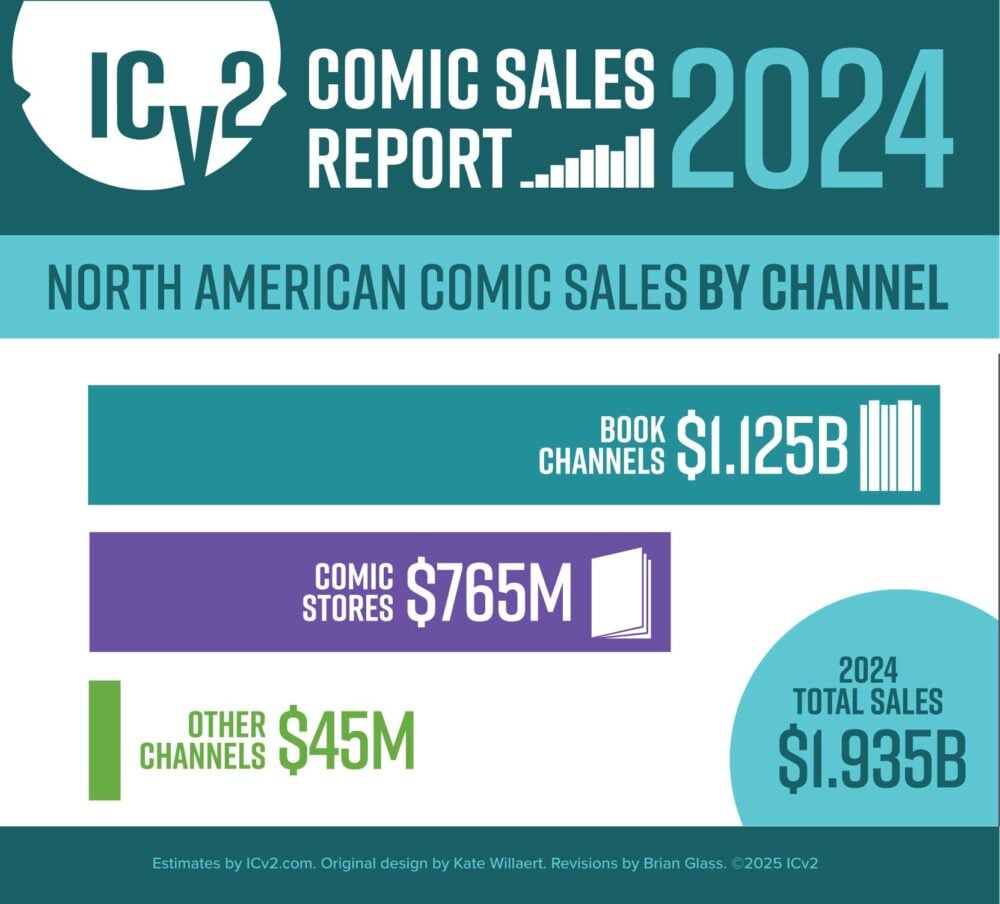
Comics hit nearly $2 billion in 2024 (we’ll have numbers this summer for 2025) despite economic hiccups in the broader culture (which contributes to my theory that books are considered the small luxuries often bought during economic downturns), solidifying the COVID boom in book sales as the new normal. With this came new imprints at major publishers, and more eyes on the market. With more eyes on the market, the Faustian bargain with capitalism comes due.
To extend the metaphor, this is when you find out that your cousin (the chef, the nurse, the entrepreneur, etc.) gets their money by less than ethical means, whether it be scabbing for hospitals with striking staff, making money through hedge funds led by the tech-bro class, or being a chef at said tech bro’s parties.
For traditional publishing, one major contributor to their current success is the boom of openly capitalizing on fan fiction and its audience to sell books. For the past decade, “trad-pub” looked at follower count to see if a book would be a sure bet for representation, let alone publication. This style of recruitment leads to all the “-ists and -isms” that have always plagued publishing. White men and women getting all the deals for having more “marketable” work, and everyone else getting scraps.
Rather than opening the door to supporting marginalized people in the industry, companies look for “sure-fire” bets. What’s more sure-fire than a book with a built-in audience? Hell, a book that was written in the world and voice of an already-successful IP — with easily marketable tropes, characters, and sex scenes that can be sold as original with a few changes — is as sure of a bet as any.
Look at Alchemized (whose advertising literally towered over fans at New York Comic Con in 2025) for example.
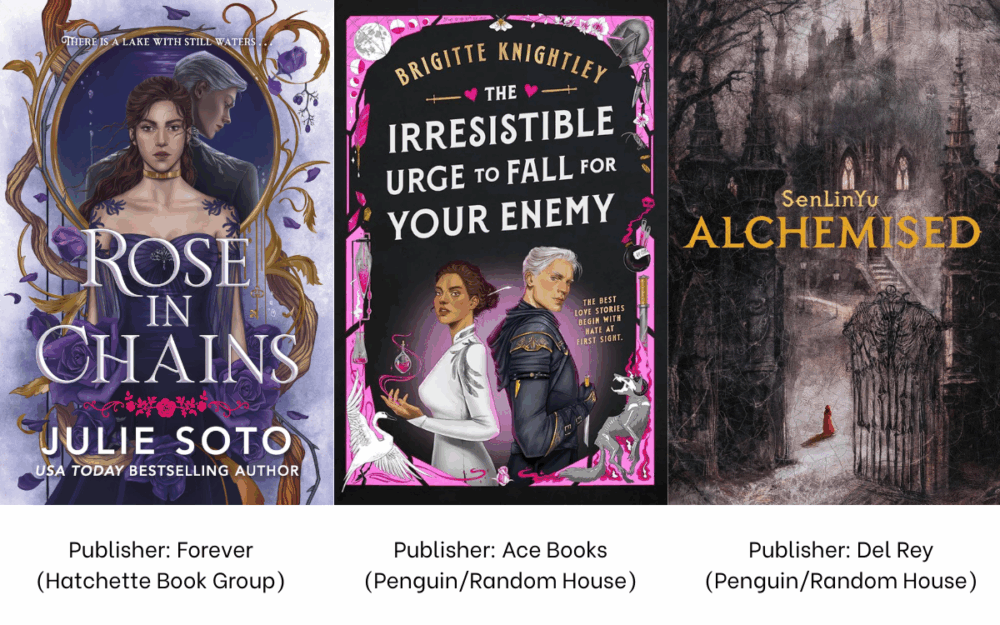
Alchemized, a book that is over 1,000 pages long and focuses on a retelling of The Handmaid’s Tale in the world of Harry Potter, featuring expies of Hermoine and her love interest/enslaver Draco (I’m not about to get into the weeds about how problematic of a concept that is for the sake of this article). It started as a fanfiction called Manacled written by SenLinYu on the fan fiction website Archive of Our Own (AO3). AO3 is a free site where, like fanfiction.net in the Aughts, fans can write and post fan fiction.
What makes Alchemized different is that while many an author has cut their teeth in fan fiction before making original work, Alchemized took the same exact words from the original fan fiction, removed what names and settings could pose a potential copyright issue, and printed it. The ghost of the fan fiction Alchemized is still there, and the characters just became Not-Hermoine and Not-Draco. It’s the book equivalent of your annoying younger sibling putting their finger real close to your face and saying “I’m not touching you!”.
SenLinYu didn’t change their pen name either, encouraging the association between this fanfic and the “original” book. Instead of plagiarism allegations, they got an 8-figure deal from big-five publishing. They were rewarded for filing the serial numbers off, cheating the creative process and other authors that work for years to produce original work.
I also bring up SenLinYu’s case as an example of this because they’re non-binary and a person of color. A nonbinary person of color who received a deal larger than the vast majority of their counterparts for repurposing a fan fiction from a series whose creator uses the proceeds off to legislate people like them out of existence in the UK. It’s the equivalent to being Steven from Django Unchained: a prop to keep other marginalized people from expressing the very real harms with the systems we occupy.
Finally, I think about the fact that because this deal made so much money, it had caused a gold rush-style race to find the next Alchemized, by publishers and agents alike. Publishing has always had trends, but what makes this different is that it’s a trend defined by being openly derivative of other works. This race to profitability stymies creative development. It sounds lofty and deeply privileged to say that there should be a space to enjoy art and create stories for their own sake when (at time of writing) gas prices have hit four dollars in the national average and the diesel used to transport ¾ of our commerce has hit 5 dollars, but it should still exist. Having everything be strip-mined for cash is not healthy for the mind or the culture, but capitalism is increasingly demanding it.
The mere presence of a fan fiction-to-tradpub pipeline will inspire some to capitulate to the market even more than before. I use the word capitulate because even though comics titan Scott McCloud stated “Just because you sell out doesn’t mean people are going to buy” in his acclaimed work Making Comics, bills have to be paid — and healthcare is a nightmare in America.
Bringing this back to comics, exploitation and racing to profits is nothing new. The Webtoon boom over the past 5 years has led to new avenues of exploitation for artists after the past 20 years of webcomics having to build audiences from the ground up to get bare minimum support from publishers. Stories featuring white straight protagonists will be at the top and everyone else is fighting to make it on the board. We are already marching down the road to having our own Alchemized being on our shelves, whether it’s a graphic novel adaptation of one of these “trad-flips” or a repurposed fan fiction used to pitch an “original” graphic novel.
When we see it, we should condemn it. I understand that for a number of people, there’s a financial incentive, especially with an economic downturn on the horizon from the war. The books have fetched 7-8 figure deals, which means that the adaptations would have a shot at 6 figure deals themselves. However, what’s a 6-figure deal today going to do when the community views you as a pariah for being even tangentially involved with a work written by a virulent transphobe? That’s not a thinly veiled threat if you’ve had even a cursory glance of social media, that’s almost a guarantee.
How about when it’s discovered that a book was adapted from fan fiction that’s filed the serial numbers off and gets passed as their own? What then? Would it be pulled from shelves like Shy Girl was for the UK and the US? I’d like to believe it would.
All in all, I think we ought to think of what we’d do to handle this now, rather than have it sneak up on us later.




I disagree that fan fiction isn’t original work – also, I’ve seen a lot of cartoonists adapt existing characters that have gradually turned into characters that only barely resemble the originals. I actually think they absolutely should adapt those characters into their own works.
I’m not sure on if I fully understand the article, but comics have jumped on trends and bandwagons ever since their inception.
It’s not as if “filing the serial numbers off” is anything all that new for comics. Peter David took ideas he’d planned for Supergirl and turned them into Fallen Angel. G.I. Joe was built from Larry Hama’s retooled S.H.I.E.L.D. pitch. And Watchmen was originally supposed to have the Charlton characters.
It’s also kind of surprising that this article doesn’t mention the original fanfic-turned-bestseller, Fifty Shades of Grey.
I’m all for fan fiction being legitimized by traditional publishers, including comic publishers. Writing is writing. Folks have been getting Sherlock Holmes and Dracula fan fiction published (with and without the serial numbers filed off) for more than a century now, even before the characters were officially in the public domain. As long as the story’s good, why does it matter where the characters originated? In some cases, fan authors use fanfic as a means of righting wrongs perpetrated by the original authors. Female characters can gain agency, minority characters can be protagonists, LGBT+ relationships can be explicit rather than implicit, etc.
I agree with all of the comments above. Also, it somehow feels that this article is an indirect attack on JK Rowling disguised as an article about publishing.
Is it really all that different from a comic book series with a group of yet another expies of the JLA or some other highly recognizable four-color superheroes?
Comments are closed.