
In this week’s Wednesday Comics column, the annual Energon Universe Special has arrived, there’s a robo Lincoln running around in If Destruction Be Our Lot, and much more! Plus, FOC Watch and The Prog Report!
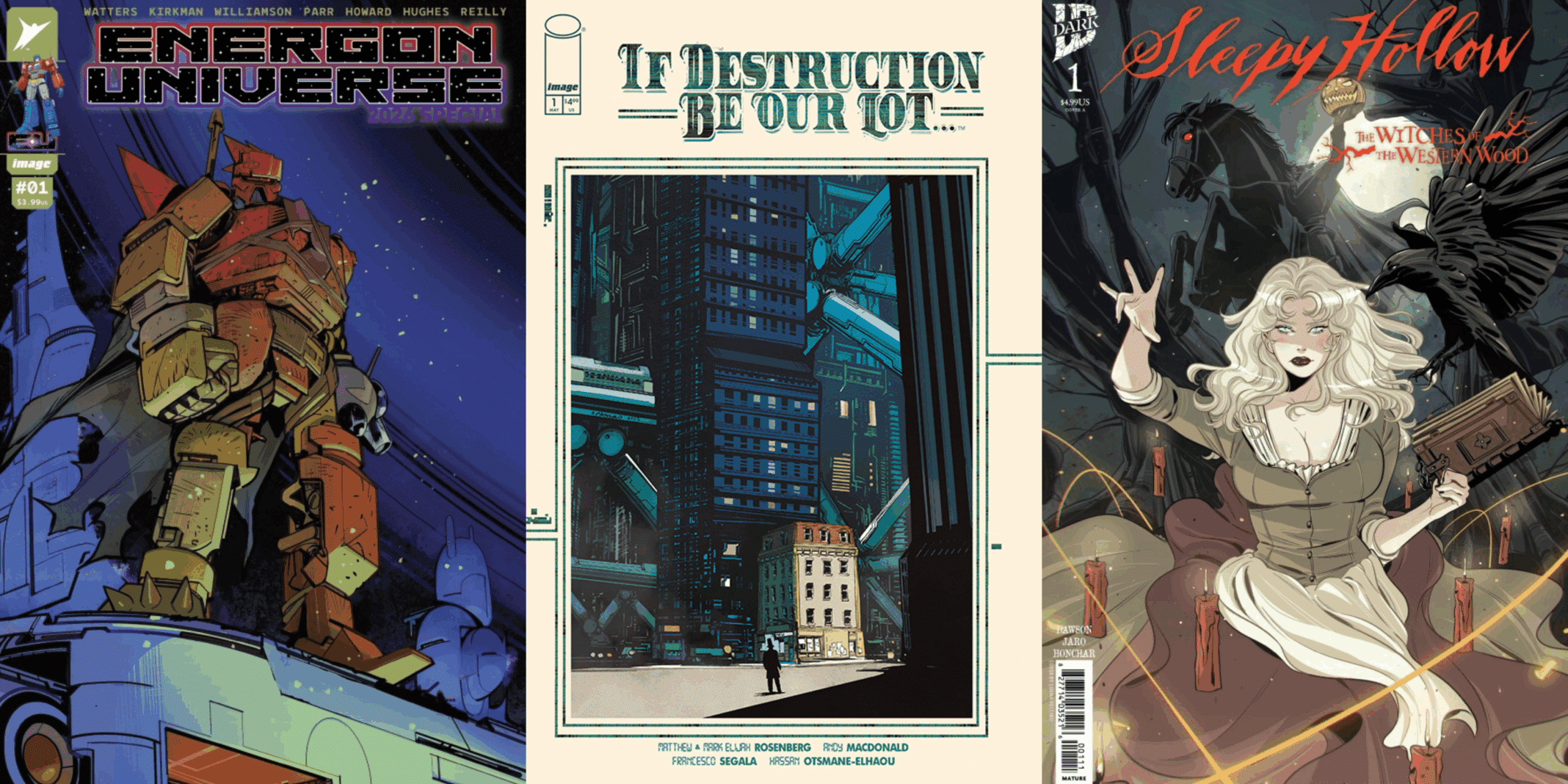
 Energon Universe 2026 Special #1
Writers: Dan Watters, Robert Kirkman, and Joshua Williamson
Artists: Pye Parr, Jason Howard, Conor Hughes, and Tom Reilly
Colorists: Sarah Stern, Patricio Delpeche, and Lee Loughridge
Letterer: Rus Wooton
Publisher: Image Comics – Skybound
Review by Zack Quaintance
I think it’s fair to say that DC Comics’ Absolute Universe has for some time now claimed the throne of hottest line in comics, but this week’s Energon Universe 2026 Special #1 is a great reminder that a challenger remains.
Indeed, this one-shot — which covers all the ongoing Energon Universe books while introducing the new M.A.S.K. comic as well — is a fantastic and galvanizing set of short stories for this world and these characters. If you’ve somehow missed it but are still reading this, the Energon Universe is comprised of Transformers and G.I. Joe revival comics, as well as the new series, Void Rivals, which itself feels like a lost Saturday morning cartoon from the mid-80s. Those series are going on year 3 now, deep into a set of runs that have intertwined sparingly-yet-enticingly.
And this one-shot has big implications for all those existing books. There’s a great new Transformers concept that hasn’t really been done before, a wild G.I. Joe plot twist that’s pretty inspired, and some really neat Void Rivals setup that enhances the Energon Universe’s shared continuity.
And those are all great, but the real shot in the arm in this year’s annual special is the new M.A.S.K. comic from writer Dan Watters and artist Pye Parr, two excellent creators who come together perfectly here. For whatever reason, M.A.S.K. missed me entirely as a kid, despite my earliest years straddling the ’80s and ’90s, but the short story in this book did a great job of entertaining me without any prior knowledge of its references. And that’s high praise for books that are inherently in at least some small part build on nostalgia. But Parr’s artwork is superb, and Watters has really grown into a comics writer you can trust to always be up to something interesting, no matter what characters he’s working with.
To sum it up, the Energon Universe remains a fantastic line of books for readers who want exciting new stories with the old toys / characters of their childhoods. Or, I suppose, it’s also a great way for younger readers to, sigh, understand why their dads remember these toy / characters fondly, because if you’re not into sports, what else are you going to talk to your dad about? We’re getting off track here. The point is this is a fun comic and an excellent reminder that the Energon Universe is still one of the most exciting shared stories in comics.
 If Destruction Be Our Lot #1
Writers: Matthew & Mark Elijah Rosenberg
Artist: Andy MacDonald
Colorist: Francesco Segala
Letterer: Hassan Otsmane-Elhaou
Publisher: Image Comics
Review by Tim Rooney
It’s all but impossible to explain the premise of this comic, from writing duo Matthew and Mark Elijah Rosenberg and artist Andy Macdonald, in a way that accurately captures the tone and themes at play. Set nearly 100 years in the future in a world populated only by robots, an animatronic Abraham Lincoln attempts to rouse the silicon citizens to examine their existence and purpose. Mocked by other robots for his human appearance as well as his speechifying, Robo-Abe is a lonely voice shouting in the wilderness. Lacking as they are in emotion, no robots are moved by his famous inspirational oratory.
The Rosenbergs play up the bizarre juxtaposition of the log cabin president among the mechanical world for laughs but never at the expense of real drama. Abe’s annoying longing—to achieve something other than what the real Lincoln did—drives him forward to ask questions no one else is capable of considering. That questioning is repeatedly bashed against machines who exist for a single purpose, some as obsequiously pleasing as an AI chat bot, others gruffly reacting with canned responses. Abe’s eagerness is thus reduced to an exercise in futility. He is an artifice of a man trapped in an automated, soulless world. There’s a haunting resonance there, inundated as we are with messaging and pressures to give up our faculties, our art, and our critical thought to the latest technology.
Andy Macdonald’s art is superb—intricately detailed and moody but never messy. All of the robots are distinctive and thoughtfully crafted. Francesco Segala enhances the striking layouts and inky shadows with diffused neon lighting that grants this barren world a haunted glow. Lettering is by Hassan Otsmane-Elhaou and as always he takes the art of comics lettering to new levels. His work doesn’t just deliver dialogue but gives it texture, volume, and tone.
If Destruction Be Our Lot #1 is the total package. An assured debut issue that is at turns funny and touching. It is the offbeat dystopian scifi satire for our bizarre dystopian reality.
 Sleepy Hollow – The Witches of the Western Wood #1
Writer: Delilah S. Dawson
Art: Jose Jaro
Colors: Xenon Honchar
Letters: LetterSquids
Publisher: IDW Publishing
Review by Clyde Hall
The 1999 Tim Burton film Sleepy Hollow is an annual Halloween season watch for my family. Not because of its faithfulness to the Washington Irving short story, but instead for the way its extreme loosely based status is effectively unraveled and rewoven into a most enjoyable bit of historical horror cinema.
Much of the film’s devilish delight rests in its hidden antagonist. And yes, this is where I ‘fess up that the review must include spoilers for the film in case you’ve never watched it. Reading the premiere issue of Sleepy Hollow: The Witches of the Western Wood, which is based on the movie, would be an unusual choice. Still, let it be known that from this point forward spoilers are, like the storyline McGuffin itself, ‘a head’.
The mysterious antagonist which plagues the farming community of Sleepy Hollow through her manipulation of the murdering phantom called the Headless Horseman is Sarah Archer. She and her twin sister were children born of a poor couple working for the landowning family Van Garrett. After her father’s demise, their landlord Master Van Garrett evicted the widow and orphans from their worker’s cottage and brought in Baltus Van Tassel and his family as replacements.
Sarah’s mother was suspected of witchcraft and so she, along with her children, were shunned. Treated as outcasts. The trio had to take refuge in a cave along the eerie Western Woods, and there they lived until the death of their mother a year later. The sisters fended for themselves, Sarah taking on the role of protector for her smaller, weaker sibling.
One day when the children were out gathering firewood, they witnessed a skirmish. A brutal Hessian mercenary died at the hands of American militiamen fighting a battle for independence against the British. The cavalryman was felled by the same method he had killed so many colonial soldiers: Beheaded with the stroke of a sword. But Sarah, taken with the seething power and hatred of the Hessian as he died, plied her mother’s sorceress ways and promised her soul to Satan if he would raise up the Headless Horseman to serve as her undead avenger against the Van Garretts, the Van Tassels, and all who had wronged her family.
All this is revealed near the end of the film in villainess monologuing with flashback accompaniment. The conspiracies that Sarah, who eventually became Lady Van Tassel and stepmother to heroine Katrina, spins like a complex web in her revenge and murder schemes are also revealed. All this as the Horseman comes to claim Katrina’s head in exchange for his own.
Writer Delilah S. Dawson recreates Sarah’s childhood experiences in this limited series launch, filling in some of the offscreen blanks mentioned in the film but left unseen. In some ways it’s a rehash of the film canon. Yet, it’s also a recapture effort that succeeds.
The adult master manipulator we see as Lady Van Tassel is portrayed in the film by Golden Globe and BAFTA Awards-winning actress Miranda Richardson. The ease with which she shifts gears, her character being whomever was required in the moment to blackmail, deceive, or connive for her ultimate goal of owning the Van Garrett and Van Tassel estates, is amazing.
And when she is proven to be the villain, it’s a role Lady Van Tassel proudly embraces. The world’s treated her like dirt and finally all those responsible are going to receive payment long overdue. She even becomes uneasily playful with her last victims, Katrina and Ichabod Crane, as the Horseman goes about fulfilling her directed checkmate for the win. Almost as if, denied most childhood happiness, Sarah is happy to indulge in whimsy now that victory is so nearly at hand.
Except that we know how many innocent lives had to be weighed alongside the wicked ones in making that victory possible. And the way Dawson has Sarah recounting her life retains that tone, not of a victim righteously seeking a reckoning against those who harmed her. Rather, of a victim who has fought back against her tormentors by becoming far more wicked and through ruthlessly causing collateral damage of blameless victims without hesitation.
It’s hard believing that, even with a normal upbringing free of tragic circumstances, Sarah wouldn’t have found ways of justifying her manipulative nature and brining unnecessary harm to others to attain her goals, whatever they might be. Dawson’s exploration of the character reminds us how, despite claiming to be her twin sister’s defender growing up, we witnessed in film just how quickly that ‘defender’ role was abandoned when Sarah’s schemes were in danger.
Jose Jaro’s art mirrors the film aesthetics, especially regarding characters made to resemble the actors who portrayed them. The natural world surrounding the farming community of Sleepy Hollow has an unspoiled beauty which again reflects the movie’s production designs. Likewise, interiors are mostly kept plain and practical when it comes to the more common folk of the Hollow, which this opening chapter centers on.
Besides pure entertainment value, Sleepy Hollow: The Witches of the Western Wood succeeds in drawing on and then expanding one important element of the screenplay. Many of the villagers in Sleepy Hollow are deeply flawed. Some even despicable. Pride, infidelity, and avarice abound. What separates the heroes from the villains in the piece is how the former are trying their best to break cycles of generational violence and abuse while the latter embrace and perpetuate those cycles by making them worse. It serves as the axis around which all else turns in this first issue, and the result is hauntingly consistent with the spirit of the film itself. Watch the movie and, if it satisfies your horror vibe, then pick up this title and have a second helping. One from the villainous side of the buffet.
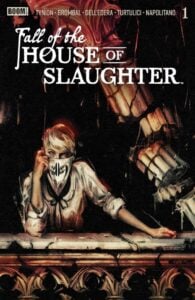 Fall of the House of Slaughter #1
Writer: Tate Brombal
Artist: Adriano Turtulici
Colorist: Valentina Nepolitano
Letterer: Andworld Design
Publisher: Boom! Studios
Review by Jordan Jennings
Palace intrigue is afoot as the head of the House of Slaughter lies on his death bed. Various forces begin to jockey for political power in an attempt to be elected as the new Dragon of the house. Yet, nothing is a forgone conclusion as truths begin to come to light.
This is my first time reading one of the Something Is Killing The Children comics. Talk about jumping into the deep end. That said, I found Tate Brombal made this comic fairly accessible to a casual comic fan. I won’t lie there’s a lot of nuance I am certain to be missing, but the larger story beats still work even as a complete outsider. This comic is a typical “king’s dying” story and I picked up on internal dynamics from the interactions. The data page in the middle outlining the election process was essential for me in understanding all of the mask hierarchy that was flying around. I am a sucker for a game of thrones being played out that I will seek all info necessary to understand the characters. The barrier for entry was also helped by Brombal’s dialog. The dialog was crisp and kept the issue engaging even as I was trying to learn all of the intricacies on the fly.
Adriano Turtulici’s art is fantastic. There is a lot of care put into the layouts and composition to help keep this very political issue dynamic and engaging. The frequent two-page spreads were a great tool to give this maximalist approach to a real formalist 9-panel grid. It created a wide-screen format to the panels that allowed for a better showcase of critical events and emotional beats. Turtulici’s excellent use of body language is essential to the issue’s success. The way they are able to get the characters’ emotions across with only their eyes is masterful.
Overall, The Fall of the House of Slaughter #1 is a well executed comic, but maybe wait until reading the prior issues before jumping in. I mean, you can follow it along just fine, but I feel like a lot of the nuance and significant moments ring hollow without some sort of background. Still, if you are a fan of Something is Killing the Children, check it out.
FOC Watch
The following titles are currently available for pre-order at your local comic shop!
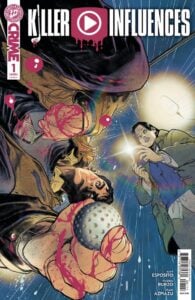 Killer Influences #1
Writer: Joey Esposito
Artist: Valeria Burzo
Colorist: Inaki Azpiazu
Letterer: Alex Ray
Publisher: IDW Publishing
Publication Date: July 1, 2026
Review by Zack Quaintance
The new IDW crime comic, Killer Influences, is probably going to surprise you. It’s a complex, character-driven serial killer story, interested in dissecting the media industry that has sprung up around murder, and it’s doing it here with a first issue that excellently builds out a pair of fascinating characters.
Indeed, if Killer Influences was a film, we’d call it a two-hander, as it hinges on a pair of so-far equal leads. If you want to go into this comic entirely blind, I will tell you here that this is a good, smart crime/horror comic, and it gets my recommendation. I will also tell you that now is the point to turn back. I’m not going to discuss anything here that wasn’t in the preview text, but I am definitely going to discuss the things that were in that text. So, you’ve been warned.
So yeah, the two leads in this book are an ultra-efficient serial killer who is so careful he has wracked up dozens of kills without anyone noticing his work, or at least connecting or sensationalizing it; and a small-town newspaper reporter who hates where she lives and has big ambitions to get famous and get out. This is the story of the two coming together for mutual benefit. It’s essentially the story of a true crime podcaster helping a serial killer do murders that will make for a good show, and that’s a clever twist that I’m not sure I’ve ever seen done before.
Of course, a clever idea only takes you so far without great execution, but, thankfully, this comic is very well done. I’m a big fan of writer Joey Esposito, who wrote the absolute gem, The Pedestrian, and he’s back with another great script here. Esposito excels at Lynchian comics that posit something sinister or mysterious is lurking beneath the veneer of our small towns, and there’s a fair amount of that in Killer Influences. But I think what his script does best in this comic is efficiently build the two lead characters without ever feeling forced or plodding. In the course of one issue, I know both characters, their motives, and what they’re going to want for potentially the full run of this book. That’s no easy feat.
And, of course, it requires an artist in lockstep to pull it off, and Valeria Burzo is excellent in this comic. Everything from her character face acting to the gruesome instances of bloodied murder pops right off the page in this one, colored to perfection by one of my favorite colorists, Inaki Azpiazu. To be a bit corny, the creative team is as killer as the influences in this book.
All of that is to say that I am absolutely hooked for the duration after reading Killer Influences #1, and I can’t wait for the rest of this book.
The Prog Report
- The Prog Report is taking a break! The issue that is out this week in the UK — 2000AD 2481 — will be the first released in the U.S., come May 20, and so we’re going to put a pin in this section until that day arrives, thereby synching it up with the new stateside release dates. Cheers!
Column edited by Zack Quaintance.
Read past entries in the weekly Wednesday Comics reviews series or check-out our other reviews here!