

Comics are doing great. Cartoonists? Not so much. At least that is the finding of a survey of 689 British cartoonists organized by the UK Comics Creators Research Report. Headed up by former UK Comics Laureate Hannah Berry, the study was jointly released by the Comics Cultural Impact Collective, the Association of Illustrators and the Society of Authors. A previous survey covering the same topics was produced in 2020, and this one – written by Berry, Johanna Rivera-Carlisle and Amanda Nicole Curtis – includes direct comparisons with the previous survey.
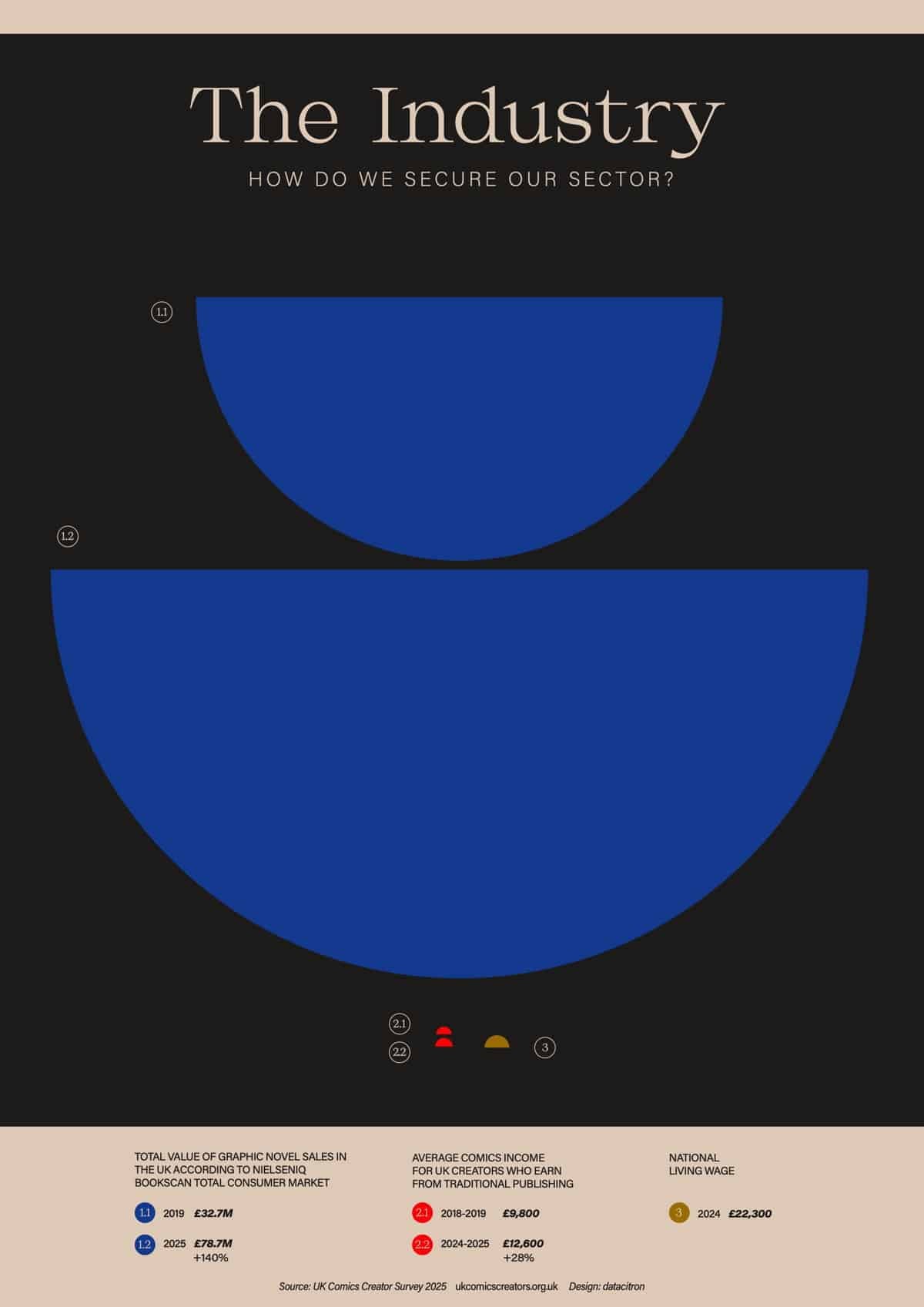
The complete report can be read here – it’s a lengthy and eloquent statement of something we all know: making a living as a cartoonist is very difficult. Almost 90% of respondents who earn income from traditional publishing make below the UK national living wage (£22,308) from their comics work. And 13% are relying on state benefits.
The report sets this against the industry success and growing sales that we’ve been talking about all year:
The report includes figures from the NielsenIQ BookScan, showing that in 2025 the UK comics market reached its highest-ever total sales, making £78.7 million, an increase of 13.9% from 2024. Children’s comic strip fiction and graphic novels hit £25.9 million – a 28.7% increase on the previous year, and the biggest sales year the category has ever recorded in the UK.
As comics and graphic novels have become increasingly popular, there has also been a growing recognition of their role as an accessible and welcoming way into reading. 2026 is the National Year of Reading and comics play a key part in the campaign, providing a vital tool for engaging children and young people.
But while the sector is booming, the landscape for creators is increasingly precarious. Alongside low pay, comics creators are experiencing rising pressures on their time as they juggle multiple jobs and administrative tasks, as well as rising costs. Other challenges include the threat from AI and the lasting impact of Brexit.
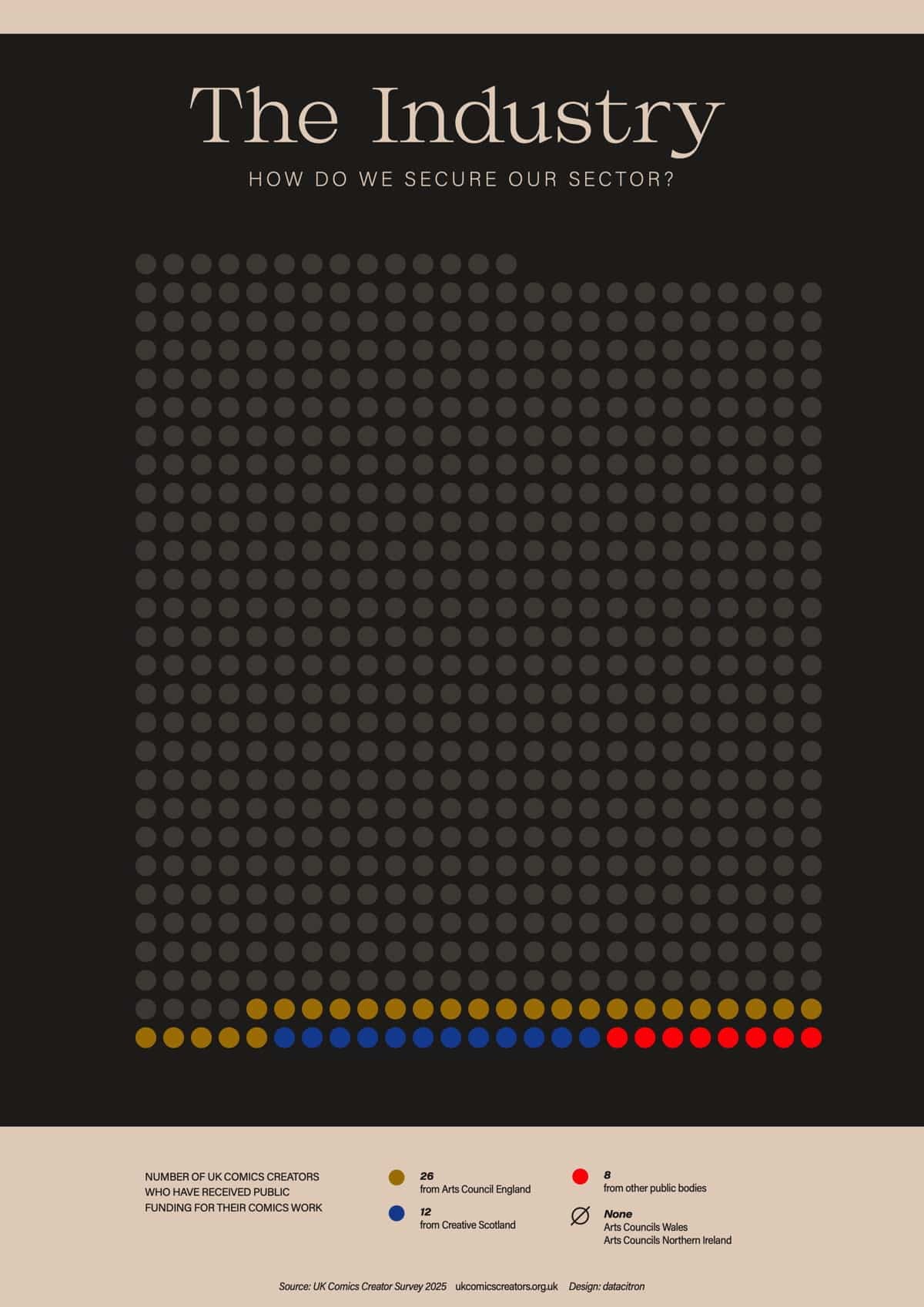
And, despite their growing status, comics still receive negligible public investment compared to other art forms in the UK.
“This is an industry that needs urgent attention,” says Berry, “and finally — amid an exciting artistic gold rush, glittering with potential for shiny new works to reach delighted new audiences — it might just receive it.”
Anna Ganley, Chief Executive of the SoA, said: “The results from this survey provide insightful data into the working conditions and pay of comics creators. This report is valuable and timely as improving contract terms is a current high priority area for the SoA. Comics creators aren’t spared by the AI threat, and this report is another reminder that urgent action is needed from Government to protect our world-leading creative industries.
“Comic creators are a core part of our creative industries and should be recognised and supported as such by being provided with access to funding. Tailored support from DCMS and Arts Council England would help to ensure that comics creation is a sustainable creative career.”
Josie Dobrin OBE, Chair of the AOI, said: “Comics are a rapidly growing part of our creative industry, yet this report clearly demonstrates that many creators are not sharing in the success of this growth. We urgently need to address the gap between a booming market and the reality of low pay, insecure work and increasing pressures experienced by many comic artists. By bringing these experiences together, the report strengthens the case for meaningful action – from fairer funding and recognition, to targeted support to make comic creation a sustainable career. Comics are playing an increasingly important role in engaging readers and reflecting our society, so it’s time that the people behind them are properly valued and supported.”
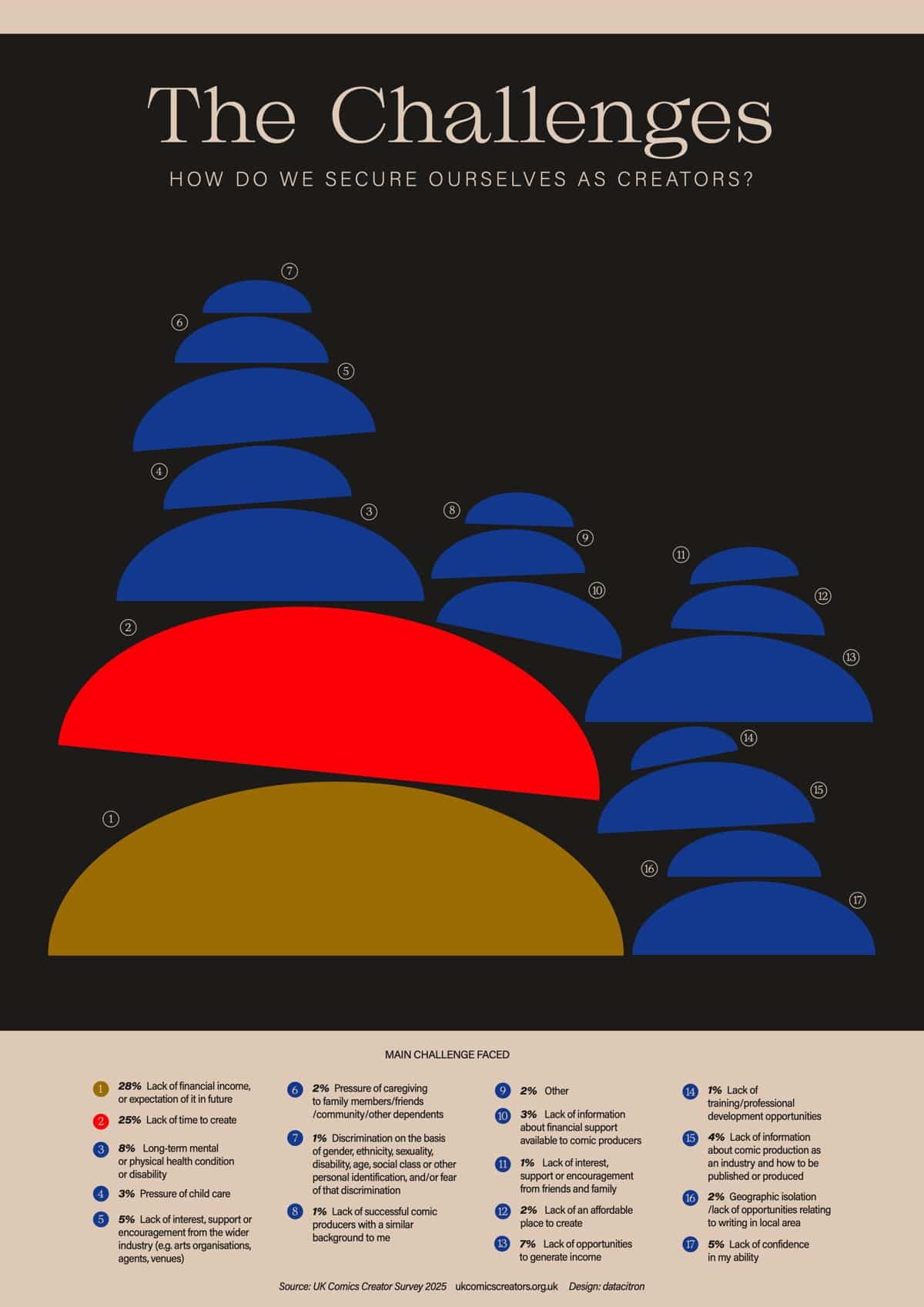
It’s a little hard to summarize the survey’s findings for various reasons. The release we got included infographics that are absolutely lovely – they remind me of an Orla Kiely scarf – but the actual statistics are small footnotes, so it’s hard to get the gist of it in one go. A bit of a design flaw, although the report itself includes tons of graphs and charts.
But midway through the report, quoting various responses gives you a nice snapshot:
As a result, attitudes towards the UK comic industry are starkly split between those who see ‘ a hopeful frontier’ for ‘a beautiful, cherished and respected art and literature form ’ and those who view the sector’s future as ‘a burning dumpster fire’ . Many creators are caught in between, wanting to believe in their craft but struggling with the harsh realities of finding no support. One creator noted: ‘I am now more resigned to making comics, as if it’s somewhere between a vocation and an affliction’.
The Beat has covered the hardship of making a living from comics endlessly over the last decade or so, but the survey lays it out clearly:
Of the 76.8% of respondents who want comic creation to be their primary career, fewer than one in three are currently able to achieve this. Only 144 respondents (around 1/4 of all career-oriented creators) earn the majority of their income from comics. Even traditional publishing, which provides income for 39% of respondents, rarely affords a living wage: 89% of those earning from traditional publishing make less than the 2024 UK National Living Wage of £22,308 per year.
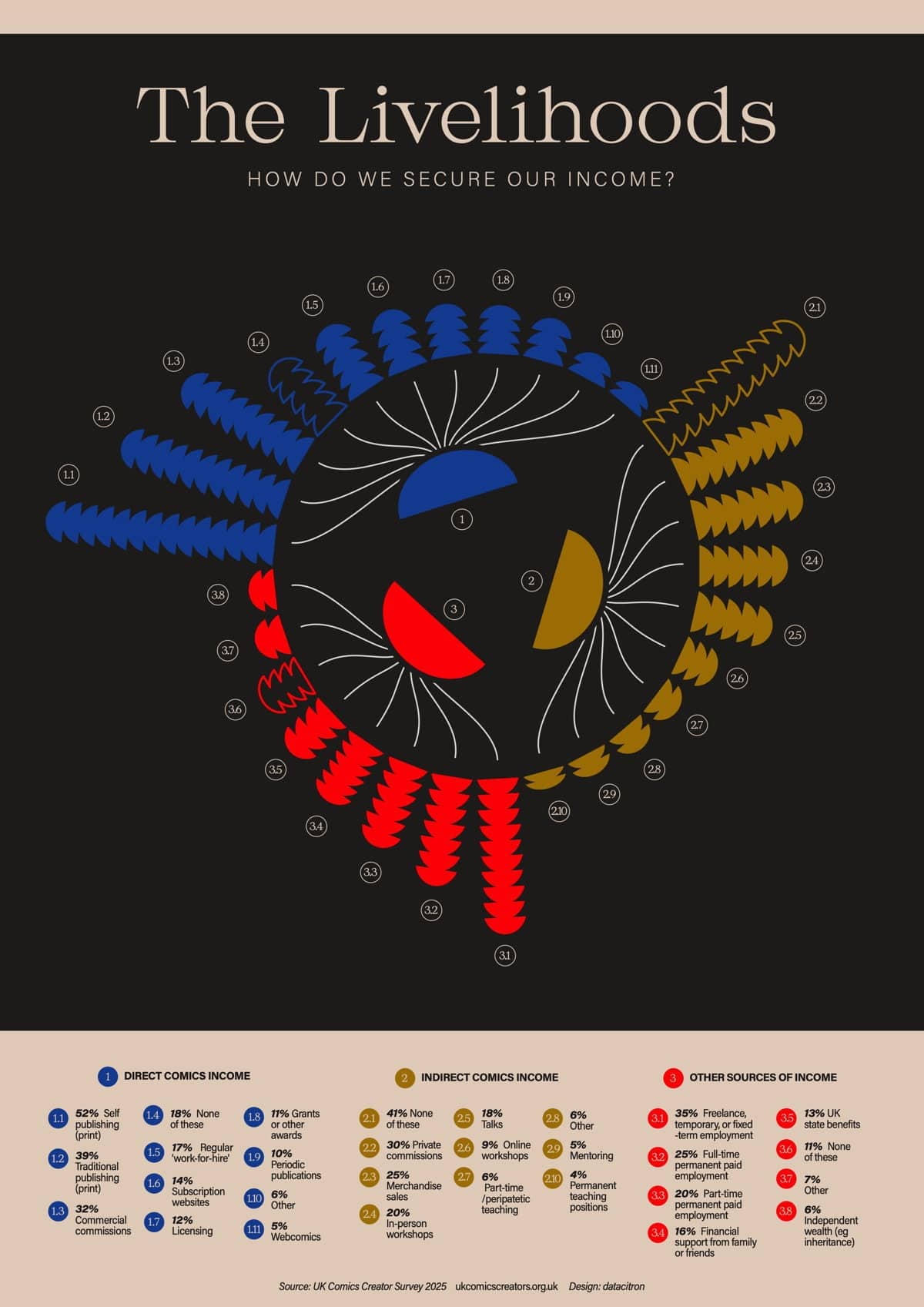
As a result, creators rely on a patchwork of income sources:
57% earn income from self-published print (up from 50% in 2020)
30% from private commissions;
25% from merchandise
72% from employment outside of comics (freelance, temporary, fixed-term or permanent)
13% are relying on UK state benefits (up from 9% in 2020)
63% of respondents cited lack of financial income as a key challenge to their career. With material costs, printing, and postage all rising exponentially, and with no equivalent increase in rates paid by publishers or commissioners, creators are earning less for more work.
We’ve also reported on stagnant page rates here many times. Absolutely stunning.
There’s also a lot of demographic information: the cartoonist community is more non-binary, queer, neuro-diverse and disabled than the general population – 13% are non-binary; 42% are LGBTQ+; 25% are disabled; 44% are neurodivergent – and there has been a significant rise in respondents who identify as female since 2020.
A few other points summarized by my HUMAN eye skimming the 100 page report – no AI summary here!
- Comparisons with the 2020 survey show a rise in the use of Patreon, Ko-Fi and Substack for income – I’d assume crowdfunding platforms are also on the rise, but some mention the increase in postage making these more difficult.
- The stark decrease in comics journalism outlets is a problem, with fewer places for reviews and publicity. (But shoutout to Broken Frontier for keeping on!)
- Conventions can make money but there are fewer indie shows, and travel costs eat into profits. Also, it’s so expensive to get into shows, people might not have much left to buy the comics and settle for a sticker or two.
- Creators feel marginalized from other arts, and the low income creates anxiety and stress which may make them leave the industry. As the report puts it “Perpetual financial uncertainty, exclusionary industry practices, and the emotional labour required to remain visible and competitive, compound to an environment in which resilience is constantly demanded but rarely sourced.”
- Despite the problems, cartoonists love working in the medium and, generally, in the community. Team Comics! This is set against complaints about cliques, old boy networks and generalized gatekeeping in various areas.
- AI is a universal concern, but UK cartoonists must also deal with the effects of Brexit.
- Resources and recognition such as those afforded French cartoonists would help.
Anyway, that’s a few brief takeaways. As mentioned, the report is 100 pages long and VERY detailed.
The report makes seven core recommendations:
- Develop comics-specific vocational training and apprenticeships, prioritising craft-based and regionally accessible provision.
- Create practical guidance resources covering financial management, taxation, IP rights, and freelance business skills.
- Introduce short-term financial safety nets like gap-funding bursaries and emergency grants to prevent creators from being forced out of the industry during income gaps.
- Invest in a UK-specific creator-to-audience platform which enables regional community patronage, integrates with local cultural infrastructure, and prioritises accessibility and human-generated works.
- Fund subsidised table fees and travel bursaries for conventions, and support smaller regional festivals through partnerships with local councils, libraries, cultural venues, and funders; prioritise accessibility; and offer training and resources to encourage grassroots events.
- Introduce sector-specific wellbeing initiatives for freelancers, including peer networks, mentoring schemes, best-practice guidance on fair pay and working conditions, subsidised mental health support, and community studio spaces.
- Recognise comics as a cultural art form in UK policy and increase Arts Council funding proportionally, based on the French model as an aspirational framework.
Basically, people need more support systems and access to comics-related resources – and getting comics recognized in the UK the way they are in other European nations would be a start.
This report basically lays out a lot of the things we’ve been pointing out for years: being a cartoonist is a fulfilling vocation, but actually making a living at it is kind of an exhausting crap shoot, with dwindling outside resources. The UK differs from the US (as the report points out) in that it really doesn’t have a huge native comics industry the way the US does. Our large, well regarded network of comic shops is actually something to envy!
All that said, I wish someone in the US could do a similar survey of US cartoonists. There have been several attempts but they didn’t get anywhere near the nearly 700 respondents this one did. It would take time, effort, and funding, none of which seem to be available at the moment.
My complaints over infographics aside, this is a huge and useful undertaking from Berry and her colleagues and gives an insightful snapshot of the industry. It’s well worth your time to give it a look.







Per your statement, “All that said, I wish someone in the US could do a similar survey of US cartoonists. There have been several attempts but they didn’t get anywhere near the nearly 700 respondents this one did. It would take time, effort, and funding, none of which seem to be available at the moment.”
I know the Cartoonist Cooperative has done similar surveys in the past (and I think they’re in the middle of one now). However, I do know the response size is smaller (a couple hundred, not quite 700) and I think it’s US plus Canada, but it’s still a start.
The underlying problem is that it simply takes too long to make a comic versus the amount of time it takes to read it. You have multiple peoples’ monthly wage depending on something people are already begrudgingly paying 4-5 bucks for, and they read it in 10-15 minutes tops. Its not just comics. The collected editions don’t really cut down on time, and the price isn’t much of a savings. The average domestic manga artist also lives in poverty.
Comments are closed.