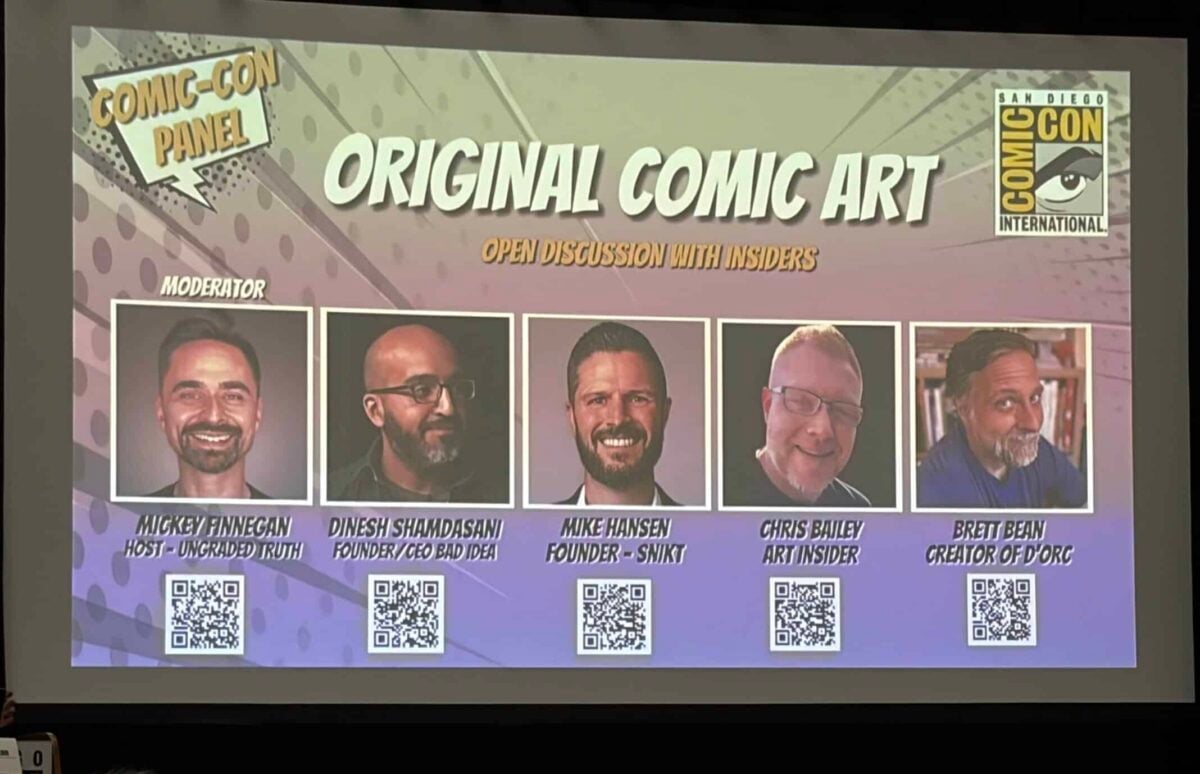

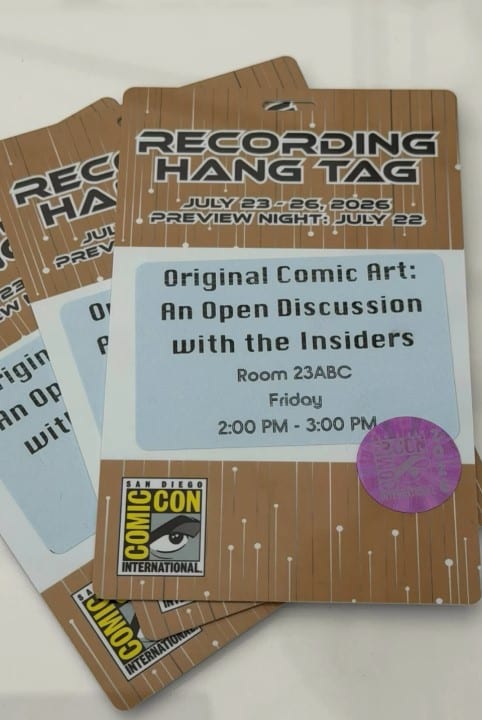
San Diego Comic-Con got a prompt and a brief introduction into the world of collecting comic art in the “Comics Original Art: Open Discussion with Insiders” panel hosted by Mickey Finnegan, aka Swagglehaus, Bad Idea CEO Dinesh Shamdasani, SNIKT founder Michael Hansen, art insider Chris Bailey, and lastly, one of the current most in-demand comic artists and creator of D’Orc, Brett Bean.
The panel covered the importance of research and meeting people face to face at events like SDCC; original art collecting is a very niche corner of the comic book world that needs a more hands-on approach to be successful.
“One of the pieces of advice that I got early on was to make a list of things you are after,” said Hansen, when asked how to get started in collecting. “This is the most important thing I was telling you. So the reason you want to make a list is that this can be an expensive hobby. And there’s so much about art out there. You will be broke as a joke, and it’s like a squirrel seeing nuts everywhere, right? So figure out what you want and then go after that.”
In terms of what can be a starting point for collectors, the panel mentioned how interior comic page art is a fairly affordable entry with prices that don’t have to break the thousand-dollar mark.
“You can still buy great art for under $100 a scene at this show. Serving under $500 for some, some people for years. So don’t feel like you see these prices and you can’t get into collecting,” said Hansen.
Host Mickey Finnegan then went on to highlight the rise of fandom for the collectible market: “Just last year at SDCC, we had George Lucas announce the opening of the Lucas Museum of Narrative Art, calling it a temple of the art and a celebration of not just complex art like the film but also storyboards and adjacent art.”
Finnegan then asked Bean—who has worked on multiple film and TV productions—about what happens to art and props after filming is done.
“Even when the Jim Henson team was making The Dark Crystal or Fraggle Rock, we weren’t thinking any of these things would end up in a museum. We would make the thing and then think, ‘I’m going to need those parts for the next thing.’ So you aren’t always thinking of preserving it, which makes this museum so awesome,” said Bean.
These behind-the-scenes components and art make a great entry point for collectors because they might initially be available at a small price.
“I think a lot of people don’t know about all the stuff that happens to make a product, especially like a movie. So I don’t think it’s really in people’s minds; not very many people watch behind the scenes or watch how stuff is made, especially with ’80s, like, Star Wars. But I ate it up because that’s what I wanted to do,” Bean continued. “So a lot of people watch it and think, ‘That was amazing.’ They think about sabers, and they think about Jedi as well. But then, a smaller section thinks, “How do they make a X-wing?”
Adding a comment to the opening of the Lucas Museum and its impact on art collecting, said: “I think it legitimizes what we are doing here and what everyone knows at these conventions, but that’s always how it is, right? We hear stories of impressionist artists being hated by traditional artists. They said they didn’t have talent, and when the art is displayed, the line went around the block. People don’t even remember what it was like. So I believe there will be a time in the future when major museums will have a Frank Miller piece or a Jack Kirby page. Lucas sees that and has decided the 3rd act of his career will be to put that on his back and carry its importance over the line.”
Collectors also need to look at non-traditional places like video game art, or even toy box art, because you never know what will be cherished and valued by fans years in the future. In fact, we saw that here at The Beat last year with the $3.875 million sale of Star Wars Original poster art. It’s not just a big number, but hard proof that fans love these unique, one-of-a-kind pieces used to create other projects like comics or film.
Ultimately, original art is a whole different game than slabbed comics or cards because there is no real arbiter like CGC or PSA authenticating or researching where a piece of art comes from. Provenance and proof are huge when it comes to the value of art, and Chris Bailey advised everyone in the panel to “follow these artists on social media, find out if they have an art rep. You can ask who might have bought it; heck, you could find out they have it and buy it right there.”
Bean concluded the panel with perhaps the best piece of advice for anyone trying to get into collecting original art: “Don’t hesitate to reach out to people. People in this industry love to connect; you tell stories, and you need another person with that type of passion. So never, never hold back in DM with somebody; introduce yourself.”
Stay tuned to The Beat for more news from SDCC ’26.