
Interview by Avery and Ollie Kaplan
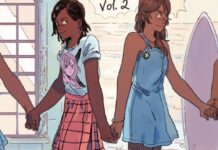
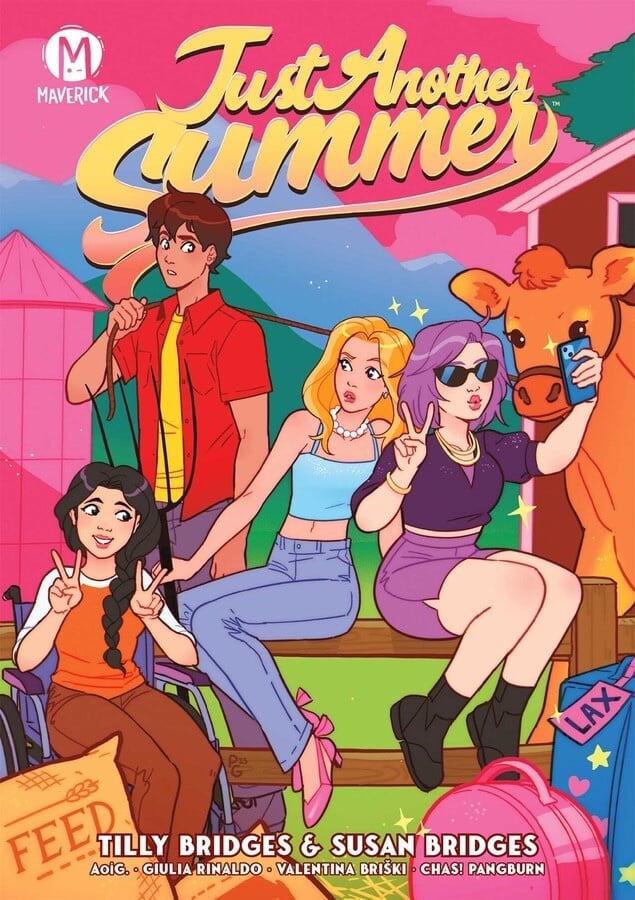
Tilly and Susan Bridges are having a moment. The wife and wife power writing couple has recently released a YA graphic novel from Mad Cave Studios’ Maverick imprint, Just Another Summer. And soon, the trade paperback collection of the critically acclaimed five-issue limited series Star Trek: Voyager: Homecoming, one of Comics Beat’s Best Comics of 2025, will be published by IDW on August 18th, 2026. On top of those accomplishments, the couple directed a short film adaptation of a very personal comic, Long Away, and their next graphic novel, Princesses of the DC Universe, will be published in spring 2027. And who knows what other exciting announcements might be waiting in the wings?
Near the Marriott pool during San Diego Comic-Com 2026, The Beat’s own power writing couple, Avery and Ollie Kaplan, got the chance to sit down with Tilly and Susan and ask them all about their various projects. We had an in-depth conversation on their recent work, on the state of trans representation in popular media and also we learned a lot about dairy cows! Read on to experience it all for yourself.
This interview has been edited for clarity and length.
AVERY AND OLLIE KAPLAN: Can you tell us about how you got involved with Mad Cave for Just Another Summer?
SUSAN BRIDGES: Actually, that’s a wild story.
TILLY BRIDGES: It is! There’s a former editor there, Lauren Hitzhusen. She had heard an audio drama that we wrote ten years ago; she worked at the company we wrote it for back then. And ever since then, she said she was a big fan of our work and she’d always been looking for something to work with us on. And then she came to us and said, “Would you like to write a YA rom com for Mad Cave?”
SUSAN: We were like, “What? We don’t write that! Why would you think of us?”
TILLY: We write all of this sci-fi and action.
SUSAN: And then she mentioned this other thing and she said, “You wrote this audio drama and it was really funny, I know you can do it.” And we said, “Well, I guess we could do it…”
TILLY: Our stuff tends to be funnier and lighter, but we’d never done a straight rom-com. We were intrigued by that challenge.
SUSAN: So we kind of leaned in and asked, “Can we make it queer?” And she said, “Yeah.” So we said, “OK. We want the sister to be a lesbian, but we also want a trans guy.” We wanted to put two because we thought they’d say “no” to one of them. And they said, “Yeah, that’s fine.”
TILLY: The editor, Lauren, we had no doubts that she would be fine with it. But she has to get the OK of everyone else at the publisher, and so often publishers say, “You can’t make anything trans. You can’t put a trans person in anything.”
SUSAN: Even “queer friendly” publishers.
TILLY: So, it was a huge surprise when they came back and said we could do both; we were really excited. Trans guys don’t get to be romantic leads, and they should!
SUSAN: They really wanted Montana to be involved. They have a thing where they want a book that takes place in every state, like, there’s some editor who wants this. Because at first we asked, “Well, we’re from the Midwest – could we do something more Midwestern?” “No, it has to be Montana.” OK, we can do that.
TILLY: We’ve never been to Montana. But it’s only half set there, and half in Los Angeles.
AVERY AND OLLIE: How has working with Mad Cave been?
TILLY: Well, we only worked with Lauren up to until when the book was almost ready to go to print and she got laid off. So, we really had only dealt with her; we didn’t have any contact with other people at Mad Cave. So as a company we don’t know them that well; we know some of the other editors who were also laid off and they were also wonderful people.
But they’ve been so far great. They let us be as queer and trans as we wanted in this book, and they didn’t tell us “no” on anything.
SUSAN: Yeah, I would say we feel a certain loyalty to Lauren, because Lauren’s amazing.
TILLY: And she made all of it happen.
SUSAN: We still absolutely keep in touch with her, and she’s watching Star Trek and we’re texting and it’s fun.
AVERY AND OLLIE: What has the process of working on a graphic novel been like?
TILLY: Graphic novels are so different from writing a monthly series, even if it’s a miniseries. Because we finished scripting this book at the end of summer 2024. So it’s been a really, really long time! But we didn’t have anything to do until art started coming in, and then we would do art approvals, color approvals, letter approvals.
SUSAN: Usually when we’re writing we just go back and forth, chapter by chapter. That’s how we did it. But we were writing Just Another Summer and Princesses of the DC Universe at the same time, so we were just swapping chapters back and forth.
TILLY: For an entire six months. We got the contracts literally the same week for the two books, so they had the same deadlines. So there’s two of us, thankfully.
SUSAN: But we only just finished Just Another Summer right before it went to print. We were looking at the letters and everything right up to the very end.
TILLY: Through March, April… Somewhere in there. The final print proof we also had to go over, to check for any final errors…
SUSAN: Yeah. So even though you’ve turned in the script and it’s approved, you’re still involved in every other stage. So, “Oh, the colors. This was actually night and not day,” or, “It should be getting darker as the panels go on.” Stuff like that.
TILLY: We also ran into a few issues because both our artists are Italian. Which, no shade to Italians, but they don’t know anything about what life in the United States is like. They’d never been to LA, they’d never been to Montana. And there’d be times where we’d be like, “The barn is full of hay bales.” And they were just piles. They didn’t know what hay bales were. And we didn’t have the context for what they didn’t know.
SUSAN: We did provide a lot of reference.
TILLY: So much reference.
SUSAN: Because the LA stuff takes place at the Griffith Observatory – real places. These are real places, you can’t just make it up! So, giving all of that to the artists so they don’t waste more time looking for things.
I want them to draw. I don’t want them to be looking up reference.
TILLY: And art takes so much longer than the writing process. So we tried to always provide reference.
SUSAN: Just Another Summer was definitely the one that had the most reference.
AVERY AND OLLIE: Do you have any thoughts regarding the work by the rest of the creative team on Just Another Summer? What has the collaborative process been like? Is it different from usual?
TILLY: It is because they’re not here, so they don’t have the same cultural context we have for things. So, it wasn’t a struggle, it was just different. There’s a little bit of a communication barrier. They could both write English very well (we haven’t spoken to them), but they grew up differently than we did, so there’s just some things that we don’t… Like, “Oh, that’s not what I meant, but I see why you thought that’s what I meant.” So there’s a lot of dealing with that as we went.
OLLIE: Did Mad Cave find them?
TILLY: Yes, Mad Cave found and picked the artists. We had no input on who the artists were – not that we’re unhappy with it. But that was all their doing.
SUSAN: And we were totally able to talk to the artists the whole time, some publishers don’t let you do that, so that was good, too, that we were able to address things as they came up. Like, “Hey! This fence, it has barbed wire, and they wouldn’t have that for cows. Can we take the barbs off the wire?”
Some of those things did still make it into the book. I tried really hard to make the cow stuff accurate, I really did! The cows especially.
TILLY: That was her pandemic lockdown hobby, was dairy cows.
SUSAN: And dairy farms.
TILLY: And I’m so delighted we got to put all of that knowledge into this book, so I could hear less of it.
SUSAN: It’s very technological, by the way. There’s all sorts of cool stuff with dairy farms, like robots who milk cows. The cows will go in and get milked by the robots without any prompting.
TILLY: Because they like it.
SUSAN: They get a treat when they do it!
TILLY: But for all of lockdown, all I heard everyday were cow facts. “Cow facts! Cow facts! Cow facts!” It was so many cow facts. They’re all in the book.
SUSAN: Jersey cows are the cutest, and that’s why they’re in the book. It’s objectively true.
TILLY: In fact, you want to talk about part of our process. If I was scripting a part that had dairy cow stuff in it, I would put, “Cow facts, Susan.” And she would fill it in later.
OLLIE: Are there jersey cows in Montana?
TILLY: They are, the thing is, Montana has mostly steer, for beef. So they do have some dairy farms but not that many. But, since Susan had the dairy farm knowledge, we decided this would be one of the few dairy farms in Montana.
SUSAN: And the editors really liked that. We were thinking of doing the beef side of things, and we talked to someone we know who has a beef ranch in their family, but they were really enamored with the dairy thing so we went with that.
TILLY: It worked out. It was OK. You don’t have to talk about slaughtering animals.
SUSAN: Yikes!
TILLY: You don’t have to think about the dairy cows so much. They live a nice little happy life.
SUSAN: They do!
AVERY AND OLLIE: How is working on a graphic novel distinct from an onscreen script, single issue, etc.?
TILLY: They’re different from periodical comics, which have to have a little cliffhanger at the end every 20 pages or however many pages you get, usually 20. You don’t have to worry about that with a graphic novel; although we did write it in chapters, they’re not released separate, so you don’t really need cliffhangers.
It’s kind of similar, a graphic novel, to a feature screenplay, because it’s one single contained story, but you have more space; more room. And you know, no moving pictures, so what’s the most important single image to show as you go through.
SUSAN: Right, because you’re directing as you go. What’s the most important visual images, what are the things you need to convey, what are the actions you need to convey.
And then while you’re going through the art process, then figuring out, “Oh, I wanted them to be doing this thing, you can’t really tell they’re doing this thing, so we have to rework the dialogue so you can tell.” Or, it’s super clear, and you don’t need this whole paragraph because you can tell what’s happening.
TILLY: We did some other fun things like, when the romance was heating up a little bit and the two characters were getting closer together, on one page we had four panels and on the next page we had only three and then it’s down to two and then it’s down to one… So you’re reading faster and it’s speeding up and then you’re just frozen in that moment. So you can control the pace of it that way really well, if you play around with it, which is kind of fun.
OLLIE: I guess you also can’t take up three pages in a 20-page comic for that kind of pacing.
TILLY: Yeah, you cannot do that in a single issue floppy, but when you’ve got 200 pages to deal with, you can say, “You know what, let’s play with this a little, because we’ve got 20 pages for this chapter and we don’t need all of them to be completely jammed with dialogue.”
OLLIE: My preference. When I see too much dialogue, I’m overwhelmed.
AVERY: You say, “Why is this a comic?”
SUSAN: Yeah! You need that balance! Otherwise the bubbles are hiding half of the art anyway…
TILLY: That’s what was so hard about the Voyager: Homecoming comic, is Star Trek: Voyager is such a talky show. They need to talk about their problems and figure things out… But it’s a comic! You have to cut so much.
AVERY AND OLLIE: What was it like seeing Just Another Summer in person for the first time at SDCC?
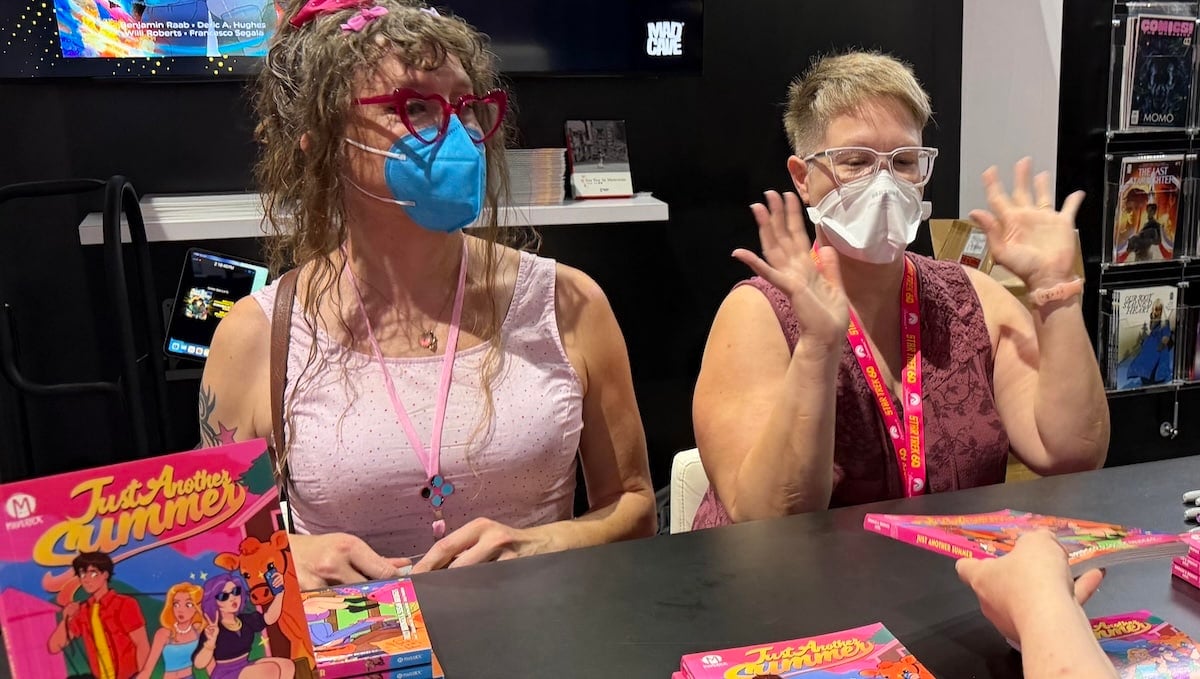
TILLY: Oh, I think I screamed. Yeah, because we had not seen the book until we got to the Mad Cave booth to do the signing today. So that was really cool!
SUSAN: We got to hold it in our hands!
TILLY: It’s real, finally! After two and a half years…
OLLIE: Did anything surprise you about it, seeing it in person?
TILLY: No, except that it’s done. When it takes that long it feels like it’s never going to be done. Every comic is a miracle.
SUSAN: That is true, that they get made at all.
TILLY: If any of them actually come out and are released to people, it is a miracle. You are very lucky it happened. So, we’re thrilled.
OLLIE: Is that the standard amount of time it takes a graphic novel to get done, over two years?
SUSAN: At least one.
TILLY: For a graphic novel, I guess it depends on the size, the page size, the page count.
SUSAN: That’s true. A middle grade novel has smaller pages, a YA has a little bigger pages.
TILLY: And then the full-size adult comics.
SUSAN: They’re all different.
TILLY: It also depends on how detailed your art is going to be. Someone could maybe draw one in a year and it takes another person two, because of the amount of detail. I don’t know if there’s any kind of set time but they take a long time. I mean, it took us almost six months just to write it, so the art’s going to take way longer than that.
AVERY AND OLLIE: What was your process and goals for representation in Just Another Summer?
TILLY: Well, we wanted queer and trans characters in it from the start. We wanted to specifically portray a trans man as a romantic lead for a cis woman because a cis woman should be attracted a trans man if she’s heterosexual, and that’s something you see not enough of, you know? Trans guys don’t get to be the romantic lead ever, and they definitely should. So we definitely wanted to do that, and we wanted to have that quote-unquote secondary lesbian relationship running through the whole thing, for a lot more queerness.
SUSAN: But we also wanted Jake to be shorter than Hayley. We actually made them redo art…
TILLY: The trans guy realism. Because the original art had him taller than everyone, like a cis guy, and we said, “That’s not what most trans guys experience. They’re shorter.” So we kept him short all the way through, to be authentic. Short kings. We love them.
And we wanted to make sure we got some disability rep in there with Anne, because we have friends – you know, everyone has friends who are disabled. And some of the stories we’ve heard from them, the things they have to go through and deal with… That’s not our exact experience, we don’t want to appropriate their story, but we also want to show a little bit of what it’s like and that they can also just be a waitress in a diner who’s really good at her job and is really just a very forward lesbian and that’s fine. That’s fine. She’s hot and Becky really likes her, so.
We’re always trying to do as much as we can without projects to push representation on all fronts, because there’s just not enough.
OLLIE: Did you have a sensitivity reader then, for the disability stuff?
TILLY: On this one, no, because we only got into it a little bit. We didn’t want to appropriate that story, but we did have a friend we talked to a bunch who is a wheelchair user, because Anne is a wheelchair user. So we put a bunch of experiences she has had specifically to speak to their community.
AVERY AND OLLIE: Are you at all interested in working on “non-queer” stories in the future?
TILLY: I mean, if the opportunity was there and there was a good story. I’m a huge fan of Superman and Lois Lane, they’re not queer and I’d love to write them. So under the right circumstances, yes. But I would probably also add some queer characters on the side in there, because nothing should ever be plain all cis het… That’s boring. C’mon. Let’s be more fun than that.
SUSAN: Yeah, I think so. We’re always trying to push what we can, and a lot of times we get “no.”
TILLY: That was the big twist on Just Another Summer. We didn’t get those “no”s we were expecting.
SUSAN: It’s whatever they’re going to let us do. We’re going to make it as a gay as possible, probably.
TILLY: Yeah. I mean, we’ve had actual projects where we’ve been told so many times, “No, you cannot put this character in this.” “No, you cannot make it more queer than we’ve already okay’d,” or, “only this one specific person can be queer, and only in this specific way in this little tiny box that we have approved.” And it’s just very demoralizing.
But every time we try. We keep trying. If they won’t let us, we’re going to make them say “no,” and then it’s on them and not us. Because it shouldn’t be that way. We want it to be better.
OLLIE: Have you seen ebbs and flows in that?
SUSAN: We’re definitely in the “ebb” phase.
OLLIE: Because acceptance was going up for a little while.
TILLY: It was, right? And then it all turned around.
SUSAN: They pendulum has swung…
TILLY: This is ancillary to our fiction work, but in my Tilly’s Trans Tuesday essays that I do, every year I’ve done an annual report on trans rep in television and movies, and I track every single thing I watch every year. And over the past four years, the trans rep has gone down and jokes at our expense have gone up. And it’s just climbing and getting worse and worse every year. So it’s definitely been a swing. And you could even see it happening before the election happened.
SUSAN: That’s because all of media has gotten more conservative, too. I blame Yellowstone, I think that’s why.
TILLY: Well, and all the tech companies taking over the media companies, and tech companies are largely conservative, so, you know.
OLLIE: I don’t get the Yellowstone thing. Not for me.
TILLY: No, not for me, either. Because you know who else lives in middle America? Queer people, like Jake from Just Another Summer.
SUSAN: That’s right.
AVERY AND OLLIE: Can you tell us about Long Away and the showing here at SDCC ’26?
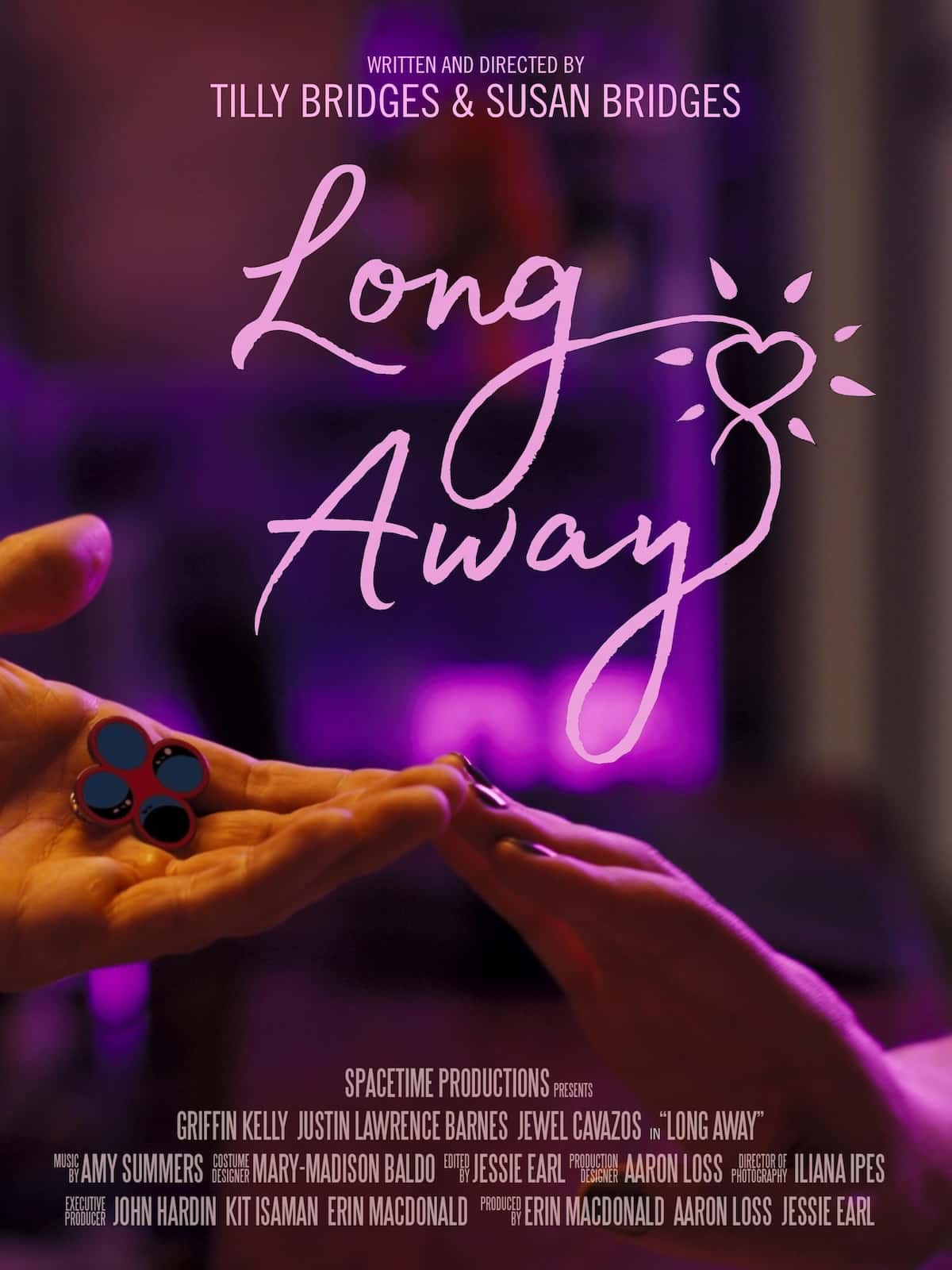
TILLY: Yeah! That is our trans queer sci-fi short film. It’s 16 ½ minutes long, it’s based on a comic of the same name that we wrote that was in The Color of Always anthology, with art by Richard Fairgray (who has won a GLAAD Award, which is very cool).
But it was so grounded, compared to most of our sci-fi stories, that we thought, “Maybe we could actually turn this into a film.” And we sent the comic to Erin MacDonald, who was our producer, and who is also the science advisor for all of Star Trek. She said she read the comic and she cried and knew that she had to help us make it into a film.
So we did. We shot it all in one day in 2025. On Trans Day of Visibility, no less – on accident, but that was the only day we could get. It was shot in a comic shop on location, we only had one day to shoot it in. We had 91 takes of 36 shots in one day, which most people on a show or film would say is impossible. It was a really long, hard day.
But we’re really, really proud of it! It stars Griffin Kelly, who is an amazing actress and she is the funniest person I’ve ever met in my life. I’m a little jealous, she’s so freaking hilarious. She’s going to blow up, in five years she’s going to be an absolute mega-star. And she’ll be at the panel along with Justin Lawrence Barnes, who is in the film as well. He’s also very great in it, very warm and loving.
It’s a time travel story. You should check it out! We don’t want to spoil it.
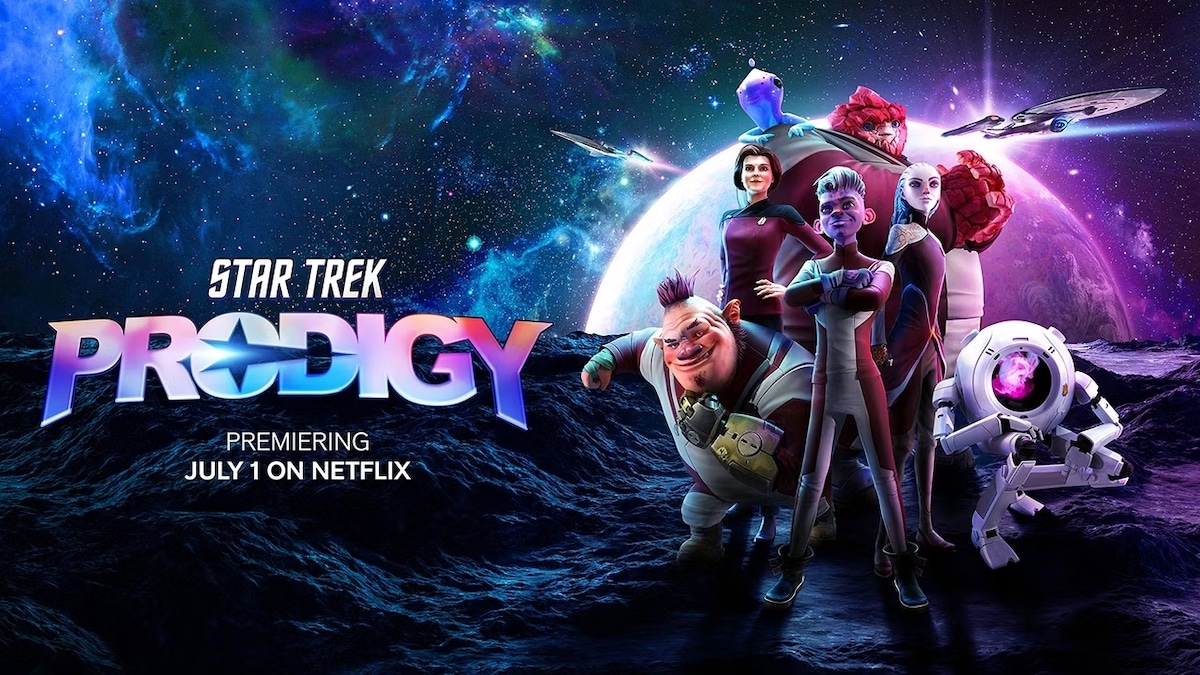
AVERY AND OLLIE: Can you tell us about the consulting work you did on the animated television series Star Trek: Prodigy?
TILLY: So, Aaron Waltke is a producer on that show. He’s great. And we had been friends with him for a while, so he had know about the writing I’ve done about trans allegories, my book on The Matrix, Begin Transmission: The Trans Allegories of the Matrix. So he was familiar with that and he came to us when they were writing Prodigy Season 2, and said, “We have this character that we think the story we’re planning could be a trans allegory, and we would like to make sure it is intentionally a trans allegory, but we want to make sure we’re not hurting people when we do it. So can you come on board and help us?”
So we said, “Yes!” And we went and we got to go in the room a couple of days and we read all the scripts for the season and gave them notes on little things they could tweak here and there to make the allegory hit even harder. And there’s that one episode especially for Zero, “Is There in Beauty No Truth?,” where they get the physical body for the time, and that one we’re so, so happy with how it came out. A lot of our suggestions were peppered throughout that to help that happen.
So yes, Zero’s story is intentionally trans. And that’s cool.
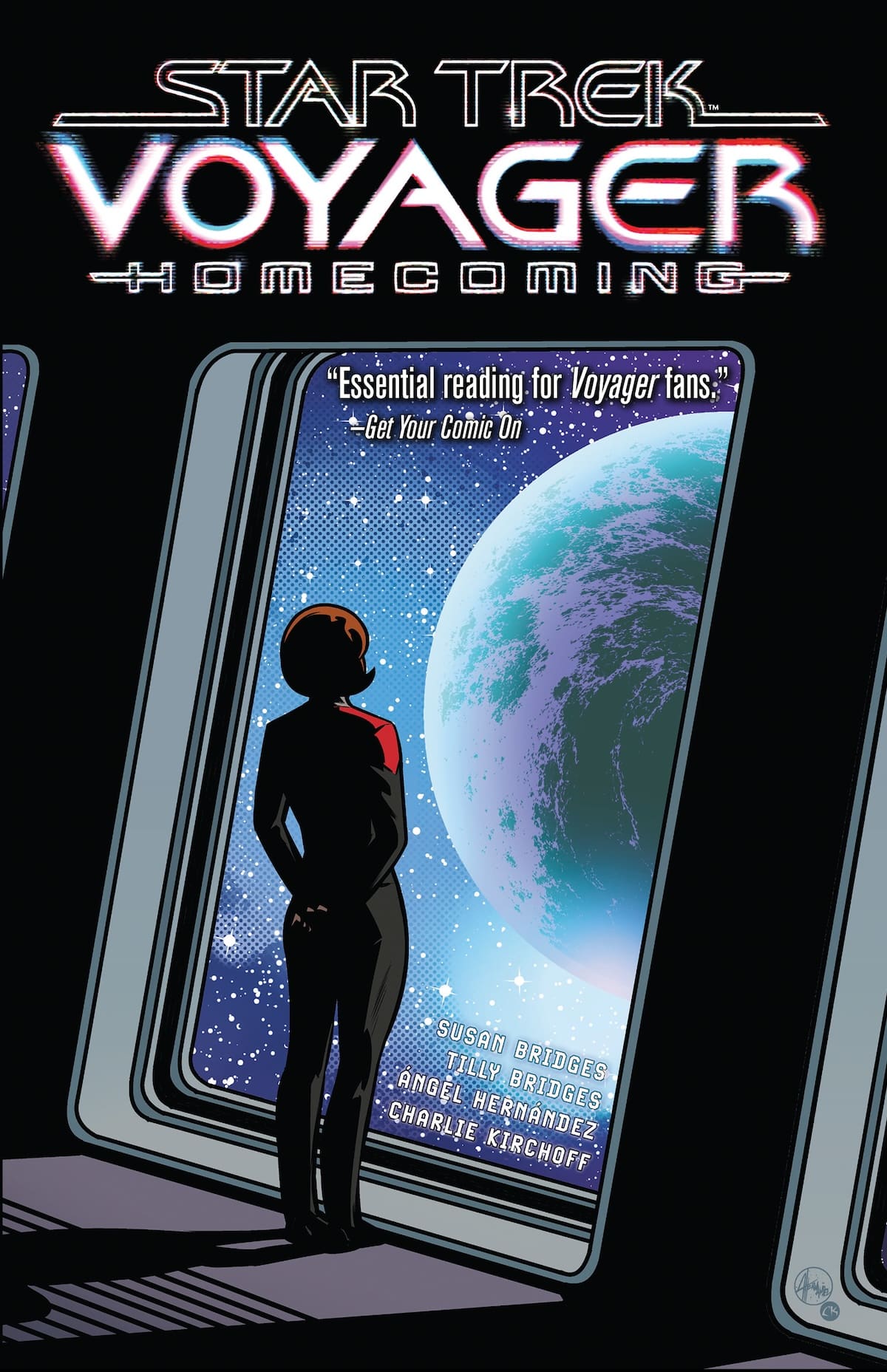
AVERY AND OLLIE: Is there any word on whether we can plan to see more IDW Star Trek comics from you?
TILLY: We can answer in saying there isn’t anything right now, but that doesn’t mean there won’t be in the future. There’s just a lot going on and they have a lot of plans. So we’re hoping, definitely, to do more, but we don’t know what or when yet.
SUSAN: Although we have expressed our interest.
TILLY: They’re aware. Yes. That we are like, “Hey, one was not enough. We want to do more.”
AVERY: Do you have stories in mind already?
TILLY: Actually, before we got the Voyager: Homecoming gig, we were already talking with IDW Star Trek Group Editor Heather Antos and we had pitched her an idea we had for a Star Trek story. And she really loved it and it was going to be a twelve issue series, and Paramount OK’d it – she just hadn’t run it past IDW yet. And as she was about to do that, Paramount came to her and she said to us, “Hey, it’s Voyager’s 30th anniversary and they want a book, would you maybe be interesting in doing that, we’d have to do it right away,” because it was already March of 2025, which was the 30th anniversary… and comics take a long time!
So we said, “Yes, absolutely,” and we had to get that going right away. So our other pitch got put on hold and then Paramount got sold, and so. We’re hoping we can still do that one day, that one is our Star Trek dream project that we’ve wanted to do for years and years and years and years. So I’m hoping we get to do it still some day in some form, but we can’t really say anything about it… It’s a story that has… It fits between the cracks of things you already know, as something that could have happened in-between that people didn’t know and we’re aware of.
SUSAN: Which is kind of like how Voyager: Homecoming fits between the cracks, which is really fun.
TILLY: Yeah, we love finding those little moments, like, “What happened between these two things? You could fit a whole story in there.”
AVERY AND OLLIE: What can we expect from you next?
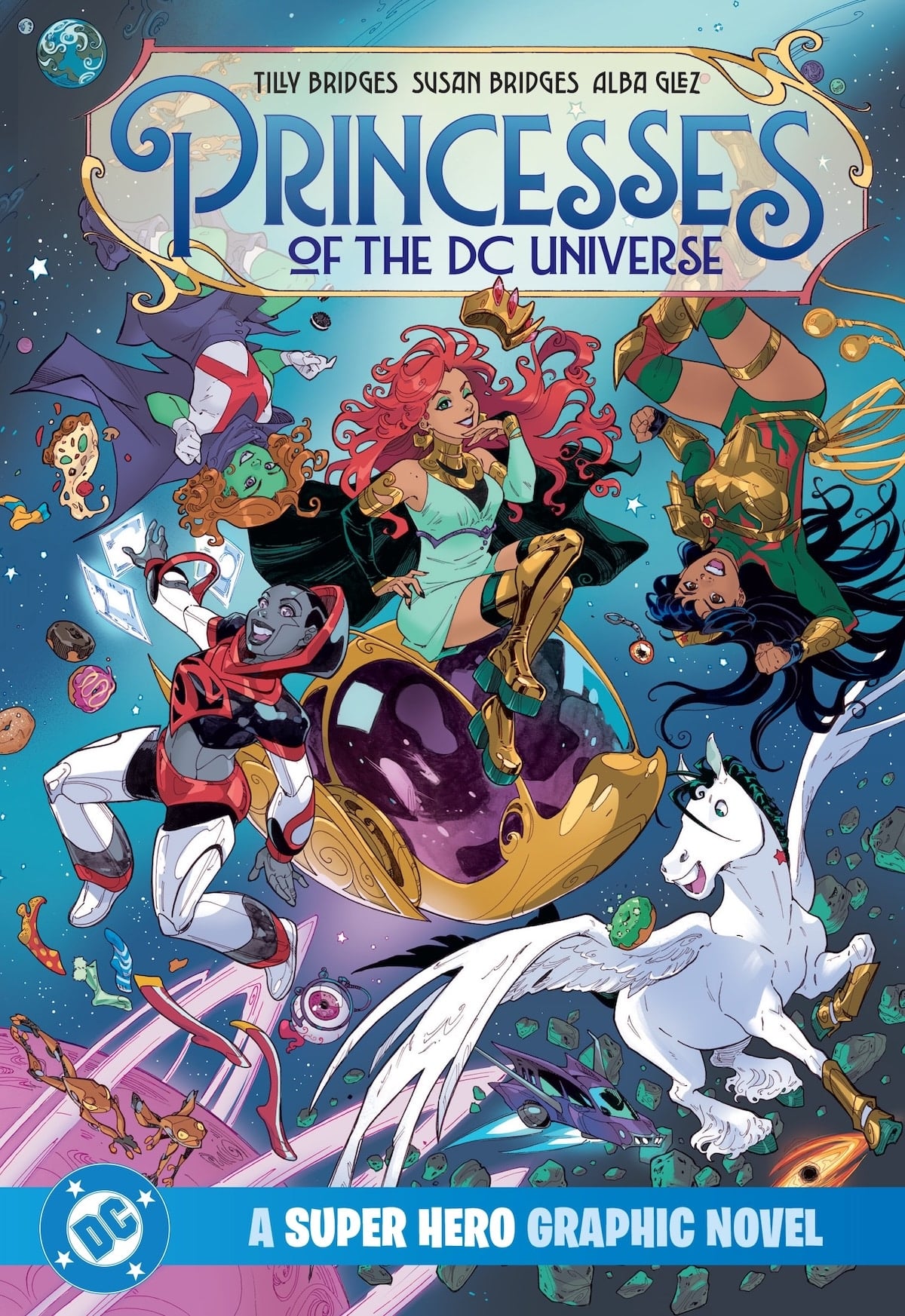
TILLY: Well, our middle grade girls adventure novel, Princesses of the DC Universe, comes out on March 2nd, 2027. It is available for preorder now! It is a teen girl road trip though the stars. It is a comedy, it is really really fun. The art is gorgeous.
SUSAN: It’s definitely not just for middle graders.
TILLY: No. It’s for middle graders the way Pixar movies are. We tried to make sure it was something that was super entertaining for everybody. Although kids will definitely get a real kick out of it.
SUSAN: And the art is so adorable!
TILLY: It’s so good. What else do we have? We’ve got another pitch that our agent is taking out, but I don’t know if we’re supposed to say anything about what that is yet because they’re sending it to publishers. So, we probably shouldn’t even mention anything about that one. But it’s a graphic novel pitch.
SUSAN: But it has lesbians!
TILLY: Surprise.
SUSAN: Lesbians in space. That’s how much we’ll say. Maybe we have a lane?
TILLY: It’s a good lane! But we’ve got a bunch of other pitches we’re working on, in different stages, that we’re hoping somebody will pick up here or there. So, we’ll see. We might do another short film, we’re toying with a new idea.
SUSAN: Yeah… We don’t know yet. We’re doing our best, in these deeply weird times.
AVERY AND OLLIE: Do you have a big career goal you have yet to accomplish?
TILLY: Run a Star Trek show.
SUSAN: I was going to say “write for a Star Trek show.”
TILLY: Well, of course be staffed for one, but a full-on goal…
But we would also love to sell one of our original pilots and run that show. We just did a live reading of Robo Waitress Assassins, which is one of our pilots, and that was the first time we really had actors – I mean, outside of the short film – so getting to see that brought to life was really, really cool.
SUSAN: But whatever comes next, it’s going to be really fun, because we write to entertain ourselves first and then everyone else. Because if I don’t love it, I can’t make other people love it.
TILLY: It will be really fun, but it may also make you cry.
SUSAN: Laugh/cry. We love to do that.
TILLY: That’s our brand.
AVERY AND OLLIE: Is there anything else you’d like us to include?
TILLY: In-N-Out fries are good, actually. Even plain, on their own. Don’t listen to the haters. That is an elite fry.
Read all of our SDCC ’26 coverage here.