

It’s not called the BCEC anymore, but PAX East is still PAX East, and once again seeing the convention center all laid out in front of me from the top of the escalator, a glittering and blinking field of game-based nerdery that stretches out under the high ceilings of now MCEC, catches my breath, alive with a low murmur and endless bustle of people.
I had a lot of questions heading in the door, but crossing the threshold into the expo hall shook me loose from them for a moment. The first day, and early still, the name of the game is if you want to play, get in line now. Despite the world, PAX casts a spell that endures.

Last year I compared PAX East to MICE, since that’s the convention I usually cover, and PAX’s indie- and community-forward programming. Uniquely, PAX is a con you attend to try instead of buy. I mean, yes, hopefully you buy that wishlist stuff once it’s out of development and available for sale. But the point of going is to discover what you otherwise wouldn’t.
2025 was also a year with “nobody there” in terms of the big companies, kind of like 2023’s initially feared and subsequently celebrated absence of cross-media superstars in the storied SDCC Hall H. In 2026, Nintendo has come back to PAX. Meanwhile, in the last year, pretty much every single person in the industry has been fired, and the rising price of memory casts an ill shadow over the future computer hardware in general.
As it turns out, PAX is like C2E2, a sister convention with a comic book culture lean, also owned by ReedPop. The traditional comicon model was comics, the people who make comics, and the people who make stuff based on comics. Sort of cohabitating, sort of in competition. C2E2 is more explicit about including things comic books have inspired, and more inclined to include adjacent interests. MICE felt that way, a Comic Expo for people who made comics that acknowledges they were also illustrators and designers, giving them a space to present their comics, prints, and stuff.

PAX is about gaming. Video games did feel different this year, but if they receded, tabletop gaming filled the space. I went this year with the intention of doing a deeper dive into something I’d only walked past the last time and regretted, so this coverage was predestined to be a bit more about books.
But, objectively(?), the publishers were showing up in 2026. The versatility and inclusivity of gaming et al. meant that it felt different, but not like PAX was missing anything, nor unfamiliar. I saw the guy in the banana costume with the maracas, who this year (on this day) wasn’t also Thor, but simply gigantic, and with a chicken head on top. And I felt at home.
On offer at PAX East 2026
Plan was, hit the Nintendo booth first to ensure the shortest possible wait in line, and that the exclusive goodies you get at the end didn’t run out. Their presence at the convention was surprisingly reserved, a spare, smart use of their space and that’s that. No ubiquitous sponsorship branding, no merchandise mart. Two different demo games, one line for playing, one line for photo ops, each line with their own exclusive pins.
The line for the new Switch 2 Mario Party-esque was nonexistent, the minigames super fun, excellent casual company pass-the-controller chaos, the photo op scenarios (skipped) Mall of America grotesque.
Pokémon Pokopia was the line to wait in. And yeah, okay, after playing, I would like to own it now, please. The Animal Crossing aesthetic is strong, reaching beyond icons and HUD to dialogue that’s that distinct villager blend of insightful and off-kilter.
What I played in Pokopia was having terraforming powers to solve a puzzle: create the specific habitats Pokemon appear in. I liked this. And found the angle more successful at evoking what I like about puzzle platformers in a modern-feeling game environment than a lot of newer direct remasters and/or sequels to games I liked back when.
And that was that for “Nintendo is back!” I got a Ditto enamel pin and now I want to buy a new console.
Atari was nearby, same with Halloween, biggish bites of floor space but nothing untoward. The throwback vibe was more matched by the peddler’s fair element of PAX. Buy a floorrunner that looks like a giant Mario 3 cartridge, Demon Slayer Loot Crate, bargain nostalgia. The video games demo section of the expo floor did feel different this year, but not because of that.


Lots of horror. Lots of deep space and dark fantasy. There were so many games relying on vivid but scant colors standing out against black backgrounds that the games that were in high-relief black and white ended up standing out to me from the rest.
This one game, Secret of Weepstone from Talesworth Game Studio and DreadXP, was like the RPG sourcebooks I was searching for, animated into a dungeon explorer. Its environmental textures looking like 2-D drawings creates this marvelous optical illusion battling depth that stopped me in my tracks to watch the gameplay.
Double Fine’s new game Kiln did that too, though because the environment was Wackyland rather than Fiend Folio. A brawler played as a clay vessel you throw on the wheel yourself to determine your uh creature type.
PAX felt darker, like screen brightness, with more games that were built on a striking environment, or a fun take on physics, that left a coding-first, story-second taste in my mouth. The smaller the booth, the more excitement there was for games. The big communal kiosks section for new up-and-comers, their odd looks and weird ideas were kicking the ass of the money games where the scenarios in which you shoot people look like reality. One company wanted me to experience what Minecraft would smell like (skipped). Weird vibes.
I saw a lot of Metroidvanias whose (admittedly superb) environmental designs were supposed to give them the flavor that make them stand out. Ironically the one I ended up liking the most was the most brazen of lifts, Retroware’s Transylvanian Adventure of Simon Quest. Retroware’s more about juicing up the gameplay than unique repackaging- though their sprite animation is utterly delightful, real Metal Slug wit and whimsy.

My MVPs from last year had no booth on the expo floor, but again brought enough cabinets to create a kickin’ free play arcade room, pun intended. This year mostly focused on fighting games and beat ‘em ups: one of like everything, from Soul Caliber to Tekken to some wild Street Fighter variation I’ve never heard of, TMNT and X-Men, Dragon Ball, the new Toxic Crusaders game. A Gundam and a Sailor Moon one?? And some incredible rhythm games from Asia, one was like Rock Band with big button pads you also spin I could not get enough of.
But the arcade was off the floor, not on it.
Tabletop games galore
Anyway, PAX East is more than just video games, and this year the tabletop stuff had shown up in force. More board games, more board games with cards as part of the game, more card games in general, with so many adaptations of other properties by companies that range from corporate to bespoke. There were more businesses buying cards at the show, “WE BUY” signs all over the floor, card singles being bought and for sure card singles being moved, hand over fist.
IDW was there with its new Godzilla TTRP. It was selling comics at the booth, too. Just the Best Ofs and Library Collections, great jumping-on points for readers new to the comics, but sadly not the niche, super cool stuff like James Stokoe or Monster Island Summer Camp.
Most of the IDW booth was dedicated to demo space so that people could sit down and try playing the game rather than being merch’d out. Choose Your Own Adventure was also there (sorry, I was a Lone Wolf kid), on the fringe of the big exhibitors section rather than out in the games with Godzilla.
My goal for 2026 was finding something publishing- not console-based, but more indie than IDW: the micropress sourcebooks I browsed last year but didn’t pick up. Specifically a mech game influenced by Filipino folklore from Joaquin Saavedra and Soul Muppet Publishing called Maharlika. A year of Gio Manning robot designs haunting the fringes of my memory. And, at the Indie Press Revolution booth, find it I did.
Getting a group together to game becomes harder as you get older, so I was just going to enjoy paging through it in the way one does with nice reference books. Who among us hasn’t owned the NYPL Desk Reference? But some digging around, I also found some journaling and mapmaking games where one or more players develop the setting through play. Ex Novo was that specifically, a cartographic storytelling device in a book, from Martin Nerurkar, Konstantinos Dimopoulos, and Sharkbomb Studios.


MIRU, by Hinokodo and Mimic Publishing, turned out to be my most distinctive micropress pick-up. There’s a strong sense of design throughout the whole book that I adore. The charts and procedure lists were visually lively and aesthetically coherent.
Sourcebooks are often like reference books, with images and supplements separate from text. MIRU intermingles things. Each two-page spread looks more like viewing a video game menu (Citizen Sleeper comes to mind), or a computer interface. These “analog adventure” books don’t just treat the publication as a means to play the game, the book is the game.
PAX East passed the vibe check
The PAX food report: I could have eaten my own weight in Masshole Pokeball vanilla cream donut holes. Treated to some Guitar Hero karaoke while I snacked.
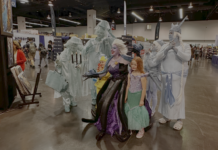
DOOM cosplay got an audible shout out of me. The costumes were all over the place, in the sense that there was a spectrum from casual to ridiculous everywhere you looked, and by people dressing up as all kinds of everything. Lots of games, of course, but also total whatever. Mix that up with lots of nice shoes, some alarmingly witty bootleg t-shirts, a bunch of event-specific gear, a bunch of total casual comfortable gamer folks starting the weekend early. A stylish and surreal cocktail, and time for people watching while waiting in line. Lots of FRUiTS looks as well as anime costumes. A crowd still deeply in love with enamel pins.
I am that crowd, getting my exclusive pins from Nintendo, and a prank Phanto pin from Mega64, this year’s Fangamer mascot as a lagniappe for being on their mailing list, and a Chun-Li lenticular enamel pin from them to go with the Ryu one I got last year. Found a goblin game, Undergoblin Heist, from Weird Works, one of my favorite booths last time (10/10 odd-as-promised fishing RISO print), who also make the goblin hat we were hyping over the holidays.
Something all over the marketplace was anti-AI sentiment. The creators at the show had signs condemning it and championing art made by people, the indie publishers have “Human Made” hand branding, even the regular folks attending were wearing hats, shirts, buttons, shirts—often lewd and hilarious—lambasting AI.
More cards. More dice, if that’s possible. This year I noticed a bunch of schools with booths. Also spotted, a group of middle school kid programmers who were on what had to be the coolest class trip. Old school conventions would be where you went for a giant stack of anime videos, and the peddler’s fair vibe of yesteryear endures at PAX. But now it’s vinyl soundtracks to video games, and boutique cassette releases of unlicensed remixes and reworks.
You can find old games and consoles from resellers, just like the single cards on the other side of the expo floor. There’s room for Nintendo, too, and the people and publishers selling you the games they make. Room for distros, for people who make the stuff you play games with (many dice). People who make stuff games players like, like coffee and tea and things to put them in, people who make games who also make other stuff selling that stuff. Artisanal junk.


Got some coffee from a wizard, as one does. Merlin’s Munchies Coffee Company makes dozens of small-batch flavored coffee roasts. I think this might have been the company’s first PAX; I asked and immediately forgot the answer as we launched into a conversation about how many cons they do, which is a lot. Merlin liked working with ReedPop and does its shows all year long. His partner was doing C2E2 that same weekend.
Got some cookies, too, from the famous PAX Cookie Brigade. The Cookie Brigade raised over $100 thousand for charity over the weekend, but just because you’re not at PAX now doesn’t mean you can’t still pitch in. This year, the Cookie Brigade also highlighted one of the secret traditions of PAX East: Christian’s origami dollar cats. Every year since 2011, Christian has given out (or hidden in plain sight on the expo floor) 100 dollar cats a day.
Health reasons will keep him from doing it in the future, but we can pay his kindness forward by donating to a couple charities Christian wanted to shine a light on: Camp Brainy Ridge and the Children’s Tumor Foundation.
Games are art worth preserving
Not every convention has been so robust. The common topic of con conversation is how to take money in rather than give it away. The confidence from 2023 has eroded, and now the Big Two pulling back to fewer conventions is seen as a hype deficit problem for selling tickets.
The growing number of conventions should act as regional triage for the artists bleeding out taking time off and booking travel and accommodations and getting their stuff to the booth, the cost of the booth, food, and on and on. Why do that to yourself if there’s an option you could drive to? But instead creators struggle with having more choices, trying to guess which show will be the hit worth being at.
More worrisome is how many conventions are being swept up by the same few companies, and who those companies are. ReedPop, who put on PAX, are owned by a company called RELX. RELX has come under fire in the form of both legal action and cultural boycott several times in the last decade for harvesting data from its subsidiaries without users knowledge or consent, and doing things like selling it to paramilitary organizations including ICE.
What can you do about that? How do indie games free themselves from depending on bigger companies that do that kind of thing? Besides UBI that is. Comics have benefited from being recognized as art in the form of receiving arts funding. BCAF, the Boston Comic Arts Foundation, hosts MICE in Boston. BVGAF (Boston Video Game Arts Foundation) when? More practically, how?
Cartoonists United is a modern advocate organization for creators. The WFH model much of comic book employment operates under makes the protection of unionization impossible for individual creators. Cartoonists United has grown from being an organized collective (it was the Cartoonists Cooperative when it was still BCEC) to an incorporated nonprofit organization. It’s building a community that respects the craft of comics and a collective that protects the craftspeople who make them, are them.
So, uh, video game workers have established unions, but do they have artists’ co-ops?
Asking video games creators to defend their work as art while they are going through waves vaguely at the industry right now is maybe not the move. This is my bias as a writer showing, or as a reader, but maybe if we want to change the cultural consensus of record, we need more video game magazines? Let the creators make the games and the critics decide what to call them. There are plenty of academic explorations of culture, but set apart from the hoi polloi. Zines are by, for, and of the people.
What makes video games art is something communally decided by the people who create them and the people who play them. Nintendo can tell you what a game is, but not what it is to you. Magazines are a way of preserving what the games community finds meaningful.


Comics have a robust scene right now. Bubbles from Ryan Holmberg. Comics Blogger from Thomas Campbell. Tiffany Babb bringing it out from the underground with Comics Courier, newspaper, and Comics Staple, zine. Even the mainstream has got one, Comics! The Magazine (skipped). Historians, we salute you!
I bring up print magazine when there is quite a bit of very good online video game coverage right now for a reason. That reason is DVLSBLSH, an esoteric video game screenshot curator who does magazine collections, talking about making zines because of reading magazines as a kid. Most of the stuff you saw in a video game magazine back before everyone was plugged in, you’d never play, you’d never even see move. You’d dream about what they were like. That’s the screencap goal.
That’s the feeling I get when I read an exquisite, text-only essay, about some comic book I’ve never read, and never will. The feeling of playing a game only that one time at that particular spot but then thinking about it afterwards forever. The goal of a demo is to pique the imagination, right? PAX is all about dreaming as well as playing. That’s worth continuing.
PAX East returns to Boston in April 2027. PAX West Seattle is in August, and PAX Unplugged Philadelphia is in December.