
by Rich Johnson
You’re interested in reading comics again. You went to see a Marvel or DC movie, and you had flashbacks to when you were a kid and how much you loved comics. The movie was Spider-Man: Homecoming. You really liked the kid who was Spider-Man. You remember watching the Tobey McGuire and Andrew Garfield movies and even the MTV animated series. You don’t want to buy single issue comics like you used to, you’re not a collector, you just want to read a good Spider-Man book.
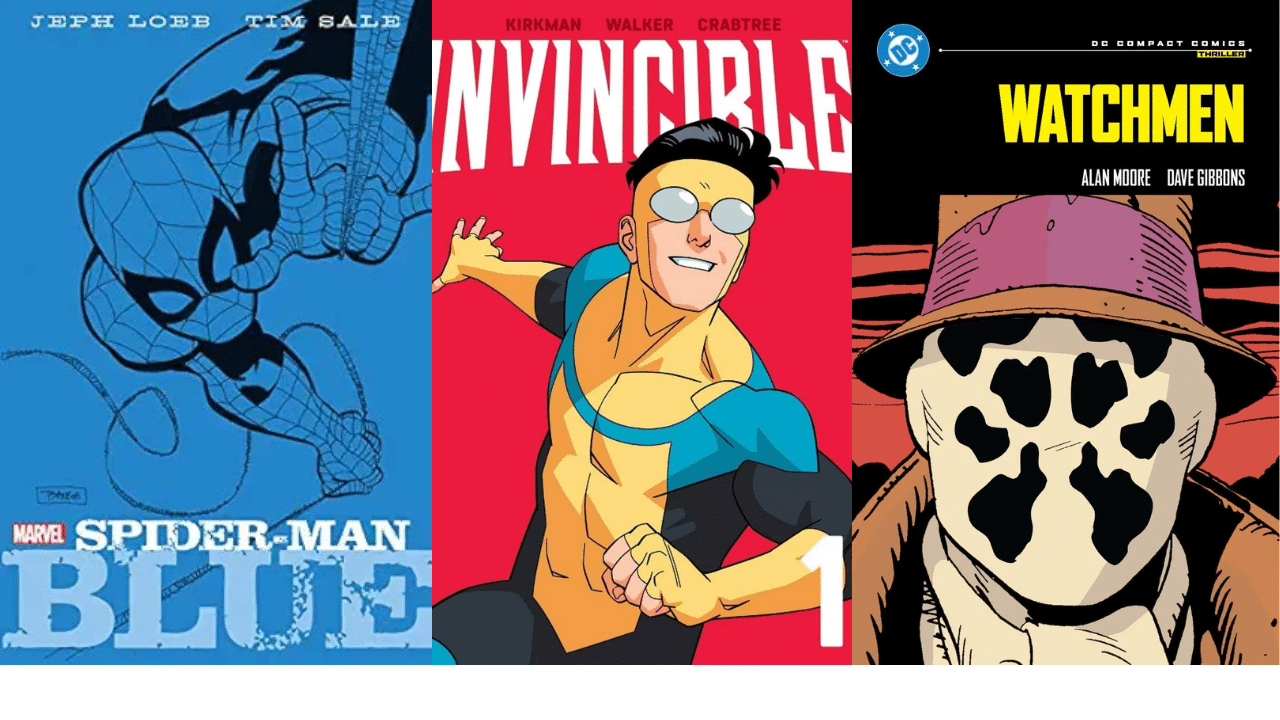
Someone recommends to you a book they’ve read called Spider-Man: Blue by Jeph Loeb and Tim Sale. They tell you it takes place early in his Spidey-career, but the art is beautiful and the story is good too. And your friend tells you that you don’t need to know about the “continuity” of the characters over these past few decades. They call it a stand-alone story. Great, sounds perfect.
You go to the local Barnes and Noble and don’t see it on the shelf. You venture into the local comic shop and it’s not there either. You check Amazon on your phone, and they refer you to a third-party seller for a used copy. You ask the clerk at the comic shop. They tell you that there are four books by that creative team and in addition to the Spider-Man book they have Hulk: Grey, Daredevil: Yellow, and Captain America: White. They tell you, “Unfortunately, none of them are available. are out of stock with no reprint date.” You’re bummed. You were getting excited about all four books and were thinking of buying at least a couple of them.
You go home empty handed. The store doesn’t make a sale, all because a well-received book with a well-known and talented team attached isn’t in print. Yeah, I know I am being dramatic. In the real world the clerk might have made a recommendation for a different Spider-Man book. But for the sake of my argument, he goes home dejected and cries himself to sleep. Okay?
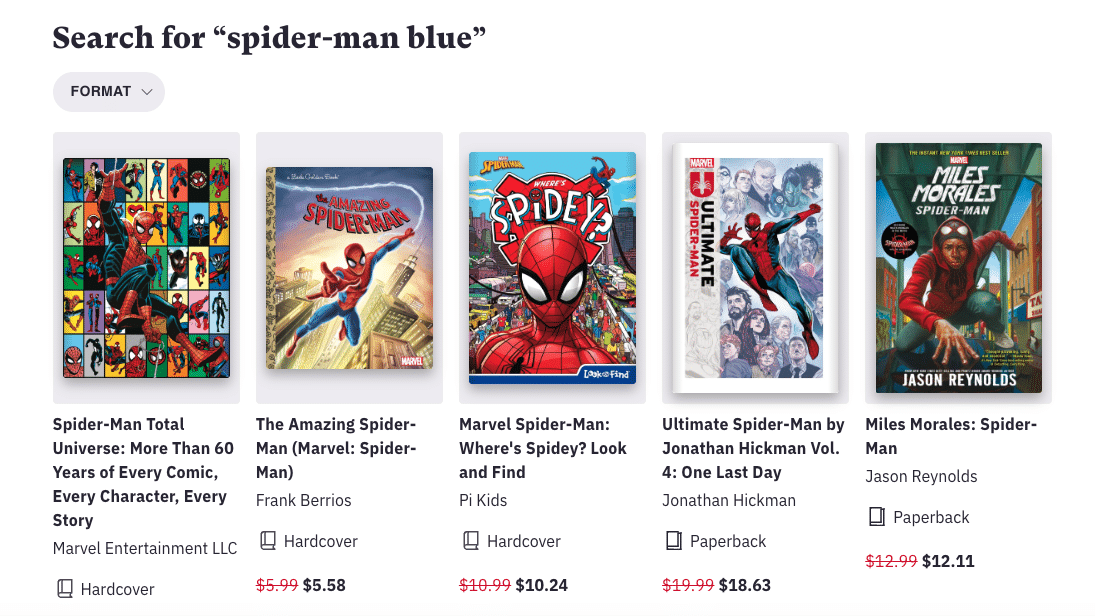
[Editor’s Note: Incredibly, when I was looking for a cover image for Spider-Man Blue on Bookshop.org, it didn’t even show up!]
Comic shops and bookstore rely on publishers to have books in stock so they can order them and sell them to customers. It seems like a pretty simple formula right? But doing that requires someone to manage the inventory.
A strong backlist is essential for a publisher to build. It is their bread and butter. Backlist can account for 80% or more of a publishers’ sales. Having the right amount of books available at the right time is nothing short of a juggling act. But it’s a necessary juggling act.
Backlist management can be a computerized algorithm or someone monitoring inventory levels and sales trends. You look at how many copies a book has sold for the past few years and average it out. And you look at the unit sales for the same period of time. Book X sold 5,000 copies per year on average over three years. Depending on how many months or years of inventory you want to hold will depend on the print run you set.
But you also need to factor in events; the author has a new book coming out that can drive their backlist. A movie of a book is going to be released. When the trailer for Watchmen broke, the sales of that book went through the roof. It was already a strong seller for DC, but the trailer pushed it to a new level. Eventually that will level off. That’s true for more recent titles like Invincible and The Boys. A new TV season hits and sales go up.
When a book is tied to a television show, it becomes a little tricker because the sales are the biggest for the first season and they slide with each season. To make things more difficult, keeping a four-color graphic novel in stock is more complex because they are usually printed overseas because it’s cheaper. It’s easier if you are publishing black and white prose books because many of them are printed in the United States and a reprint can be turned around in days. When you print overseas (usually in Asia) the turnaround time is now months, not days. You need to account for weeks of shipping on the water. And then you need to rely on it clearing customs quickly. You also face the challenge of the shipment getting offloaded at the port and it getting loaded on a truck destined for the warehouse.
How do comic book publishers handle their inventory? Let’s take a look at how DC and Marvel keep books in print.
For years I had buyers at the major chains complain to me how Marvel managed their book program. I was told that Marvel’s approach to their graphic novel program was to treat the books like they were magazines, in-and-out sales. Marvel would sell out of the print run and not go back to press. The title would be out-of-stock for months or years and then they would print a totally new edition of the book with a new ISBN. Changing the ISBN is a problem for online and chain bookstores. It makes it harder to keep track of historical sales. It can also cause confusion when there are multiple listings for a book.
The reason Marvel did this I have been told was Issac Perlmutter. He was notoriously cheap and didn’t want to tie up money with inventory that might just sit there for a while. Now that Perlmutter has been gone for some time, I ask the question – is it any better? Are key Marvel books in print? Are they staying in print? Is Marvel keeping their Premier Collection in stock? How are the Epic Collections doing?
I ask this because we need Marvel to have a healthy backlist program. Under the Perlmutter system there was money lost by everyone. We need to have new readers come to the table.
What about DC? With all the corporate turmoil are they still keeping books in stock? One of the things I helped institute at DC was a never out of stock list. These were the books that sold year after year. They included Watchmen, Batman: The Dark Knight Returns, Batman: Year One, Batman: The Long Halloween, Kingdom Come, Sandman, The Death of Superman and as Vertigo grew, many of those titles went on the list as well.
I’m happy to say that Marvel did put the Loeb and Sale books back in print. First in hardcover and now in paperback. Is it too late? Can we get that guy back in a store to buy these? Well, we can hope that he checked his local library and he was able to get them there.
My questions are, has Marvel gotten better keeping these evergreen titles in print? Has DC with all the corporate turmoil maintained the way they have historically managed backlist? Please leave a comment to let us know!
Rich Johnson has worked for Waldenbooks, Scholastic, DC Comics, Lion Forge, and Diamond Book Distributors and was the co-founder of Yen Press. He is currently the founder of the publishing and media consulting company Brick Road Media, LLC. He has been an adjunct professor at both Drexel University and Pace University and is the author of four art books about Marvel Comics for Universe/Rizzoli and has a forthcoming book from Inside Editions.







I think DC’s been CONSISTENTLY on top of making their back catalogue of trades available or reprinting them compared to Marvel.
I had to wait YEARS for Marvel to reprint an omnibus I wanted…..DC regularly reprints.
Spider-Man: Blue isn’t in print anymore. Marvel dropped the colour out of the titles when they reprinted them. It’s called Jeph Loeb & Time Sale: Spider-Man. The comic shop should have looked these up and known that. Other titles are Jeph Loeb & Time Sale: Daredevil, Jeph Loeb & Time Sale: Hulk, Jeph Loeb & Tim Sale: Captain America. These are all currently available.
Actually, @ArtistsEditionIndex, both Spidey and Hulk are, in fact OOS at this minute, and have been for months.
DC was the gold standard for keeping books in print for decades, but that largely was abandoned rough at COVID time where more and more books started disappearing. This has been getting much better over the last year pr so… at the same time they are starting to keep more periodicals in print
-B
Marvel is a nightmare for keeping stuff in print. If something is a year old, I have to hope and pray I can get one of the remaining copies for the library. For example: we ordered the first Thunderbolts epic collections about a year and change after publication. The movie had just come out. Stock went dry, the other volumes were on hold for months, and when those cleared, that first volume was nowhere to be seen, dropping into the “hard to find, out of print” category on Ingram and it’s been there since mid-2025. I basically don’t buy volumes of Marvel series if I show up late to the game because of this.
It’s challenging with the Omnibus format. Once a (usually small) print run is sold out at pre-order, that’s it. It could be YEARS before a new print is announced, or never.
I’m always hopeful for the announcement that X-Statix Omnibus will be reprinted, but I’ve almost given up hope!
Marvel slices their collections of new releases too thin, for too high a price point, which then go out of print too fast. Granted, not everything needs to remain in print, but evergreens are the lifeblood for selling books, and they seem not to know their own catalog, and where the demand is.
Immortal Hulk (remember when Marvel was still beating DC at the single issue game?) was also in demand in TP collections, but you had to get about 12 thin volumes, which Marvel then failed to keep in print) where 6 volumes would have worked way better; see for example Garth Ennis’ Punisher Max series (ALSO out of print). Now it’s too late and Immortal Hulk has been forgotten.
Not everybody is looking for an Epic Collection or an Omnibus. We had a store appearance of Clayton Crain last week, but could not order a Venom vs Carnage TP, which has been an evergreen for years, and would have been great for customers to buy and get signed. The only way to get it now, was a Modern Epic Collection costing $54.99. That’s not something a casual visitor will buy.
DC fucked up before Covid when they had to cancel a bunch of their solicitations for so called Essential Editions, which half of the time were weak rebrands of stuff that already had been in print for years like Final Crisis. Didio (remember HIM?) admitted there had been too much glut in their TP releases, and pre-orders had been way below expectations. Also, their Rebirth TP’s came out way too soon after the release of the bimonthly comics, which ate into both their single issues sales AND TP sales as people could not keep up. DC also killed of Vertigo (one of THE perennial backlist labels) and let a lot of stuff go out of print (like almost the entire Hellblazer back catalog, which might be DC’s equivalent of Daredevil, in that it is a series with a high general level of quality, jeez DC wake up!) Then of course COVID decimated their stock as it did for everybody.
DC once again has a healthy space time wise between the release dates of single issues and collections, and I think releasing TPs and HCs at the same time is smart. Everybody is praising their Compact Editions, and these do sell, but it remains to be seen what this will mean in the long run. Will previous $24.99 evergreens (like Watchmen) be reduced to being ‘shelf-filler’ as there is now a $9.99 alternative? What will this do to a retailers bottom line? And when will next volumes of series like Batman by Snyder & Capullo or Y Last man be released in Compact Editions?
Could someone more knowledgeable on this subject explain to me why all the publishers haven’t yet switched to Print On Demand, at least for collections, so that all these problems would instantly disappear. Is this because every new release has to be marketed as an “event” for some reason, and pressure buyers under artificially manufactured scarcity ? Frankly I find this very puzzling. Obviously being French I find that European publishers do a better job of keeping things in print generally speaking, but some of the smaller ones issue such tiny print runs that a desired book willfly off the shelves and find itself almost instantly on eBay at ungodly prices for someone else to line their pockets with dough. How does that make any sense business-wise ?
Comments are closed.