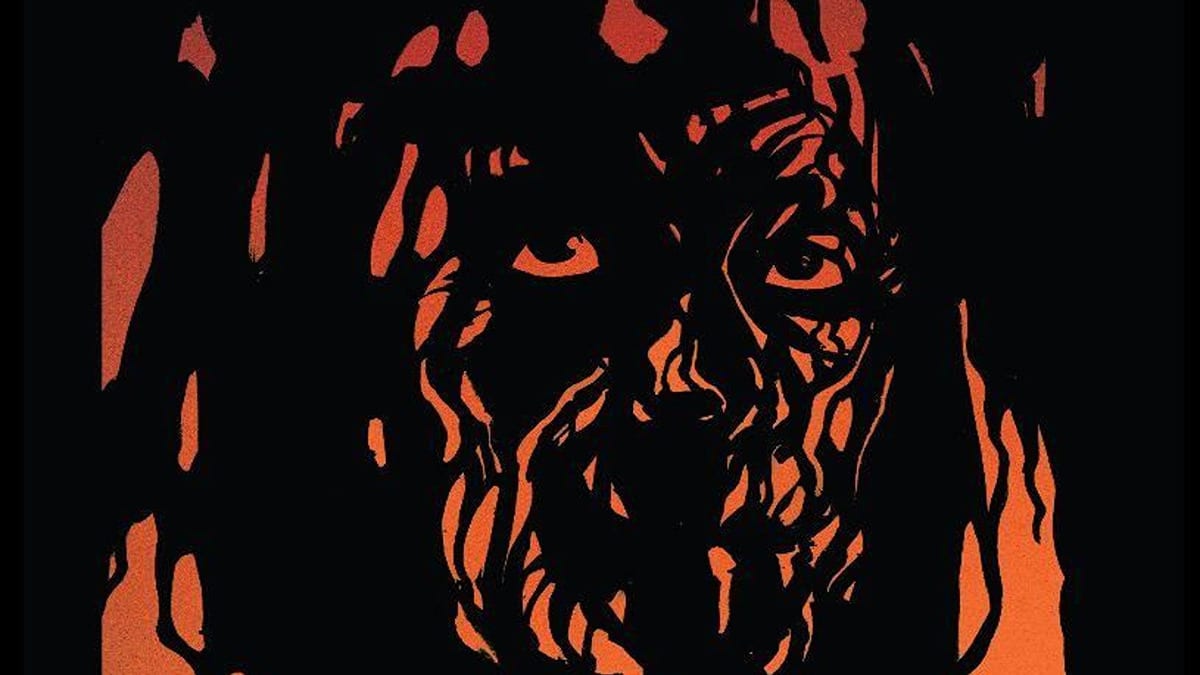

Americans love themselves a mythical monster, especially if they’re homegrown. Big Foot, the Jersey Devil, the Mothman, they all point to a strand of folklore that conjures strange creatures borne out from the American experience specifically. Chris Condon, Charlie Adlard, and Andrew Ehrich have come up with their own for their new Image comic Of The Earth, a neo-noir horror tale that deals in oil drilling and the darkness that can surface from it.
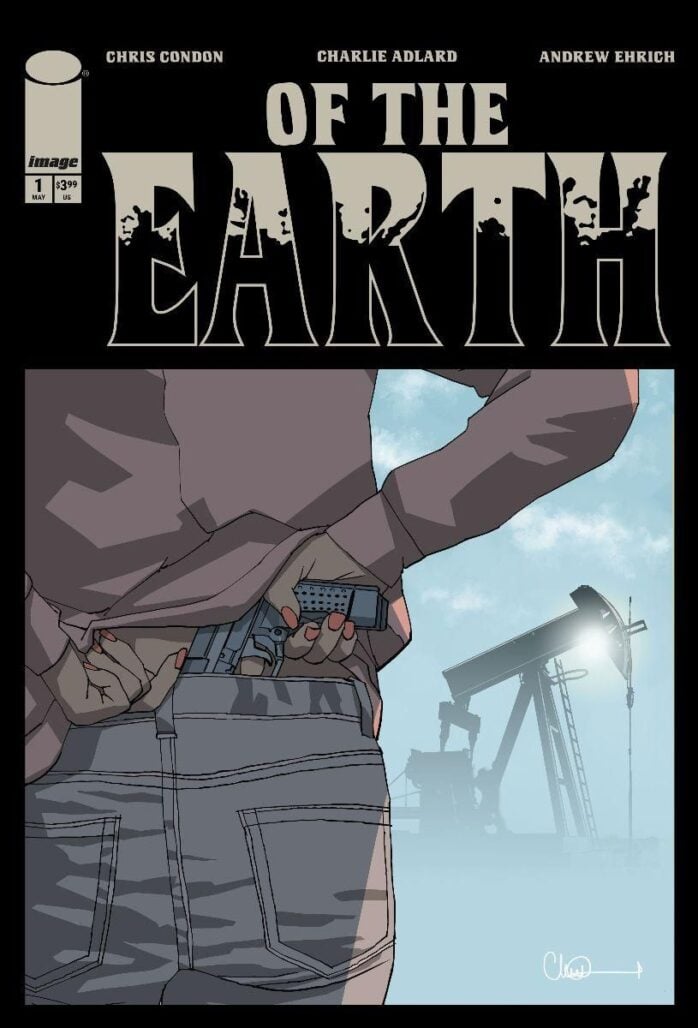
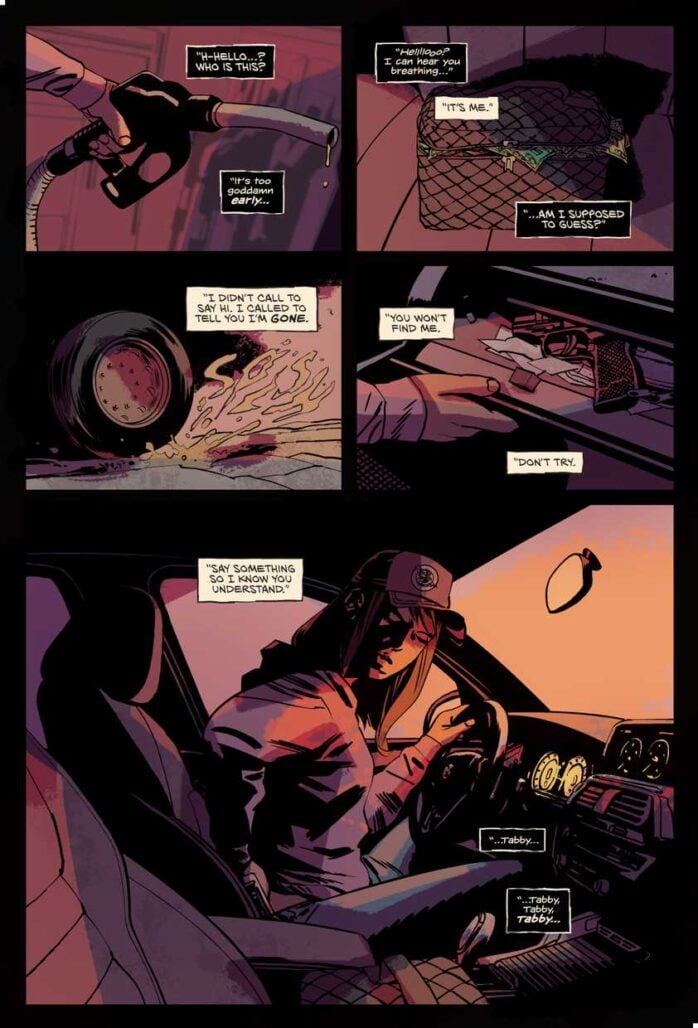
The story follows Tabitha “Tabby” Black, a woman on the run. She goes back home, to her grandma’s house, after seemingly stealing a bunch of cash from someone. What she finds is granny hiding in a corner, drenched in a black liquid. Mention of a creature called the Wildcatter comes up soon after her arrival, a creature tied to irresponsible and desperate oil prospecting. And then, the horror starts.
The first few issues of Of The Earth point to a methodically paced affair that rewards patience. It belongs to the same school of thought as Alien, It Follows, and Jaws. The action comes from character development first, outright horror second. Condon and co-writer Ehrich go lengths to give each character a sense of life and history that elevates each piece of dialogue shared between them.
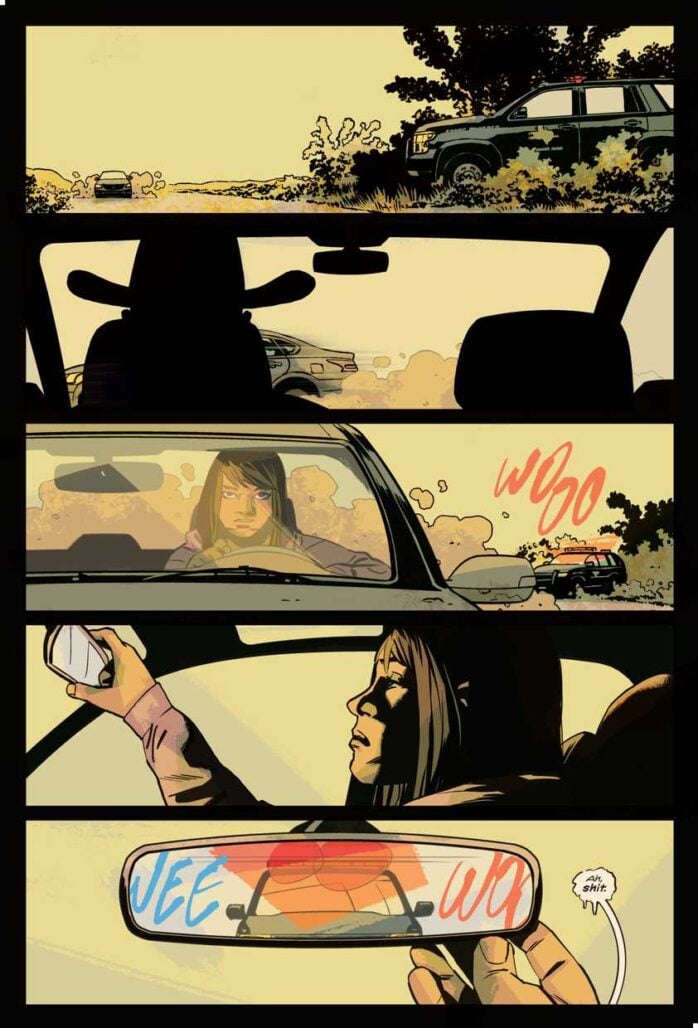
Long stretches of silence are indulged here. They invite deep explorations of the surroundings and the elements that interact in them. Charlie Adlard proves a master of environmental storytelling, often preferring to focus on a barely discernible shape in the distance to get the reader’s mind going. We’re allowed to create our own monsters.
I sat down with Condon, Adlard, and Ehrich to talk the fluid nature of horror, influences and the risks of boxing stories in them, and the benefits of holding back on big reveals.
RICARDO SERRANO: Of The Earth taps into the world of folklore and cryptids. What separates these types of creatures from the more general idea of a monster, both textually and visually?
CHRIS CONDON: I don’t necessarily see a difference that separates the two by that much, although you could say we created our own cryptid. I think it revolves more around the story behind them and how they relate to their environment. Monsters have a tendency to reflect the people in their vicinity as much as the places they inhabit. Getting to that story is what’s interesting.
CHARLIE ADLARD: I always prefer my horror off-screen. That’s not to say I’m a prude or anything like that, but I firmly believe that the mind can conjure up much worse imagery than anything you could ever show. It’s always slightly disappointing when the monster’s finally revealed. It’s almost like the magic’s gone. It becomes something else as soon as you see the monster in full. It loses a bit of its power, doesn’t it? So, I prefer keeping things in the shadows. It was a bit of a challenge here because we’ve got a black, oily monster in the shadows. You’re kind of drawing a lot of black on black. It was fun though, figuring out how to get that visual to work.
ANDREW EHRICH: I also prefer keeping the monster in the shadows, or at least a slow reveal of it. I think that it helps tell a story that’s a little more appealing. In our case, revealing everything right away just didn’t really serve the story. I thought a lot about John Carpenter’s The Thing. It feels great when you get a good payoff, especially when they get built up so well.
SERRANO: You mention Blood Simple and The Thing as influences here (maybe Tremors and There Will Be Blood, too). How do you honor these influences while still shaping a story that stands on its own?
CONDON: Everything I do is just steeped in the things that I love. I mean, a lot of the people I admire, like Darwyn Cooke, tend to let their influences shine in their work. If you look at Brian De Palma, his work is steeped in his influences. The same thing with John Carpenter. I mean, he put The Thing From Another World in Halloween years before we ever knew that he was going to be doing The Thing at Universal. It’s so fun to get to play with those references and those homages.
These things permeate in our minds. They make us want to create. Sometimes, I don’t even know I’m pulling from certain movies or books going into a new project. For Of The Earth, I started on this image of a desolate road. I instantly knew it was a really interesting scene. I wanted to know more about the characters to sort of build out the world and think about certain scenes. I’m like, oh it’d be kind of fun if we do like a Psycho homage here and so on. That helped me get onto the next part of my story. It’s not about aping what’s come before. It’s using the tools that the influences give you when these other storytellers were creating their art.
We’ve mentioned Blood Simple and The Thing, but one of the biggest influences on my end was an Australian film called Wake in Fright, which is one of the scariest movies I think I’ve ever seen. And that was a huge influence throughout. It’s not a monster thing, but it’s a really intense film. That’s what I was really pulling from, more than anything. Goes to show, you never know where these ideas will eventually come from.
ADLARD: Everyone has their influences. Whether it’s literally looking out the window or watching movies, reading comics, novels, whatever. The trick is to take those influences and not say I’m going to try and draw like them. Don’t say I’m going to draw like, I don’t know, Will Eisner. No, never do that, because you’ll always be a sub. You’ll never reach that level of art, and that’s okay.
Straight away, the best way to do it is to just sit there and let the ideas percolate in the back of your brain and just carry on. Some influences will come through and then you keep drawing. Give yourself the time to understand your own process, your own art. The influences will still come through but in a much better way. They’ll be part of you, part of your style. Other people might not recognize them, but you’ll recognize them.
EHRICH: I think so many of the things that you know, you watch, or you read can come across as fun things to incorporate into your own stuff. You have to be careful a bit there not to let that take over your ideas. Having said that, so much of it becomes unconscious in a certain way. You’re not necessarily approaching a scene or a moment thinking in a heavy-handed way that you want to recreate this moment from this movie or whatever. It’s all just sort of in you, and you just let it flow. I think oftentimes, from a writing perspective, you’ll write something and maybe you weren’t even aware of what you were incorporating into it. The things we love, that stuck with us, will come up whether we want to or not sometimes.
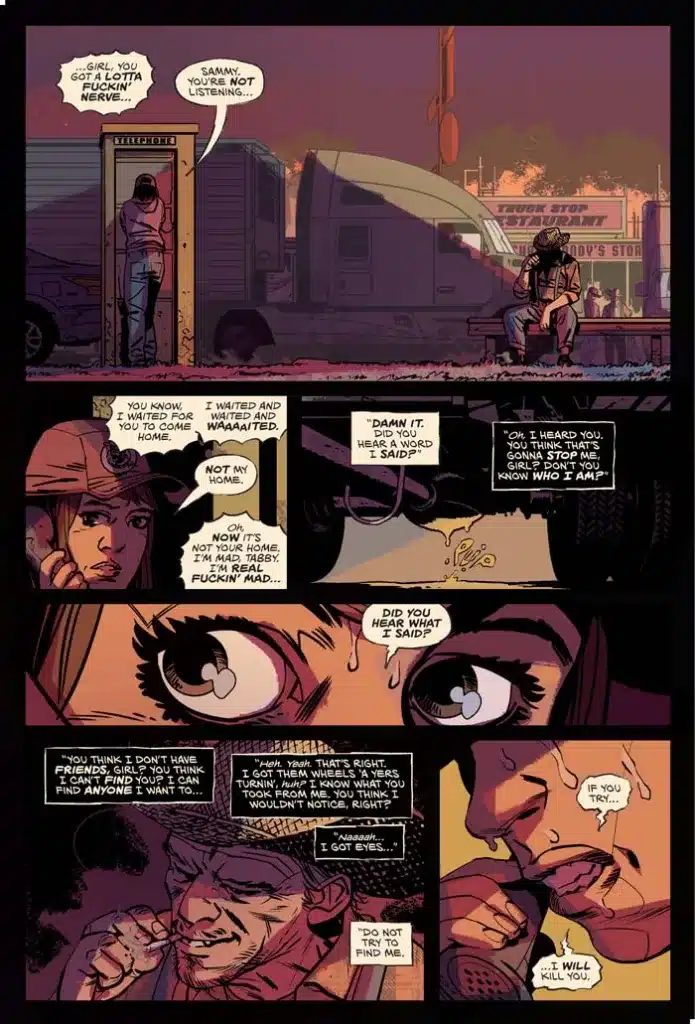
SERRANO: There are stretches of wordless pages and panels throughout. They really build on not just the tone and the atmosphere of the story, but also its geography. Why was it so important for you to make the location so believable?
CONDON: You should definitely want to play the locations up. You want to make it known how isolated a place can be and how isolated the people that live in it are, especially when you know something is going to happen to them. You can establish how there’s no cell reception, that the only phone that works is the landline. You know that there is no help anywhere near, and that the closest gas station is at least a couple of miles away. And then you have to consider if it’s even open when you need it the most.
It all helps you tell your story. It’s a really cool tool to use. It’s something I’ve done in That Texas Blood especially, but then that book’s also very similar in terms of atmosphere and location. It’s a great way to build suspense.
ADLARD: Well, it’s because you’re working with the best comic book artist of all time, aren’t you? So why hide it with loads of speech balloons? Joking aside, the trick of a good writer is to let the art breathe and vice versa. The artist should know when to pull back and let the words do the work.
If you’re a half decent artist, you should be able to depict story without having someone explain it all in detail all the time. In Of The Earth we’re in the desert. You look at how bleak it is and what that means for tone and atmosphere. Then you determine whether the silence of it speaks for itself. The challenge is giving a faceless, flat, and open space enough life to make it carry a big part of the story.
EHRICH: It’s kind of inherent in horror and in science fiction, the idea that you become very close to the spaces that you’re in. It speaks to buildup. We lay out the story, but then we also build up to suspenseful moments and scary moments and that sort of thing. Having panels that don’t have any words in it invite contemplation. They can inspire longer stays in each image.
When you’re working with someone of Charlie’s caliber, you know he’s going to add something special to each panel. Maybe a panel description is two to three sentences long, but you know Charlie is going to turn that into a true moment. Sometimes it’s about asking whether a moment needs to breathe, without words.
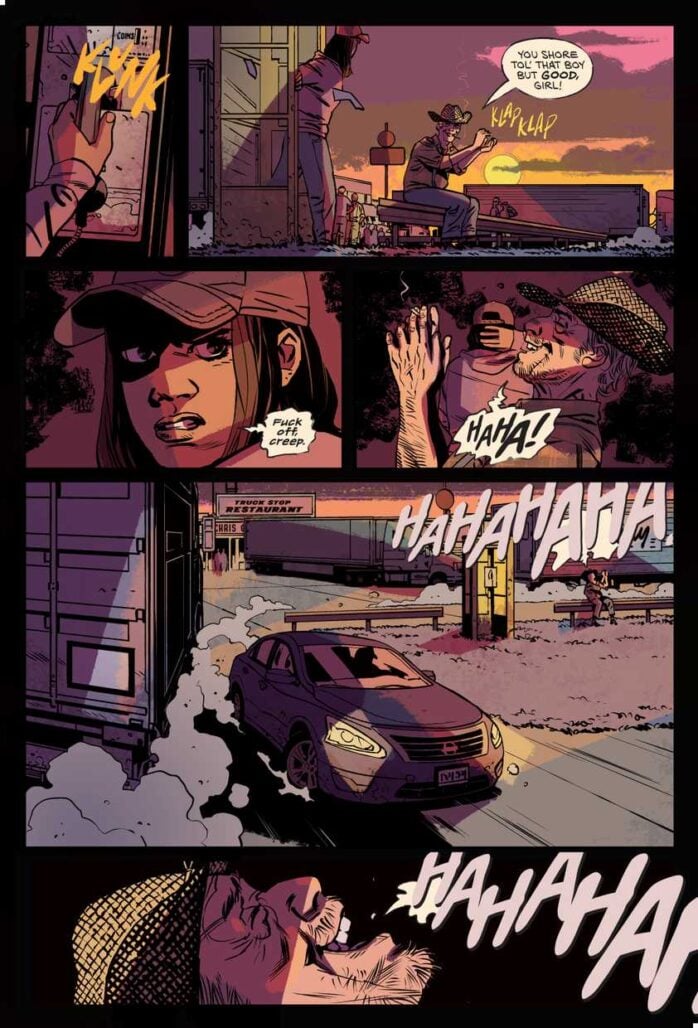
SERRANO: What is it about neo-noir that makes horror fit so well within it?
CONDON: I feel like all genres exist in very similar places. There are very slim borders between them. Ultimately, it’s about the type of characters you can get out of them. Neo noir, and noir in general, get you really interesting characters. You get characters that make bad decisions, characters who lie, characters who have done things poorly, or who’ve done bad things in their past.
Horror is the comeuppance. Like comedy as well, horror is simply one of the most emotional genres. They elicit emotional reactions from the audience. Horror will make people squirm and scream. Comedy will make people laugh out loud. Noir isn’t something that inspires that sort of reaction from you.
I think that there’s something about combining different genres with horror. With noirs, it’s all about shadows. It’s all about existing in the shadows, living in the shadows, seeing what comes out of the shadows. Horror does the same exact thing, but its relationship with it can change. You can ask what’s lurking in the shadows, what lives in it. It makes sense to combine them. They’re like brother and sister.
ADLARD: I like finding out the differences between horror and the horrific. I know everything has to be pigeonholed nowadays, but there’s something in the details. By the nature of the images we’ve shared, it’s easy to see our book as simply horror. But it’s much more. Some of the things we discover in it could come out in a more drama-centric story because the horrific can come up anywhere. That’s the good thing about not putting things in a metal box.
EHRICH: When you think about the genres at play, you know you’re dealing with characters who are in desperate situations. It inherently creates drama. As the story unfolds, those things start showing you why they go hand in hand. The mix has allowed us to create a very grounded sense of place that can steer all the other elements in play.