


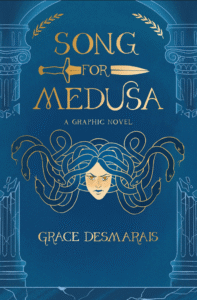
 Song for Medusa
Creator: Grace Desmarais
Publisher: Andrews McMeel Publishing
Publication Date: November 2026
In Ovid’s Metamorphoses, Medusa is a tragic figure. First assaulted and then transformed into a monster as punishment, Medusa becomes the antiheroine of a story about misdirected vengeance. The feminist philosopher Hélène Cixous offered a different interpretation, however. In her influential 1975 manifesto “The Laugh of the Medusa,” Cixous argues that Medusa can be understood as a symbol of female liberation in her role as a woman who strikes down anyone who challenges her with the fierceness of her gaze. Still, as empowering as this reading might be, one wonders what joy might be found in the life of a woman deprived of the possibility of human connection.
Grace Desmarais’s graphic novel Song for Medusa allows the myth of Medusa to shed its tragic skin and emerge as a new story of queer love and resilience. Desmarais draws on Anne Carson’s translation of the poetry of Sappho as an inspiration for a romance between Medusa and a Grecian princess who seeks to protect her kingdom from the violence of the semi-divine hero Perseus. Despite the high stakes of its conflict, Song for Medusa promises a happy ending for everyone while demonstrating the transformative potential of viewing old stories from a proudly monstrous perspective.
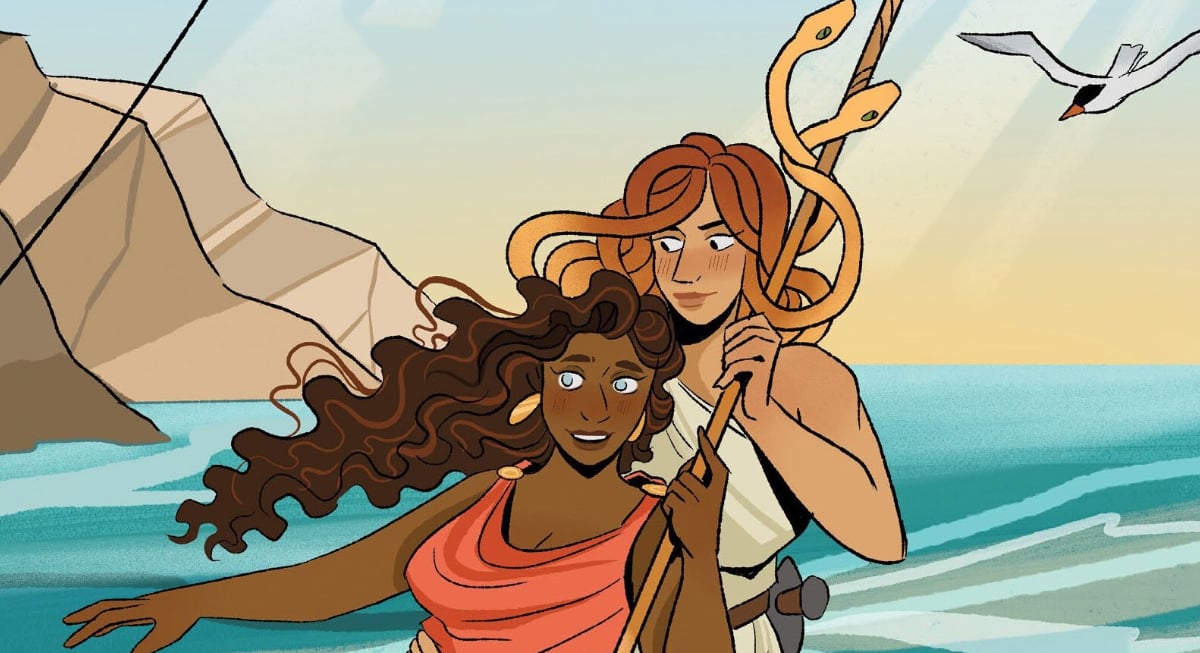
Song for Medusa joins a long tradition of retelling myths to speak to the interests of a contemporary audience by recasting existing characters into new roles. Along with Medusa herself, the primary heroine of the story is a young woman named Cyrene, the princess of a coastal city-state in Greece called Aeolis. Cyrene is kind-hearted and beautiful, as well as a gifted musician, and she’s arrived at an age when it would be politically advantageous to marry. Unlike her mythical namesake, who was a famed hunter and warrior, Cyrene is visually impaired and an advocate for diplomacy during an ongoing naval siege.
The visiting hero Perseus, a semi-divine son of Zeus who fights and kills Medusa in most versions of the legend, has come to Aeolis to fight in the conflict on the side of Cyrene’s father, King Darius. After an outstanding military victory, Perseus proposes to Darius that he wishes to marry Cyrene. Fortunately, the princess isn’t impressed by his jingoistic swagger. Cyrene’s friend Lyra is sensitive to the practicalities of political leadership but nevertheless agrees with the princess’s negative assessment of Perseus. Sword-wielding heroes might make for a good story, but their violence has consequences.
With Lyra’s help, Cyrene escapes the palace, and she meets Medusa in an isolated cave along the shore. Cyrene’s blindness protects her from the curse laid on Medusa by the goddess Athena, who decreed that anyone who met her eyes would be turned to stone. Despite Medusa’s serpentine hair and debilitating curse, Cyrene doesn’t perceive her as a bad person, and the two women talk and play music through the night. Their immediate connection is so strong that the gods get involved, and even Eros flies down to grant his blessing.
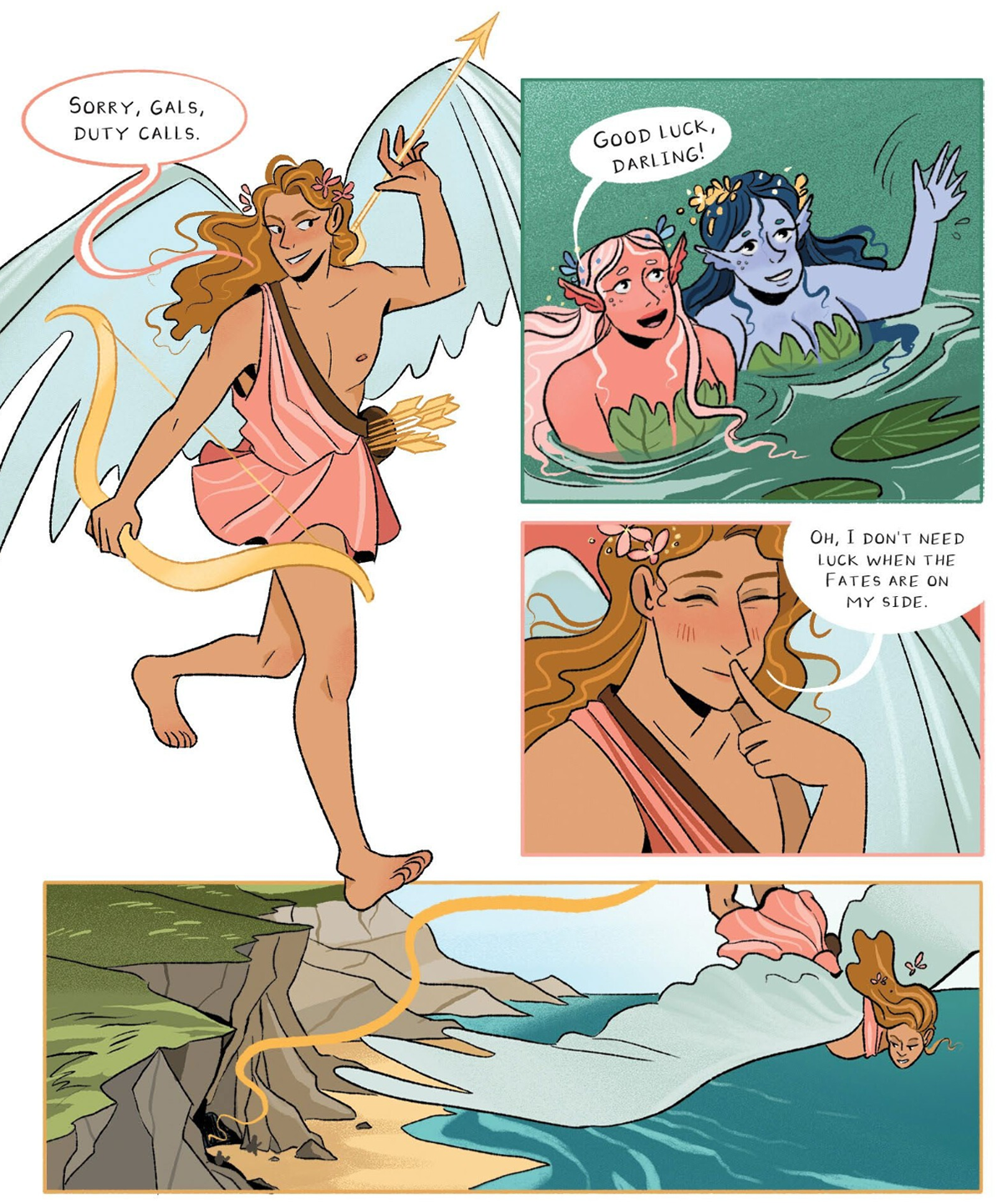
From the loftiest of gods to the most mundane of background extras, Grace Desmarais imbues her characters with a bright and sun-drenched warmth, and the range of their physical features reflects the diversity of a region in which people sailed freely between kingdoms and frequently moved between cultures. The Mediterranean Sea is rendered in a gorgeous deep aqua that sets the tone for the vibrancy of the color palette and provides a visually pleasing contrast to the shining amber hues of the characters’ skin and clothing, as well as the golden snakes of Medusa’s hair. By the end of the story, Medusa stands tall as the radiant figure made famous by the Versace fashion logo, a symbol of female power who isn’t afraid to see and be seen.
The story of Song for Medusa is just as attractive as its characters, and it’s clear that Desmarais put a great deal of thought and care into representation, especially the representation of disability. As a blind woman, Princess Cyrene is neither helpless nor supernaturally gifted. With the use of a cane, she’s able to navigate familiar environments on her own, but she still finds herself grateful for assistance in more unfamiliar circumstances. I appreciate that no one treats her differently because of her disability, either to discriminate against her or to treat her with condescension masked as kindness. Cyrene is a princess, and she is respected as such.
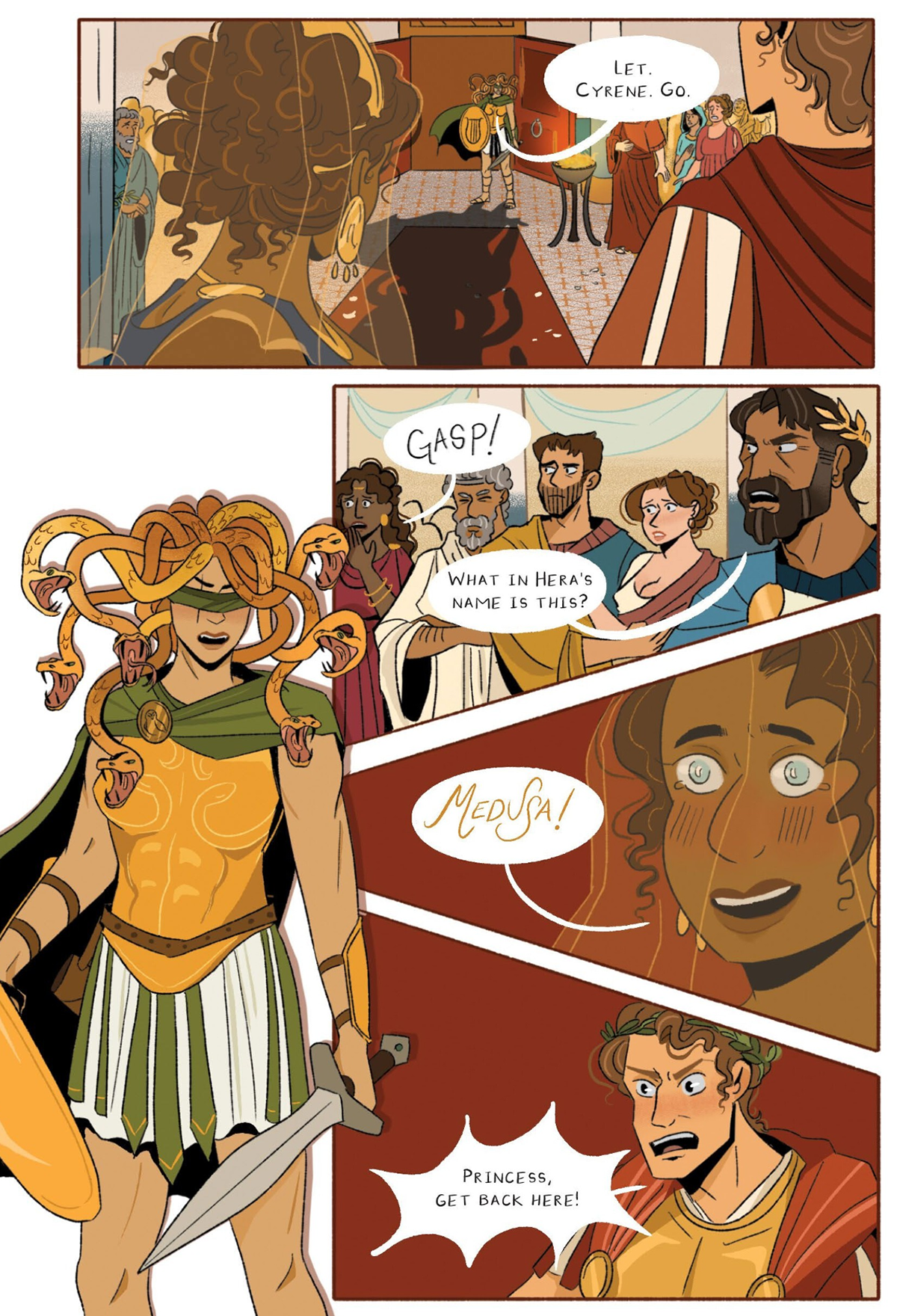
As a counterpoint, Medusa’s disability (as manifested in the form of her stone gaze) presents severe problems. Her circumstances require her to take her accommodations into her own hands, and she does so with strength and pride, donning a blindfold along with the armor she wears to defeat Perseus, a walking symbol of intolerance. As peace-loving as Cyrene might be, Medusa understands that some enemies need to be fought, and that some battles can only be won with a decisive display of action. If words won’t work, perhaps (metaphorical) swords will.
At its heart, Song for Medusa is a sapphic love story. Appropriately enough, Desmarais has included several illustrated endnotes regarding the poet Sappho, the illuminating work of translator Anne Carson, and the legacy of Sappho’s poetry as a source of queer pride and creative inspiration. Desmarais quotes from Carson’s translations of Sappho’s poetry throughout the story, and she explains that “it seemed fitting that Sappho served as a poetic voice for the love between Cyrene and Medusa, two women who long for something greater than the world defines for them.”
In Song for Medusa, Desmarais has crafted a satisfying blend of genres. The graphic novel offers a romance with a gloriously happy ending, and it also presents the adventure of a young woman who moves through multiple worlds before ultimately deciding to leave home. Cyrene’s father, King Darius, has a compelling character arc as well. The young hero Perseus lives by a code of violence, but Darius proves that wiser men are capable of listening to a diversity of voices so that they may use their authority to enact meaningful change.
Song for Medusa is a contemporary story that invites readers into a colorful ancient world as beautiful and enticing as any period drama. The colorful and well-researched setting is a treat for fans of historical romance and adventure, and there’s an incredible magic in the realization that, despite their cultural legacy, none of these myths are set in stone.
Song for Medusa is available from Andrews McMeel Publishing.
Read more great reviews from The Beat!