
With more people reading manga and webtoons (aka vertical scroll comics) than ever before, Beat’s Bizarre Adventure gives three writers an opportunity each week to recommend some of their favorite books and series from Japan, Korea, and elsewhere. This week we have a psychological thriller, a hard science fiction saga, and, of course, romantasy.
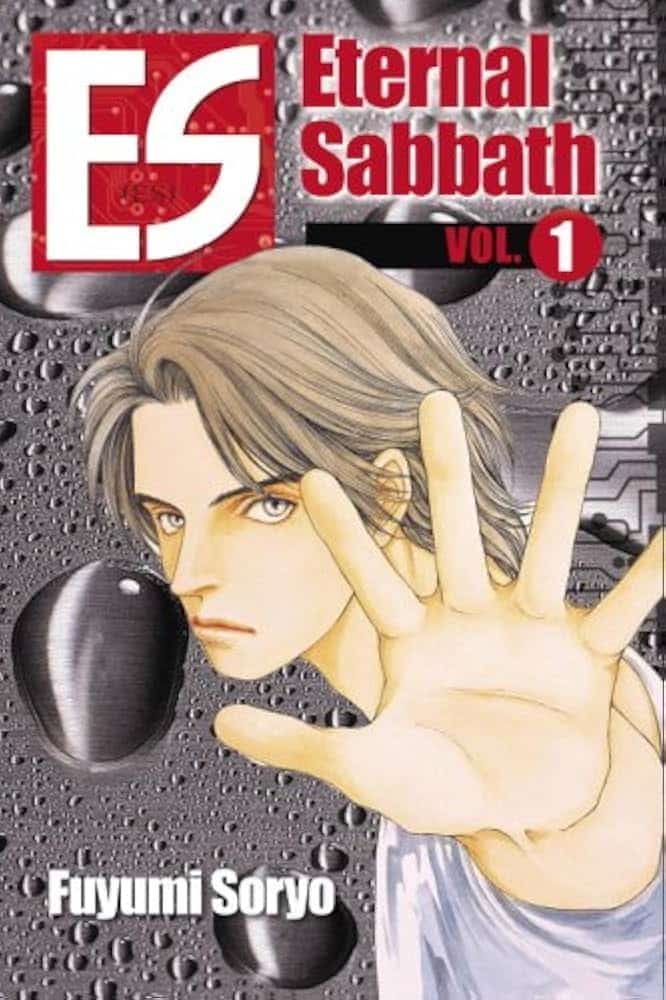
ES: Eternal Sabbath
Writer/Artist: Fuyumi Soryo
Translators: Akira Tsubasa, Ikoi Hiroe (vol 2-8)
Adaptation: Egan Loo
Lettering: H. Jones
Publisher: Del Rey
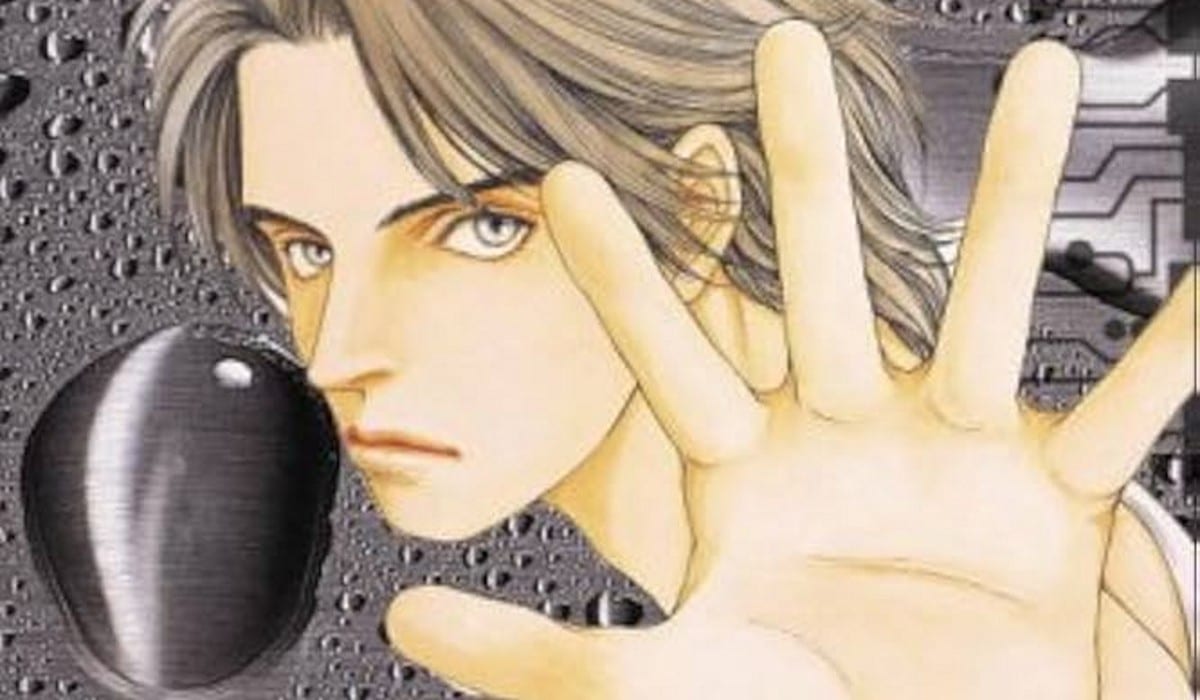
A collection of consciousness fragments: that’s how ES defines himself. He can enter the minds and hearts of others and feel their emotions, manipulate them at will. He might casually approach two strangers and convince them he was their friend in middle school.Yet the second he severs the connection, he returns to being a stranger. His access to the innermost worlds of others is both a blessing and a curse.
One day, Mine Kujo, a renowned researcher specializing in neurology, is tasked with an unusual patient. He’s a young man who, despite not physically burning, manifests typical burn symptoms including skin lesions. This strange case brings her and ES together–while also opening the door to one of the most mind-boggling cases Mine has ever encountered.
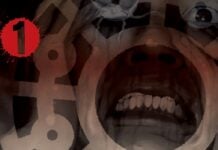
From the acclaimed creator of the shojo manga MARS, Fuyumi Soryo, comes ES: Eternal Sabbath, a compelling, gruesome, and evocative psychological science fiction/thriller series. It’s completed with eight volumes, although the availability of the series in the English language will depend on your local library or second-hand bookstore. The series has just been picked up by a publisher where I am, so this is my impression after reading the first volume.
What a strong start this is! ES, or Ryosuke Akiba, has the power to alter the fabric of reality: not in the sense of bending objects or moving mountains, but in changing people’s perceptions . This is quite the terrifying and intrusive “skill”, if we can even call it that. He delves deep into your psyche and can make you see hallucinations with real-life manifestations or repercussions. It’s enough to make the reader second-guess every piece of information they are presented with.
Mine Kujo is a compelling character as well. It’s equally relatable and aggravating to see her experience casual, everyday discrimination as a female specialist at every step she takes. Whether it’s her coworkers or the people who greet her at the Tokyo Police Hospital, they’re constantly explaining to her what an adult video is, assuming she can’t handle the sight of a criminal, or expecting her to be a man (since she’s a renowned researcher.) Fuyumi Soryo does not put these instances under a blaring spotlight, but their presence is felt all the same.
Judging from the first volume, ES: Eternal Sabbath will focus less on physical action and more on human cognition and how it shapes our understanding of the world. The pages where Akiba enters somebody’s psyche are so mesmerizing and imaginative that I couldn’t tear my eyes away. I’m looking forward to getting my hands on the rest of the series; it’s a feast for the eyes and mind! — Merve Giray
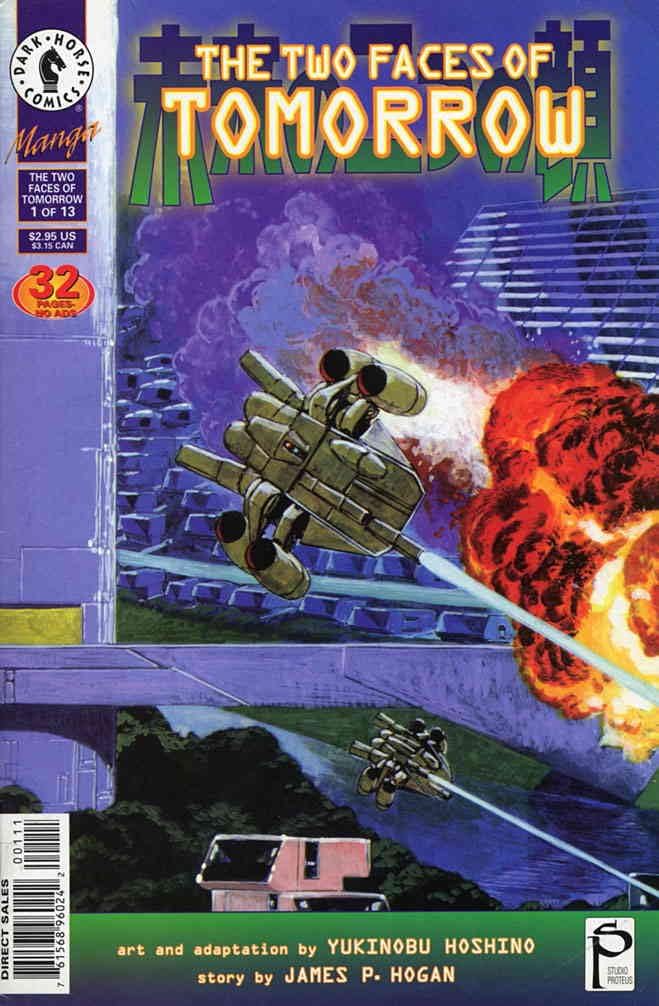
The Two Faces of Tomorrow
Writer/Artist: Yukinobu Hoshino
Original Author: James P. Hogan
Translator: Frederik L. Schodt
Lettering and Retouch: Tomoko Saito
Publisher: Dark Horse
The Two Faces of Tomorrow, a manga adaptation of the 1979 James P. Hogan novel by Yukinobu Hoshino, asks a question that remains relevant even today: how do we deal with artificial intelligence? In the near future, the supercomputer Titan misinterprets a building command and destroys a section of the Moon, endangering many lives in the process. Since Titan controls most of the Earth’s computer systems, governments become increasingly concerned about the next generation of thinking computers.
Titan’s creator, Dr. Raymond Dyer, proposes a test. The International Space Agency will conduct a self-contained experiment on the space station Janus. They will test Spartacus, a next-generation supercomputer, on its will to survive. What starts as a test of resiliency turns into a battle for survival between Spartacus and the humans trying to control it.
Yukinobu Hoshino translates Hogan’s hard science fiction novel with deliberate pacing and close attention paid to the science. Spartacus’s self-actualization happens gradually as the scientific team meticulously analyzes how it reacts to obstacles. Even as Spartacus kills hundreds of people in its drive to survive, Dr. Dyer continues to speculate whether the machine is learning.
Hoshino’s visuals have more in common with 2001: A Space Odyssey than Star Wars. His character illustrations adhere to a realism well-suited for this material. That’s not to say that the book looks static after everything goes to hell. Hoshino knows how to compose action as well as brutal horror. His mechanical designs are also exceptional, contrasting realistic human technology with inhuman drones.
The Two Faces of Tomorrow is an altogether different flavor of science fiction manga. It’s more interested in exploring ideas than creating escapist worlds. Hoshino grounds his imagined technology in actual hardware, and asks questions about AI that we’re still asking today. Like scientific progress itself, we should yearn for more of this. — D. Morris
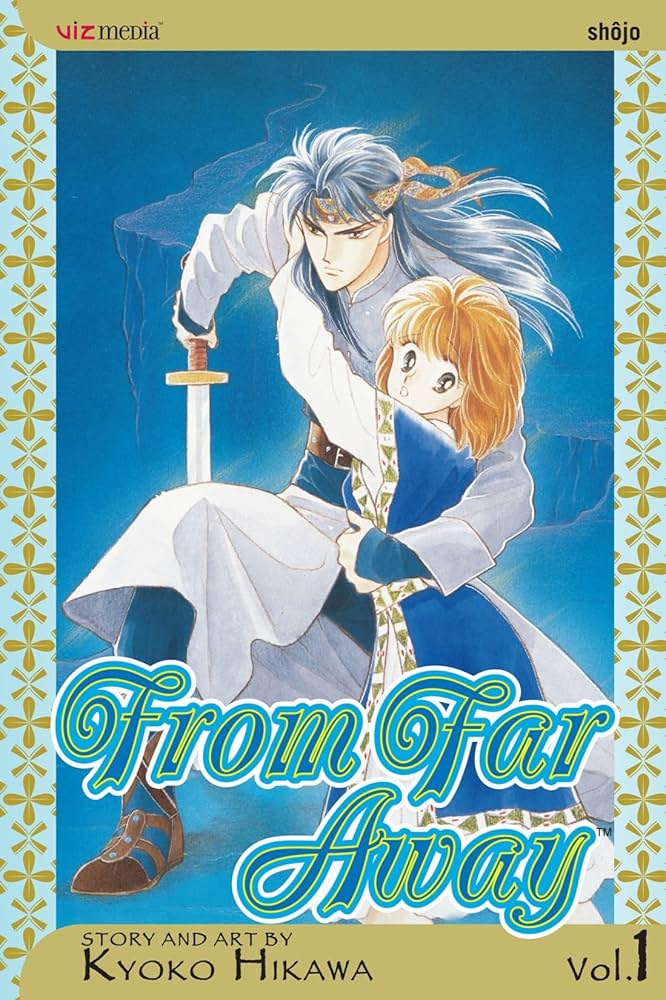
From Far Away
Writer/Artist: Kyoko Hikawa
Translation: Yuko Sawada
Touch-Up Art and Lettering: Walden Wong
Cover and Graphic Design: Andrea Rice
Editor: Eric Searleman
Publisher: VIZ
For as much as folks groan about the prevalence of romantasy today, authors have been blending the romance and fantasy genres for decades. Case in point: From Far Away, a classic 1991 shojo manga series from Kyoko Hikawa that hits all the beats you’d expect. She’s a girl transported from Earth to another world! He’s a boy with long black hair, regenerative powers and a cursed destiny! Can these lovers overcome fate to be with each other at last?
The devil’s in the details, though, and From Far Away has its share of details that set it aside from its peers. I like that the heroine Noriko is (at least at the start) thoroughly ordinary–not only does she lack magical powers or special skills, but she can’t even speak the language of the world she’s fallen into. Hikawa indicates language via speech bubble borders, but otherwise makes everything understandable to the reader, so that we know what both Noriko and the hero Izark are saying even though they can’t say the same for each other.
Izark is a more conventional romantic lead, who becomes increasingly frightening the more that we learn about him. He lets slip to the reader in the first volume that Noriko is “The Awakening,” a being chosen by fate that he must kill. But he doesn’t, and that act of kindness informs everything that comes later. If Izark’s first instinct when faced with a defenseless teenager was to keep her out of harm’s way, he can’t be that bad, right?
Just because Izark is nice to Noriko doesn’t mean he’s nice to everybody. That’s when Hikawa has the chance to flex her action chops, pitting her hero against increasingly dangerous foes. (As she writes in one of her chapter notes, “I love Jackie Chan movies.”) From Far Away mixes choreographed hand-to-hand fights with more outrageous flourishes such as chi blasts. I also appreciate the simple but effective way Hikawa depicts magic: a hand in the sky clenches its fist, and a rock wall crumbles.
From Far Away is currently set to be adapted into an anime in 2026. I’m happy to see shojo manga (particularly my 90s faves) making the jump from page to screen. At the same time, these anime rarely have the best production values compared to their shonen peers. If you’re curious about From Far Away and want to see it in its best possible state, I think the manga is likely the best way to go. The two volumes I’ve read integrate 70s shojo visual tricks with sweeping fantasy adventure in just the right quantities. — Adam Wescott
Follow Beat’s Bizarre Adventure to get weekly manga and webtoon recommendations!