
This week’s Wednesday Comics Reviews column is brimming, chockful of great releases ahead of the upcoming SDCC madness, including pieces about a pair of new Ignition Press titles, a Sonic X Godzilla crossover, a new comics universe from Jonathan Hickman, and much more! Plus, FOC Watch and the Prog Report!
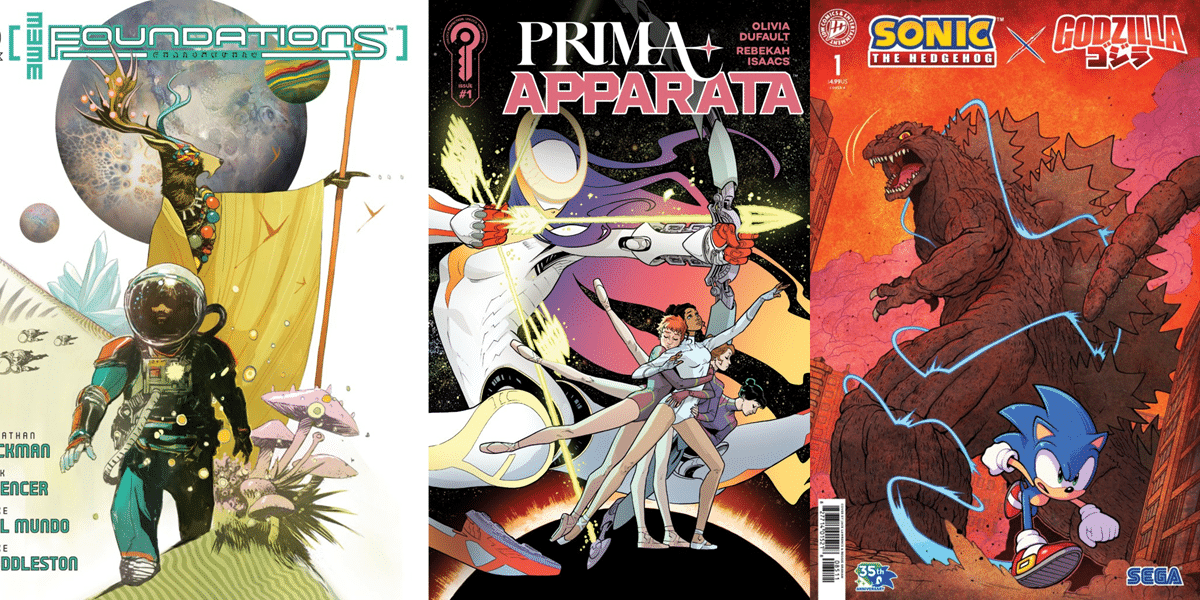
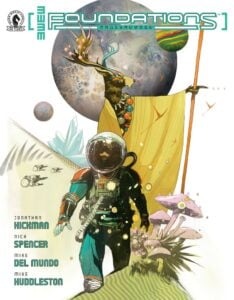 3 Worlds / 3 Moons: Foundations #1
Writers: Jonathan Hickman and Nick Spencer
Artists: Mike Huddelstone, Mike del Mundo, and Jerome Opeňa
Colorist: Matt Hollingsworth
Letterer: Rus Wooten
Designer: Sasha E Head
Publisher: Dark Horse Comics
Review by Jordan Jennings
In 2021, it was announced that Jonathan Hickman was signing a massive deal with Substack to produce comics. It was a part of a larger wave of Substack deals as the platform sought to draw attention to it beyond being a newsletter platform (often for groups with less than wholesome intent).
Nick Spencer, Mike Huddlestone, and Mike del Mundo would join Hickman to produce 3 Worlds/3 Moons, an ambitious sci-if fantasy universe. They would begin releasing adventures, digitally, later providing print copies to subscribers at different tier levels with promise to eventually release the comics to the direct market. Well, after years of waiting we finally have the first mass market printing of 3 Worlds/3 Moons: Foundations.
Was it worth the wait? As someone who personally refuses to subscribe to Substack due to the company’s willingness to not only platform hate speech but pay the hateful creators, I am glad to finally see this book in print. It’s exactly what I expected and wanted from this stacked creative team. Foundations collects the first adventures in this new universe along with the usual Hickman data pages that help construct a world. Hickman and Spencer have a knack for not just long form plot and world-building but capturing the surreal and making it feel real.
The three stories in this 50-plus page comic all provide something different for the book: Fable is a great bit of world building and provides the necessary exposition to outline the worlds in a natural way. It’s a touching father and son moment before the hero embarks on a doomed mission. The way Huddlestone is able to evoke the sense of wonder and foreboding doom into the story is phenomenal.
Ruins is a haunting space body horror story with shades of Jeff Vandermeyer’s Annihilation. The way del Mundo and Huddlestone illustrate the haunting and surreal nature of this cursed world. I love the whole space horror aspect on display, just phenomenal.
Finally, Breathe gives the hero his quest and gives us a peek into the complex cosmology the 3W3M crew have laid out. Opeña’s guest art for this story is perfection. It allows for the quiet and supernatural moments to flourish.
Overall, Foundations serves its name well. The mythology and construction of the world laid out here has me interested in picking up the rest of the issues that is set to publish in the coming months.
 Minotaur #1
Writers: Si Spurrier
Artist: Mike Dowling
Colorist: Sofie Dodgson
Letterer: Hassan Otsmane-Elhaou
Publisher: Ignition Press
Review by Jared Bird
Magic meets technology in a world on the brink of annihilation in this brand new series from brilliant writer Si Spurrier and acclaimed artist Mike Dowling. Five years ago, a government-created supercomputer set off The Singularity, a moment of technological advancement and superintelligence that could change the world; however, after mere moments, the project was aborted and that future abandoned. However, something leaked into the ether in the meantime, in the brief moments before the failsafe, something Gloria Monday is on the verge of uncovering…
Set in a scientifically advanced world not too dissimilar to our own, photojournalist Gloria Monday, creator of Gin and Eschatonic, documents the lives of others impacted by the resulting outbreaks from the abandoned Singularity, attempting to chronicle it and tell the stories of people directly in response the mad happenings of her world. It’s equal parts Hellblazer, with a supernatural and esoteric mystery to unweave, and Arthur C Clarke, with haunting moments of advanced technology that borders on the unimaginable. There’s definitely a lot going on in this first issue, and you will absolutely have to take your time to unpack all of its dense plotting, but the reward is a brilliant and exciting start to a bold new series that has social commentary on the mind and conveys its important messages efficiently and compellingly. If you give yourself the time to truly reside in this world, absorb all of the details thrown your way and make the most of it, you’ll bring out the best the series has to offer.
Si Spurrier brings his A-game to this first issue, utilising every trick he’s learnt over his long and varied career to bring this story to life in as compelling a way as possible. It’s taut and economical, with a sense of urgency and importance to every plot development and moment. It’s also full of character, with a lot of humour and engaging character work that lays the foundation for great arcs to come whilst still making sure the characters feel human and believable in a way that’s unique. Whilst some of the exposition is overwhelming, it’s all in favour of getting any and all set-up out of the way so the story can truly flourish, and by the time it kicks into gear it’s firing on all cylinders.
Mike Dowling’s artwork, colored by Sofie Dodgson, takes the complex and vivid story and compliments it perfectly with a widescreen, epic approach that really brings out the scale and scope of the narrative, whilst not sacrificing the character work that makes the story shine. There are some genuinely brilliant page layouts here, which break down huge chunks of information into easy-to-digest sections that also tell us about Gloria, her perspective and worldview, and how the world she inhabits enforces that. There are some pretty bombastic moments of fantastical and futuristic action here, and they’re all done with such a great sense of scale and weight that it makes each one stand out no matter the brevity. It’s a great combination, as it feels like the art and writing go perfectly hand in hand with one another.
Minotaur #1 kicks off a bold new story brilliantly, with a great sense of style, anger, passion and urgency that truly make it stand-out. This is a narrative explicitly tackling “educated people talking like cultists” and the current crazy state of affairs we live in, whilst using magic and technology (and magical technology) to really unpack what all of this means and how it impacts us in a way that’s easy to digest as a reader whilst still enjoying yourself and having a fun experience reading. Spurrier and Dowling work in perfect sync, complimenting each other at every turn, to make one of the strongest first issues of the year, full of potential for the series to only get better and better from here.
 Sonic the Hedgehog X Godzilla #1
Writer: Nick Marino
Illustrator: Jack Lawrance
Colors: Reggie Graham
Letterer: Ed Dukeshire
Publisher: IDW Publishing
Review by Ricardo Serrano Denis
Speed and fun, the two main ingredients in every successful Sonic The Hedgehog game, movie, cartoon, and comic. The point is to always have those two elements be the guiding force behind everything, down to the plot and the character interactions. Writer Jack Marino and artist Jack Lawrance know this well, which is why IDW’s Sonic The Hedgehog X Godzilla #1 is off to a great start with the promise of great time to follow.
The first issue of the new crossover event sees Sonic going at it with Doctor Robotnik in Station Square. Amy and Tails are there and things are unfolding much like we’ve seen them unfold before. Suddenly, two giant monsters stumble out of a rift: Mechagodzilla and Mothra. They’re already engaged in battle. Sonic rushes to safe other animals from the destruction while Robotnik stops to admire the giant lizard mech.
That’s all you really need to know about the plot, and it’s more than enough. The real fun lies in Marino and Lawrance’s masterful orchestration of action sequences and giant monster brawls.
Marino keeps the script tight, with quick and fun banter that always works to move the story forward without putting a stop to the action. Word balloons fly by, giving the read an amazing sense of speed, wholly appropriate for Sonic.
Lawrance does the same, capitalizing on the things that make both licenses shine. Sonic is the embodiment of speed and velocity, and he gets to show us why on every page. Godzilla’s monsters are iconic and colossal, and they transition over to Sonic’s world seamlessly.
Panels go by quickly, as if trying to catch up with the blue hedgehog. Stop long enough on one of them, though, and you’ll be able to appreciate just how much love and detail the creative team affords to these characters. Mothra in particular gets special treatment with a look that accounts for all the textures and patterns he’s known for. Same goes for Mechagodzilla. It works to establish the idea that two distinct worlds are colliding.
The scripting honors these monsters by also making them behave like they do in their own movies. Special attacks and shows of strength carry over and they work to present Sonic with a unique challenge. Mechagodzilla and Mothra aren’t made to look like just another Tuesday for the heroes. They will require different strategies to take down.
Reggie Graham’s colors also do an amazing job of capturing both the physicality of the monsters and the video game energy of Sonic and friends. They establish an even stronger connection to the source material in both cases. Care was taken to make sure everyone here looks like they belong in the same world, but that they’re also emblematic of their own. It’s like holding a blockbuster movie in your hands.
Sonic The Hedgehog X Godzilla is everything you’d want from a summer event. Big, colorful, action-packed, and fast enough to get swept in by the excitement. Issue #1 lays the foundation for a lot of surprises, one of which will very likely be Robotnik creating his own kaiju. It’s the type of book that’ll make you want to read more Sonic comics and more Godzilla comics. Marino and Lawrance are just that good at making this story feel special.
 Mister Nemo #1
Writer: Mark London
Artist: Alden Kaye
Colors: Alex Sinclair
Letters: Pat Brosseau
Publisher: Mad Cave Studios
Review by Clyde Hall
Having read ‘The Fall of the House of Usher’ in grade school, watching the excellent TV miniseries of the same name gave me new appreciation for projects retooling and retelling classic literature. It seems that’s a similar mark Mad Cave’s aiming for with its Mister Nemo ongoing series premier this week. There’s still the framework of an anti-imperialist, ocean travelling adventurer. But other foundational aspects are apparently altered, themes of technology working in concert with nature rather than destructively against it being one.
Ecological blocks in a modernized Nemo foundation were what I expected. They may still come into play. Yet in the opener, writer Mark London chooses a different opposing force for the protagonists, one skewed toward the original Captain Nemo’s disregard for national boundaries and desire for individual freedom. Unity Ultima is a covert organization at work for the last 200 years to establish a small global oligarchy that will run the world like plant supervisors and CEOS. All workers outside their tiny circle will merely be inconsequential, interchangeable, and expendable parts.
We’re treated to nefarious applications of their philosophy this issue with the treatment of a young boy. Unity Ultima murders his parents, leaves other members of his family alive, and sticks the boy child in a prison known as a Forever Site. The boy’s cellmate, an elderly man called Moro, explains that their captors sometimes prefer handling troublesome individuals by disappearing them rather than assassination with risks of martyrdom. In the case of the boy, his captors claim they wouldn’t kill a child and so he’ll be imprisoned for life. They also order him never to speak his own name. or else his remaining family will be murdered. Moro takes the boy under his guidance and dubs him ‘Nemo’, an old word translating to ‘no one’.
Years later, Dr. Petra Arronax working for the Office of Naval Intelligence shares information she’s uncovered regarding a terrorist group called Workgate 88 and their communications with select government officials. Despite her convincing track on the clumsy electronic trail-covering of the terrorists, her boss ignores the evidence and accuses her of creating patterns that aren’t real. He adds his belief that her goals are also suspect, making her agency peers look incompetent while serving her own ambitions.
Petra soon finds herself the target of a Unity strike team and being measured for either Forever Site prison garb or casket accommodations. She’s saved by Nemo, now an adult, and together they escape the operatives. Petra’s taken aboard a high-tech submarine, The Nautilus, and introduced to its A.I. operating system, Ishmael. Seems Petra is only the first of several targets Nemo has in mind for organizing an elite crew which he’ll then lead in battling, and defeating, Unity Ultima’s evil schemes.
London keeps the introductions tight and flowing, treading between readers familiar with the Jules Verne original 20,000 Leagues Under the Sea source material and those experiencing elements of it for the first time. The dialogue is sharp as well as efficient, an example being how Moro explains to Nemo as a child why Unity would want enemies neutralized as stories fading from collective memory and not as firebrands immortalized for a cause.
Adult Nemo is portrayed as a lone sea wolf with sufficient tech edge and combat skill to prevent being easy prey, even for a worldwide web of intrigue. Petra also has clever quips, especially rankling at the exposition node she occupies having to ask all manner of who’s, what’s, and why’s rather than receive an upfront explanation from Nemo.
Those bits of the narrative sparkle. But the gleams are bright because other portions have a much duller finish. Mostly, that’s due to the handling of practical and relational matters.
Unity imprisoning a child for life rather than killing him isn’t logical, and his murder surely isn’t a recourse such a group would avoid on principle. Housing that child with an elder they are afraid could become a martyr were they to kill him is another foolish tact on their part. Because “You’re dangerous to our cause. So, here. We’re giving you a student ready made for hating us after we killed his parents.”? Usually that’s not part of a global domination strategy. Or maybe it’s why Unity’s been at it for a couple centuries and has yet to achieve success.
Dr. Petra Arronax is smart and outspoken. Nobody’s fool, as portrayed here. Yet, after finding evidence of terrorist complicity among government officials, evidence they left negligently exposed, Petra never considers it might be a way of detecting exactly who in the intelligence game’s paying attention? Nor does she suspect for a second that her superior, the one dismissing every shred of her findings as well as Petra herself, might be one of those government contacts the terrorists are trading emails with.
It’s early in the series, and maybe there are underlying reasons for each of these things as our backstories unfold. But it certainly made my disbelief suspension system drag along these first issue furrows.
Clearly, we’ll eventually learn how Nemo’s confinement with Moro shaped him into the man claiming the sea as his domain and oligarchs his targets. And how Nemo escaped imprisonment. I am curious how the series will handle or bypass the paradoxes of classical Nemo.
Verne’s Nemo was opposed to Imperial social order yet very much operating within its class system when dealing with other characters in the novel. He was an outlier promoting freedom from national ties, while insisting that anyone boarding the Nautilus remain there permanently to safeguard his secret operations.
Such fleshing out done well might take an Andor approach to the ongoing conflict, exploring how ruthless freedom fighters must be in effectively opposing authoritarian rule. While this first issue’s handles on aspects of the world building seem shaky, such possibilities spark my curiosity for where and how London proceeds.
Alden Kaye’s art was just as it needed to be for this kind of story. People, even those in body armor and masks, were organic, in motion, natural. The contrast when placed at interestingly framed angles on stairs, as in a page 15 panel, draws the viewer’s attention. Meantime, machines from firearms to Nautilus herself are expertly rendered. It’s one thing getting the everyday weapons, buildings, cars, and equipment right. It’s next level granting the less commonplace and more inspired devices such soul.
The delineation between human and engineered elements in this tale get a major assist from the art of colorist Alex Sinclair as well. There’s a warmth of hues in his people, cooler gleams reflected from manufactured surfaces, and his balance between shades of both is aesthetically satisfying.
Mister Nemo tries applying modernized tailoring to a classic literary work. In this case, by aiming the outsider Nemo analog at tech conglomerates and corporate giants whose overriding greed leaves no future for the 99% of humanity beneath them except as servile cogs in a worldwide lucrum ex machina. Doing so, it’s reminiscent of The Fall of the House of Usher taking on big pharma, and that’s ambitious storytelling. In this first installment, the attempt fell short for me. But this title is only the latest chapter of Mad Cave’s Underground Universe, and chances are good that subsequent chapters and installments will elevate the whole.
 Kingdom of Earth #1
Writers: David Dastmalchian and Leah Kilpatrick
Artist: Soo Lee
Letterer: Frank Cvetkovic
Publisher: Dark Horse Comics
Review by Khalid Johnson
Kingdom of Earth #1 starts with really compelling setup (and a map!): monsters (the fictional kind) have taken over America and through the art of Soo Lee, we explore the unfortunate circumstances that have befallen humanity.
Hunted, enslaved and packed into shipments while monsters politic around leadership, this first issue lettered by Frank Cvetkovic lets the monsters do the talking and then we meet a human survivor who doesn’t speak at all this issue. Through them, atmosphere leads the way where exposition provided the world building earlier.
The scope is grandiose and then really personal which kept me engaged, drawing me further in and really creating a sense of horror, illustrating David Dastmalchian and Leah Kilpatrick’s handle on the stakes of the world. Draping our human in an American flag, the symbolism is hard to miss in what becomes a tale of survival.
The art of Lee sells what is going on with an excellent use of shadows and rich textures which kept my eye on the monsters, their designs, and an imposing sense of scale. While not horrific they are captivating (especially the administrator) and even better, the end provides a codex which I think is just an excellent detail as this team throws us deeper into the world they crafted.
 Arcadia #6
Writers: Inaki Miranda and Roy Miranda
Artist: Inaki Miranda
Colorist: Eva De La Cruz
Letterer: Dave Sharpe
Publisher: Ignition Press
Review by Tim Rooney
FOC Watch
This title is currently eligible for pre-order.
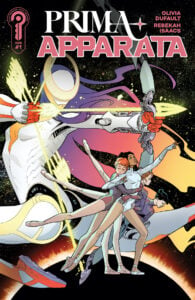
Prima Apparata #1
Writer: Olivia Dufault
Artist: Rebekah Isaacs
Colorist: Marissa Louise
Letterer: Becca Carey
Publisher: Ignition Press
Due Out: September 2, 2026
Review by Samantha Puc
“We all know the story of Appolyta the Huntress,” but if the augmented, cloned students at the Conservatory cannot perform the story to the satisfaction of its alien Patrons, they’ll be killed on the spot—accolades be damned.
Prima Apparata #1 introduces a future-flung world in which humanity’s most talented young women train at a celestial boarding school to be the next generation of mech pilots, driving their suits through fine-tuned ballet. The goal isn’t war, it’s performance: Each girl hopes to become Prima Apparata, the top of her class, to perform for the Patrons at the annual recital.
This year’s top students, Mar and Rhea, couldn’t be more different—but their bond is instant and deep, and as they compete for the top spot, the lines begin to blur.
The premier issue of this Ignition Press series kicks off with a bang, immediately establishing the stakes through an audition in which girls who don’t perform well enough are jettisoned into space and left to float dead in the surrounding atmosphere. Their instructor, Madame V, reiterates these stakes to one of the two protagonists, Mar, before she is sent off to be “amended” through a series of augmentation surgeries.
In her recovery room, Mar is visited by Rhea, who’s figured out how to unplug herself from the various machines keeping her pain at bay. Rhea wants to escape the Conservatory. Mar wants to stay: “They’re making us better, right? I’d like to be better.”
Writer Olivia Dufault narrates the story of Appolyta the Huntress through Mar’s POV, interjecting dialogue to establish the characters’ personalities and goals. This creates the structure for the world of Prima Apparata, which artist Rebekah Isaacs and colorist Marissa Louise then populate with extravagantly detailed character designs, architectural wonders, and dreamy mech suits. Becca Carey’s lettering is the secret ingredient bringing it all together, revealing a creative team at the top of its game.
The story is brilliant from the jump, the hook too good to ignore. The PR material for Prima Apparata describes it as a combination of Never Let Me Go, Pacific Rim, and Black Swan, and there are hints of all three here, but also elements of Bitch Planet that feel particularly exciting. Most intriguing is the relationship between Mar and Rhea, which is already marked for doom not just because they have to compete to perform, but because Mar has accepted—nay, embraced—her augmentations and purpose at the Conservatory, whereas Rhea has not. This likely spells danger for the latter, whose enrollment at the school and desperation to escape it raises questions. Was she forcibly enrolled? Is she at the Conservatory to tear it down?
Whatever is to come, this reviewer is completely onboard. Prima Apparata #1 is propulsive, elegant, and uniquely horrifying, deserving of a spot on everyone’s pull list.
The Prog Report
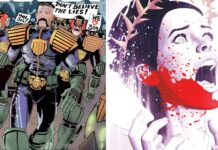
 2000AD #2489: Boy, this Oubliette sure is causing some troubles. We’ve got Dredd stuck in it, as portrayed in the ongoing story, Judge Dredd: The Oubliette by writer Ken Niemand, artist Dan Cornwell, colorist Chris Blythe, and letterer Annie Parkhouse. And if that weren’t enough, now we’ve got Anderson headed that way too in Anderson Psi Division: The Void by writer Liam Johnson, artist Rob Richardson, and letterer Rob Steen. I’m a big fan of this interconnectivity, which is one of the things that has always made periodicial comics pop for me. So, I’m excited to see where this is all going, how the stories will play with each other, and which (if any) other strips will be drawn in. Kudos to editorial for taking this swing. This week’s cover (above) is by Steven Austin. As always, you can pick up a digital copy of The Prog here. And it is also now available weekly in US comic shops! —Zack Quaintance
Column edited by Zack Quaintance
Read past entries in the weekly Wednesday Comics reviews series or check-out our other reviews here!