
This week’s Wednesday Comics Reviews looks at Filthy Lambs #1! Plus, The Prog Report!
 Filthy Lambs #1
Writer: Pallie Paul Allor
Art: Chris Evenhuis
Colors: Sjan Weijers
Letters: Pallie Paul Allor
Publisher: Mad Cave Studios
Review by Clyde Hall
On the surface, the concept may at first register as passé. A dynastic family of elites with old and new money, business acumen, and political clout having cut a deal with infernal forces to reach the pinnacle of human success. Then liberally greasing the wheels of progress and relevance with blood as a way of keeping their brood on top across generations. It’s been done before, and many would opine it remains relevant because it’s fiction with one demonic claw-hold in the real world of elites.
Which is exactly why the first issue of Filthy Lambs scores high marks. Members of the Grimaldi family so casually acknowledge their Dark Lord benefactor among themselves that it’s transfixing. At least it is in the manner which writer and letterer (there’s a combo you don’t always encounter) Pallie Paul Allor presents it.
And how they do it is by peeling back layers of the contract terms among those benefitting slowly, unblinkingly, and with certain specifics redacted until necessary within the coming issues. It’s presented as the Grimaldis prepare for their decennial sacrifice event, a blood-letting affair familiar to the elders but new to younger offsprings and spouses who’ve married into their flock. They have questions, and the answers or avoidances of answers informs the reader as well.
The offering of a ‘lamb’ as both contract renewal and obedience to the powers of darkness, perhaps even as contrition for not proving themselves evil enough in their master’s monstrous sight, is outlined. There’s a question, however, to the sort of lamb being offered. What soul sustenance do you bring forth for the Dark Lord who has every worldly power? An innocent one, or as one of the family members describes, a spiritually filthy one? Perhaps one somehow fallen from grace or compromised. Whichever their sacrifice is, for some Grimaldis this will be their first such ritual. For others, their last.
Or even a bit of both. As human nature tends to insist, certain of the privileged take issue with the process. Not with the success and the perks, but rather with what’s expected of them to keep the status and influence flowing. Their stubborn resistance may be cause for underlying concerns, the sort that could lead to their contract expiring. Or more accurately, terminating. The final act adds more infernal heat to the Grimaldi situation from a source less expected.
Allor revels in the relatable awfulness of the family members. Their dynamic parses the patriarch and matriarch roles, the newcomers, the fosters, the couples, the offspring and sprinkles them throughout the issue. And there’s a short family tree offered at the start of the story which felt at first gimmicky but turned out to be an extremely effective way of keeping the character cast concisely introduced and in focus. Having a snapping turtle hold his own place in the genealogy adds the right spice of humor to the horrific.
Chris Evenhuis gives an exacting, flat edge to the Grimaldis and their ancestral abode. Short on moodiness or murk for this sort of tale, his art style registers perfectly right for the kinds of characters and the matter-of-fact immoral malfeasance they are awash in.
To that end, the color artistry of Sjan Weijers pins the panels firmly in place with plain color varieties. Her touch brings a perceived absoluteness that is as visually inflexible as the Grimaldi elders’ drive to maintain their grip on power. The combined effect of Evenhuis and Weijers makes the family an anti-Addams clan, members variously twisted or bent, yet not embracing the shadows. Rather, they boldly stand in full candlepower of the hellish light enabling their reign.
The first issue of Filthy Lambs shares spirit underpinning with The Fall of the House of Usher miniseries, and fans of the show will likely be on board for the story arc here. That said, the creative team has forged a similar storyline trail in a uniquely different way based on the first installment. And readers familiar or unfamiliar with Usher are going to find plenty of reasons to return for the coming four issues of this series. It’s a worthy addition to your creepy comics pull list for the Halloween season, but equally worthy of remaining on that list throughout the holidays beyond.
The Prog Report
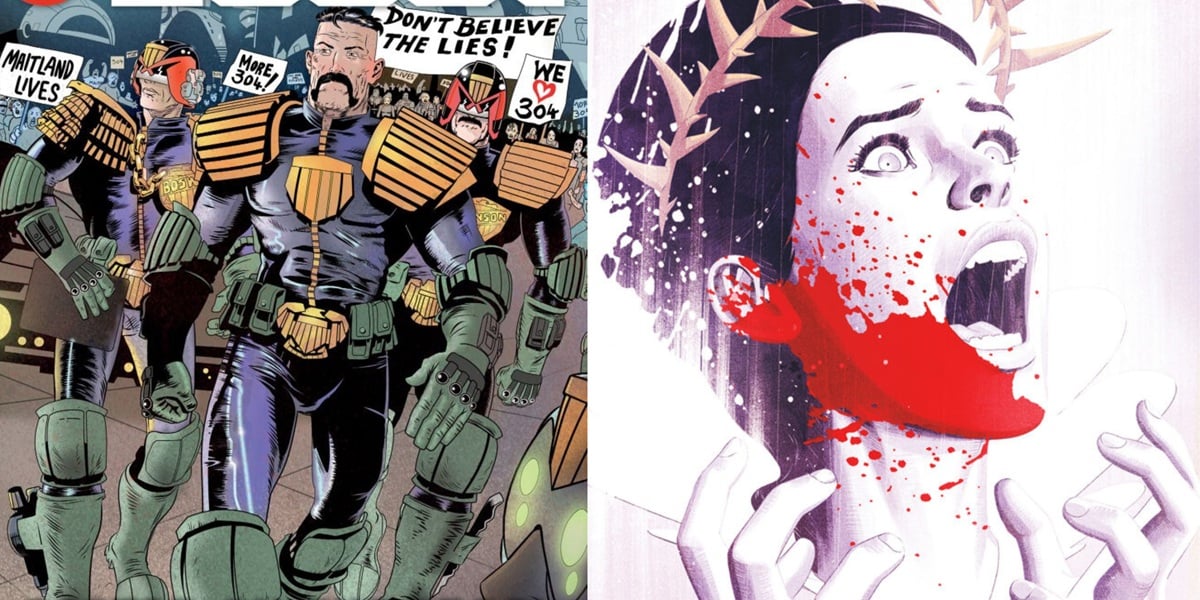
 2000AD #2503 (Rebellion): Judge Dredd: The New Future Part Three by writers Rob Williams and Arthur Wyatt, artist Henry Flint, and letterer Annie Parkhouse, continues to bring this story’s main focus into sharper view — and it’s the media. This strikes me as a pretty ingenius way to follow-up Judge Dredd: A Better World. A more direct sequel would have almost certainly disappointed by comparison to its predecessor. It just feels smart and more than a little exciting for the follow-up to shift more toward media consolidation and the manipulative opportunism that the intersection of failed police reform/mob violence has provided. “Just keep reminding them that there was so much for them to be afraid of.” This is well-done stuff. And if this chapter is any indication, the scope of the story is likely to expand in the chapters to come, and I for one am rapt. This week’s cover (above) is by Stewart Kenneth Moore. As always, you can pick up a digital copy of The Prog here. And it is also now available weekly in US comic shops! —Zack Quaintance
Column edited by Zack Quaintance
Read past entries in the weekly Wednesday Comics reviews series or check-out our other reviews here!