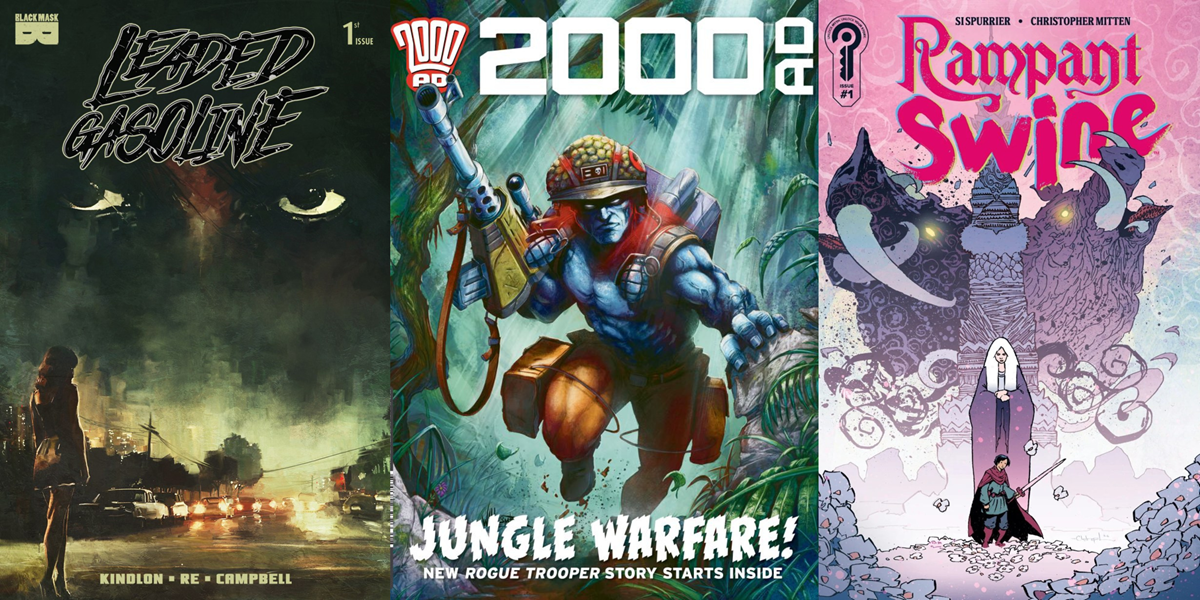

This holiday week’s Wednesday Comics Reviews looks at a pair of new number 1s with Leaded Gasoline and Rampant Swine! Plus, The Prog Report!
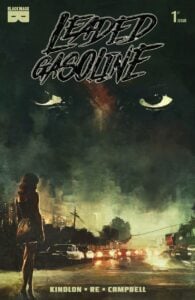 Leaded Gasoline #1
Writer: Patrick Kindlon
Illustration: Lorenzo Re
Letters: Jim Campbell
Publisher: Black Mask Entertainment
Review by Clyde Hall
My first experience with the work of writer Patrick Kindlon was on Frontiersman at Image, a series of superhero tales enjoyable for their sense of humor and action blend regarding an aging, human-powered operative not a million multiverses different from Oliver Queen in weaponry nor attitude. Kindlon delivered the graphic novel goods then, and he did the same this week in an entirely different way when the starter for his new title, Leaded Gasoline, crossed my desk.
It’s March of 1987, and two L.A. homicide detectives, Tulloch and Szenet, have a caseload problem. They have limited manpower and budgetary restraints, and yet a steady parade of murder victims that spring keeps increasing. Springtime can be like that with police work, but many of their cases involve specific targets. They’re called the Strawberry Murders, and the victims warrant, unofficially, minimal investigation due to a crappy roulette wheel of ‘extenuating circumstances’.
These victims are sex workers. And crack addicts. They are young girls who often have violent johns and even more violent pimps, relying on the predatory pushers who keep them supplied. Compound these factors with their involvement in what many term a ‘victimless crime’, a tolerated profession dating back as an organized industry to the Roman Empire and to Mesopotamia long before that.
One of the assets our overworked detectives turn to in the quest for outside-the-box ideas without a huge price tag is Nathan, a Community College professor of zoology and ethology, the study of animal behavior. They’re looking for any source of info or insight which might help them discover how, even if, the cases ramping up in their jurisdiction are related. If they’re the work of a serial killer, or simply random acts of violence against women already being used and abused. Their hope is finding a key factor, something they might have missed, which could link at least some of the cases, bring killers to justice, and even give some peace and closure to the grieving families left behind.
Nathan is one of those economically viable sources they turn to, reluctantly, because his insights into animal behavior might shed light on possible motivations for human predators. Their professor has another theory he’s evaluating as well, one the cops are less interested in, and it also dates back to the Roman Empire.
American sociologist S. Colum Gilfillan published “Lead Poisoning and the Fall of Rome,” in 1965, arguing that chronic lead exposure in plumbing and utensils caused cognitive decline and lowered fertility among the Roman aristocracy. It’s also conjectured to have perhaps altered behavior, creating a more violent society. It’s a debated theory in scientific circles, but in the story, Nathan seems to be drawing similar conclusions about the increased lead-infused gasoline car exhaust Americans have been living in since the advent of the automobile.
Recent studies calculate that exposure to car exhaust from leaded gas during childhood altered the balance of mental health in the U.S. population, making generations of Americans more depressed, anxious and inattentive or hyperactive.
At the time of the story, lead is being reduced in gasoline due to EPA guidelines rooted in such health concerns, yet it would not disappear altogether until 1996. One postdoctoral scholar in neuropsychology at Duke University, Aaron Reuben, and colleagues at Florida State University, have proposed that Americans born before 1996 experienced significantly higher rates of mental health problems as a result of lead, and likely experienced “changes to their personalities that would have made them less successful and resilient in life”. 1983 places the rise in our story’s violent crimes and murders, based on actual events and trends of the era, in the crosshairs of cause-and-effect possibility.
Again, speculation. But it gives our 4-issue miniseries its title and elements of the theory may work into the story further as it continues. Along with the murder investigation, we get a glimpse into Nathan’s single parent home life which includes young son Jim and sometimes caregiver Gram, Nathan’s mother. We also get foundational law enforcement Los Angeles 1980s-style, as gritty and jaded as one would expect. It sets up Nathan as a professor included almost against better judgment so far as the police department regulars are concerned. And with investigator control over how much volume they want to hear out of him. His advisory capacity on the cases is a lot of watch, stay out of the way, and wait until we ask for your input while the grownups talk first. Nathan’s volunteer help isn’t exactly as appreciated as it is valued, at least by some members of the overworked homicide crew.
That, more than anything else this issue, grounds the story with a realistic basis, its narrative equivalent of fleshy tissue and blood stains and evidence swabs and body bags. What gives the opening narrative a second level of real life is one conversation. One in which Gram and Nathan discuss the L.A. neighborhood she still resides in as it was during hiss childhood, and how it’s changed by 1987. From those dual components, Kindlon grinds out a true-crime foundation I’m confident will bring aficionados of the genre back for every issue of Leaded Gasoline. Especially after Nathan so succinctly and eloquently drops his serial killer hypothesis into the laps of our homicide partners on the case.
I won’t lie. The black-and-white nature of Lorenzo Re’s illustration left me cold at first glance. Sure, it’s a grim and gritty tale based on the blurb alone. That didn’t automatically qualify it for a b&w treatment in my book. However, in all truthfulness, the story was so engaging that I never even noticed a lack of color once I began reading. Add in Re’s subtle shadow working along with the monochromatic nature of his street scenes and character profiles and the panel work on every page comes off as imperfection in the most tone congruent way possible.
His L.A. at night from the skyline POV is stark, messy, convoluted, and pitched in ways the characters trapped in this string of killings would recognize. And the depiction of a murder scene, narrated by one of the homicide detectives assigned, is chilling without being graphic. The straightforward, pragmatic style of lethal presentation is predator and prey choreography as horror comics seldom achieve. Most are too busy making sentimental pitches for the profound, but the creative team here knows where the real story, and its horrific elements, are found. They make the coroner’s report must-read fascinating.
And because they do it so masterfully, this is whodunnitism not meant for every crime comics connoisseur. Kindlon does a much better job unapologetically explaining his laudable storytelling goal in the issue’s afterword than I can here. Just know that if 1980s true crime storytelling is your interest, you should shower this miniseries with both the cover price and your attention. It’s an excellent opening chapter for a crime comic delve into an era when crack cocaine helped fuel a death spree. This promises a story that explores the resulting chemically induced death toll and perhaps how a serial killer used its resulting murder wave to cover his own. Leaded Gasoline is street poet tragedy, so searing in how it captures the loss and fear of the hopeless and the helpless relegated to society’s margins, you’ll feel like it’s in need of a good hosing the same way a hit-and-run pavement gets sprayed down before the morning commuters gather. Kindlon and Re do not flinch or look away, and you won’t be able to, either.
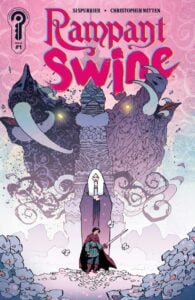 Rampant Swine #1
Writers Si Spurrier
Artist: Christopher Mitten
Colorist: Brennan Wagner
Letterer: Hassan Otsmane-Elhaou
Publisher: Ignition Press
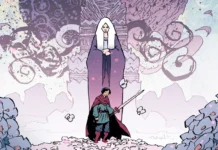
The year is 992, C.E. Britain has been formed through blood, magic, and mud, and the legendary King Arthur is a violent warlord, surrounded by knights every bit as brutal as he. Yet, when a young knight named Culhwch arrives, begging for aid in his quest to achieve 39 impossible tasks, Culhwch and Arthur’s knights must battle their way through an age in which myth is on the decline. A brand new fantasy epic from Si Spurrier (Minotaur) and Christopher Mitten (The Autumn Kingdom), Rampant Swine explores where myth and reality savagely collide.
All histories are fiction. That’s the central thesis statement to Rampant Swine, which both explores very real, beloved Arthurian legend and invents its own beautiful, brutal mythology set in a Medieval British setting. In exploring the area between real, lived history and invented mythology, the series manages to craft something that feels both unique and known. Culhwch, a young knight, has been assigned 39 impossible tasks by the giant Ysbaddaden, in order to win the hand of his beautiful daughter Olwen. By asking Arthur and his knights for help, Culhwch sets himself on a path through a world of magic, bloodshed and barbarism. Yet this comic isn’t just about its core premise. It takes time to situate the reader within the larger world, establishing character relations and crafting a greater sense of mythology, all under the guiding principle of exploring ‘the story underneath the story’, the reality informing the myth. In doing so, Spurrier and Mitten craft a world that feels lived in and vibrant, as wondrous as it is harrowing. It’s also a lot of fun to see the creative team play with Arthurian legends, particularly if you’re familiar with those stories or this time period at all, but that never feels like the only point to the book, which instead feels far bigger and more creative than that.
Si Spurrier continues to be one of the most eloquent writers in comics, seamlessly balancing dense, esoteric worldbuilding and philosophical concepts with fun, energetic comics scripts. Culhwch and his companions make for interesting, flawed protagonists, whose goals feel both sincere and selfish. There’s a lot of ground covered in this first issue, with wonderfully fleshed out mythology that acts as the central narrative thread to the story, but it never feels overwhelming or too difficult to comprehend. Instead it rewards rereads and introspection, inviting the reader to explore the world further in the way that naive Culhwch is going to as well. I particularly loved the way Spurrier reinvents heroic feats from British folklore and Arthurian legend into tales of barbarism and savage violence, adding a stark reminder of the real impact of these stories which are otherwise seen as fantastical.
Christopher Mitten is, to me, one of the most underrated artists in comics right now, with a great sense of pacing, dynamism and energy that allows the book to truly thrive. He works perfectly with the dense dialogue and scripting, breaking it up so that it flows intuitively. He’s utterly excellent at drawing moments of explosive fantasy action, and wondrous magical monsters, which makes the entire comic come alive. He’s also great at character expression work, using every moment he can to flesh out the characters, often showing the contrast between their outward appearance and their inward personality in a way that enriches the text and it’s themes. It’s a dense book, and Mitten rises to the challenge, making sure it’s enthralling and told through beautiful visuals with help from colorist Brennan Wagner.
Overall, Rampant Swine #1 is a wonderful and fascinating beginning to a brand-new fantasy epic, cleverly exploring the grey area between mythology and reality whilst also serving as an enthralling, bloody and wondrous comic book narrative. Spurrier delivers some of his most interesting writing yet, and when combined with the stunning artwork of Christopher Mitten, you get one of the strongest fantasy comics of the year yet. As the tale of Culhwch progresses, it will be utterly fascinating to see what surprises the book has to offer, and there’s no better time to get on board than now.
The Prog Report
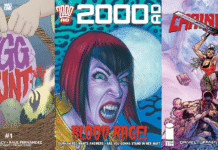
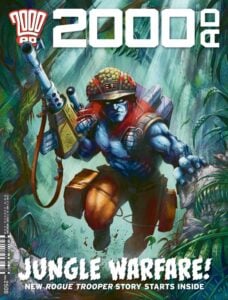 2000AD #2508 (Rebellion): This week’s Prog was a decent one, with great new chapters in the ongoing Judge Dredd main story as well as Durham Red, which as I wrote last week continues to be a fun comic that feels like a nice mix of ’90s comics elements repurposed in new ways. There’s a new Rogue Trooper story underway this week, and that’s maybe the most interesting individual chapter in this issue, hinting as it does at potentially revealing some hidden reality of Nu Earth (although it could be a feint … we’ll see!). That strip is by writer Geoffrey D. Wessel, artist Neil Edwards, colorist Matt Soffe, and letterer Rob Steen, and I’m looking forward to seeing where it’s going. This week’s cover (above) is by Toby Willsmer. As always, you can pick up a digital copy of The Prog here. And it is also now available weekly in US comic shops! —Zack Quaintance
Column edited by Zack Quaintance
Read past entries in the weekly Wednesday Comics reviews series or check-out our other reviews here!