
Face front, True Believers! This week Avengers: Armageddon #5 wraps up the series, and we explore the overall themes and wonder about the lasting impact of the series. Meanwhile in the Rapid Rundown we review Doomquest #5. Buckle up because the Marvel Rundown begins now!
Note: the reviews below may contain spoilers. If you want quick, spoiler-free buy/pass recommendations on the comics in question, check out the bottom of the article for our final verdict.
Avengers: Armageddon #5
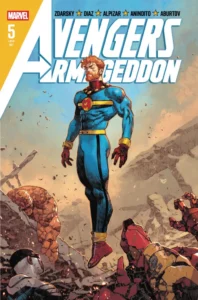
Writer: Chip Zdarsky
Artist: Delio Diaz & Frank Alpizar and Ario Anindito
Color Artist: Jesus Aburtov
Letterer: VC’s Cory Petit
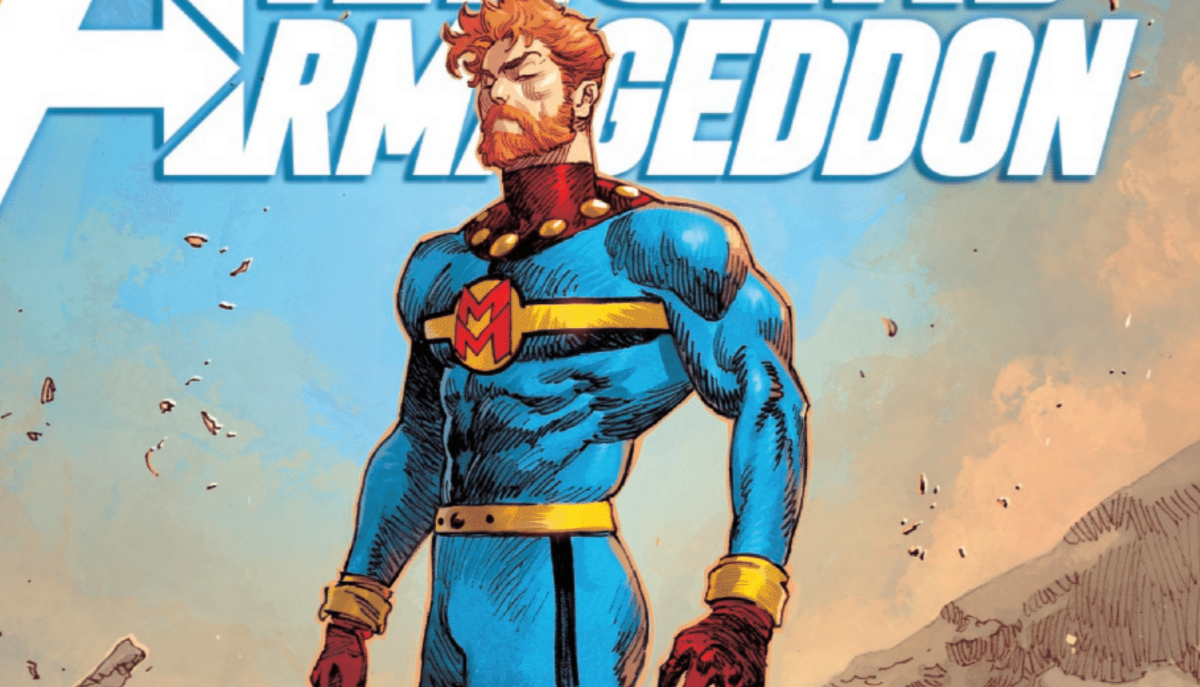
As the radioactive dust settles on the outskirts of St. Petersburg, Russia, the world comes to grips with the most recent series of events and decides to do something about it…by going to the United Nations and outlawing superpowers, sort of. It’s honestly not clear what truly was enacted but it leaves the world without an Avengers team, a depowered Captain Marvel, a resurgent (and even more fascist) SHIELD, and a lot of questions regarding who/what Miracleman is.
After reading Avengers: Armageddon #5 and marinating on the series, I am left approaching this comic from two angles.
Firstly, this issue in particular serves as a quiet issue following the rather frantic events of the previous four issues. Writer Chip Zdarsky uses this moment for the characters to reflect on recent events. Specifically, there is a focus on a few characters (Spider-Man, Wolverine, Miracleman, and Iron Man) that I found to offer not only differing viewpoints but address the larger theme of the series: The Nature of Power. In a lot of ways Armageddon harkens back to the superhero deconstruction trends of the late ’80s and early 2000s that were largely a response to the tumultuous state of the world in those eras. It should come as no surprise, though, given our current situation, to see these themes return to the forefront. Zdarsky himself has touched frequently on the corrupting nature of power in his recent works at both Marvel and DC.
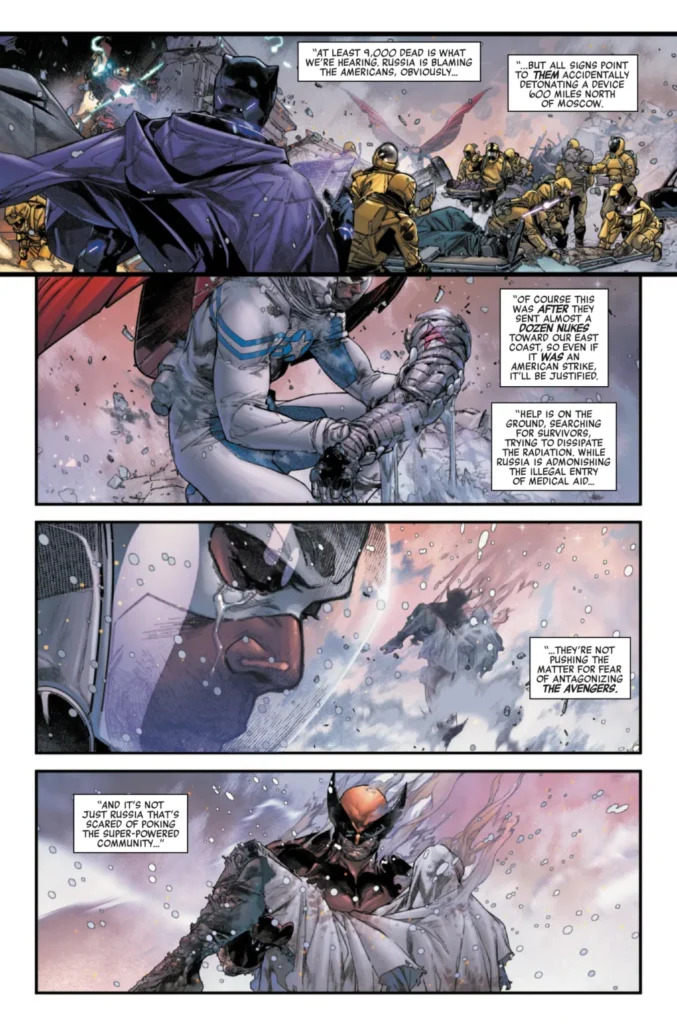
Now, is the issue, and series for that matter, successful in addressing this theme? To that I say, inconclusive. This issue does not provide a satisfying conclusion to the prior issues. Sure, there are moments with Spider-Man where Zdarsky articulates and showcases the importance of using power responsibly. Yet, the scene between Miracleman and Wolverine, which feel like it should be more developed given the time Zdarsky has put into the characters, feels half-baked.
That leads me to my other angle of approach to Avengers: Armageddon #5 and the series itself: it is not truly a finale for a series but just the end of the chapter. It is no secret that Zdarsky used this event as a big shake-up to the Marvel Universe, at least on the Avengers side of things. As such this issue serves as the table setting for his new Avengers series debuting next month. Which is fine, but also results in an unsatisfying ending. For example, there was little to no effort in trying to make the in-story significance of Miracleman clear beyond the reality of fiction (either Zdarsky really wanted to use the character or Marvel is trying to improve sales following DC’s recent dominance). The ending of the issue makes the nature of David’s powers even more confusing, to the point I have found myself struggling to put clearly into words why.
I do wish there was a bit more finality to it as it could help this series serve as bit of an evergreen story, but that is just not the Mighty Marvel Way. All of that said, the path ahead being teased by Zdarsky is promising, but I have concerns because of Marvel’s recent track record.
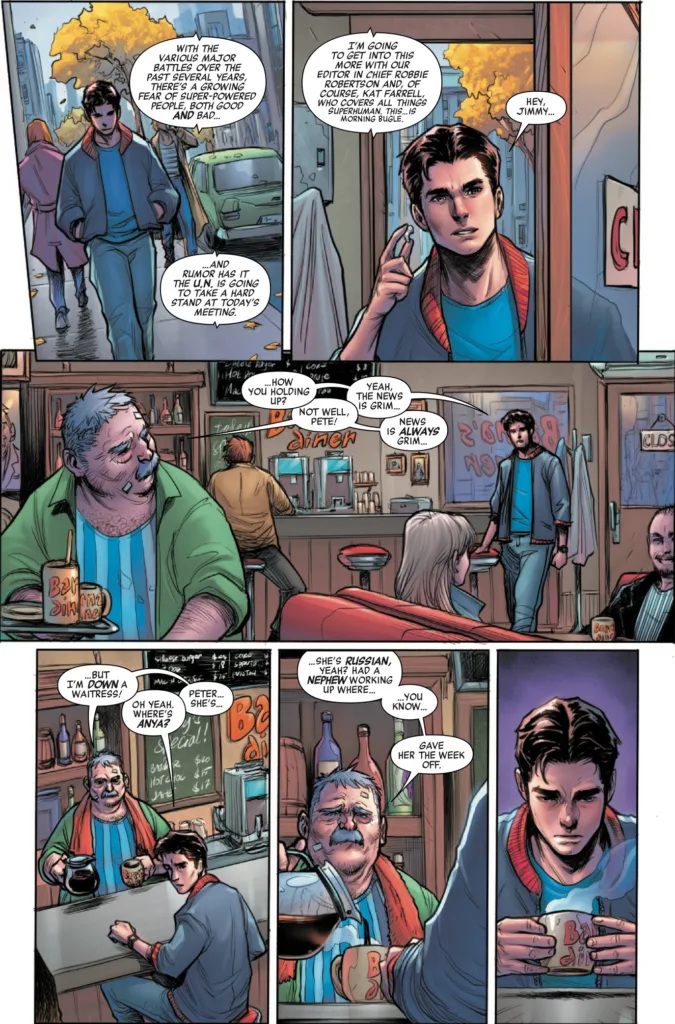
First off, I like the idea that the new Avengers team will be centered around Spider-Man as the core character. I know folks don’t care for Spider-Man as an Avenger, but I think it works here, partly because I really like Zdarsky’s handle on the character. His rendition of Peter Parker is one that captures the conflict between civilian and hero identities, but at the same time understands and heeds the call to be a hero. Zdarsky’s Pete is a reluctant but proud hero. He and Wolverine serving as the emotional core of the team is going to be different, but I think it will be good.
Second, the big status quo shift is that now the Avengers are on the outs with the world governments and there is a resurgent SHIELD that is going to enforce the new anti-superhuman policies. Not exactly a new concept in the slightest, but it is vehicle to explore the larger themes that Zdarsky seems intent on exploring. Though I am skeptical about a few things. Is this concept of the world against heroes going to be found across the Marvel Universe? I am not the biggest proponent of demanding every single title follow a single narrative, but one of my biggest gripes about the Marvel Universe under C.B. Cebulski was it felt too siloed off. Great if you are only wanting to read the Avengers or X-Men, but It undercuts the magnitude of events that are meant to shake up the status quo.
Take One World Under Doom. That event had some tie-in miniseries and obvious tie-ins with Fantastic Four and Avengers, but not ONCE did it feel like a big deal in the X-Books who were busy dealing with Raids, Manhunts, and Revelations. Something like Doom taking over the world FOR EIGHT MONTHS should have had at least some repercussions in the other titles.
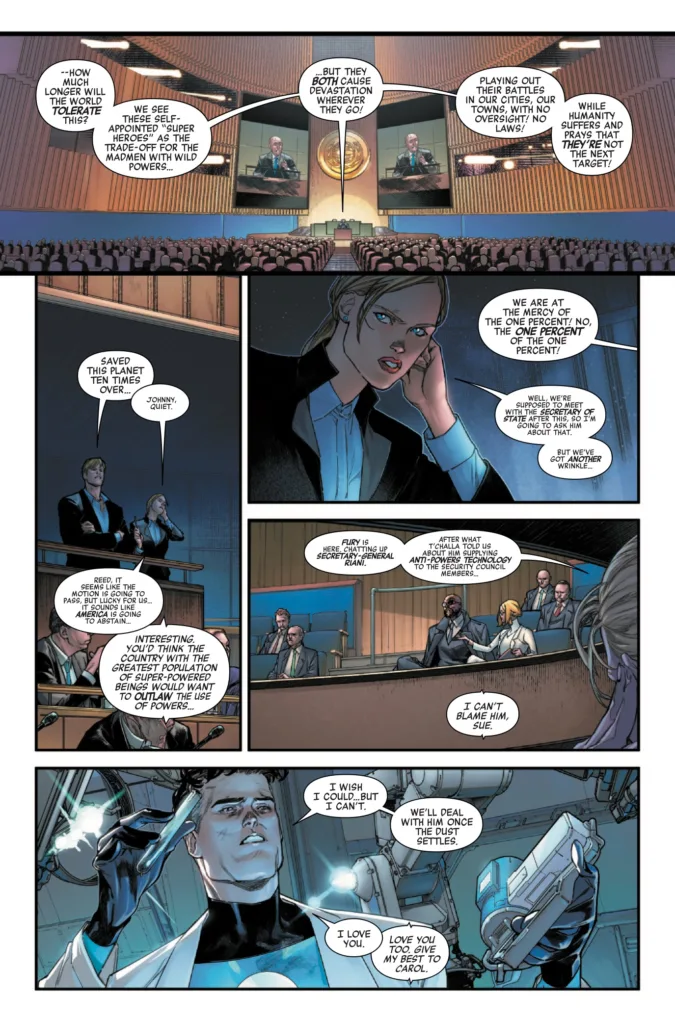
Are we going to start seeing SHIELD agents hassle the X-men, Fantastic Four, or Spider-Man? The Marvel Universe has become so compartmentalized that nothing matters, especially when there are upwards of 4 micro-events and crossovers happening simultaneously. Superhero comics are largely the illusion of change and that’s fine. It’s the kayfabe that we all agree to when we read these comics. However, when everything is changing but those changes aren’t reflected anywhere else in the shared universe then it feels hollow. I don’t long for the day of company-wide events like Civil War or Secret Invasion, but at least when that happened there was some lip-service paid to show the reader that the universe truly has changed! I am hoping that new Editor-in-Chief Stephen Wacker addresses these issues.
Now, with all of that out of the way let me talk about the issue’s art. As you can tell by the credits this issue is a bit of a jam issue. It is not too surprising considering Avengers #1 launches next month. That said, Delio Diaz & Frank Alpizar and Ario Anindito all do a great job creating a cohesive product. There are some interesting visuals in the book especially juxtaposed with the narration but overall, it is a quiet issue and one that feels very safe. Nothing wrong with that, mind you. It is very much a solid house style issue. Normally I try to balance the discussions of the writing and art, but there isn’t a lot to add here beyond what has been stated. It’s fine.
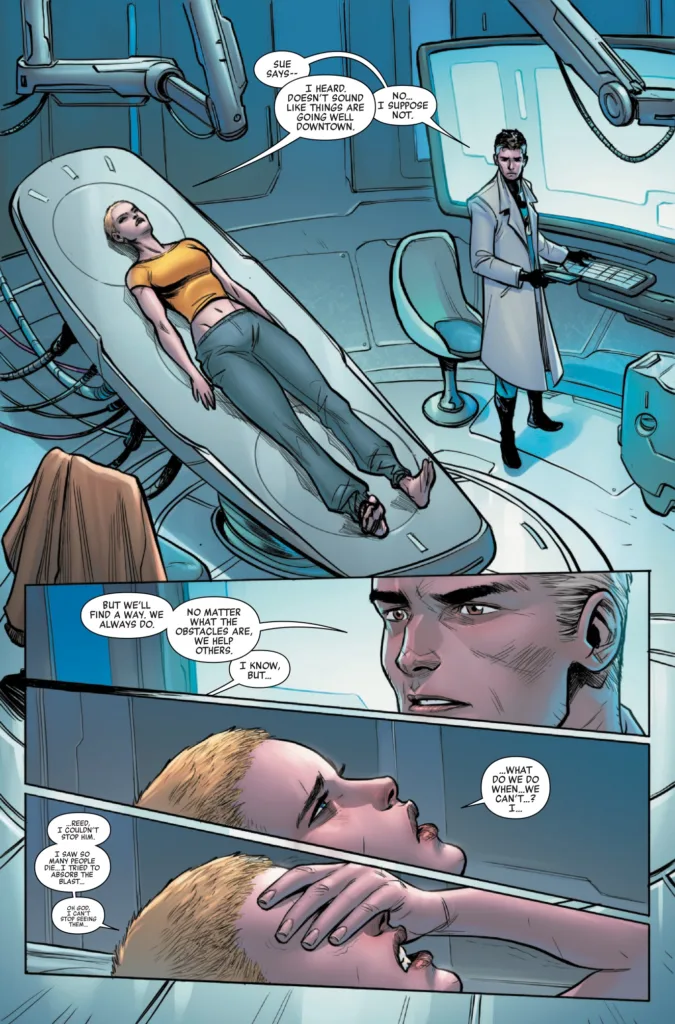
While I have liked Avengers: Armageddon and routinely held it up as one of Marvel’s better books, the ending underscores a lot of my concerns with Marvel in general. That said, there has been a changing of the guard. My concerns are largely centered on the previous era and I hope that the new one returns Marvel to its former glory. This issue leaves me cautiously optimistic about the future, though for its importance, mileage will vary. It is important for setting up the upcoming Avengers storylines, but it feels like it’s largely resetting the table for the next diner and not a satisfying conclusion to a great meal. Endings are hard. Especially those that are the prologue for the next era.
Final Verdict: Browse
The Rapid Rundown
- Doomquest #5
- It’s crazy that this is the first time I’ve written about this title because more people should be talking about it. As we transition from the summer of Doom into Doom’s autumn, writer Ryan North expands the legendary arrogance of Latveria’s favorite son, Victor Von Doom. In what can only be the TVA’s worst nightmare scenario, Reed Richards traps Doom in a time loop on the Titanic the night of its sinking, only for Doom to escape through time, Quantum Leap style, inhabiting people to alter historic events to benefit Latveria (Sam would not be happy). From a passenger on the Titanic to General George Washington, to a younger version of himself, to this issue of Doom in the body of Susan Storm, the Invisible Girl, as the Fantastic Four faces the threat of Galactus for the first time. North has made this series all about the indomitable will of Doom and his ingenuity in turning lemons into champagne, damn the repercussions. Doom immediately takes advantage of Sue’s then-untapped potential to reshape the moment and relationship that Galactus and the Silver Surfer have with the FF, and Earth is off the chain fantastical. Without spoiling, there are some great moments in this issue, one is a fun bit, and the other is a terrifying shakeup for the status quo of the MCU. Artist Francesco Mobili and color artist Frank D’Armata have been bringing it for the past four issues, and this one is no different. Mobili’s line work and storytelling are sublime, his Galactus has a funky interpretation that is the essence of the World Eater, but definitely has his stamp on it. Normally I am not a fan of pencils without inks, but D’Armata’s colorwork keeps Mobili’s linework visible, helping to carry the detail and energy of his pencil strokes. I can’t wait for the next issue and Doom’s interpretation of For All Mankind. – GC3
Read past installments of the Marvel Rundown here! And check out the Beat’s other recent comics reviews!