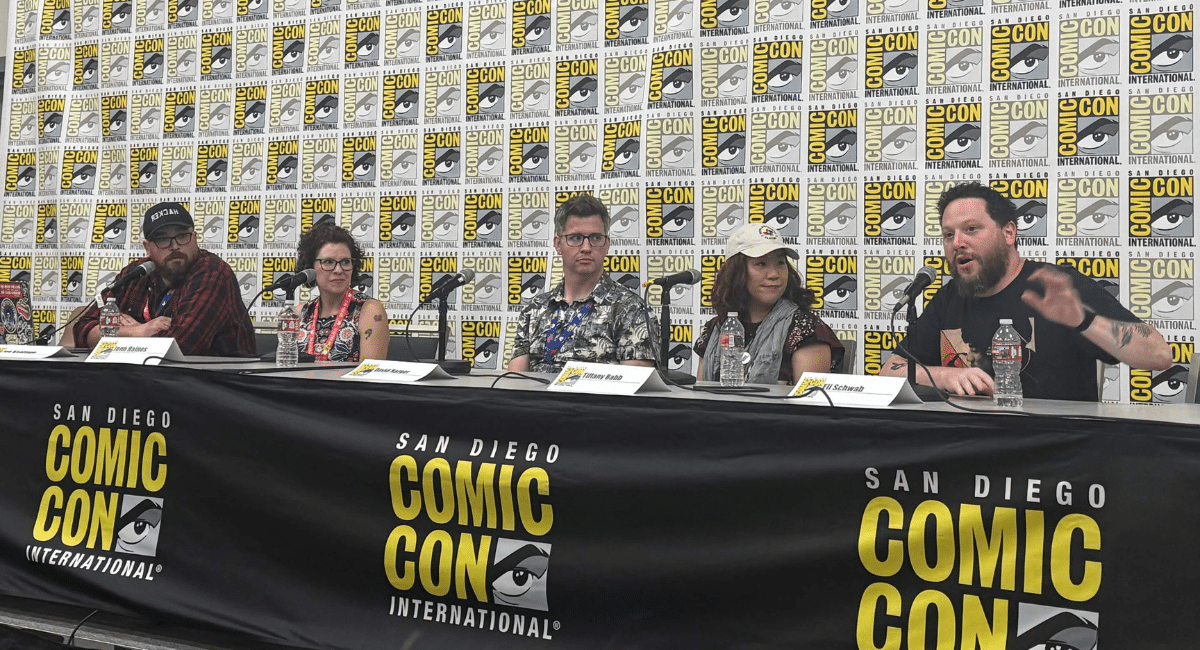

Joe Keatinge (Shutter, COMICS! The Magazine), Tiffany Babb (The Comics Courier), David Harper (SKTCHD), Jenn Haines (DragonGuelph), and Eli Schwab (Cosmic Lion Productions) put together a San Diego Comic-Con panel to ask an important question: Why have readers stayed with print while everyone else is moving on?
To begin, Harper pointed to sales data from comic book retailers, arguing that the numbers speak for themselves. Referring to the percentage of print comic sales that could be attributed to readers who first discovered books through digital platforms like TikTok and YouTube, Harper noted that “larger chains are over 25%, and one was even over 70%.”
Harper continued, explaining that the 70% belonged to Third Eye Comics, and even then they had much more to say.
“They told me that to further the connection between digital and print, it was driven heavily by younger readers, diverse readers who were discovering comics like Absolute Batman on TikTok and on YouTube, and coming in, and they desperately wanted to own that thing of something that they’d already seen and heard was awesome,” Harper explained. “So these variant platforms are driving people in, and they’re desperate to own this thing that they love, and it’s huge across the entire country.”
“That 70% is insane,” Keatinge added, thanking Harper for setting up the panel before delving into a brief history of comics publications, mentioning the 1930s and the evolution of comics culture. He even dug into the underground scene, including Robert Crumb and the East Village, before touching on the ’90s heyday of comics magazines.
“There were a lot of magazines covering a lot of ground, and you know, a varying quality,” Schwab said. “But I think currently we’re selling a lot of comics. We’re having a lot of discussion.”
Keatinge then took the time to talk about one of his favorite creators working in print media on that very panel.
“One of the kind of favorite things that involves someone on the panel, so I need to compliment them in front of a room,” he said. “But one of the favorite things I’ve seen lately, you know, because you get this stuff over your desk for so long, a broadsheet of comics journalism, which I thought was so cool and so declarative.”
Keatinge was referring to The Comics Courier, a biannual print newspaper edited by Babb. He then passed the mic to Babb herself.
“I think a big part of it is I like to read in print,” Babb said. “I’m on a computer all day. I’m looking at screens all day for work, and then. You know, when you’re awkward, you want to also open up the screens and read your stuff digitally. But also, part of it is a gimmick too, right? I love newspapers. We love to smell the newsprint. We love to design and edit. But putting together a website, it takes a lot to get someone to a new website.”
Babb continued, explaining that even though we have some of the best writers writing amazing comics, having something like a newspaper that comes out twice a year that you can subscribe to, right into your mailbox, a paper that you can put on your coffee table and pick up to read, is something people would do as opposed to clicking on a website.
In fact, it’s what inspired Babb to continue their work into something more regular. That’s where the idea came from for The Comics Staple, a monthly comics news magazine.
“So the Courier doesn’t have any ads, and so a lot of like comics journalism relies on the now. Like, this is the book that’s coming out this month. Everyone wants to click on that to see if the book is good or not,” Babb explained. “So the Courier is kind of like a newspaper that comes out twice a year. I email people that I want to work with or call them, and I say, hey, this is your moment to do whatever you want.”
Babb really did mean that as well, saying that writers can cover Jeremy Dapper writing The Yellow Kid, or how Douglas Wolk wrote about old romance comics. It’s the kind of moment to just do whatever you want. Anything they couldn’t get published elsewhere because it’s too old or too esoteric. Something that no one has ever read in that medium because it might’ve only sold 20 copies.
She concluded: “Like this is your moment, and that’s something I’ve been really grateful to be able to do because we crowdfund the newspaper, just let people have the rating, and we get kind of more unique writing for the paper.”
In short, The Comics Staple is the new product and acts as the exact opposite of everything Babb said about The Comics Courier. The Comics Staple is going to be a monthly series, starting in September, that will be mailed to your mailbox. A black-and-white print zine is what you will receive, “Just like the olden days,” Babb said.
“We have interviews, reviews, kind of like what are we most excited about, and the whole concept of that is like how can we make something useful to people who are going to their comic shops and want to know what to buy or what they should check out, all the while like not overwhelming them with hundreds of reviews, it’s a lot to kind of pick through.”
Keatinge then directed his attention to Schwab: “What are you seeing from creators and people that you are publishing and curating?”
“I think taking a little bit of what everyone else has said,” Schwab began, “Webtoon is huge; we have a creator who has like 10s of 1000s of followers on Webtoon, but we now publish all that stuff, and it’s like a huge selling manhwa. I’m seeing a large part of the market is manga. I asked that creator, I was like, if you want to start a manga line, let’s go. So she started this long line, and now that’s moving like crazy. I try to take a little piece of all the things that made this special for me, and then find a market for those things.”
Schwab went on to say that Cosmic Lion makes a point to publish these books on newsprint. He loves seeing people purchase their books and say, “Oh my god,” when they get to experience the texture and feel of holding a physical book.
“Digitally, people see things and they’re like, ‘I want that.’ The digital is like a taster,” Schwab said. “I think about it for music too. If I’m on Spotify and hear a new album, I’m like, ‘Well, I better go buy that on vinyl because I want that in my collection.’ You know, I want that.”
Keatinge then pivoted slightly to comment on bootlegging, which he said is going to exist in this space. It will eventually happen, and while people might first encounter comics through unofficial means, they eventually want to become part of the scene. They want to own the items they are discovering online.
“I want to be a participant in this. I want to buy the shirt. I want to throw this show. Spend too much money going to the Sphere. You know what I mean?” Keatinge said. “I get it. Before the panel, we were talking about how there’s sometimes this fear of digital amongst retailers. But again, you’ve been on the scene for a long time. What have you seen actively?”
Haines responded first: “I would say confidently that digital has zero negative impact on print comic sales.”
Even at the height of digital comics, Haines said, digital comics still accounted for around 10% of the market, and that never changed. It did not eat into the print market, and as the print market grew, the digital market stayed at 10% or less. Sometimes it even shrank below that. Digital simply hasn’t had the opportunity to cannibalize print comics.
“That’s generally been a fear amongst retailers is that, ‘Oh, that’s going to beat into my sales. Somebody’s going to like decide now to switch to digital,'” Haines said. “Well, no one’s switching to digital. It’s definitely the other way around that happens.”
In the end, the panel explained that the fear of digital has never become the frightening reality that many in the retail community expected. If anything, the panel made a compelling case that digital and print are not rivals but partners in the comics sphere.
Social media, Webtoon, YouTube, and digital discovery are introducing new readers to comics, while print remains the format they ultimately want to own, display, collect, and cherish. From beautifully designed newspapers and monthly zines to newsprint manga and comic shop exclusives, the passion for physical comics is far from fading.
If this discussion proved anything, it’s that print isn’t surviving in spite of the digital age. It’s thriving because of it.
Stay tuned to The Beat for more news from SDCC ’26.




Comics is a visual medium, mostly designed for print. If the designer/artist knows his job, there’s no way reproduction on a screen can beat the reading of a physical print copy. Just like a YouTube clip can’t beat being present at an actual performance, or a photo of a painting or sculpture cannot beat being present in the same room as the actual object. This has always seemed obvious to me.
Then why the fear of digital? Well, just think back to the days ‘Napster destroyed the recording industry’, or how the magazine industry got disemboweled by free news websites on internet (like, for instance, The Beat). But even though recordings are sold as objects, the actual art itself consists of making air molecules vibrate. Being fleeting has always been a significant aspect of newsstand print media.
So if one is making predictions about digital comics by comparing comics to these previous digital disaster areas, this would just out you as being totally ignorant about the subject you’re pretending to be so savy about. If people feel like they have a connection to art, they want to own (at least part of) it, when they can afford to.
Now it would be interesting to see what would happen when somebody made a digital comic, in a way that could not be reproduced in print, that then would become very, very popular; like Calvin & Hobbes level popular. To my mind, this hasn’t been done yet.
I am confused by the second paragraph.
Harper makes an excellent point that the stats could, in fact, speak for themselves: “Larger chains are over 25%, and one was even over 70%.”
The article then discusses the awesomeness of the 70% but never says what the 70% refers to. Is it print comics sales over some period of time? It seems like this article needed better editing.
Comments are closed.