

By Gabriel Neeb
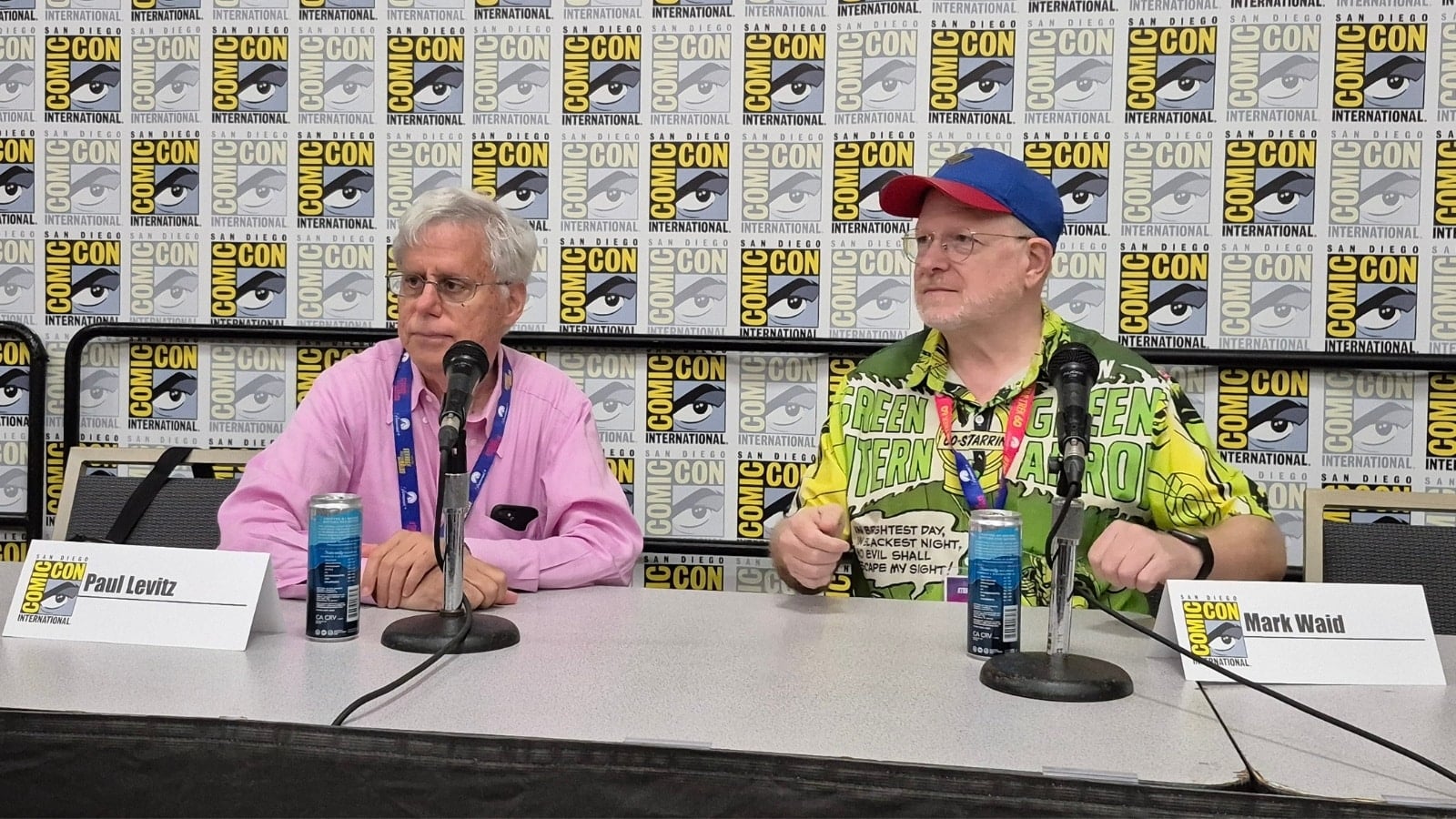
On Thursday at San Diego Comic-Con 2026, comic book legends Paul Levitz and Mark Waid, who have nearly a century of combined comics experience ranging from writing to time as editors, sat down together for a free-wheeling discussion about building stories in universes that work.
Levitz and Waid started by wondering about the demands of creating fictional worlds that didn’t exist—which Waid has done. Waid said that it’s not as enjoyable as having an established universe in which to play.
The pair then pondered Batman, with Waid commenting that he thinks there have been more stories written about Batman than any other fictional character in history. Levitz countered that Batman writers get paid, which is a great motivation, whereas those penning mythological tales were doing so “off the cuff” without compensation.
The conversation segued into discussing Levitz’s work on Legion of Super-Heroes (LOSH), the 30th Century team in the DC Universe that… often requires extensive world-building because it is so far removed from the timeframe of mainstream DC stories (which are mostly set in the 20th and 21st centuries). Levitz explained some of the reactions and his process. When he began his second run on LOSH, he made it a point to read every previous story available and then subsequently wrote up pages on each character.
(Levitz said did something similar when he took over Batman editorial duties in 1978—when you could do something like that. Now? Probably not.)
Levitz slightly digressed to discuss the ‘nature versus nurture’ of child-rearing, where he endorsed the ‘nature’ argument and spoke of the current careers of his children: his son is a lawyer who successfully sued the NYPD over protestor treatment. The audience applauded.
Levitz’s point, he said, is that he feels characters’ experiences on their homeworlds motivate their actions and attitudes. As Levitz planned to work on LOSH for 100 issues, he wanted to have a firm grasp on the characters.
Waid related his experiences receiving pitches for stories which focused on the texture of universes (like how the subway systems would work) but had very little to do with the actual characters in those universes. For Waid, stories are about character, which is in conflict to how he was first introduced to DC in the ’80s. At the time, editor Julius Schwartz focused on plot-centered stories of the Silver Age (when Jimmy Olsen became a turtle). Waid said he spent a lot of time learning and unlearning writing where this was more important than character work.
Levitz continued his thoughts on universe-building by talking about Junot Diaz and the class Diaz teaches about it at MIT which, in Levitz’s words, is “Fucking amazing.” Levitz stressed that his choices in the creative process come down to interrogating how world changes impact characters.
Waid then talked about his time at Archie Comics as a way to illustrate universe-building. He began by asking himself who these characters were, and then just wrote. He said he would come up with 20 or more pages by just thinking about the characters and what their relationships with other characters entailed. This exercise fueled the majority of his work at Archie: “You had to look at the world through their eyes.”
This technique helped Waid on his work on Daredevil and for characters as diverse as Saturn Girl, the telepath from LOSH. Waid imagined that the vocal abilities of someone from a planet of telepaths might be a little “croaky.”
Then the topic of Waid’s work on the New History of the DC Universe came up. Levitz expressed his admiration of Waid and dubbed him the “puzzle-solver” as Waid detailed writing out every event in the DC Universe and placing as many as he could in the back of the issues (some bits ended up being cut). Waid said he was fortunate enough to work with editors that (1) trusted him and (2) weren’t old enough to have read some of the events Waid would reference.
This led into a discussion of the current status of DC’s editorial situation in Burbank, Calif., where the various departments exist on an open floor plan without separate offices. For Waid, this reflects a more communicative and in-sync editorial policy. He said the current success with the Absolute line possibly benefits from this situation.
Towards the end of the panel, Levitz and Waid touched on what might harm shared universes: ego and ego battles that result. They used the example of Secret Origins #10, which featured Phantom Stranger and a quartet of stories (one of which was by Alan Moore) detailing the many “origins” of the character. Levitz attributed the success of the issue and the technique to editor Bob Greenberger, who often volleyed credit for success back to Levitz.
Waid compared the teamwork involved in these issues to the combined efforts of The Beatles working on the song “Get Back,” as depicted in a recent documentary. The song is what it is because of the group all working alongside each other in the same room, not necessarily concentrated on making a specific thing.
The main portion of the panel finished when Levitz read a section from his upcoming book, Marvel Explodes, about the business history of Marvel comics from the 1960s to 70s. Marvel Explodes will be available on October 15 from Bloomsbury Academic.
To conclude their SDCC panel, Levitz and Waid answered questions from the audience. The pair admitted that while they enjoy working in the shared universes of Marvel and DC, they’re aware that their stories can be affected by the needs of creators that follow afterwards. Waid stated that he tends not to plan ahead because of this.
The final question asked Levitz about his proudest achievement (besides his successful children). Levitz said it has to be the first standard contract at DC, which was the product of combined efforts from him, Dick Giordano, and Jenette Kahn. He said this led to the modern concept of the graphic novel which was evolved by many other editors and personnel that were too numerous to name.
The panel ended there, though Waid said, “We could do this for hours.”
Stay tuned to The Beat for more news from SDCC ’26.