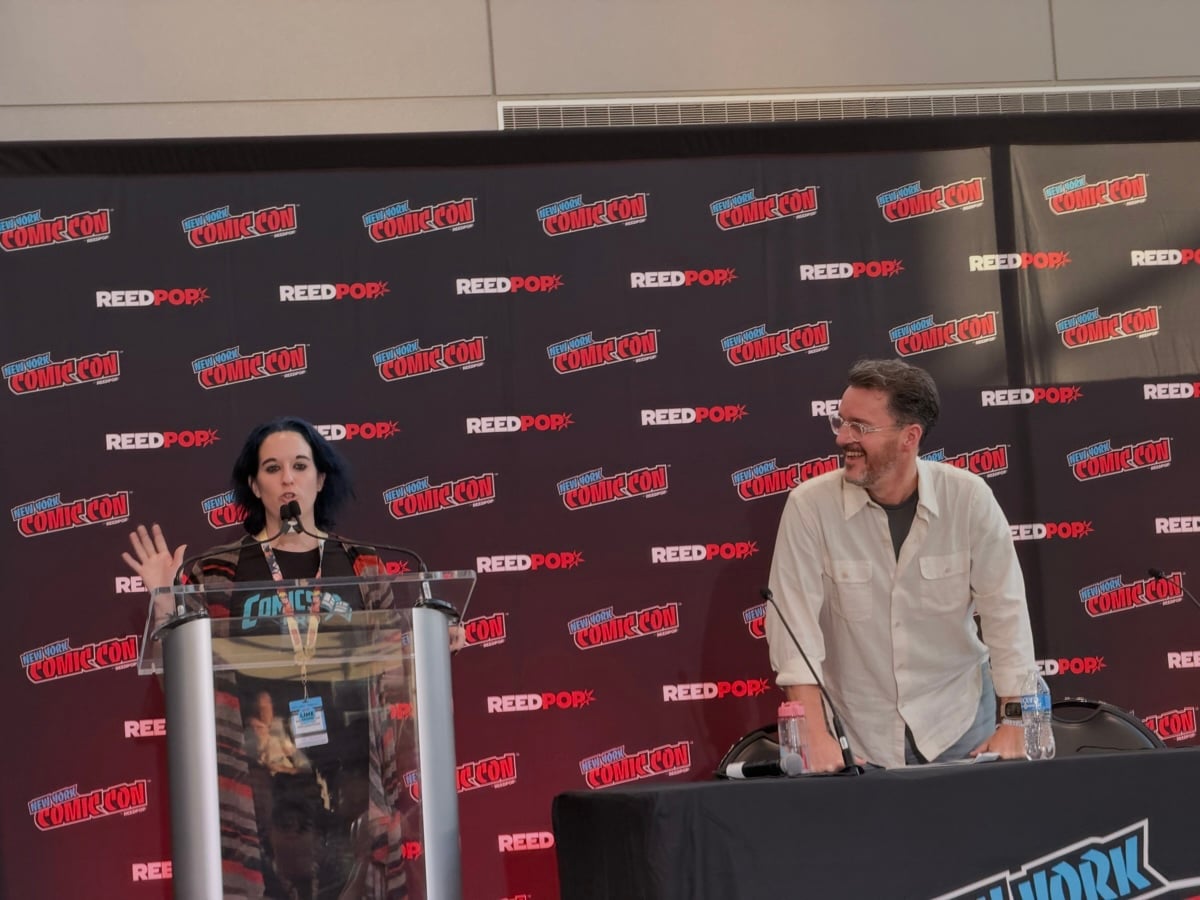

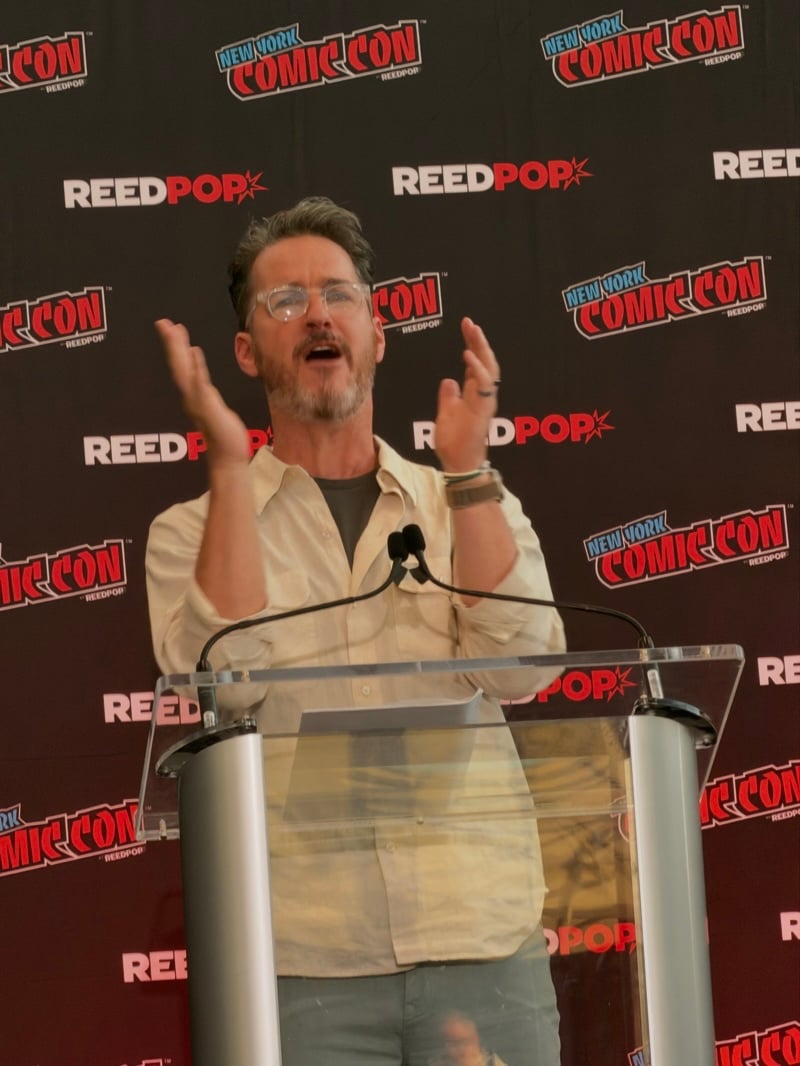
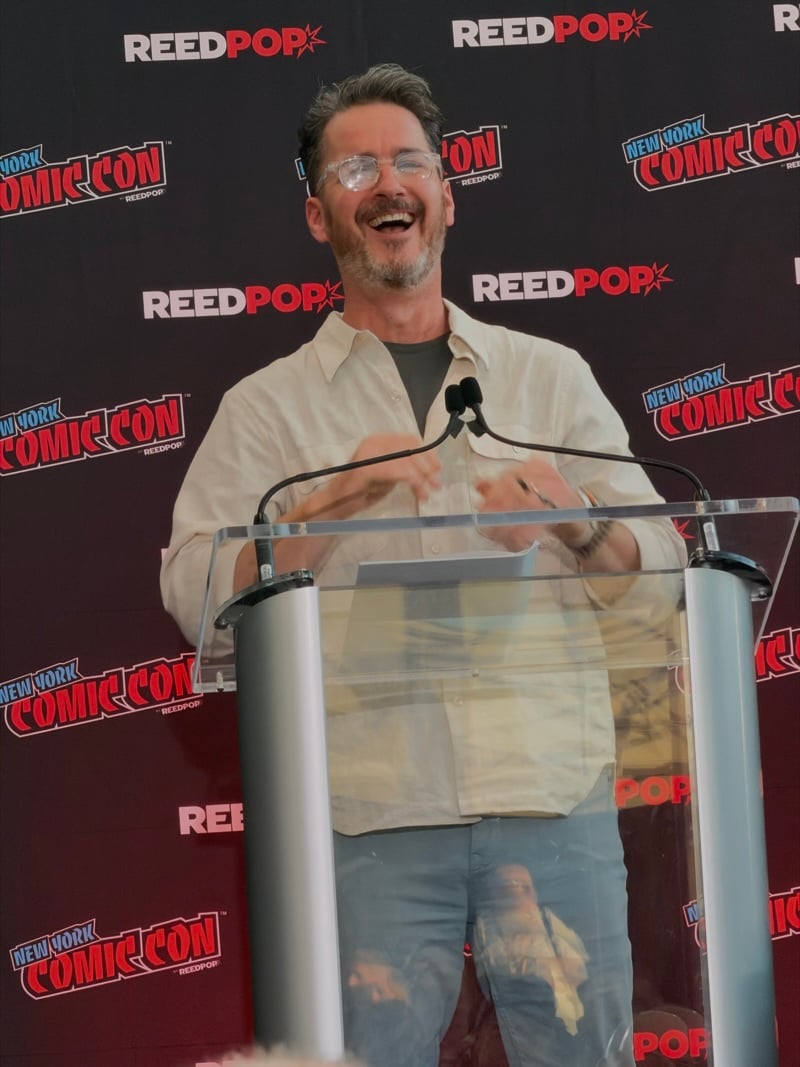
Capping off Retailer Day on Wednesday, October 7th, new Marvel Editor in Chief Stephen Wacker delivered a keynote address to the assembled. He had a few adlibs – including some anecdotes about Kevin Feige – but this is mostly what was relayed. In my opinion, there is a lot to be optimistic about in this message, including just a fresh take on publishing at Marvel. But you can judge for yourself.
As I noted on social media, both Brad Winderbaum, Head of Marvel Television, Animation, Comics & Franchise, and General Manager, Comics & Franchise David Abdo, were there for the talk, and they were smiling every time I looked at them.
Thanks to Marvel for providing the text.
Stephen Wacker | October 7, 2026
I’ve always wondered what goes on in retailer meetings like this. I’ve spent most of my career on the other side of the door, and now somebody’s finally let me in. So, thank you for that.
Quick bit of history just so you know who’s talking. My first two jobs in comics weren’t at a publisher. They were behind a counter. First at Comics and More in St. Louis, then at Golden Apple in Los Angeles way back in the 90s. It’s where I met Stan Lee for the first time, years before I ever worked with him.
For the other old-timers in the room, I remember being at Golden Apple when Alex and Kurt’s Marvels was coming out. We couldn’t get enough copies. And as I remember it, there was a flyer called Marvel Mart inside Marvel’s comics telling people how to order those same issues directly. What I remember very clearly is standing behind the counter thinking: We can’t get this book, and you’re advertising somewhere else to buy it?
 Before we put the books out, Bill Leibowitz, the owner of the Golden Apple, and I, along with a bunch of other staffers, went through every Marvel comic and just ripped out that flyer. I have to say, the other employees and I felt pretty proud doing it. I started off by sticking it to Marvel. Now I’m on the other side, and I need to remember what made us rip those flyers out in the first place.
Anyway, for most of you who’ve been wondering just who in the hell Marvel hired, I went on years later to be an assistant at DC. Working on books like JLA. JSA. Legion of Super-Heroes. Jonah Hex. And ultimately 52… Or, as I call it, 36, since I left partway through and found a home at Marvel.
Thanks to Joe Quesada, Dan Buckley, and Tom Brevoort, I got to work on books like Spider-Man. Daredevil. Hawkeye. Captain Marvel, Ms. Marvel…and of course everyone’s favorite: Marvel Apes! You’re welcome!
So, I’ve spent 26 years in the part of the business that lives or dies on what happens in your stores every Wednesday. And I know how much love of the medium is required to do what you do.
Nobody in comics has an easy job, but when it comes to the video game skill tree, you have one of the hardest.
You order books three months out with no returns, on a guess, from a catalog the size of the Springfield, Illinois phone book. And of course it’s not one catalog anymore. It’s three or four, from three or four distributors, each with its own cutoff, its own FOC, its own invoice, its own shipping details, its own way of telling you a book is late.
From the outside looking in, I imagine it’s like studying for the SATs, every week, usually after close, usually by yourself.
And after you’ve done all of that, you still have to show up on Wednesday and convince somebody to try a comic. I don’t know where you find the energy. But I know everyone who’s stood up here today owes you a thank-you.
You’re the ones who talk to the readers every week. A good retailer, a good back-issue manager, a good cashier can do more for a book than a whole marketing campaign. We make the thing. You make the reader. I’ve been on both sides of that counter, and I know which one is harder.
Anyway, I wanted to come here because I love crashing parties, and because Brad Winderbaum, David Abdo, and I have been talking about a lot of this since we took these jobs a few weeks ago. And after coming out of this week’s first Marvel Creative Summit that I’ve just run, where we’ve talked about some big new initiatives, I wanted you to hear some of it for me.
I’m proud of what you heard about today. Midnight. Hope Assembles. Chip’s Avengers and Stephanie’s Daredevil. Maximum X-Men. X-Orcists, which you’ll hear more about at the House of Ideas panel on Friday. The Incarcerated and War Machine arc in Iron Man. Spider-Woman, Alias, Incursions, Hulk War. And the work on Compacts, Renown, and Brick. There’s a lot there I’m excited about.
But please don’t hear that list as, ‘There. We are done.’ I know there’s a lot of hunger out there for us to figure out our way forward. I feel it too.
Some of what you saw today points toward what we want to do. The bigger changes are still ahead. Brad, David, and I have only been at this a few weeks, and we’re going to need more than a simple presentation to convince you.
But there are some key points I want to bring to this group with the goal of showing you where our early focus is:
#1: Does Marvel publish too many comics?
This is one I’ve been wrestling with. We have thousands of characters, hundreds of talented creators…and Chip, and readers who want very different things from us. There are good reasons to publish a lot of comics.
But you can only order so much. Your customers can only buy so much.
If we’re launching everything at once and telling you it’s all essential, what are you supposed to do with that? How do you know which book we’re really going to get behind? And how are we supposed to give each one the attention it needs?
So before we put another book on the schedule, I want us asking:
“Are we giving every comic we publish a reason to exist?”
 Who’s going to want this? What’s the creative team excited about? What can we tell you that will help you sell it? If we don’t have good answers, we need to keep working on the book.
That might mean fewer books. It might mean giving a launch some room instead of piling three more launches on top of it.
The overall business has evolved, and I think we need to evolve. I don’t want Marvel to succeed simply by taking up the most shelf space.
I want us to succeed by making the books on that shelf matter.
Look at Midnight this week. Grew naturally out of a conversation with Dan Buckley and Jonathan Hickman. Compelling stories, fantastic creative teams who are challenging each other to raise the bar, and some fresh ideas from sales and marketing that has made the launch feel different.
Unfortunately, almost all of that was underway before I got here, so I can’t take credit.
But you took a chance on it, and look at what we were able to bring to you:
Three books, one day, and nothing else from us that week.
Cloaked covers, so the book itself was the reveal.
 Making sure you could read issue 1 before FOC. And working to make sure issue 2 didn’t FOC until issue 1 was on sale.
A bundle that basically handed you 60 launch issues for the price of a cool sign.
Promo materials that actually showed up.
We can’t do all of that every week with every single book. But I’d like us to spend more time thinking that way.
Ultimately, I want a core of books you can count on, with room for something you didn’t expect. I’d rather you sell out of ten books than sit on thirty collecting dust.
Which brings me to…
#2: Variant covers.
Look, I like variant covers. Readers like them. You guys seem to like them. And we get to put some incredible artists on those covers, including people who might not otherwise get to do a Marvel book.
So, I’m not here to tell you that variant covers are going away.
But I do worry about overuse and confusion.
But sometimes I wonder if a reader even knows what the main cover is anymore. Think about your favorite comic. You can probably picture the cover right now. I’ve seen Mark Waid do his parlor trick of naming a comic cover from across a hundred yards of a convention floor. That image of a great cover stays with you. You remember a cover by Neil Adams. You remember a cover by George Perez. You remember a cover by Joe Q, You remember covers by Amanda Connor. You remember Marcos Martin. You remember Denys Cowan’s cover on the first issue of Hardware!
It can be a high you chase for the rest of your life.
A Marvel cover needs to do that. And I don’t want it getting lost in a lineup of twenty other covers for the same comic.
We need to be clearer about which one is the main cover, whether you’re looking at a solicitation, an ad, or a book from across a crowded convention floor.
I still want the unique ideas and breathtaking art that a variant cover lets us experiment with.
I just want to bring a little more logic to the operation and make sure we aren’t mindlessly throwing an endless number of covers at any single book. We want to make sure they’re easy for you to order, which is why we’ve implemented the new Cover A, Cover B, etc. system.
Covers are our first line of offense; we’re going to make sure our strategy makes sense.
#3: The movies are not the point.
I’m not sure you’re aware, but Marvel also makes films, and in this new structure, Marvel Comics is now housed directly within Marvel Studios physically. That’s where the new location is going to be. Right now, when I’m not in New York, I sit right down the hall from Kevin’s producers, from Kevin, from Brad, right there on the Disney lot.
I love the MCU. I worked in the previous iteration of Marvel Television and Animation. I’ve seen what Kevin and his team can do, and it’s without a doubt the biggest, most impressive entertainment franchise on the planet.
But I think the success of the MCU has sometimes created an assumption among fans, and maybe even among some of us, that the comics should stay close to what’s happening on screen. That our job is somehow to get the characters ready for their close-up and not stray too far from where the films are going.
That is backwards.
The movies came from the comics. And one of the things Kevin has made clear to me is that our job isn’t to follow them.
Our job is to make great Marvel comics. Let the creators take a chance. Let a character go somewhere we haven’t seen before.
We all want the next game-changing idea to start on the page. Marvel Comics are clearly better when they’re leading, not following.
Marvel Comics should be the creative engine. And the best thing we can give the other parts of Marvel…and you…and our audience… is something they never saw coming.
#4: Probably the most important element of all this … Creators.
In the spirit of trying new things and getting us out of our comfort zone, we chose a different venue for this year’s Marvel Summit. So, I just spent three days in a cramped rehearsal space at the New Amsterdam Theatre on 42nd Street (Home of Aladdin!) with our editors and a gaggle of our creators, talking about the future of the Marvel Universe. And talking pretty frankly about what’s working and what isn’t.
To say that some hard truths were spoken understates how the days went. It was challenging but incredibly instructive and fruitful.
As I sat there listening to everybody, the obvious thing that came up is that none of this happens without the people making the comics.
And even though I’ve spent most of my time in comics working for the big two companies, here’s something I’ve come to believe, and possibly shouldn’t say: we cannot compete with the feeling a creator gets from owning their own work. Image, Substack, Kickstarter, all of it. They have been good for comics, good for you, and most importantly good for the people who make them.
But here’s what we can offer that nobody else can. A chance to add a chapter to the biggest ongoing story ever told. Decades of stories, thousands of characters, and it’s never taken a month off no matter what the world has thrown at us.
 But we can’t expect a creator to be grateful simply because we let them write Spider-Man. We need to pay them on time, back them up when things get loud, and listen to what they want to do with the book and help them try and make it better rather than stopping them cold.
I recognize that doing creative work here isn’t for everybody. But I believe that if you dig hard enough, every writer or artist has a Marvel story in them somewhere, and I want us to be welcoming to them. Play in our sandbox for a year, go back to your own thing, come back when you’ve got another one. Even a soloist likes to play in a band once in a while.
So, you’re going to see names on Marvel books next year that haven’t been on Marvel in a long time, and some that have never been on one at all. I don’t believe in a house style, and I think to compete in 2026, our taste needs to be broad, not thin. The previous editor-in-chief brought a metric ton of new talent into the company, and I want to continue that.
I’ve wanted to work with some of these people for years. I’m looking forward to seeing your faces when you see the names.
#5: New readers.
Walk into any bookstore in America and look at where the kids are standing. They’re reading comics. They’re just not always reading ours. They’re reading manga and manhwa, and honestly, good for them, because those publishers figured out something we’ve tried but couldn’t make work long term: make it inexpensive, make it thick, make it fit in a backpack. They built the on-ramp. There is no law that says we can’t learn from it.
We’re looking at the size of the books, the price, what somebody gets for their money. Compacts, Renown, and Brick are part of that conversation.
But in addition to that, when we start a project digitally, I want us thinking about the physical book from the beginning. A kid might find us on a phone. Great. That’s the world we live in. But when they want more, I want them to know there’s a comic shop either down the street, in the same city or somewhere online where somebody can help them find more.
Maybe they find Marvel at thirteen and walk into your store at fifteen. You know what can happen after that. It happened to a lot of us. And we’re going to be here to make sure it continues to happen. Our market is built on physical product.
#6: The part that’s actually about you.
Everything I’ve talked about so far is editorial. Here’s the other half.
Earlier today, you heard from Jim Nausedas, John Paretti and mighty Mark Annunziato who are leading our sales team. You’ve known them for years. They want to break a lot of eggs, and I hate eggs so I’m happy to help.
We’ve been talking about what would actually make these books easier for you to sell. We can’t untangle all the distributors for you. But we ought to be able to tell you what you’re buying without making you do detective work.
If we think it’s a five-copy book, let’s say it’s a five-copy book. If we think it’s a fifty-copy book, let’s explain why. And if you tell us that’s wrong for your store, we should listen. You know who’s coming through your door.
We also have to find more ways to share the risk when we’re asking you to try something new. That Midnight bundle is the kind of thing I want us talking about.
We’re going to work hard to have more of those opportunities in the future.
#7: Last thing.
The direct market has been declared dead every year I’ve been in comics. At some point you’d think people would get tired of making the prediction.
A monthly comic can still bring tens of thousands of people back for the next issue. And you have people seeking out your stores every week searching for something to read. They’re hungry.
That’s a hell of a thing to have at your fingertips. I think that’s something we have in common sometimes. We spend so much time talking about what’s wrong that we sometimes forget the opportunities in front of us.
I’m optimistic because I’ve worked in a good store. I’ve seen somebody walk in for an issue of Hulk and leave excitedly after also being hand-sold an issue of a new comic called Bone that they’d never heard of. I’ve seen the power a good retailer, a good manager, a good floor employee can have, but we have to give you books you can do that with.
All the announcements in the world won’t help if the comic disappoints the audience.
I don’t want Marvel to be the company that just protects the trademarks for the greatest characters in comics. Or just adapts moments from movies and TV shows.
I want us to be the company that does something new and unexpected with those characters. That’s what makes people care: consequences.
I want readers to argue and debate Marvel stories. I want retailers excited about the Marvel boxes showing up from PRH. I want critics surprised by Marvel. I want competitors challenged by Marvel! I want kids discovering Marvel. I want lapsed readers wondering what the hell is going on at Marvel.
And I want the rest of the entertainment business looking at our comics and thinking: crap, we need to catch up.
 That’s the Marvel Comics that the new team and I want to build.
So, here’s what I want you to be able to expect from us:
When we ask you to order a book, we can tell you who we think will buy it and why.
We tell you what you need to know before FOC, while you can still do something about it.
And when we screw up, you hear it from us. I expect I’ll be giving you a few opportunities to test that last one.
That’s what I’m asking Brad, David, and our teams to work toward. If you’re looking at your order form and thinking we’re falling short, I want to hear it.
I want us making comics that people can’t wait to read. And I want you to have what you need to sell them.
There’s a kid out there at this show this weekend who’s about to fall into a comic that will contain a moment of storytelling they will remember for the rest of their lives, just like we did. I’d like it to be one of ours… and I’d like them to come back to you for more of where that came from.
That’s it. Go have a drink, a bite. Whatever. You’ve earned it.
And thank you.
Oh and… In case you’re wondering… we’re still not going to use AI to make our comics.
Stay tuned to The Beat for more news from NYCC ’26.