
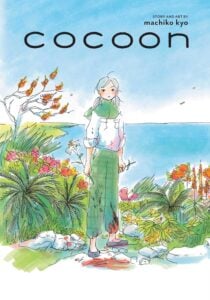
 Cocoon
Writer/artist: Machiko Kyo
Translator: Jan Mitsuko Cash
Letterer: Elizabeth Conley
Editor: Pancha Diaz
Publisher: Viz Media / $14.99
June 2026
Exploded girls, dead students, uniforms and blood and maggots. This is not something new to manga. Cocoon by Machiko Kyo is josei, a broad subgroup of Japanese women’s comics whose common thread is their stories answer to the reader in search of more, a step beyond shojo and books for manga readers who are starting out. Kyo has it, or does it, or whatever verb suits taking an ineffable concept and making it concrete on the page. It isn’t innocent kids meeting violent ends that sets this miniseries apart from everyday manga, however. Cocoon speaks in an established lexicon. A haunted manga that knows what it’s haunted by.
Cocoon is pretty traumatic. A war story about civilians trying to escape when they find themselves suddenly behind enemy lines. And by civilians, I mean kids, as well as non-combatants: a group of schoolgirls who served as volunteer nurses on the island of Okinawa. The bloodshed escalates beyond stanching, and they’re turned out to flee down the shoreline under fire. No food, no medicine, no time, no real chance to survive, far—too far—from any zone of safety or demilitarization. No weapons, no means of fighting back. No vindicating moments pulling the trigger, only the consequences of being shot.
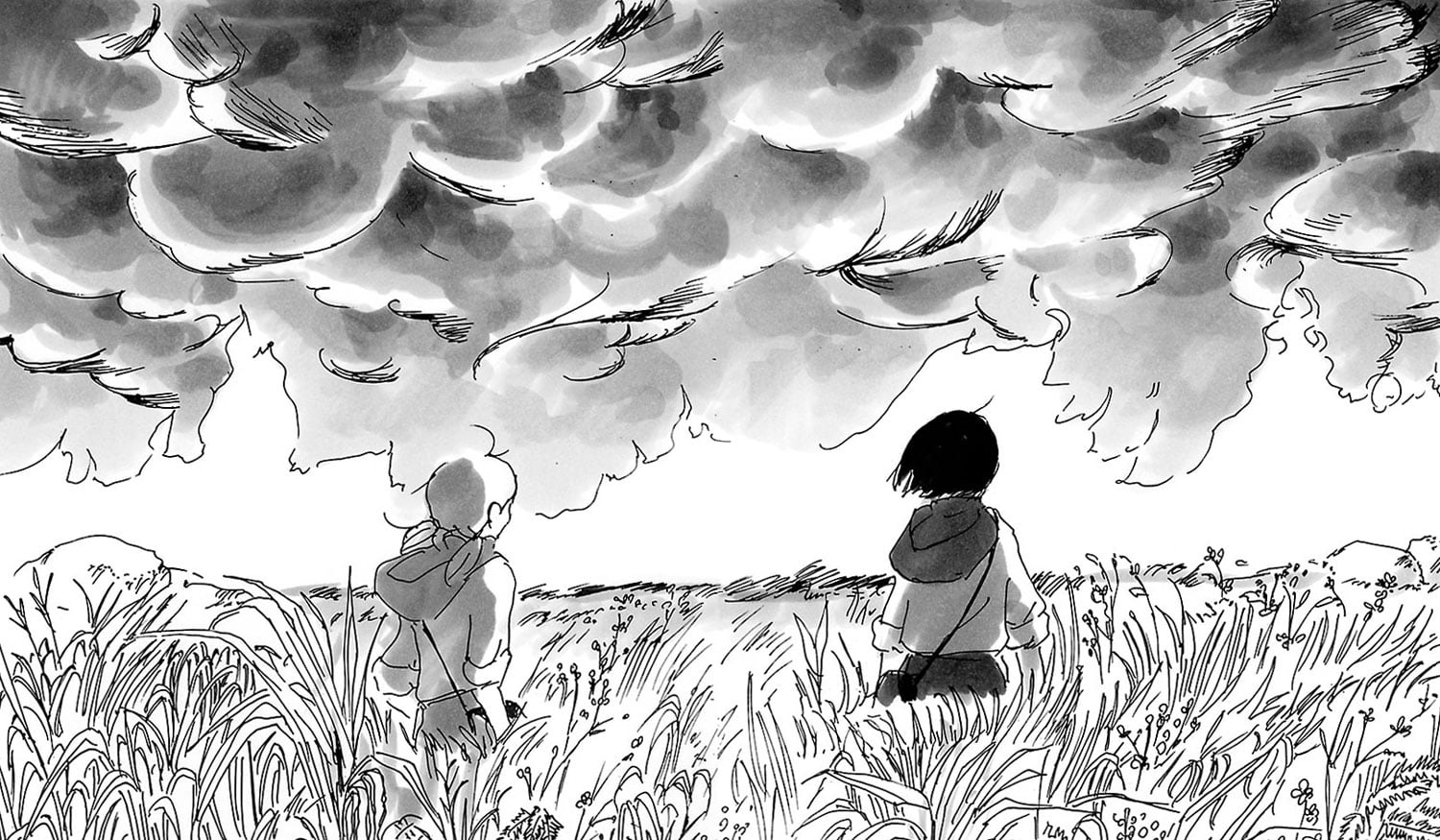
Cocoon is also just pretty. Does the world stop being a beautiful place once war breaks out? Before the bombs drop and the question is settled. A coastline that lives in tall grass and flowers and clear views of open water. Rolling hills and sheer cliffs and a swift sunrise. A home worth defending. It’s the only world these girls have ever known. A field hospital where the field isn’t the odd part, it’s the need for a hospital that’s off. The presence of death, the physical presence of casualties and corpses, is an invasion. It doesn’t change the delicate nature of the world that precludes humanity’s inhumanity. The delicacy of the art in Cocoon supports this truth, and makes the perversion of war all the more grotesque.
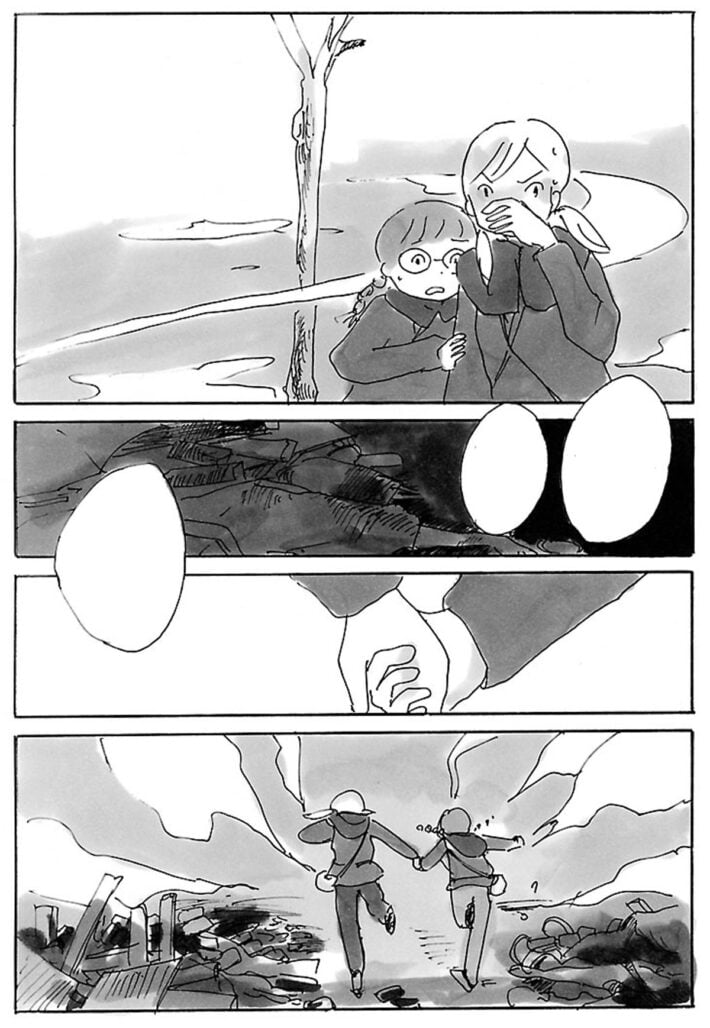 Based on a true story from WWII. Told close, like you should already know the where and the when and who is shooting at who. Won’t see a gun, or a flamethrower, the hand that pulls a lever and drops bombs, but you will see the wounded succumb to fever and rot, those who fall in the field burn alive, the scattered pieces of friends that are left amidst the rubble after the smoke clears. The world may endure it, but in the hospital there’s no denying the devastation of war is brought home on the soldier’s body.
“History is already seated in the chair in the empty room when one arrives.” No, there aren’t many movies like Grave of the Fireflies, but there is a library’s worth of manga where school kids are full-stop thrown into the thresher. Manga publishing coming out of WWII was monitored and censored, so alas there is something kind of inherently counter-cultural about letting it rip on trans-generational trauma you’re not supposed to discuss. Poor schoolgirls, everyone is out to get them everywhere.
Kyo boils them alive. It’s what the industry requires: some must be spared so that there can be future crops, but most never emerge from their cocoon. So, too, the machinery of war. The heaps of innocent bodies are the price of victory. Like the partisan war film Come and See, Cocoon concludes that there is no resolution that comes from combat that can justify its atrocity. The dream is for the cycle to end (fight war not wars). Can survivors create a different future, where no one is subjected to violence and oppression and other costs of business? Let’s hope.
The soft intimacy of the art reminds me of the indie manga I’ve come across from Glacier Bay or Popotame Books, but also Land of the Sons or even Geneviève Castrée. There’s a Euro tone, similar to how ligne claire style attempts to take a silly, classic aesthetic seriously. Refined and cartoonish are not contradictory; see here. So many contemporary indie cartoonists have come up reading manga as much as any other comics that the twee take on a serious subject in Cocoon fits right in with the times. At home with a publisher like Peow2 or Bulgilhan, if not Drawn and Quarterly.
Visually, Cocoon hearkens to the fabricated solemn and subdued art many documentary comics use to set their subject matter apart from the funny animals and spandex-clad violence that the comics medium is mostly known for. Kyo’s loose, almost unfinished quality to her drawings makes the story being told feel personal. You don’t need to underline a war crime for it to have gravity. If anything, the fragile nature of the look strengthens the idea that the tenderness in the world that existed before the coming of war might also outlast it.
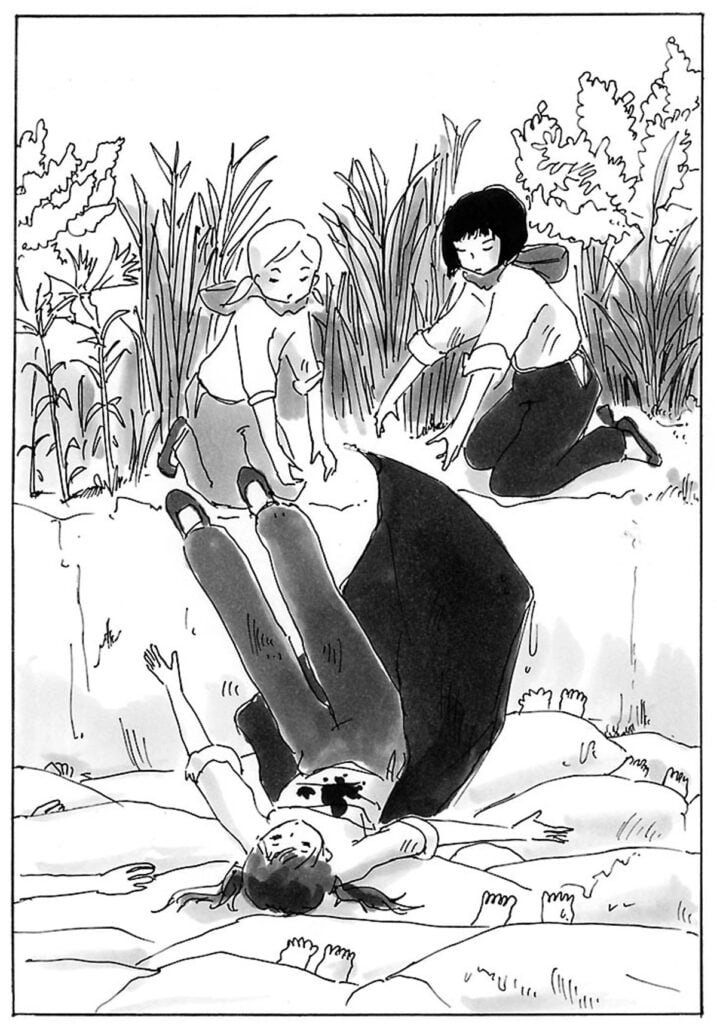 The telling of the story stumbles for me as a reader, but in a way that appeals to me looking back on the book. Some aspects are handled well, but on some it’s hamfisted. Cocoon was heavily researched, sometimes struggling with fitting all the true stories into the narrative naturally. Cocoon does a great job of showing how quickly things escalated. How swift the danger came, and how serious it was.
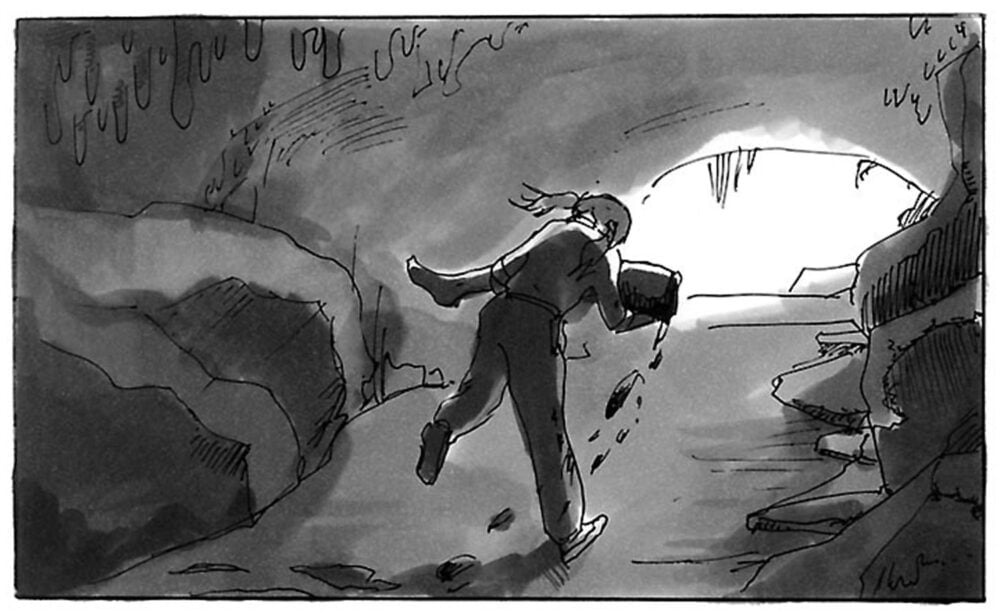
If it is burdened with the responsibility of getting the story history-accurate, it sings when it dreams. Kyo asking herself what she would do in the situation the characters are in produces moments more enlivened than the ones reporting established facts. Cocoon is respectful, careful. But what it has that nothing else can match isn’t elevated accuracy or expanded empathy. It’s Machiko Kyo.
Living in an age of constant, unmasked war crimes, it feels timely to see a story centered on unarmed civilians being treated as combatants. That said, this is a story about Okinawa. Kyo put in the research in order to imbue her characters with an authenticity of their time. Where you live is suddenly behind enemy lines. Don’t need context for that to be scary as hell, but stripping away its context to enable a statement is missing the point.
It’s not about war. Yeah, it’s set during one, filled with invading soldiers and boiling chrysalides. But it’s about a girl. This is her story. Her shoes we need to try to walk in, not the other way around.
 My grandfather wasn’t old enough to see combat in WWII, but served in the navy at the end of it, bringing soldiers home to the US from across the Pacific. The kids in this book would’ve been maybe a couple years older than he was at the time, but about his age. So then I think about the folks I grew up with who were my grandparent’s friends. My grandmother’s best friend (a former librarian), who would watch me sometimes, and showed me Destination Moon when she learned I was into comics.
So, asks Cocoon, why the fuck are we shredding students? To go from burying bodies to being one yourself, left to lie where you fell, consumed by carrion birds. That schoolgirl will never get a chance to read any postwar bandes dessinées, let alone offer them to a child as an alternative to Spider-Man. Despite Cocoon being heavy with despair, there is also hope for the future. There must be. If this is the cost of war, we need a new kind of peace.
Cocoon is available from Viz Media or wherever better manga and books are sold.