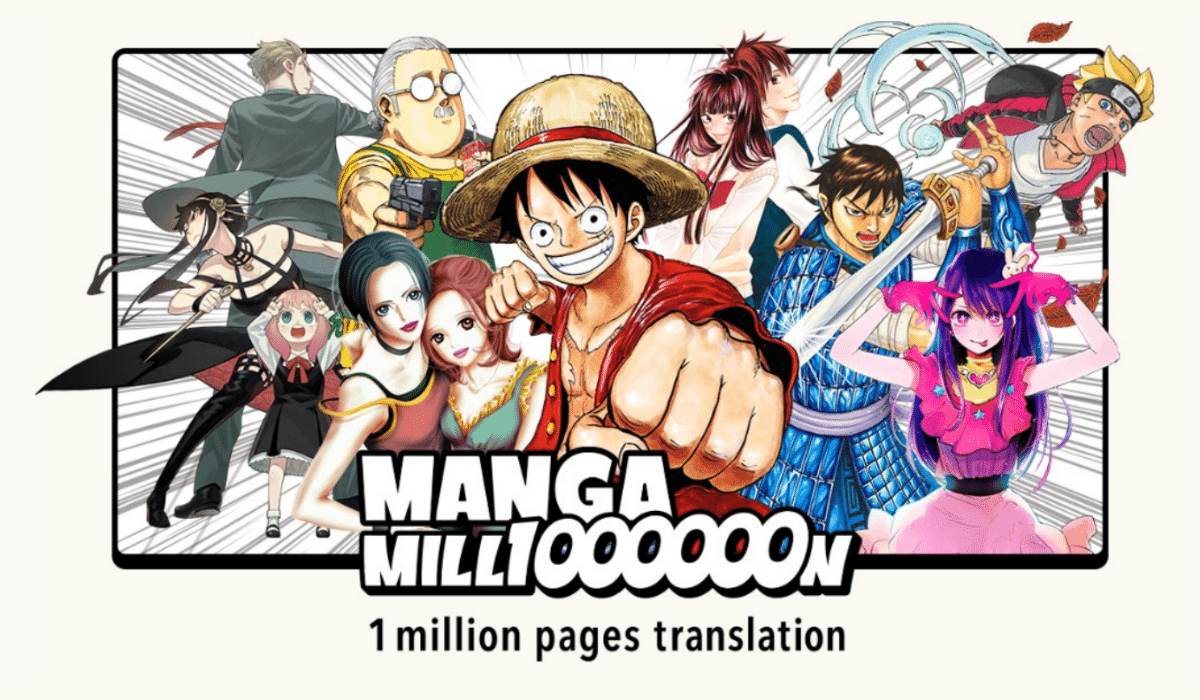

To celebrate the company’s 100-year anniversary, Shueisha just released MANGA MILLION: a new app with over a million pages of manga to read for free, in multiple languages. The app includes not just smash hit Shonen Jump titles but also dozens of titles that had never been translated to English before and titles that have been out of print for years or unavailable digitally. If you’ve always wanted to read Gintama, Papa Told Me, Kodocha or Kochikame, you have until December 2027 to catch up on nearly 400 manga. But… who translated all of this manga?
Though MANGAPlus Editor-in-Chief Shuhei Hosono confirmed in an interview with Anime Corner there was no AI used in translating all of these manga, readers have already spotted errors and awkward phrasing, casting doubts on that statement. They also noticed the number of vague companies credited for translation, lettering, and editing instead of human names.
One of these companies, Flitto Japan Inc., is explicitly collecting data for “high-quality LLM translation.” Even if they didn’t use AI for their translations, they almost certainly fed the scripts into their database, and if they did, it’s entirely possible the other companies did too.
Readers all over social media are expressing their disappointment with this turn of events.
“I really do want to be excited about this since they added Papa Told Me but I’m just so skeptical that AI really wasn’t involved…” wrote X user @/yuki_white12.
As pointed out by @/MangaAlerts, for every manga on Manga Million that already has an available English translation, the existing translation is linked to directly when possible, and the translators are credited properly. For titles that hadn’t been published in English before, the translators are not credited. When translators are not credited by name, readers tend to assume a human translator was not involved at all.
A human translator who worked on multiple titles for the Manga Million initiative tells The Beat, “The most I can say is that there are human translators who worked on these that are not being credited. And that they are for the most part told they cannot go public with saying they worked on manga being launched in this initiative—Shueisha is likely using different contractors to work on this and I’m assuming no one at any of these are allowed to put their name on the products.” The translator requested anonymity due to their contract.
On the about page of the Manga Million website, a sentence-long acknowledgement thanks the work of localizers for making this manga available to the public: “We would like to express our heartfelt gratitude to everyone involved, especially the translators, letterers and licensees, who have supported this project.”
But as many have pointed out, a ‘thank you’ is not the same as credit.
“Withholding named credits for the individual translators and letterers (and other team members) involved is an exploitative and outdated practice primarily meant to hinder professionals from finding more (often better-paying) work in the industry,” manga letterer Lys Blakeslee, who has worked on dozens of titles across publishers (though not as part of this initiative), tells The Beat. “It furthermore seeds distrust in the companies involved, at a time when many readers are especially wary of AI and machine translation. If humans did indeed provide the incredible feat of localizing these hundreds of manga titles into dozens of languages, their individual contributions should be proclaimed and celebrated.”
As far as the dozens of languages go, while it’s likely that most (and ideally, all) English titles were translated by people, smaller languages like Georgian and Armenian appear to have been handled by AI. Rafael Zaiats, a professional manga letterer who reads Georgian, Armenian, and Ukrainian in addition to English, took a look at One Piece translated to those languages on Manga Million by Flitto Japan Inc.
Zaiats said some SFX appear to be transliterated from English, rather than using equivalent local onamatopoeia, and the hyphenation is inconsistent. Zaiats’s friend, a native Georgian speaker, says the translation “Doesn’t feel human at all.” It appears as if the translators were working off of the English edition of One Piece rather than the Japanese.
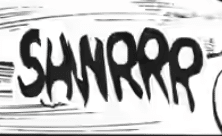
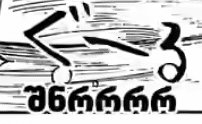
Zaiats shared an example of where it appeared the Georgian text was just transliterating English (images below): “In English this is SHWRRR that could be confused with SHNRRR and Georgian indeed says SHNRRR.”
It’s important to credit legitimate human translators for their labor, and it’s just as important for legitimate human translators to do that labor, and be able to do it as best they can. Translating from English means an extra layer of separation from the source material, and for the new titles, it means the English translators have shorter deadlines if their work has to serve as the basis for all of these other languages.
Without full transparency regarding the production process for this endeavor, Manga Million will likely continue to face controversy for the duration of its existence.