
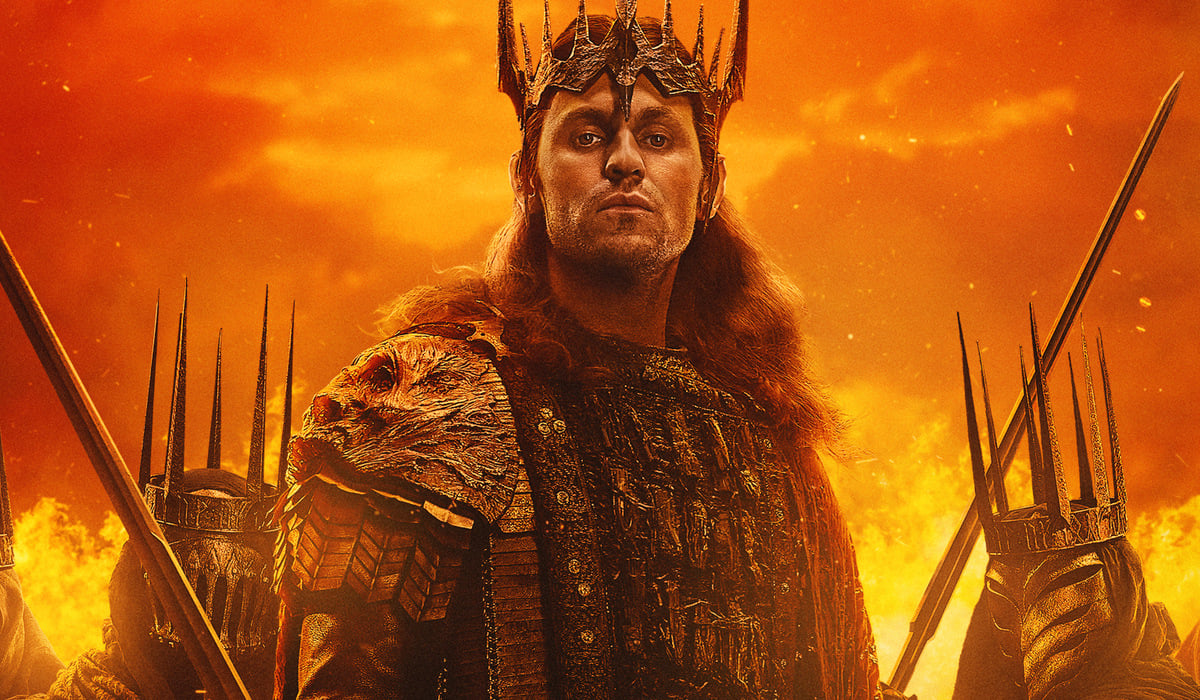

Welcome to The Beat‘s breakdown of The Lord of the Rings: The Rings of Power season three. Picking up five years after season two, the new season of Prime Video’s prequel to J.R.R. Tolkien‘s novel finds the Elves and Sauron (Charlie Vickers) at war, while the Dark Lord seeks to forge the One Ring that will grant him power over all the others (and one day come into Frodo Baggins’s possession).
The first four (of eight) episodes dropped on November 11, and the remaining ones will be released in two-part installments on November 18, and November 25. So join us for a mix of recap and review of each chapter, sharing our thoughts as a fan of the books, films, and series, their merits, flaws, and how they engage with Tolkien’s themes and ideas; in other words, there will be spoilers.
“Marnûkh” (written by J.D. Payne and Patrick McKay, directed by Charlotte Brändström):
After a helpful catch-up courtesy of Galadriel (Morfydd Clark), we find Sauron attempting to forge the One Ring in Barad-dûr, his attempt at which incinerates an Orc goaded into wearing it on his behalf. Sauron, whose hair is dark again, and sporting visible stubble, is clearly not sleeping, and delusional, hallucinating Celebrimbor (Charles Edwards)’s corpse — now a trophy on his wall — taunting him for being unable to crack his secrets. He orders the Orcs — including the smart and charismatic Marnûkh (Adam Young) — into seizing at least one of the Elven Rings, to help him finally accomplish his goal.
But that’s not the only preamble, as we get a flashback to the First Age, where Galadriel meets her husband Celeborn (Jamie Campbell Bower) for the first time at a celebration. He discovers her dancing alone in a glade, although she claims to have been practicing sparring. In an amusing sequence, the two proceed to spar, after which he tells her his name. This is a nod to how Tolkien himself met his wife Edith, with the change from dancing to sparring presumably made to distinguish their story from Beren and Luthien, whose first encounter Tolkien modeled on his own.
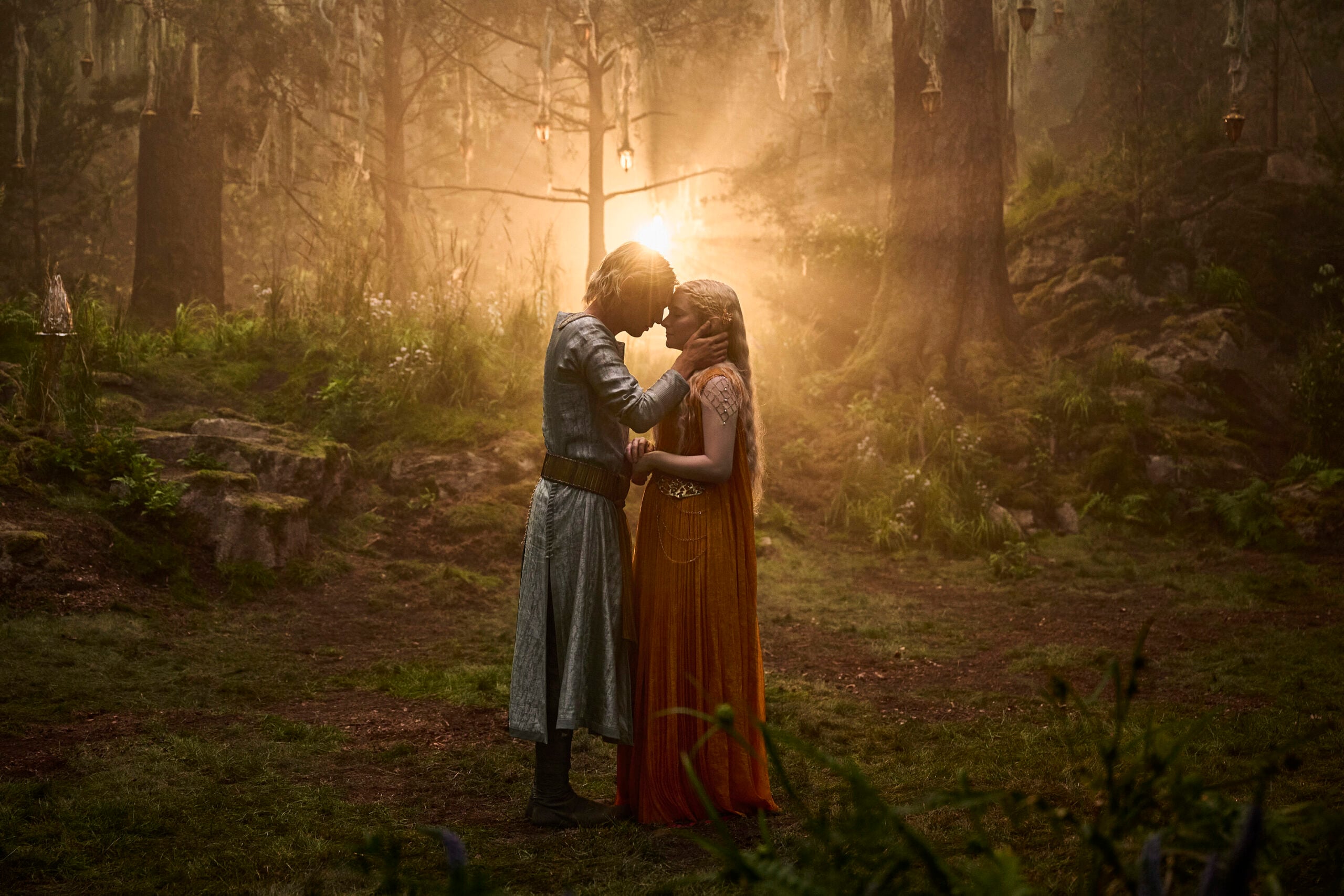
The two proceed to dance until dawn, and Celeborn proposes to her, after expressing hope for a post-war life resembling what will become their kingdom of Lothlorien. We then cut to the supposedly widowed Galadriel in the present day, battling Orcs in Eriador with Arondir (Ismael Cruz Córdova), and a subsequent contingent of Men led by a Nazgnagôl (one of the Nine who becomes the Ringwraiths, or Nazgûl). Already, we get a sense of how much darker this season is, with Arondir forced to kill a boy who reminds him of Theo (Tyroe Muhafidin); we’ve always known Sauron had Mannish troops, but it’s jarring to watch Elves dispatch them instead of Orcs.
At the hidden refuge of Rivendell, Galadriel informs Elrond (Robert Aramayo) the Nazgnagôl was the King of Lossoth, who had promised to help the Elves until Sauron turned him. (Lossoth is in the frozen lands of Forodwaith, something reflected by how the Nazgnagôl wears furs to protect him from the cold.) She pleads with Elrond to appeal to the Men of Númenor, whose royalty is descended from his mortal brother Elros, for help. After a nightmare about Sauron (still in his Annatar era), she finds Arondir is also having trouble sleeping, and gives him leave to return to Theo in the Southlands.
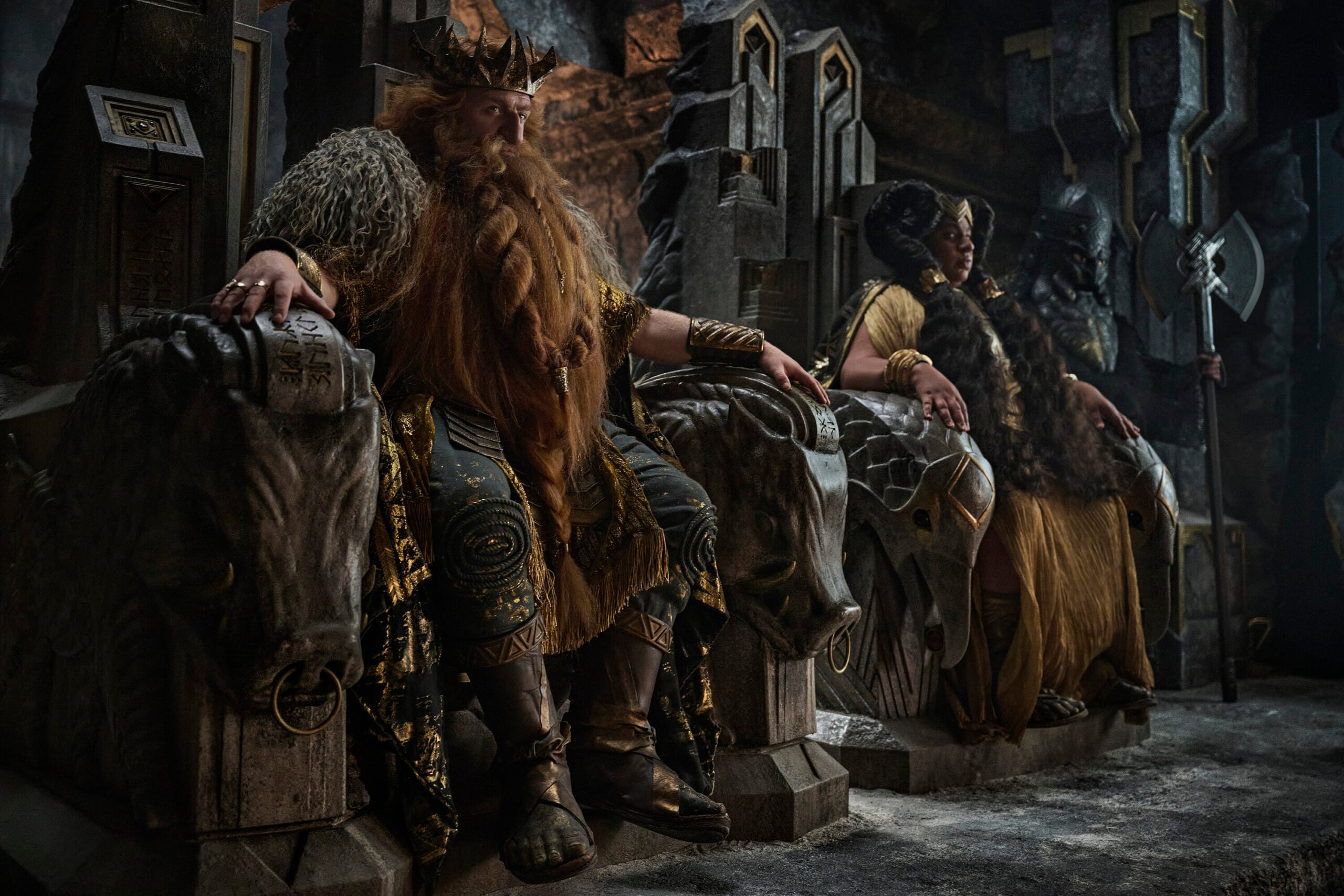
That’s surprisingly it for Galadriel in this episode, with the focus in the north switching over to the Dwarves in Khazad-dûm. King Durin IV (Owain Arthur) wishes he could join the Elves in battle, but can only help discreetly, secretly giving them new arms and armor, as his subjects wish to stay out of the war. The other Dwarven kingdoms want the Rings Celebrimbor forged for them, but Durin and Disa (Sophia Nomvete) can only tell them they are instruments of Sauron, and have been locked away until they find a means to destroy them.
The Dwarven storyline centers on the chaos caused by the coming of Durin’s obnoxious older brother Thráin (Eddie Marsan), who was away in the Iron Hills (next to the Lonely Mountain Smaug will occupy), and Durin’s kids Gerda (Amber Mendez-Martin) and Gamli (Lee Braithwaite) being old enough to be involved in courtly affairs. Poor Narvi (Kevin Eldon) is sent back and forth between the higher and lower levels of Khazad-dûm while Thráin insists on holding a court of his own in an inn: it’s funny, but golly, is Khazad-dûm really that low on manpower?
Despite a heart-to-heart between the two brothers, where Durin discloses how their father died, Thráin is clearly a sleazebag who still holds “feelings” for Disa (or Didi, as he calls her), invading her personal space while Durin attends to the Elves. When Thráin catches Durin in the act, the two get into a brawl, only to stop when Marnûkh himself appears, surrendering himself with a message for the Elves. Over in Lindon, Gil-galad (Benjamin Walker) and Círdan (Ben Daniels) are shown the Orc by their Rings, and ponder what it means, while coming to the conclusion they need Númenor’s help.
Back in Mordor, things get more brutal, as we see how Sauron recruits the Nazgnagôl, making would-be servants fight to the death for a Ring. Having no interest in an alliance with the Dark Wizard (Ciarán Hinds) who rules Rhûn, he instead recruits his servant Khamûl (Zubin Varla, as the only Ringwraith Tolkien gave a name), curing him of the affliction the wizard supposedly cursed him with. (Sauron is an unreliable narrator.) Before leaving Barad-dûr, Khamûl tells Sauron about Gandalf (Daniel Weyman); Sauron, who was already aware of the good wizard opposing the Easterlings, tells him to concentrate on gathering his troops, while he deals with him.
The episode closes with Southlanders coming to pledging their loyalty to Sauron, in exchange for ending their enslavement by Kemen (Leon Wadham)’s Númenoreans. Among them is Theo, who obtained the message Sauron originally sent in the hope Kemen would be interested in an alliance. Poor Theo, who looks utterly feral now, has really been through it, having been whipped repeatedly to cut down trees, but I don’t think he realizes that in the long-run, Sauron is not the better devil he knows.
All in all, The Rings of Power remains sumptuous TV, compellingly performed, shot, scored, and staged, that genuinely feels cinematic in a way a lot of shows produced for streaming still don’t. It is so cool finally seeing Sauron in his Dark Lord era, on his throne within Barad-dûr, the Nine in action battling Galadriel, and the growing darkness across Middle-earth pushing the limits of the TV-14 rating.
However, even holding off on checking in with the characters on Númenor itself, and the Hobbits reportedly on hiatus this season, it still feels like it’s struggling to balance all the characters and settings. This episode, which (to be clear) is 73 mins, is titled “Marnûkh,” yet the Orc doesn’t accomplish his goal of speaking to Galadriel (who, as mentioned earlier, bows out surprisingly early) here. No wonder Amazon dropped the first four episodes at once!
Check back soon for our thoughts on subsequent episodes, and as always, namárië.