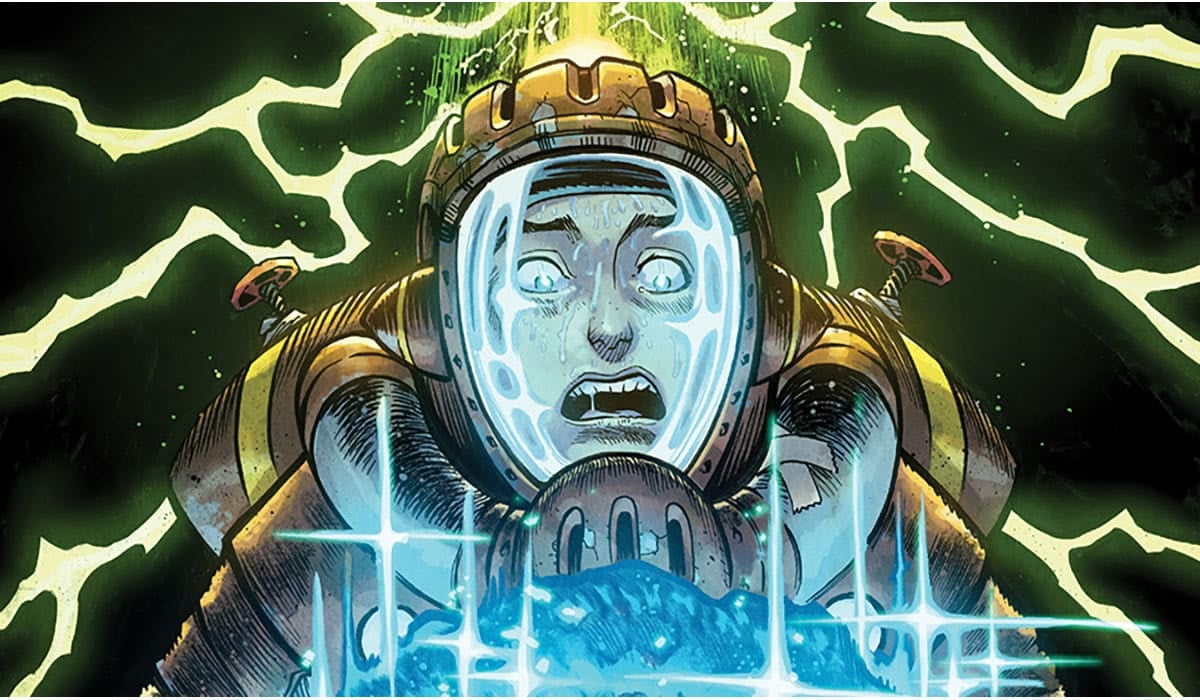

For fans of scifi/horror thrillers, Ignition Press’ series Innards is a top choice. Written by Rob Guillory, illustrated by Sam Lotfi, and with colors by Jean-Francois Beaulieu, the book occurs after a nuclear attack where humanity’s last energy resource is buried deep beneath the Earth’s surface and only accessible by teleportation and navigation through a most difficult subterranean maze.
The Beat met up with Guillory at Ignition Pavilion during San Diego Comic-Con 2026 for details.
DEANNA DESTITO: So let’s talk about Innards.
ROB GUILLORY: The premise is it’s in a future where the oil reserve has completely run out for various reasons, so they have to find a new energy source, and the only thing they could find is this rock deep in the earth, and the only way to get to it is by teleportation. But it’s not like your fancy Star Trek teleportation. It’s like crappy, redneck oil field teleportation where you lose limbs and body parts, so it’s a very risky job, but it pays very, very well.
The story is about the miners who have their own reasons for taking the work, support their families, wealth, that sort of thing. But when they get down there, they find that there’s stuff down there. There’s more than they bargained for. There’s something bad down there that they have to deal with.
DESTITO: How has it been working with Ignition Press?
GUILLORY: There is a structure. That’s nice. I like process, I like systems, so I like it. But at the same time, I like the freedom to be able to say no. The editors are great, but I also they’re open to negotiation, which I like. So I can go to them after they give me a note and say, well, I’m actually thinking this. So there’s a level of trust they have for me that I appreciate. So it’s been great. It’s just enough of a soft touch, but they leave me alone, which isn’t really the important thing.
DESTITO: How about working with Sam?
GUILLORY: Oh, Sam’s great. I mean, I’ve known Sam for like 15 years or so, and he’s dramatically underappreciated as an artist. I’ve always thought so. This is my second time working with him. And he’s a beast. I mean, he’s a genuinely sweet guy, family guy, immensely talented. It’s very easy working with him and he makes me look really good.
DESTITO: Do you feel like having that rapport helps?
GUILLORY: Oh yeah.
DESTITO: Like you’re in sync from the beginning.
GUILLORY: Yeah. I mean, everything in comics and really in the industry is all relational. I’ve worked with people I don’t really care for. That’s hard. In this case, I like Sam, so it makes everything way, way easier.
DESTITO: What else do you have coming up?
GUILLORY: Well, we just finished a Kickstarter for my next Image book, Ghost Brawler, with my Chew collaborator John Layman. So that just wrapped up. That’s going to come out from Image next year, probably in the spring-ish. And I have two more series coming out from Ignition. They haven’t been announced yet. The second one I’m writing right now, I’m still debating if I’m gonna draw that one or not.
DESTITO: Have you done writing and drawing before together, and how does that compare if you’re only just doing one piece?
GUILLORY: Oh yeah. I mean, my Chew follow-up was a book called Farmhand that I wrote and I drew.
And I mean, that was the biggest— that was very educational. I cut my teeth on that book as a writer, and writing for Sam is dramatically different than writing for myself. To some degree, when I write for myself, it’s kind of like two people. Basically what I write, I can’t do them both at the same time, write and draw. So usually what happens is I’ll take a block of time, maybe a month or two, and just write, focus just on scripting and then months later I’ll go and draw it. And by that point, there’s enough separation from the script that I oftentimes don’t remember what I wrote. So it is kind of like working with a different writer.
So as an artist, I’ll go back to my own scripts and I’ll change stuff on the fly and say, you know, I don’t know what this guy was thinking, even though it’s me, right? It’s like you’re not thinking about some of the logistics when I’m actually writing out the story, I’m not thinking about, eh, too many panels on the page, too much dialogue. I’m editing myself as the artist. It’s a weird back and forth. But when I’m writing for Sam or for another artist, I have to give some things up. You know, whatever Sam’s going to turn in, it’s going to be awesome. But it’s not gonna be what’s in my head.
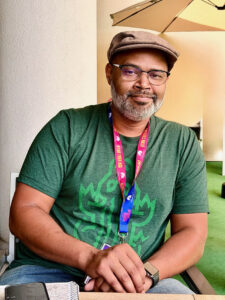
And at first I think it was a little weird, but at the end, as you do it more, I think I’ve gotten to a place of just being open and just saying, that’s not what I pictured, but this is a relationship, this collaboration. So there is a give and take. I want him to be happy and to be fulfilled in it and not just be a vessel for my thing. So yeah, there’s a level of release.
I have to like give that up and I don’t always agree with it. But when I was doing Chew with John Layman, it’s the exact same thing. We did 64 issues, and I know for a fact there are things I did that he didn’t love, but he knew that, well, I’m not gonna fight Rob on this. Like, just let him do his thing. It works. It’s our thing together, and we’re collaborating.
Stay tuned to The Beat for more news from SDCC ’26.