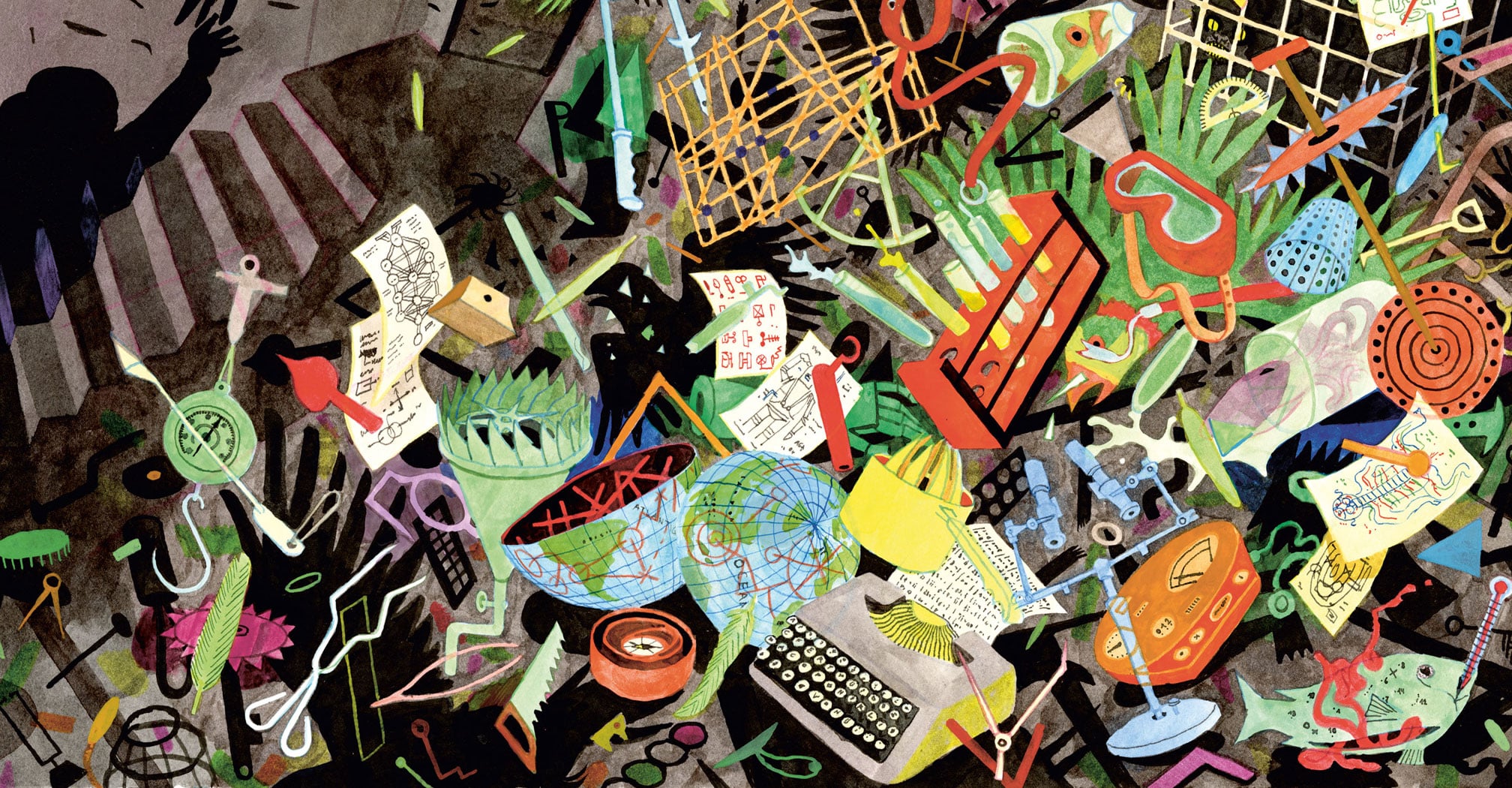

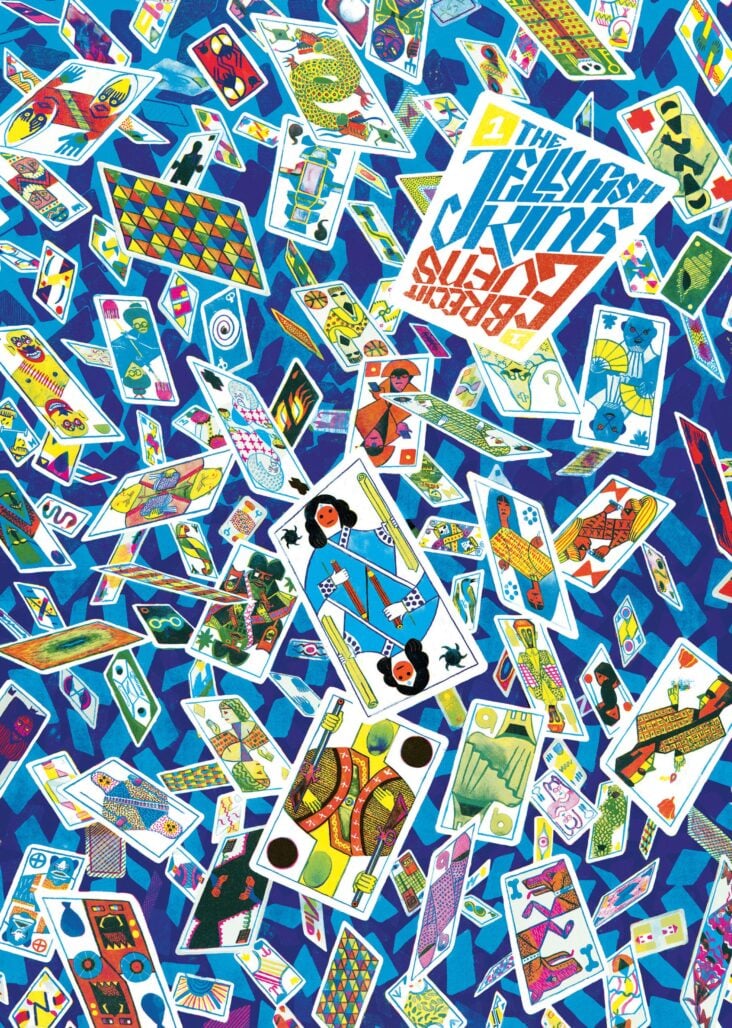
Brecht Evens is a Belgian cartoonist living and working in Paris who is known for his painted graphic narratives which mix the mundane and the mystical, including Panther, The Making Of, and The City of Belgium. His most recent work, The Jellyfish King, is the first volume of a proposed trilogy following the life of Arthur, an imaginative young boy growing up under the care of a erratic father who is mired in paranoid delusions. It was translated from French by the author in collaboration with the cartoonist François Vigneault, who also hand-lettered the English edition, which comes out on October 6 from Drawn & Quarterly.
Recently Evens and Vigneault talked by video about the mixing of text and images in the creative process, the slippery relationship between imagination, paranoia, and psychosis in an increasingly conspiracy-obsessed world, the challenges of balancing simplicity and detail in a visual narrative, and how recently becoming a father is influencing Evens’ work on the future volumes of the series.
This conversation has been edited for clarity and length.
François Vigneault: I was just rereading The Jellyfish King, and one of the very first things that the reader is going to see is the dedication, which is to your father, and it says, “To my father, who did not inspire this book.”
Brecht Evens: Yes. As you know, the French dedication is “Pour mon père pleinement présent,” or “To my father, fully present.”
Vigneault: Yes.
Evens: By which I was trying to contrast him with the, at points, very absent father in the book, but I think many people understood that as my father being fully present in this book, so I made it a bit more explicit in the English version. I’m just trying to disconnect from suggestions of this being an autobiographical book.
Vigneault: I’m sure he appreciates that you made that disclaimer at the beginning! So, what was the inspiration for this book? The Jellyfish King is a sort of Bildungsroman, it’s a story about fathers and sons, about allies and enemies, about education and ignorance. What was your inspiration for it?
Evens: Well, the first germ of this book turned up in a notebook, in 2012. I was between books, and I often make little gestures at writing, sometimes just a phrase, or sometimes just a little idea. In this case, a little paragraph where a kid is telling us about his summer. It reads like a writing exercise he would get after summer vacation. And what he’s telling is a mix of things you would expect a boy to say, and things you would expect a boy to make up. Like, there is a garden, and there’s a snake pit to trap burglars in it… stuff like that.
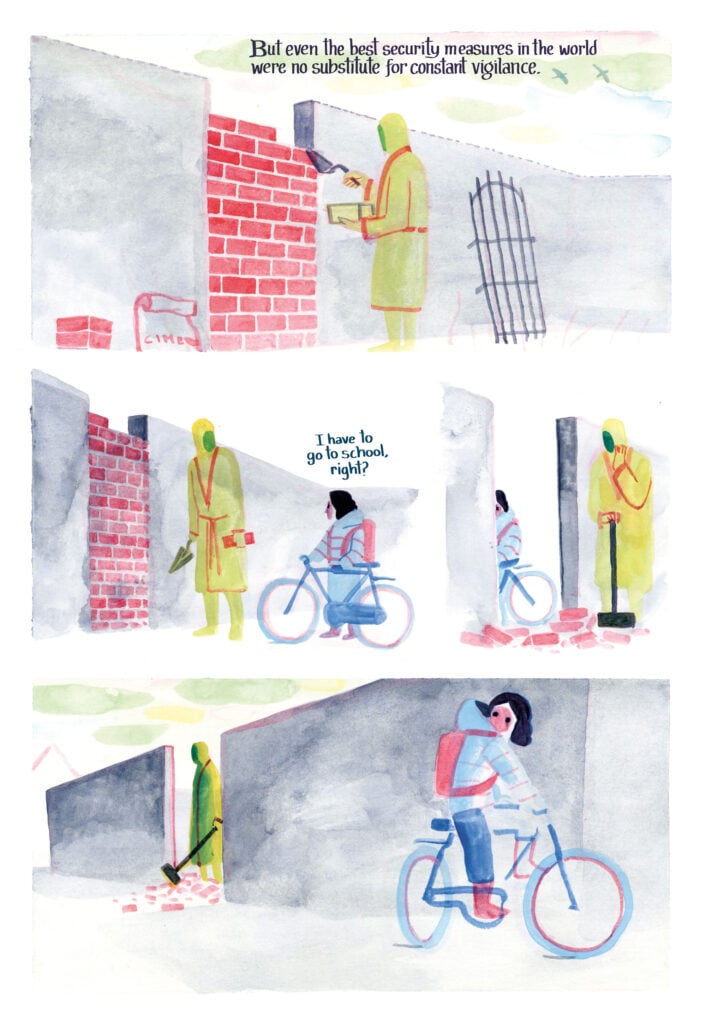
Sometimes the ideas in old notebooks inspire me later on. After The City of Belgium, I opened all my notebooks again. By that time, I was wondering if I could make a story inspired by a psychosis that I had, a paranoid experience, in the state of which I believed that everything I saw concerned me personally, that ads, and signage, and all these things were messages directed at me personally. There was something very beautiful and rich about that experience, I wanted to use it.
But in my experience, I had this psychosis when I was on a fancy illustration job in Tokyo. Let’s say it was a very luscious setting, and a very privileged protagonist. Which is one reason why doing it, making it look a bit like the real thing, was a dead-end street. Also, something in a city context, a really extremely urban environment, full of stimuli, with the main character who interprets everything as important… That’s the recipe for a 10,000-page book!
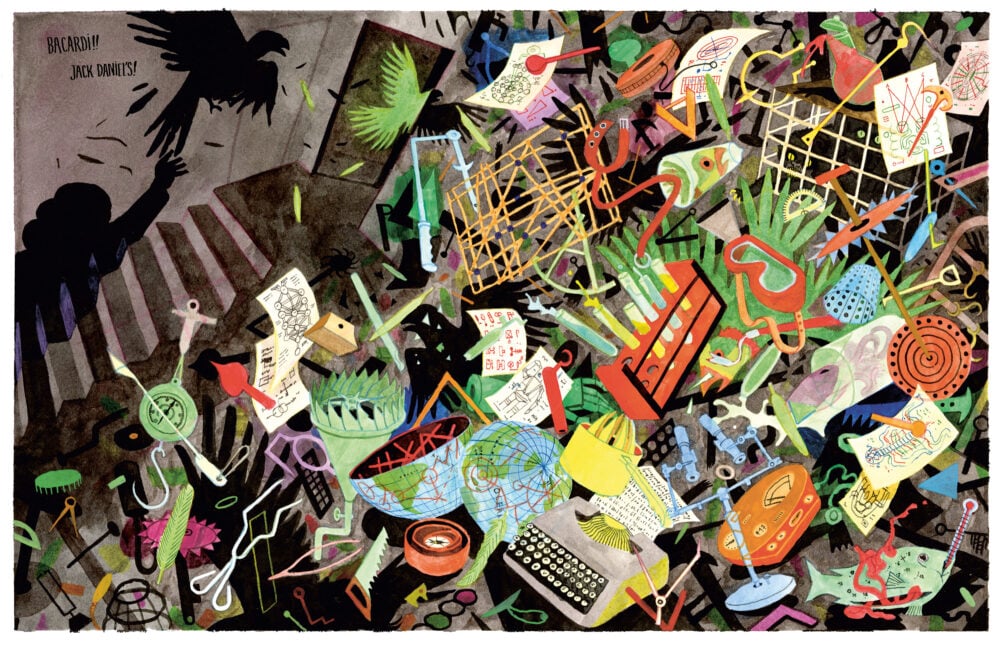
So, with that in the back of my head, I stumbled on the little paragraph with the boy telling his unconvincing, but also worrying story. You wonder what’s real, and you wonder “What about his dad? Is this all safe? What’s going on in this house?” I felt like that’s the character that can have the paranoid experience. And this boy character invited me to draw inspiration from my own childhood. I was a boy who made board games, made comics, of course, and had a much wider range of activities and interests than a lot of adults have, you know? I had more of a tendency to build things myself, to be a bit more of a Puer Universalis or “renaissance boy” as is mentioned in The Jellyfish King.
Vigneault: I can see that is very fertile for you, that imagination of the child and the different directions that you can go in. And I think many readers will remember their own childhoods when looking at the story, and a sort of sense of limitless possibility. But then you have all that being fed by a father who, as you mentioned, might be suffering from psychosis, from paranoia, who sees enemies all around him. This relationship between the father and the son, their imaginations or their psychoses are kind of feeding each other, and it goes in a more dangerous direction.
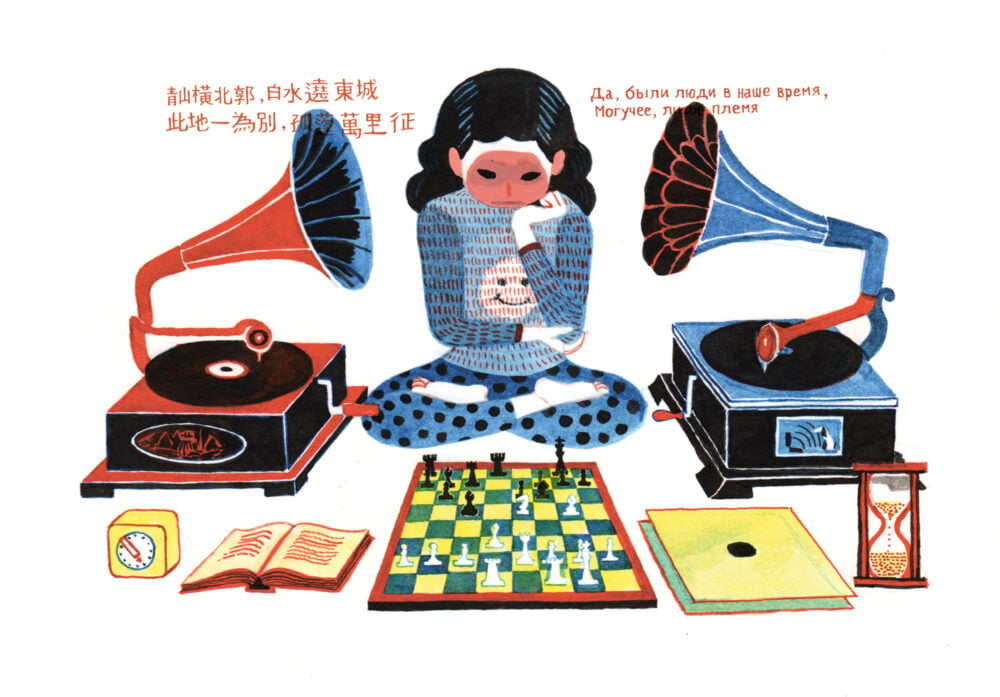
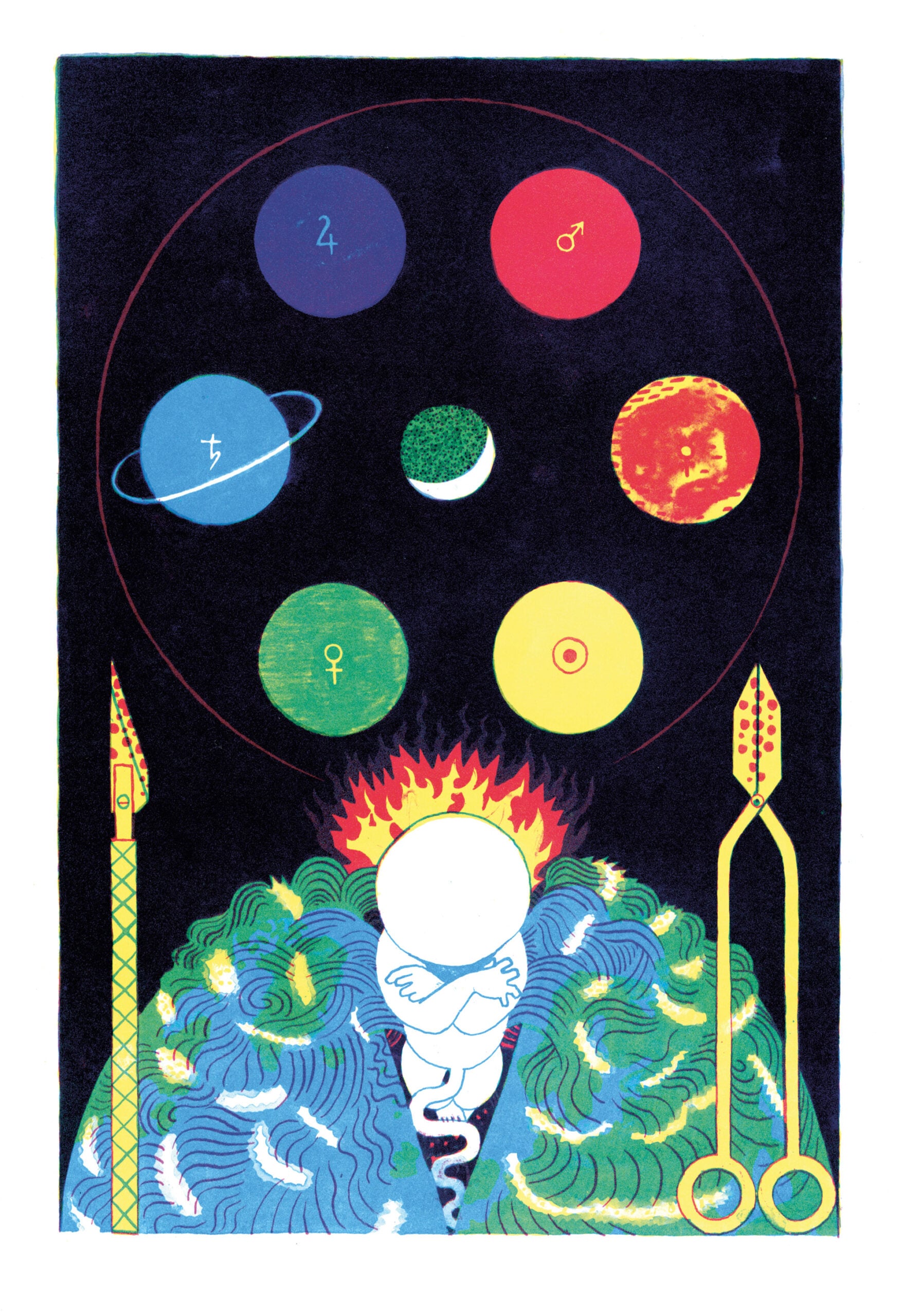
Evens: Yes, and there’s a feeling of escalation. In this way, it has some things in common with probably all my books, but it would be most obvious with Panther, I think. In the sense that we have an intense relationship between two characters. A relationship where danger and happiness mix and alternate, where there’s this tension, where there is risk, but also a loving relationship. Some very dangerous moments are also very tender, I think. I’m thinking specifically of the moment where the father operates on Arthur, or at least puts him in narcosis.
Vigneault: Yes, and Arthur at least believes that he’s been operated on, right?
Evens: Yeah, and he does wake up with a scar! But his dad really tries to, you know, put him at ease, and seems genuinely worried about his well-being. And this would not be the only instance ever of a parent inflicting hurt on his child with the best of intentions.
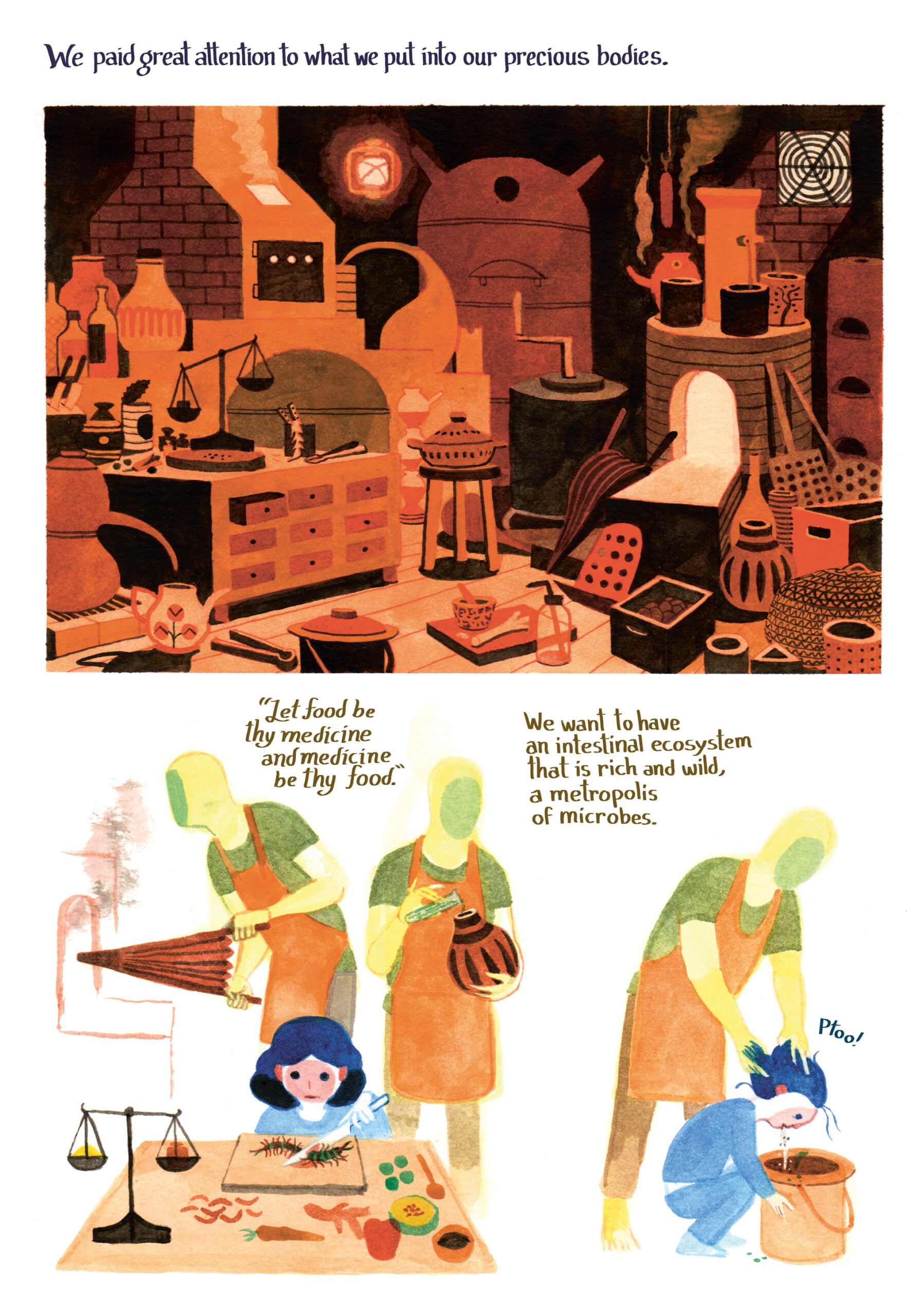
Vigneault: And you see this too in other scenes, there’s a very interesting and tender moment in The Jellyfish King with Arthur’s teacher, who is very concerned about him, and all of her words and even her way of relating to the world, it all flies right over Arthur’s head. He can’t interpret a quote-unquote “normal relationship” with his teacher. He has to interpret it through the context of a giant global conspiracy, and he can’t just have a normal interaction with her.
Evens: Yeah, he is a secret agent! He’s definitely taken his father very much at his word, and maybe even more than the father ever intended. That the world is all a sham, you know? That it’s all about a secret war. They’re on the battleground, and nothing is what it seems.
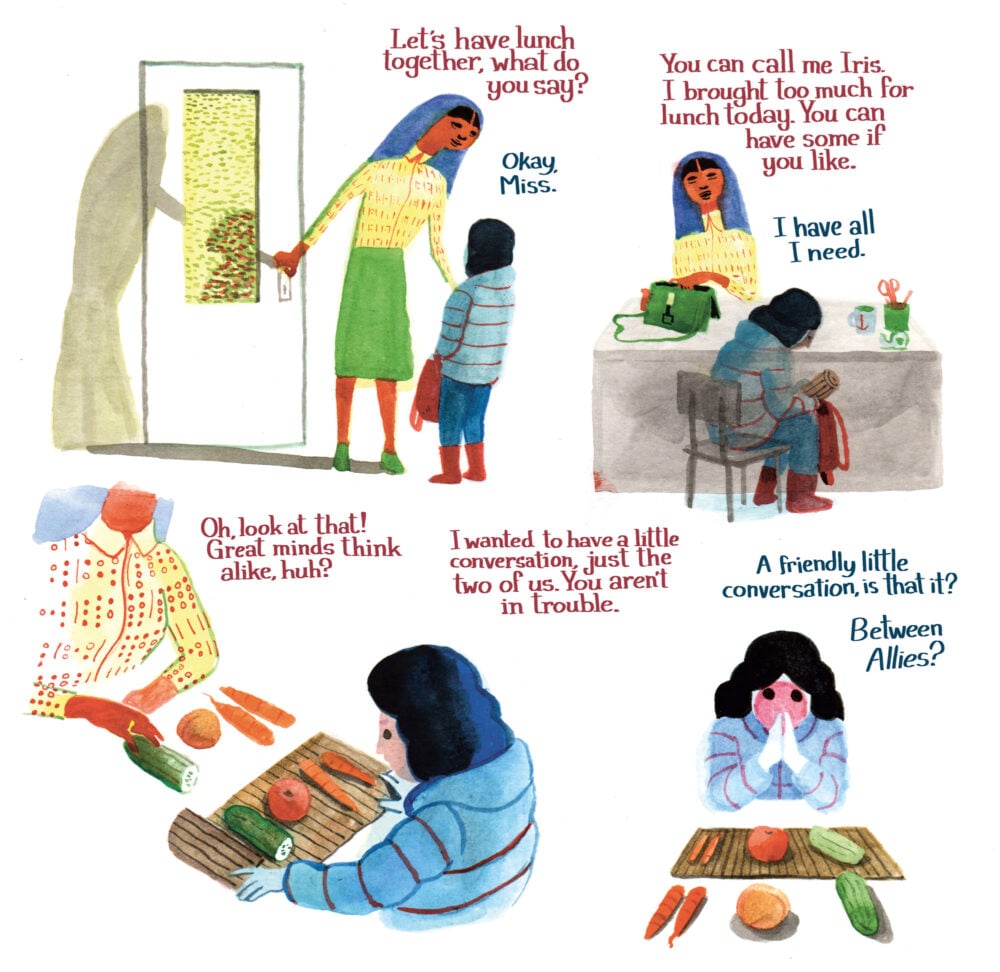
I think the best parts of the story work with some complicated stuff mixing together about observation and worldview. It’s a book that is drawn, and the fact that I drew the whole thing, that’s what makes this a specific “cultural product,” to say that horribly. When I think about what is the very specific quality of The Jellyfish King, it has something to do with that, I think. It’s trying something unique having to do with that worldview.
Vigneault: I was fascinated to hear you say that The Jellyfish King started as a paragraph in your notebook, because I was going to ask you a question if the images come first for you, or the words. Reading it I felt like the images were going to be coming first, and so I find it interesting that this started with the voice of Arthur—or a proto-Arthur—who is an unreliable narrator, but who also can’t rely on anything around him.
Evens: Having gotten this question a few times lately, I think that the good answer to “Does image or text come first?” is probably that all these stories come out of what we have in our head. The moment we put it on paper, it’s only then that we’re making some choices about text versus images. What we have in our head is, you might just call it “story stuff.” Writing is a very respected and much-used way of getting ideas on paper. Drawing is the slightly more eccentric little brother, you know? But even a novel writer—where that question would not be asked—probably has the same stuff in his head as I do, but it will go on paper as text immediately. For me it will use a bit of both. At first quickly, and then slowly, and afterwards, I clean it up, but at the beginning, in the notebooks, it’s all the same stuff, I think. It’s not clear how much is text or image.
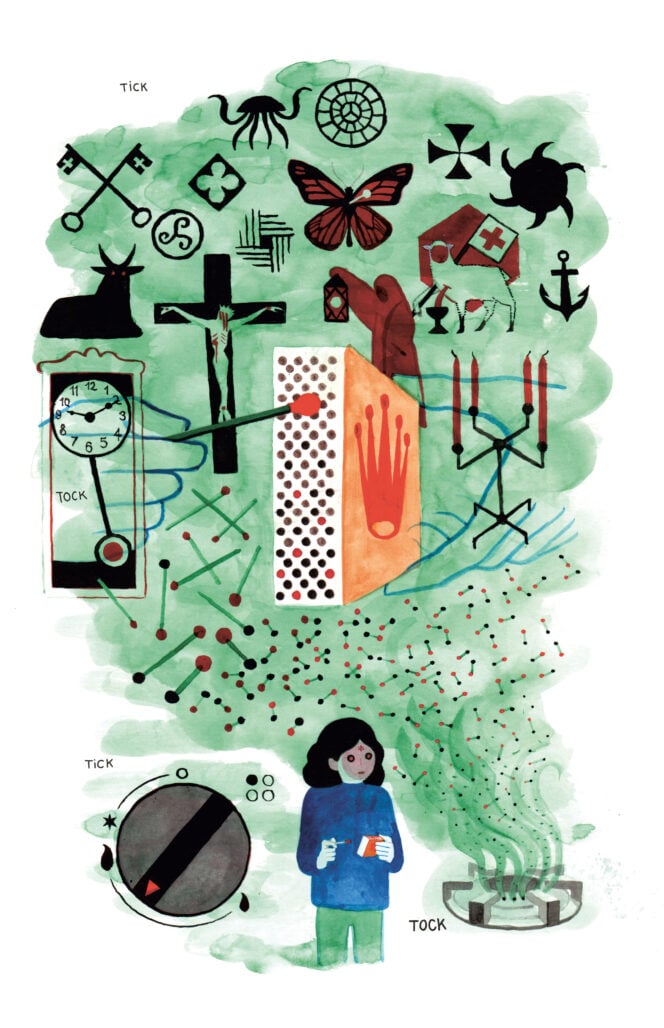
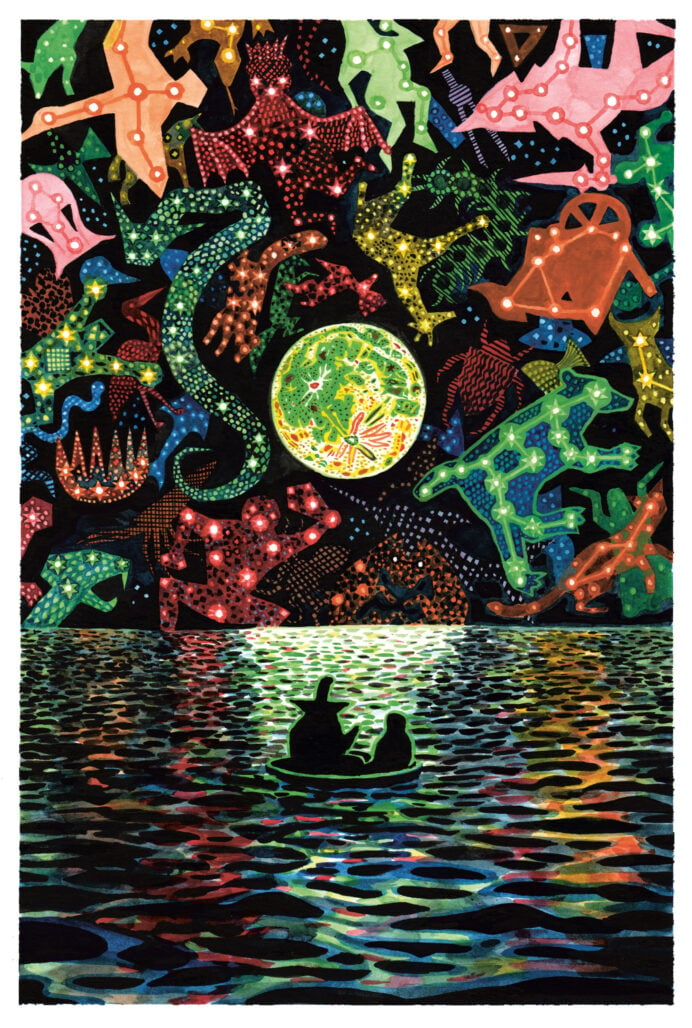
Vigneault: Your artwork itself has a sort of palimpsest quality, where there’s multiple layers of items, and little reference points, and little things for the reader to be looking at. Your environments are packed full of details. You can do a first read, and you kind of glance over things and say, “Oh, that’s a beautiful page.” But then you can do a second, and third, and be like, “Okay, there’s this item and where is this item entering into the story next?” This kind of quality makes it seem like you’re trying to capture the world in an encyclopedic way.
Evens: Yeah, there is more to be dug up in there on the second reading. I did take care not to put essential information in the second and third read, it’s more about background detail, or the little connections that are there. I try to be very purposeful about it this time. Other books I’ve made, some of them also have a lot of background detail, but here it is more personal.
Vigneault: That reflects what you were talking about, that paranoid worldview where everything has meaning and everything is about the main character.
Evens: Yeah, and I think for that reason, I wanted to be more consciously present in my decisions in the background, which, of course, triples the workload!
Vigneault: By chance, I’m currently reading The Name of the Rose by Umberto Eco.
Evens: Oh!
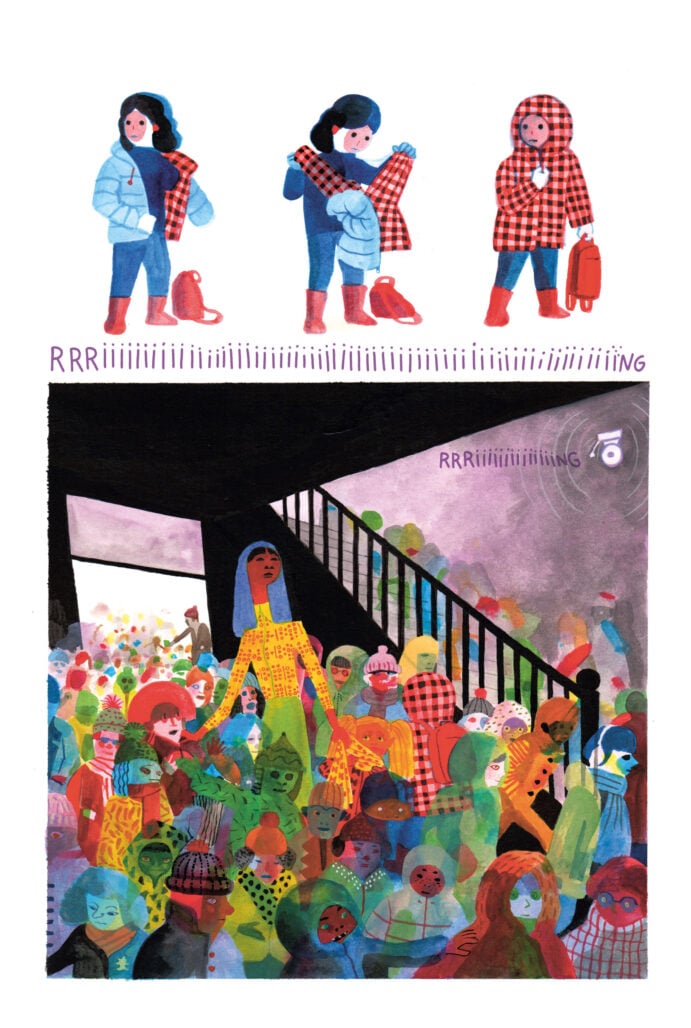
Vigneault: I remember when you and I were working on the lettering, you were often talking about the idea of an illuminated manuscript, the way the image and text interact. And The Name of the Rose connects with that, including calligraphy, translation, multiple layers of reference, religious ideology, Latin phrases, and things like that. It was surprising to feel a connection with your work on this book, and my work with you as a translator and hand-letterer.
Evens: Yeah, Umberto Eco is definitely somewhere on this little list of affinities and references I had. I had already read The Name of the Rose, and I read Foucault’s Pendulum on purpose, because I had heard it had a lot of conspiracy stuff in common with what I was doing. I’m not sure it really influenced The Jellyfish King in the end, but it’s part of a lovely big reading list.
Vigneault: The Jellyfish King is very much about ideas of conspiracies and machinations, about the world coming after the individual. We are living in a time of increasing paranoia, increasing conspiracy theories, it’s gone so mainstream. Like, what once upon a time was the purview of Thomas Pynchon novels and Ted Kaczynski’s manifesto has now become very much a part of the mainstream dialogue. How do you feel about the presence of your book at such a moment?
Evens: Yeah, the book was starting to develop a bit before this all became so mainstream. QAnon was, I think, when it became so huge, when we all had to get used to the idea of millions of people sharing conspiracy theories. And that provoked new writing about these subjects, new examples, and as an author I take a lot of interest in this, so I was happy to listen to podcasts about QAnon and stuff like that. But the trick is to watch out, not to get pulled into the orbit of these recent things, to not forget what the actual germ of this project is, which is not the thoughts of millions of Americans, you know? It’s something very much more personal. The real ingredients are the things that give it taste.
Vigneault: Yes.
Evens: But yeah, I remember at some point years ago being like, “Oh, maybe I should move this book along a bit quicker, because we can expect 20,000 conspiracy fiction books to come out right now.”
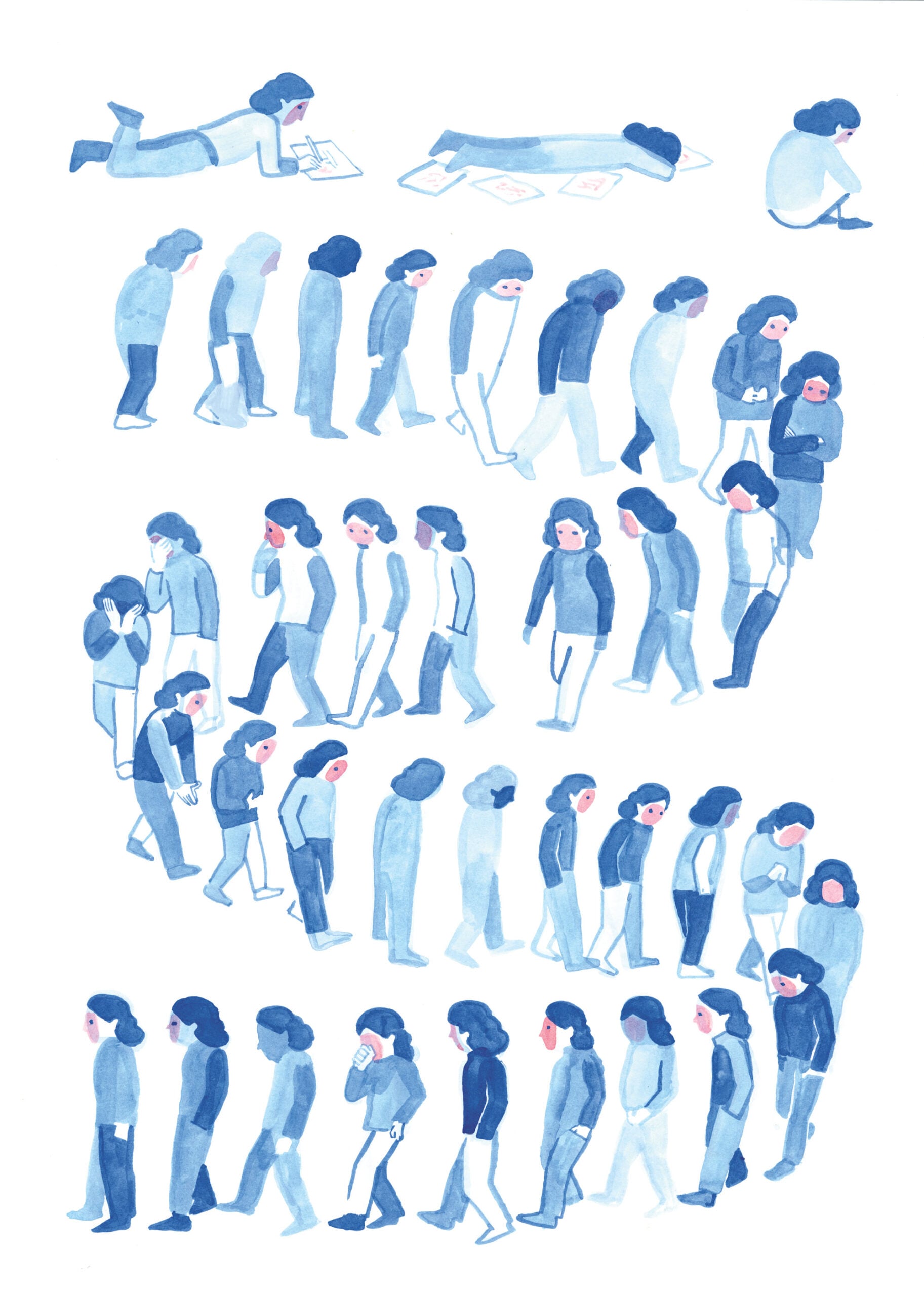
Vigneault: I think you’re right. It’s what’s personal that counts. In this book you’re really very much put into the mindset of a child, and we worry about the child, right? You’re afraid for him all the time, and I think that that’s one of the powerful things about the book.
Evens: You’re right. A big part of the mechanism of the book is that it’s a kid protagonist. Arthur imagines himself as up against big things, you know? Up against big evil. And since he’s a kid, he is, in reality, up against big things. Everything is bigger than him, he’s dealing with adults and things like that, so it’s doubly true. If the paranoid protagonist would have been someone like me, it would just be like, “When is this guy gonna come to his senses?” With the kid, he’s still gonna be up against a big, scary world, in any case. And half-jokingly, I compare it a bit to what makes The Lord of the Rings work. It’s probably not a coincidence that the protagonist is a child-sized character.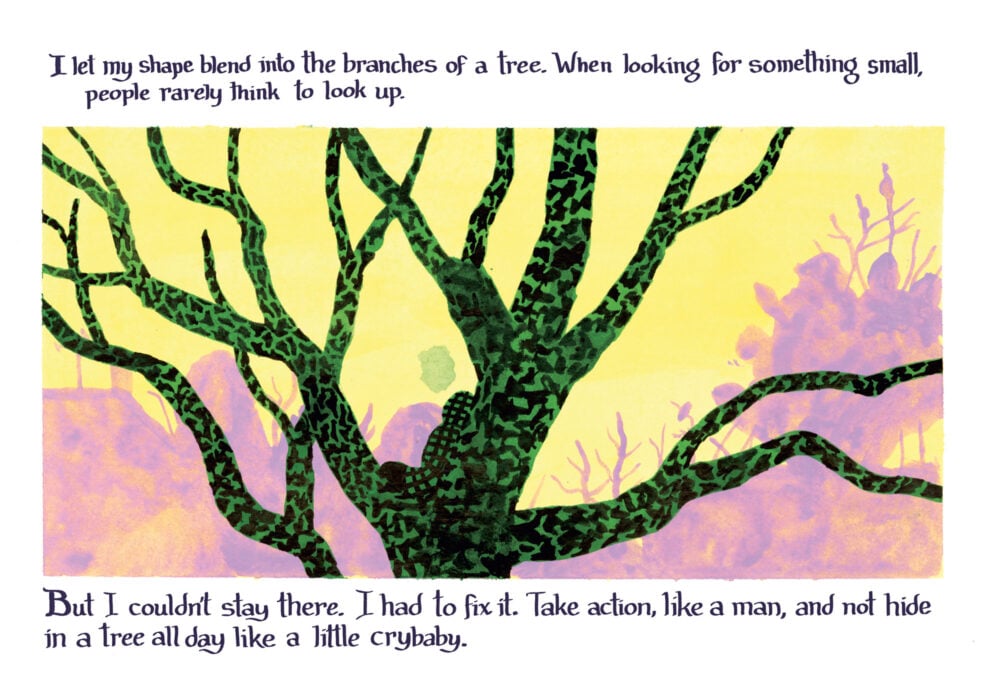
Vigneault: And the danger is not imaginary. A child did not create the world that they live in, and yet they have to learn to live in it, they have to learn to navigate it, and they should fear it in some ways, but they also have to have some sort of hope.
Evens: Maybe with conspiracy theories becoming so mainstream, and all the dark places world politics has been going, it all probably influences my thinking about the book. I think that for the moment, this island on which the story is taking place is still narratively protected from some of the goings on in our world. I think this book could have taken place in the 90s, or something like that, easily. It still seems like this is a little part of France where things are going pretty fine, and there’s normal politicians at work. Which is something that I’ve been thinking about lately. That’s another layer that I hope will not complexify the work 10 times again.
Whatever I do, whatever amount of realism I put in there, it’s still a caricature. It’s always gonna be a caricature, even if I will have worked 15 years on this trilogy. Because it’s a comic book, there will be all these little choices done for legibility, clarity, beauty, aesthetics. To give a stupid example, if I draw a coffee machine, I will probably draw a very archetypical coffee machine, so that the reader gets it quickly and, you know, is along for the ride. I will not be looking at some recent design of a coffee machine.
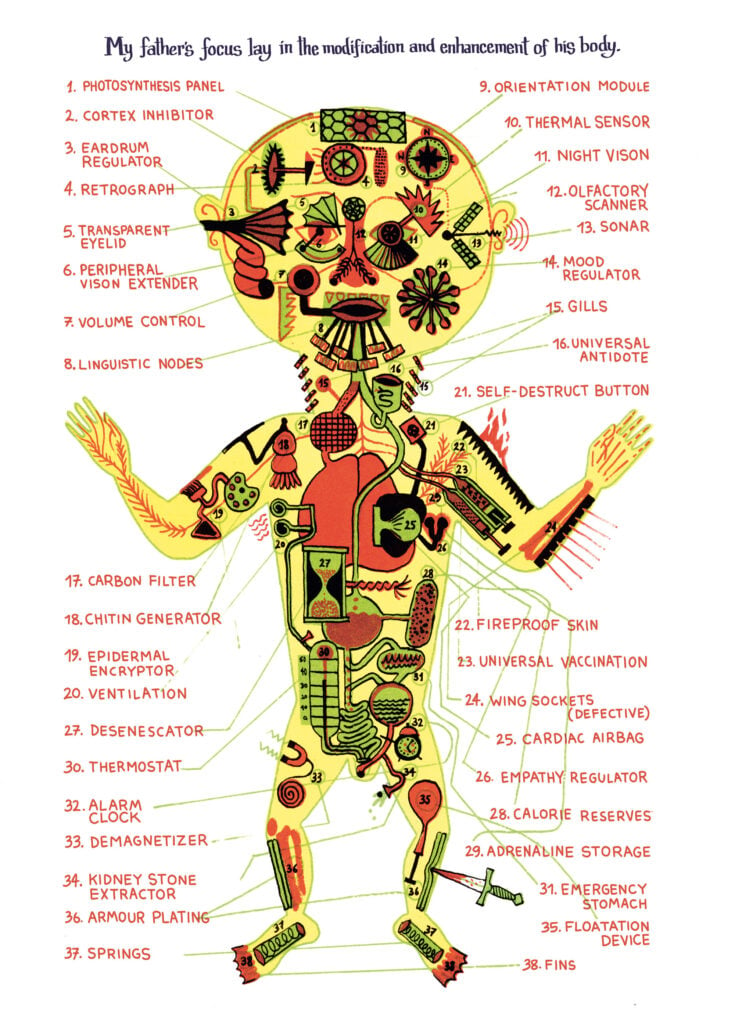
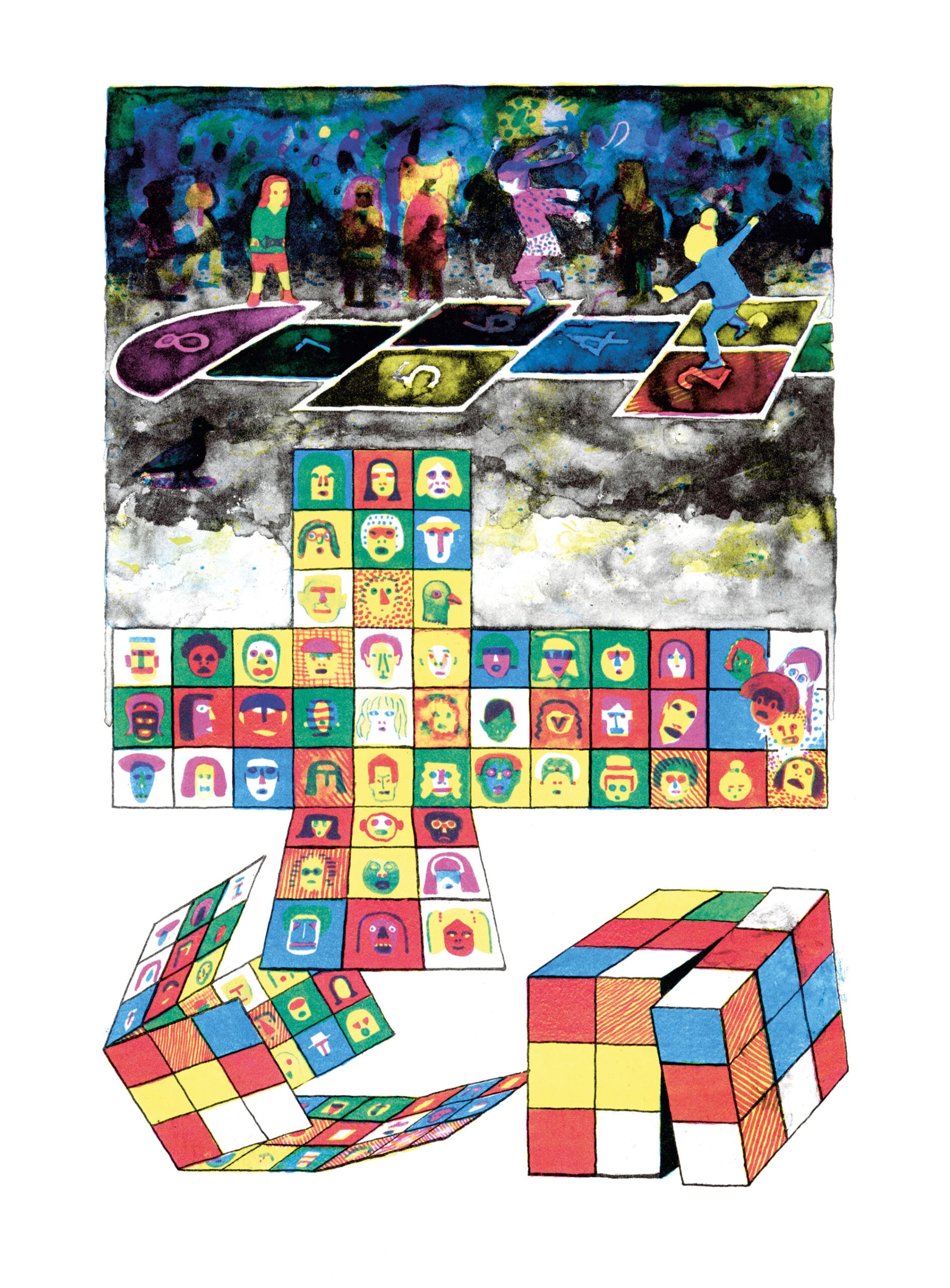
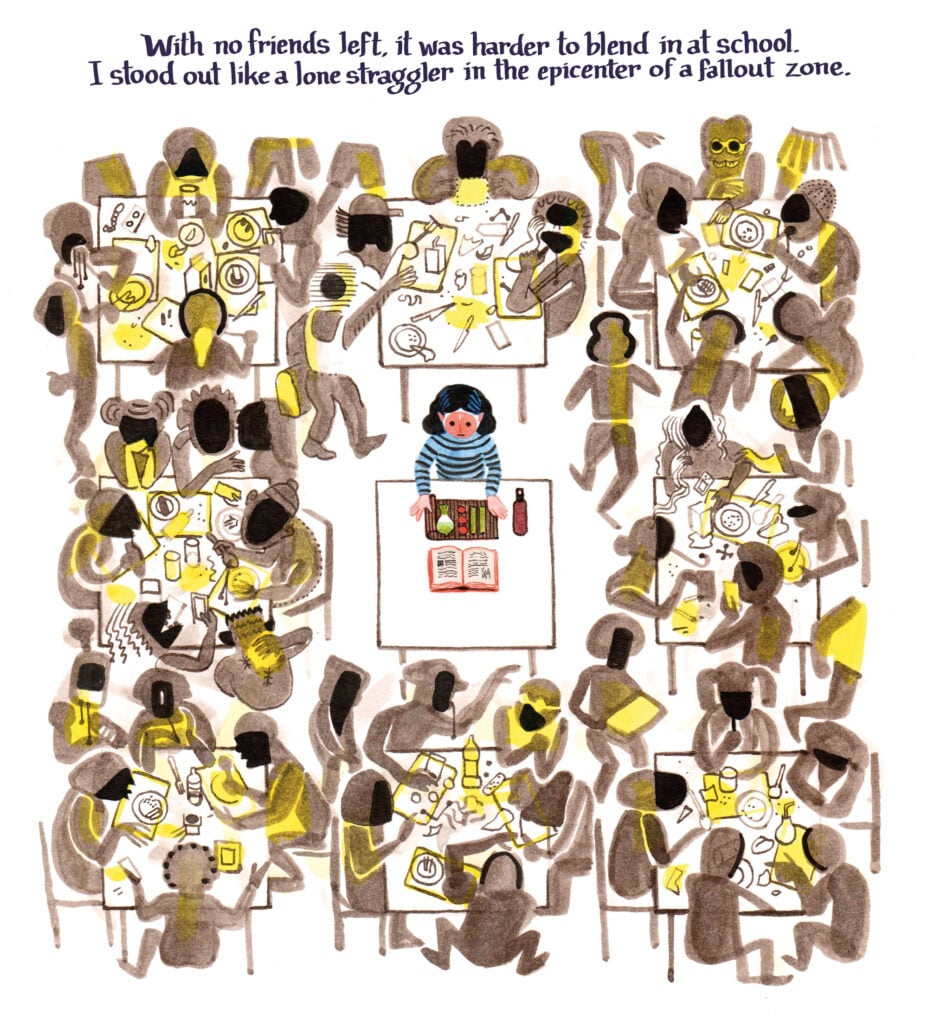
I feel like there’s something curious about the fact that I’m writing a book about people who—as a lot of us do—have simplified world views. There is a moment that is illustrated in the book, for example, a rough image of kids playing on the playground, and then Artur’s thinking, putting all these kids literally in little colored boxes that fold up into a Rubik’s Cube. It’s an illustration of this categorization and simplification of the world to fit in our brains, you know? But the whole book will inevitably be doing something like that, too, you know? Any cars in there will probably look like pretty typical cars, a lot of archetypes.
Vigneault: People might not realize how much simplification and how much classic cartooning is going into this book. It’s a bit of a hybrid form, you’ll have pages that are full paintings, you’ll also have pages that have no panels, you have the lettering, which kind of flows in and out and is done with colors. You’re pushing the form in certain directions, but at the core of it, you know, you also have very cartoony elements. You’re even connecting with children’s art, I think, quite explicitly. Arthur is himself an artist. There’s an important scene at the beginning of the book where he can’t connect with his father verbally or through writing anymore, but he’s able to connect with him through the power of illustration and the power of art, which I think is very much speaking to the role of comics. That’s one of the reasons why it’s a universal art form in many ways.
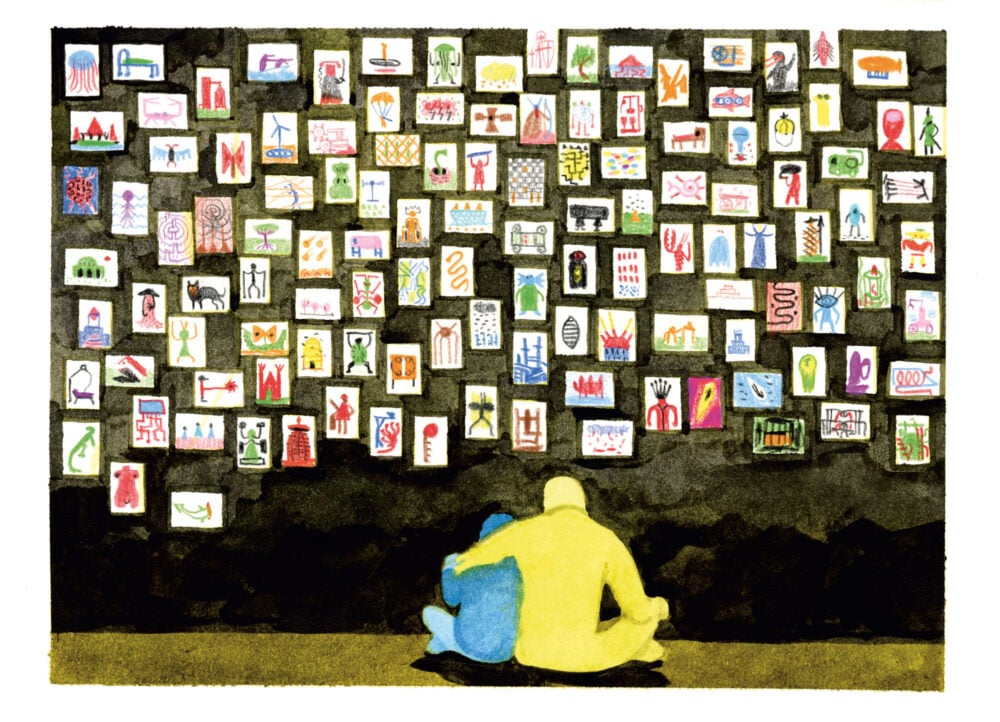
Evens: The story has a lot of eccentricity in it, the characters and the events have a lot of strangeness to them. So I’m obliging myself to be quite clear and legible in how I tell it. At least, I hope that you can tell! I’ve really been trying to not complicate things that are not worth complicating. The text has to be very legible, the action shouldn’t be hard to read. I don’t want the book to be at the “Experienced Graphic Novel Reader” level, you know? I have no interest in it being a difficult, inaccessible book. I want it to be very accessible, so there’s a lot of cartoonism to that, I think. This is not me being Picasso, you know? I have some things that I need this book to do, and the art and beauty will have to flow out of that.
Vigneault: Absolutely. Although Picasso loved the Katzenjammer Kids! I think you can see the cartoon influence in his work, too. On a more personal note, you became a father recently.
Evens: Yeah.
Vigneault: And I was thinking that this must have some influence on how you’re regarding this book. You were a son, and now you are a father. How does that affect how you view The Jellyfish King and the future installments of this trilogy?
Evens: I’m working on the second book. This thing is absorbing crazy amounts of work, it’s taking years longer already than I would have expected. Compared to the great leaps that my kid has been making in just one and a half years, it’s ridiculous to see. It really makes me see how comparatively slow going the making of this book is. She will be going to, um… Preschool is maybe the word? Crèche. She’s starting the section for the big ones! Meanwhile I have, I don’t know, drawn maybe 30 finished pages in her lifetime right now.
In the part of the story I’ve been writing, the dad is almost entirely out of the picture. So this father stuff is not seeping very directly into the book. Although there is a baby in there, suddenly, that wasn’t there before, I have to admit! But it’s early to tell, it has a lot of influence on my life in many ways, but I couldn’t pinpoint all the ways it’s influencing The Jellyfish King series yet. Realistically, at the rate I’m going, from beginning to end, this trilogy will probably be a 15-year project. It started at the end of 2018. We’re already 8 years into it.
Vigneault: It goes by fast. I think you have a certain allowance for improvisation and evolution in your work, so I’m sure that you’ll surprise yourself, and you’ll surprise your audience as you go forward.
Evens: As long as I see things that can be better, as long as these ideas keep flowing, I’ve never been in the habit of shutting that down artificially. Maybe I’m at the point where I actually should learn to shut stuff down artificially. But the machine just keeps running.
Vigneault: I love that. And I’d love to talk to you ad infinitum. We didn’t even get into the work that we did together on the translation of the book, and the differences in English, French, and Flemish. But we’re out of time for this interview.
Evens: Yeah, my answers have also been getting way longer over the last few years. And digressive. Very digressive.
Vigneault: I love the digressions, and I’m sure that the readers of this and the book itself will love following along.
Evens: Yeah, and please slide into the interview how happy I am with your work on the translation and lettering. I really thank you a lot for the crazy hours you’ve done on this, too.
Vigneault: Oh, no, it’s an inspiring project, I’m happy to be on this journey with you. It really was a big project, it was a lot of work, and now I’m really excited to see it come out in the real world, and I can’t wait for people to read it.
 Evens: That’s fun about books, right? They exist in the real world.
Vigneault: And you never know what’s going to happen to them afterwards. They go off and have another life—maybe as the underlying layer of some new palimpsest.
Evens: They can literally be under a table leg, or stopping a door.
Vigneault: That’s a noble work for a book. Especially this one! It’s a good size. Chunky!
Evens: Yes!
The Jellyfish King is scheduled for publication on October 6, 2026.



Brecht Evens is one of my favorites and a must buy. This book completely escaped my notice in the solicits. Thanks for promoting it!
(You might want to spell the name correctly in the title of the article, though)
Comments are closed.