
As far as creative kills in horror movies go, the one that opens Mark Beal’s Marginalia might just be best in class. We’re in the 1600s. A nun is attacked by a mystery assailant. We only see their hands, but it’s enough. They wrap a noose around the nun’s neck. She’s ready to hang. And then, things take an unexpected turn. Instead of dropping down for a head snap, she flies up. The camera pulls away to show her hanging from a rope tied to a hot-air balloon that’s slowly drifting into the night.
Things get stranger from there. But that opening sequence sets the tone. Nothing about Marginalia is run-of-the-mill.
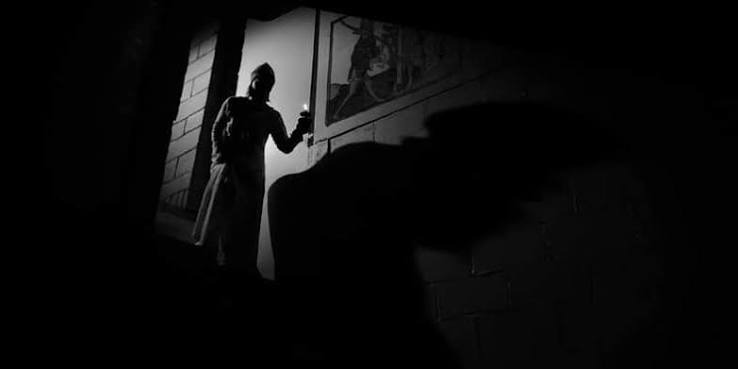
The movie follows the story of a nun called Sister Trista (Jessica Bell) that is sent to Karnstein abbey, the place where the flying hanging nun was murdered. She’s there to mourn her, taking a vow of silence as she embarks on that process. It’s quickly made apparent that dark things hide in the corners of the abbey, things that suggest devilry, witchcraft, and killer rabbits are at hand. Sister Trista, though, has secrets of her own. And they’ll make themselves known precisely when they need to be.
Marginalia is one of the weirdest and most creative folk horror movies to have come out in a long time. It’s a low-budget affair that proudly wears its DIY badge on its sleeve. Rather than seeing money constraints, director Mark Beal sees an opportunity to tell the story with what’s available to him in a way that’s entirely his own. For example, the shot of the hanging nun flying off was achieved by using a miniature figure of the holy woman and a proportionally constructed balloon prop.
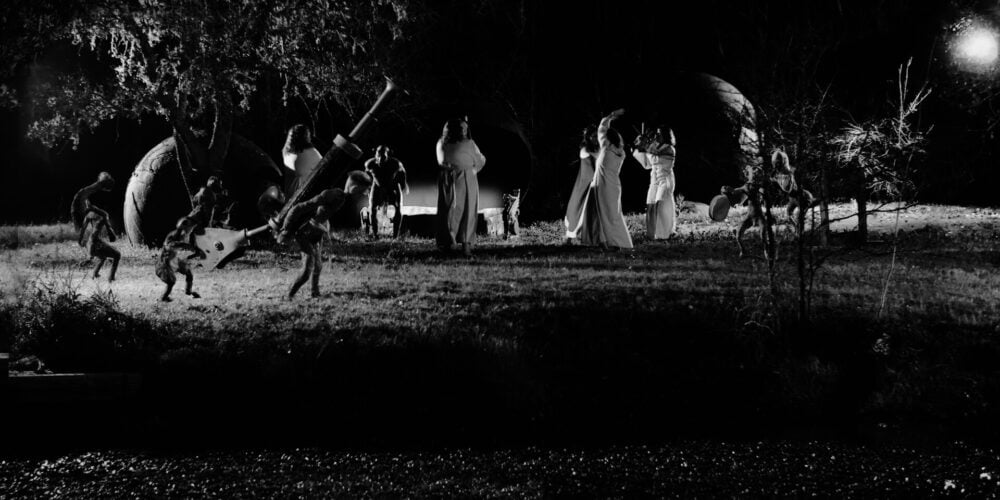
Beal’s film succeeds at being a unique horror experience by committing to that DIY style. It goes for a black and white aesthetic that honors the 1920s silent horror movies it borrows from. Given the time period it’s set in, the absence of color imagery helps to establish a gothic atmosphere where shadows and dark spaces act as primary storytellers. It helps Beal to imbue each shot with a sense of dread that hangs heavy over the abbey and its subjects.
One key aspect that really stands out is the sound design. Marginalia is both a silent movie and a talkie. At certain points the sound is barely perceptible, letting the focus fall entirely on the actors’ ability to convey story physically. These sequences include text frames with narration, which give those particular instances a very distinct feel. When voice and sound are brought back in, there’s purpose behind them. They mark moments of importance where the things that are being communicated deserve to be heard and not read.
The silent movie stylings extend to camera shots and transitions. Beal relies heavily on iris shots here, where the camera’s lens diaphragm closes in or out to guide the eye towards specific details or to manipulate depth of field.
Fans of the 1922 Swedish classic Häxan (dir. Benjamin Christensen) will see a lot of it coursing through Marginalia. That movie functions as a horror-coded essay on witchcraft and how religion enabled the vilification and subjugation of women. It became a master work of the genre thanks to its delectably eerie visions of Hell and Satanism. The director took it upon himself to portray the Devil, and he went all in.
Marginalia echoes Haxän extensively, using devils and other creatures to paint religious institutions as places that subdue female expression. Access to knowledge and the politics of personal reputation are explored in this context, making Sister Trista the vehicle through which the consequences of spiritual regulation of the individual are interrogated.
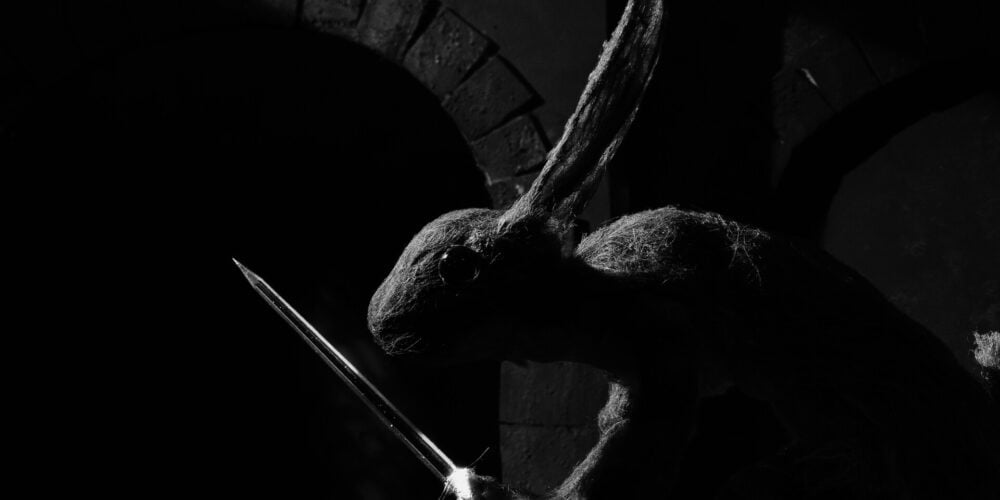
And then there are the stop-motion killer rabbits. Again finding inspiration in the black and white movies of old, stop-motion is reserved for the more fantastical elements of the story. The bunnies are a highlight. They let Beal punch well above the limits of his budget with tried-and-true cinematic effects that prove they can still help tell a great story.
Marginalia has to be seen to be believed. Mark Beal proves that the horror techniques of the silent era can still combine for a powerful cinematic experience. It invites imagination and a suspension of modern technological expectations to fully enjoy One look at its killer rabbits is enough to make anyone a believer in the old ways.