
The Abyss of Oblivion
Writer: Rodrigo Terrasa
Artist: Paco Roca
Translator: Andrea Rosenberg
Publisher: Fantagraphics
Publication Date: November 2026
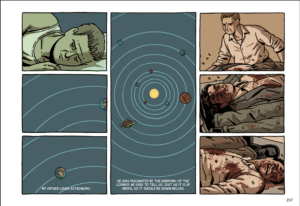
There are many places one can see why Paco Roca is one of the great comics artists. One could read his exploration of the Spanish comics scene in the wake of the Spanish Civil War in the pages of The Winter of the Cartoonist. How he uses color to express mood and feeling, all building to the cruel, isolating punchline. Alternatively, there’s the character work in Return to Eden, another exploration of post-War Spain. How each character evokes the way one remembers a long departed family member, with only photographs slowly losing detail to the grinding engines of entropy. But since this is a review of The Abyss of Oblivion, it is perhaps best to engage with what might be the most startling opening scenes in a comic to come out this year.
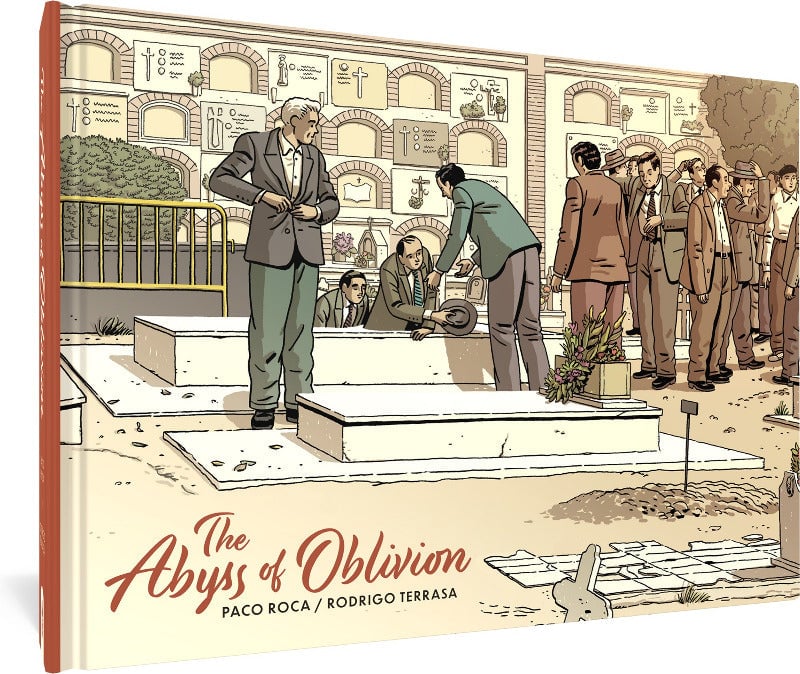
Consisting of twenty-seven pages, each presented in the widescreen format Roca utilized in Return to Eden(resulting in an almost newspaper strip feel to the events), the opening scene depicts the execution and burial of several “political dissidents” of the post-War Franco regime. And yet, the first page of the scene does not convey the political ramifications the rest of the graphic novel will present. Instead, it is of an extreme close up of a hole in the ground. The hole itself is a pure blackness without any sign of light. It is just darkness over taking the top left quarter of the page. One could almost mistake the page of being depicted in black and white, given the starkness of the image. And yet, hints of color can be seen in the pebbles and dirt that make up what surrounds the hole.
The second page zooms out, revealing the nature of the hole (or, rather, holes, given we are presented with three additional ones). Not the graves that are soon to come, but rather the holes in which lizards dwell. Indeed, one such lizard can be seen crawling across the bottom right corner of the page. The lizard is the most colorful thing on the page, desaturated green, lacking the vibrancy being “the most colorful thing on the page” would imply. This is a place for dead things.
The next page is the first one to include separate panels rather than depicting a full page spread. They are separated into two columns. The first is three panels of equal size showing the lizard crawling towards one of the holes. It pauses, briefly, before entering. The first two panels show the lizard’s approach, both from an overhead shot. We’re close to the lizard, though not to a close up. We can see his entire body. It’s only the third shot, depicting the lizard turning its head, that we get a close up of the reptile. It can hear something approaching, highlighted by the second column of two panels. The first is of a tree in the desert. It is the first sign within the comic of a man made structure in the desert. That being a barbed fence. The second provides a more concrete sign of mankind: an incomplete arch and a telephone pole. The purpose of the arch isn’t stated explicitly within the first scene of the comic, and yet its starkness provides a sense of discomfort to the reader. Not helped by the first sounds within the comic, appearing in both panels. A simple “TAP TAP TAP” repeated again and again. The source unidentified until the page turn.
The structure of the fourth page mirrors the third, starting out with a column of two panels before moving to a column of three. In the distance of the first panel, we can see a group of men walking beneath a bridge. The “TAP TAP TAP TAP TAP” marking their path forward. The second panel shows a close up of the men’s feet as they march forward, the “TAP TAP TAP TAP” moving from left to right, each one closer and closer to the bottom of the panel. We do not know the nature of these men, though an educated guess can be made. But there is something distinctly unsettling about them. Aiding the air of unsettling is the second column. The lizard crawls into one of the holes, the comic’s vision zooms out gradually, revealing that the holes were not in the ground, but rather on the side of a cliff. And there’s so many more than three.
Page five is a simple four panel grid, showing the men marching forward. We can see that these men are armed with rifles, number no more than fifteen, and are passing by the incomplete archway. Unlike the previous pages, there is no “TAP TAP TAP TAP” accompanying their march. Instead, they march forward silently, until the leader tells them to stop. The troop of soldiers is largely drawn rather indistinctively. Many of them could easily blend in with one another. The sole exceptions are the mustachioed leader and the most foregrounded of the soldiers, who wears glasses.
Turning the page reveals the final full page spread of the scene. The soldiers are standing in attention, though some more relaxed than others, while their leader approaches two men, one appearing to be a general. The page contains the first bit of exposition regarding the date and location of the scene: El Terrer, shooting range at Paterna (Valencia) Artillery Base. September 14, 1940. 5:00 p.m. The nature of the incomplete arch thus becomes apparent: it’s a tool for training like the tire trail or the ropes in the background. One could be easily be mistaken into believing that this is nothing more than a training exercise. But still, we don’t know.
What’s more, as the next page reveals, neither do the soldiers. The page is six panels separated into two rows. Each panel depicts three soldiers: the bespeckled one mentioned previously, a slightly round faced one who remains silent, and a shockingly young looking one. The bespeckled soldier has a heavyset character mold compared to his two compatriots. Not so much overweight as bulkier, built like an ox instead of a rifle. Roca draws his performance in asking what’s going on with a subtle curiosity. None of the characters move too far from where their feet are planted, with the most movement being the stocky gentleman moving his head back. What’s more, you can feel the concern and confusion on the man’s face even through Roca’s minimalistic art style of dots for eyes and lines for mouths. The bespeckled soldier doesn’t even move his mouth when talking, keeping it tightly shut, highlighting the nature of his cowardice as one who doesn’t speak up.
The next page, marked 10 by the comic, is split into two rows. The first shows the leader talking to the general. Rather than placing them in the center of the panel, Roca opts to highlight the background of the cliff face, which dwarfs the two men in its size. While the soldiers take up less than a fifth of the bottom left corner, the cliff face takes nearly the entire panel, going so far as to almost touch the top border. It is becoming more and more dreadful as to why this cliff is being emphasized so much. The bottom row has three panels. The first and third repeat the previous panel’s structure of the three solders standing in unison, while the second shows their POV of a truck approaching them on the opposite road they walked.
Page 11 shows three panels. The first, taking up the top half of the page, has the two leaders stroll towards the stopped truck. They continue this action over the course of the next two panels before approaching two men, one saluting the other exiting the truck. A simple sequence of little note, but still worth mentioning the atmosphere Roca presents. By using a more desaturated color pallet, The Abyss of Oblivion’s opening scene presents the reader with a sense of decay and collapse. This is past, certainly. But, more importantly, this is dead. There is no life here.
The page turns to show the wordiest page of the scene. While the dialogue is curt and to the point, the implications are presented directly. In some regards, this feels like a mistake on Roca and co-writer Rodrigo Terrasa’s part. At most, it provides the reader with the understanding that what’s to come will come in two batches due to the lack of soldiers willing to do what they have been ordered to do.
Indeed, the following page depicts the information more elegantly as we zoom in on the bespeckled soldier over the course of three panels as the horror of what’s going on is starting to dawn on him before swiftly cutting to a shot of the truck. Instead of existing in the desert, the truck is presented in a complete pea green background with targets in stark white and red painted over the side. We swiftly return to reality as men begin to come out of the truck. We know far too well what’s about to happen next.
The page turns, again with the top half being dominated by the cliff. Only now, as we see men being dragged forward in chains, do we understand where the holes — all perfectly circular — came from. The bottom row, three panels in total, depicts first the general and his subordinate standing still as they remind the soldiers of what they need to do; then the prisoners, accompanied by the general noting the consequences of disobeying orders; then lastly of the soldiers, the bespeckled one shaking in terror as he follows orders.
In what might be the starkest page of the scene, we are given a nine panel grid of nine panels — the most in the entire scene, which averages to roughly five panels per page. The first panel is composed of the upper body of the bespectacled soldier. You can feel the weight of the rifle in his hands as he aims the gun. The next two present his POV as he aims the gun at one of the prisoners. The first has the sights aimed a bit to the left of the guy, the prisoner looking down. But when the prisoner tries to meet the soldier’s eyes, the sights block the majority of his face, dehumanizing him to the soldier. Panel four moves to a close up of the soldier. The most detail we’ve been provided since the strip began. We can see the hairs on his eyebrows, the grit on is teeth, and how tightly he closes his eyes. This is demonstrated by the middle panel of the page, which is as black as the bullet hole void we started the comic looking at. The next panel further dehumanizes the soldier by turning itself into a target. It’s not people being shot, just paper. The seventh panel shows a close up of the soldier’s trigger finger, preparing to shoot. Panels 1 and 7 each have text in word balloons accompanying them with orders to “AIM!” and “FIRE!” respectively. They are surrounded by sharp lines that jag tightly together like a series of incomplete pencil strokes mashed together. Panel eight removes the panel border entirely alongside the cartooning of Roca. Instead, the lettering is a series of “BANG BANG BANG BANG BANG BANG BANG” overlapping each other, all atop a more traditional word balloon declaring “Long live the Republic!” Rather than depict men being gunned down by a firing squad, the violence is being depicted verbally. The final panel shows the soldier we’ve been following dehumanized. His emotive dots for eyes completely wiped away from his glasses.
That isn’t to say the comic shies away from violence, as the next page demonstrates with the general shooting the surviving prisoners (among them, the soldier’s target) in the head. It is depicted as a distanced shot rather than the extreme close ups we’ve been presented of the holes behind them. As such, there’s an air of desensationalization to the violence within the comic. The focus here isn’t in the violence of murder, but rather the human cruelties that justify such actions.
As the general and his subordinate continue to shoot and kick the remaining survivors, the soldier we’ve been following regains his humanity, albeit briefly. While the first panel of the page depicts the soldier with his eyeless glasses, the second that features him has the soldier turn away in confusion and fear. He does not want to look at the next batch of prisoners to be shot.
Damningly, the soldier he was conversing with only a few pages ago — looking as if he’s aged twenty years — shouts at him to aim right lest he be a chicken. This calls back to an earlier page in the comic, wherein the soldiers referred to the targets they’d be shooting as “Chickens.” Of course, it’s worth noting that this is not a comic about the nature of soldiers who were only following orders. Instead, as the bottom row of the page demonstrates via its emphasis through panel size, it is about the men they murdered. For all the bespectacled soldier has moral qualms and uncertainty, he still followed those orders, and it is to the benefit of fascism that their stories are emphasized above all others.
The final page regarding the soldier is of his POV. This time, it is exclusively in his POV, showing the target of his rifle — central character José Celda — at first looking rather dispassionate and dejected at his lot in life. He turns his head, and it becomes clear that there’s fear in his eyes. As we will discover, it is not death he fears. It is the final thing he sees. What he leaves behind for those who remain among the living. Aiding matters is the structure of the page. Like previous pages, it is structured in two columns of three and two panels respectively. But where previous pages had the panel sizes be roughly equal in width, here the right two panels are significantly wider, providing the reader with more detail of Celda’s face as he meets the void of death.
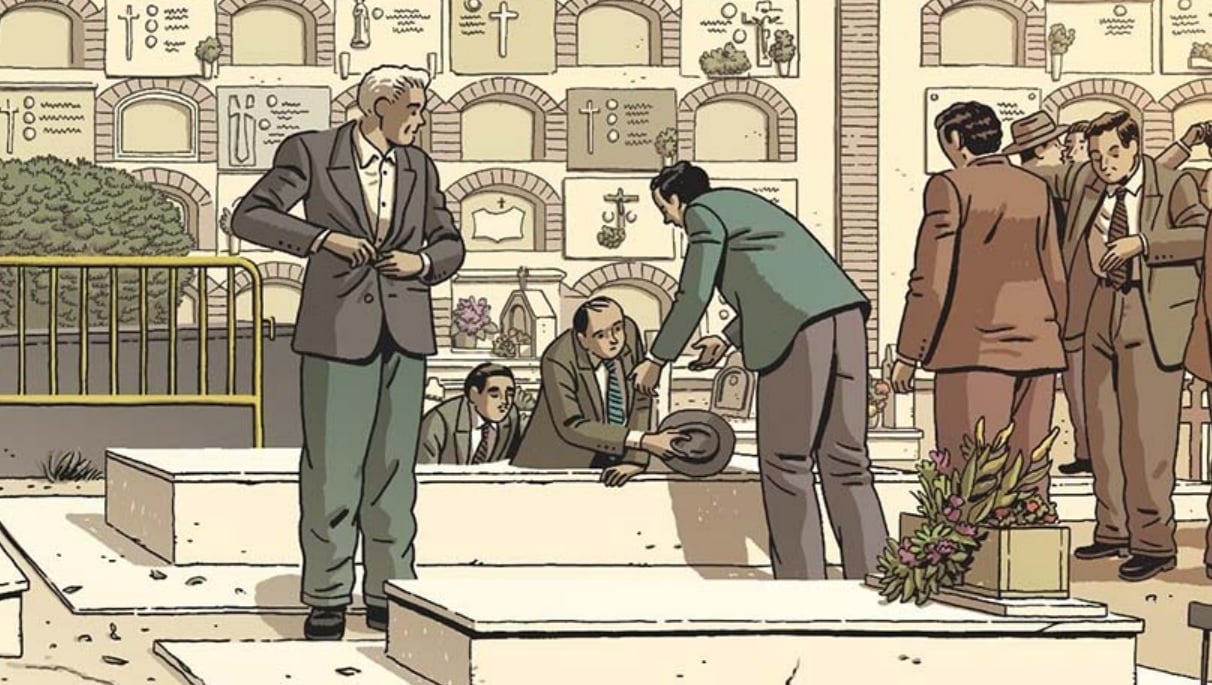
When the page turns, we see a step by step process of the gravedigger finishing his task before entering his home. The sequence is depicted in three columns of three, two, and two panels respectively. Though the last two columns are more accurately described as a four panel grid. The first three, however, depict the mood. Starting with a shot of the night from below, we see the void of space punctuated with little white holes and the moon in contrast to the void of death the previous page ended on. We cut to a gate with a little trail of blood before it. We then cut to the other side of the gate, and the two gravediggers doing their work. The trail of blood moving forward.
The following page is of one of the gravediggers taking objects — such has bloody clothes and hair — and placing them in a basket. It is unclear as to why he is doing this, but its presence within the opening scene nevertheless highlights its importance.
As does the subsequent page’s zoom in on one of the graves, depicted in a four panel grid.
The next page turns that four panel grid into eight panels highlighting the history of that gravesite. As the history moves forward, it becomes more and more apparent that this isn’t a single grave, but a mass one. We see the changing tides of history from weather to memorialization to an attempted stamping out of that memorialization. If history is to be defined, let it be defined by its ever changing nature. Night becomes day. Clear skies become rain. Flowers wilt and stones are stomped on. But the world moves ever onwards.
While the page ends with a memorial to the dead being erected, the next page shows in four panels that memorial being deconstructed. It is a healthier time, as demonstrated by the more colorful pallet being presented. Instead of the desaturation of desert and death or the coldness of night, we have a warm sunlight permeating the pages to come with workers in bright turquoise and white. There is a warmth to the light blue sky in contrast to the executions stark grey.
The next page is seven panels split into three columns. The first and last column are three panels each while the middle one is just a solitary panel. The first three show one of the workers chiseling out the memorial to get deeper and deeper beneath the bedrock, until finally breaking through to the void. The middle column shows Celda’s head beginning to peek out. It’s not completely out of the grave, but it’s starting its exit. He is accompanied by text that compares the flight of the departed spirits from the mass grave to those buried in the pyramids before archeologists opened them up. The final column shows Celda freeing himself from the void before helping someone else out.
We continue the next two pages with a pair of six panel grids. The first page shows the various spirits leaving the grave and commiserating with one another as Celda sits down to have a smoke. He turns around and places his hand on the memorial plaque made for him before finishing his cigarette and moving with the rest of the dearly and unjustly departed.
Accompanying these visuals is narration about the waiting the dead have done to be free. They are not bunched together closely in the pages. Instead, the first two musings are presented on the first page of the sequence at the end of their row while the second two are in the first and last panels of the page. This, in turn, allows for a pause between thoughts, allowing the full implications to truly sink in, letting the reader contemplate what they are being told. We wait alongside the characters.
The scene ends with a two page spread of all the dead commiserating amongst themselves. The size of the pages allow for the scope of the dead to truly sink in. We only saw three or five guys exit the grave, but the crowd looks to be at least fifty men large. The openness of the spread feels like a sigh of relief after spending page after page in tight close ups, desaturated colors, and bleak nothingness. The story of these men’s lives may end in the execution, but here, having been at last freed, we can see the multitude of possibility for what might have been. Instead of the uniform soldiers, we have a multitude of body types, clothing style, and methods of movement and posture. We can see little moments throughout this crowd of ghosts so full of life. As the sole bit of text on the spread — appearing at the bottom right corner — notes, “But at last we have a voice, a memory.”
This is but one of the many brilliant scenes within The Abyss of Oblivion. Others range from small comedic bits involving a coat getting stuck on a railing after an old woman tries to hop a fence to a retelling of the segments from The Iliad to the haunting image of a McDonalds built atop a mass grave. And they are all told sublimely. Roca remains one of the most interesting comics artists working in the field, every work a must read for anyone interested in history and those lost to it.
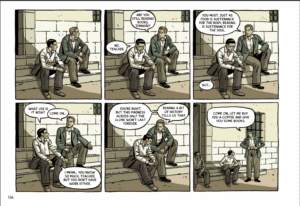
The Abyss of Oblivion is out in November via Fantagraphics
Read more great reviews from The Beat!