
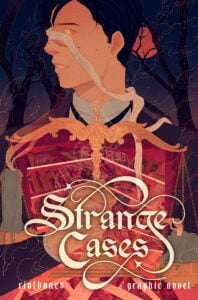
 Strange Cases
Creator: Riotbones
Publisher: Andrews McMeel
Publication Date: October 2026
Strange Cases, the stunning debut graphic novel of the popular illustrator Riotbones, collects a set of gorgeously drawn detective stories set in the shadows that fall between the towering spires of a colonial state. Instead of focusing on the procedural aspects of its supernatural mysteries, Strange Cases dwells in a state of atmospheric dread. It’s easy to get lost in the twists of the occult noir fantasy setting, but the emotionally compelling characters guide the reader toward startling revelations.
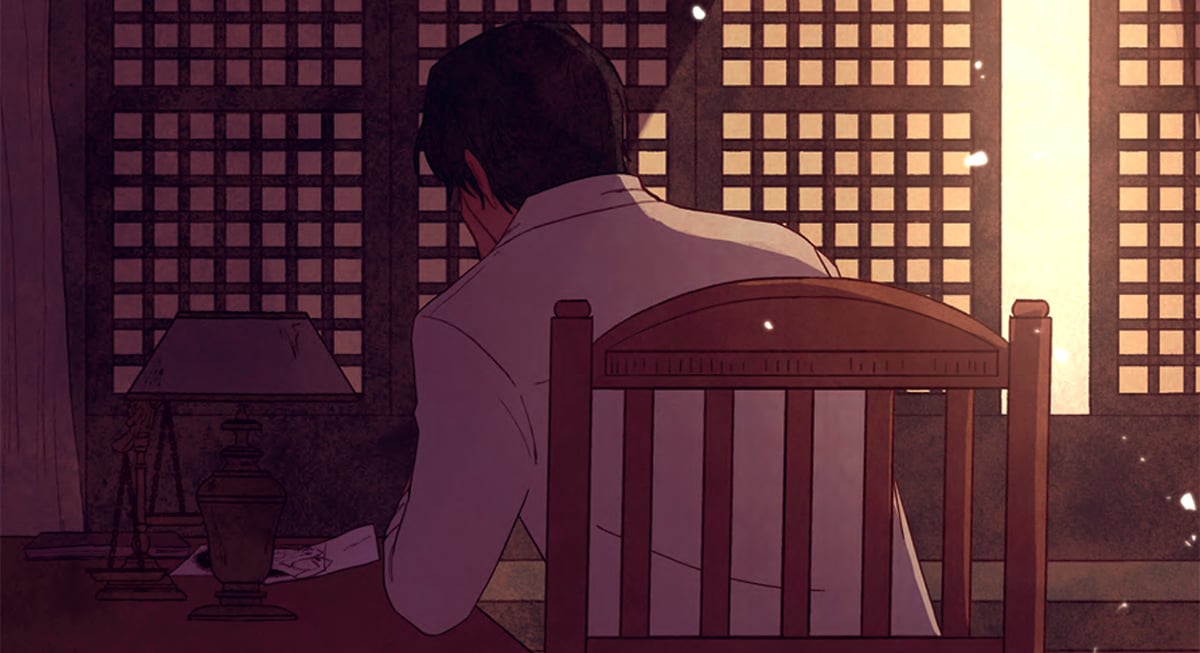
The hero of Strange Cases is Jude Aguilar, a young man studying law abroad. After the death of his mother, Jude returns home only to find that everything feels different and slightly strange. This sense of alienation is partially a result of Jude’s time away, but it’s also a result of entropy acting on a city whose foundations are beset by encroaching waters. While the decaying Gothic architecture looms and tilts overhead, Jude finds his legal expertise in demand from people much closer to the ground.
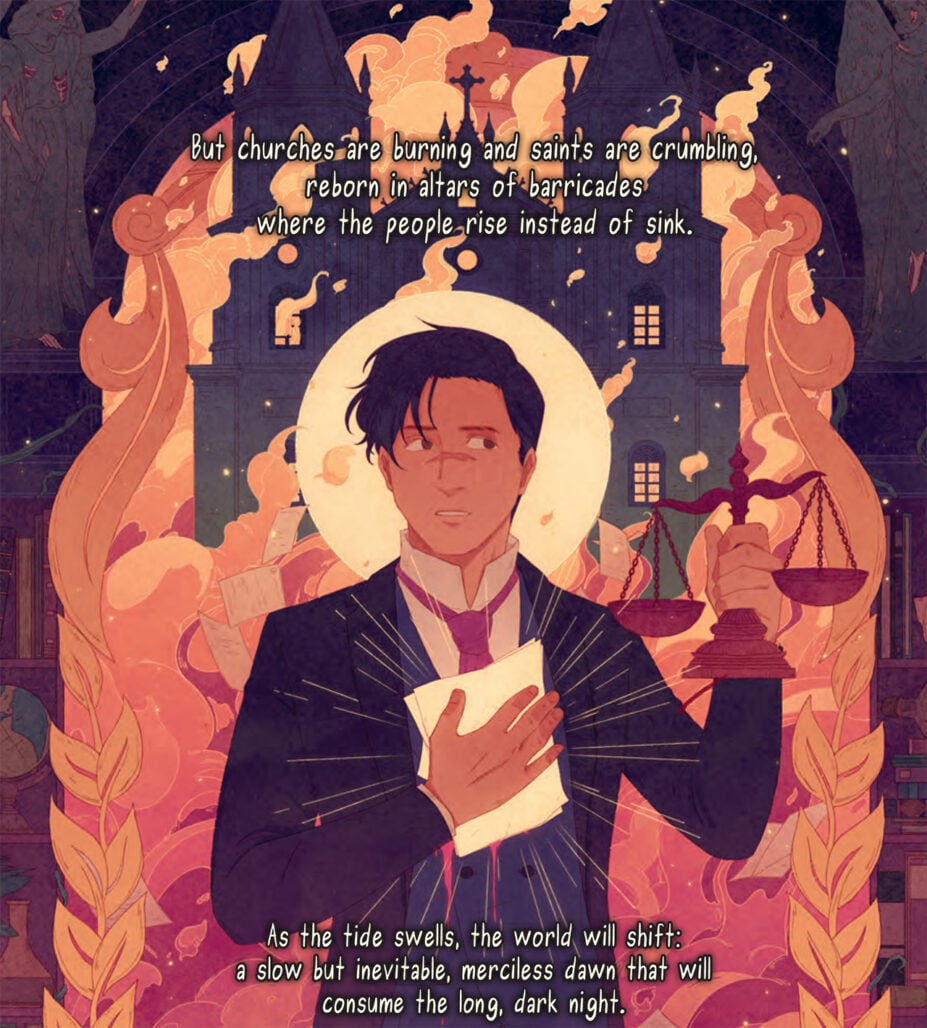
Soon after his arrival, Jude is swept into the case of a man named Manuel Silang, the sole survivor of an odd incident involving a large fishing vessel owned by a colonial firm. By the time the ship returned to port, sixty crew members had vanished without a trace, and Manuel claims not to remember what happened. Mutiny is suspected, and Manuel is imprisoned.
As he analyzes reports and conducts interviews, Jude realizes that Manuel might not have survived the incident – but something else did, and that “something” now wears Manuel’s body. Regardless of his client’s ontological status, Jude argues in court that a suspect can’t be convicted without any concrete evidence. Unfortunately, the jury is stacked in favor of colonial business interests. Where human law fails, Jude steps in to do the right thing, but his act of courage does little to soothe the tensions between the aggrieved parties.
In the second and third stories, the presence of the supernatural is never in doubt, though those affected go to great lengths to hide the truth. Jude begins to understand that even the wealthy aren’t exempt from the alienation that results from the unbending rules of a colonial system, and he gradually learns that his own comfortable existence has been enabled by the work his attorney mother did to hide outcasts from the law. As his mother’s successor, Jude does what he can to ensure that local people are not arbitrarily punished by colonial powers, which often entails escape from the city into the welcoming darkness of the seaside forests.
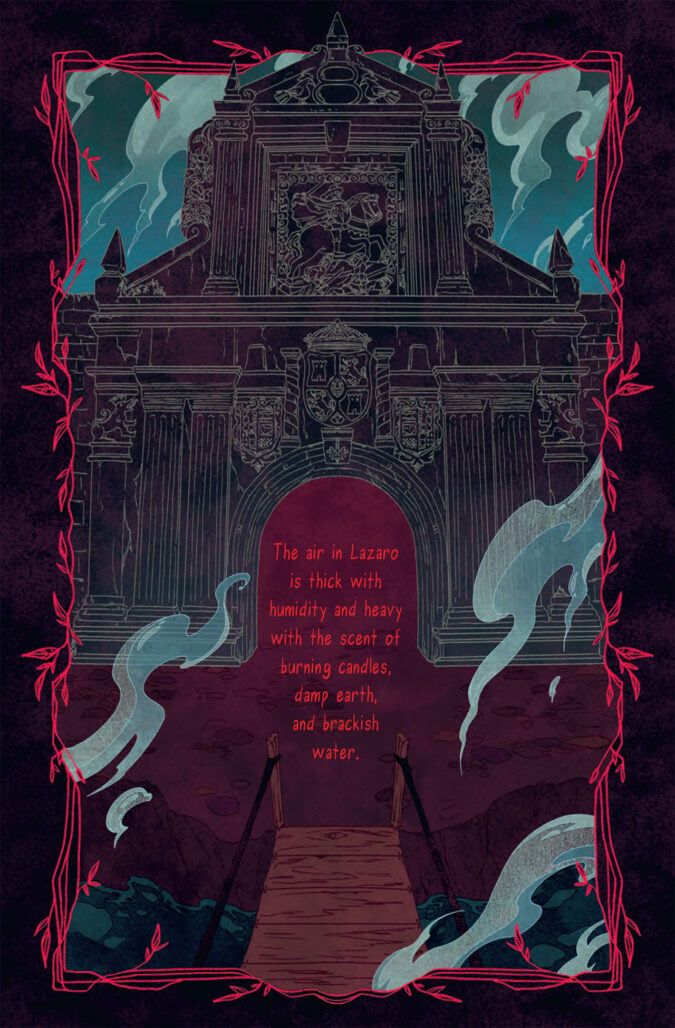
Strange Cases is set in the coastal city of Lazaro, where monumental architecture towers over more modest neighborhoods. In the opening pages, Riotbones describes Lazaro as “a fever dream of colonial ambition, caught between earth and sea” on reclaimed land where natural waterways were reshaped “to make way for stone churches and manors that never truly belonged.” Though the houses that line Lazaro’s streets are grand, the streets themselves are covered in mud and the dredge of flooded sewers. High tides and seasonal storms disinter buried corpses, whose bones are venerated inside plaster statues that erode in the salt air.
This visual panoply of erosion and decay serves as a metaphor for the failure of Lazaro’s governing institutions. The grand manors and courtrooms sit uneasily on foundations slowly being reclaimed by the sea, and colonial mandates mean little to the supernatural beings that follow their own ways of life outside the city.
As a genre, the gothic lures the reader with the promise of hidden secrets coming to light. In the context of Western Europe, and especially England – which is alluded to in the brief glimpses of the country Lornvale where Jude studied – these secrets often lurked in the shadows cast by the industrial revolution. For a person who doesn’t belong to the imperial core, however, shadows have a different meaning. Perhaps, Riotbones suggests, not everything benefits from exposure to an “enlightened” Western gaze. For people who don’t fit neatly into rational, scientific categories, the shadows provide a more comfortable place to exist. Now that Jude finds himself in a position between “colonial” and “native,” he must learn how to navigate the liminal spaces that exist beyond the boundaries of the law.
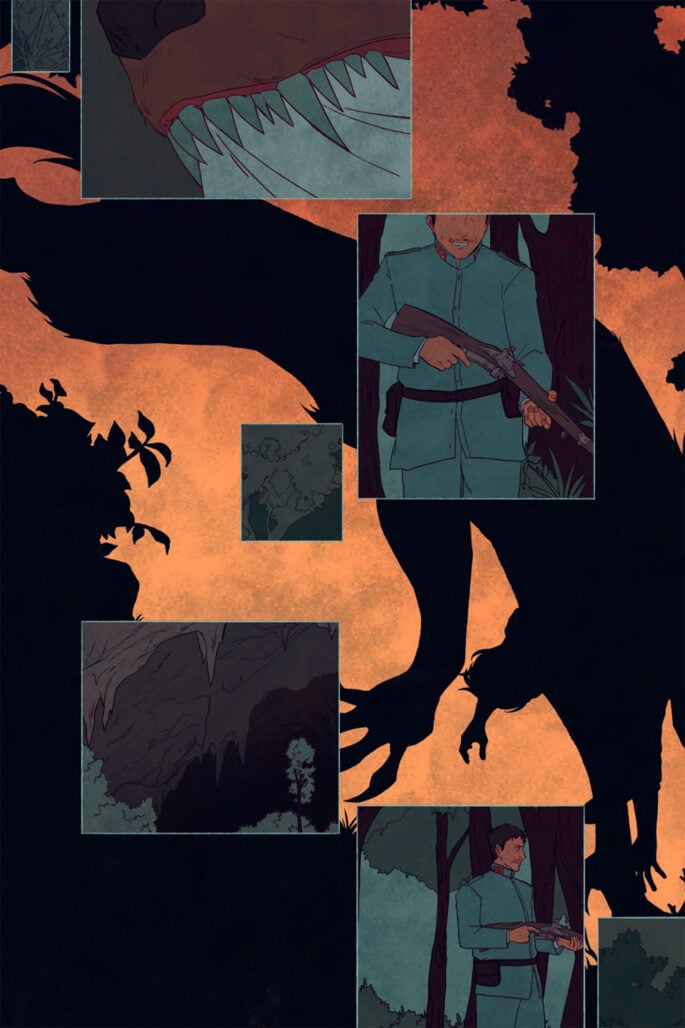
Riotbones’ distinctive high-contrast art highlights the decaying gothic grandeur of Lazaro while keeping the focus on the characters, whose faces communicate what their words cannot. The dynamic and asymmetrical panel design is equally expressive, often mirroring Jude’s disorientation and the shifting nature of the truth. Small panels that capture subtle human gestures melt into breathtaking full-page splash illustrations dominated by negative space that lures the reader into a cityscape of peeling plaster and encroaching mist. The high gothic stylizations are exquisite.
The pastiche of gothic tropes and imagery in Strange Cases selectively borrows from any number of sources, but Riotbones’ incorporation of Filipino folklore lends a uniquely textured specificity to the story and setting, as well as a sense of urgency. The city of Lazaro may be a fantasy, but rising tides and increasingly violent storms are very much a reality. The shroud of colonial rule sits awkwardly on a culture whose climate it was never meant to accommodate, and Riotbones demonstrates in fantastic detail what happens when a society allows these ill-fitting graveclothes to rot.
Strange Cases has emerged from a contemporary gothic aesthetic that draws as much from video games like Bloodborne as it does from classic European novels, and the sheer stylishness of Riotbones’ art walks hand in desiccated hand with the emotionally charged dark fantasy of E.M. Carroll. With its intensely atmospheric setting and brilliant writing, Strange Cases stands tall as one of the best graphic novels of 2026.
Strange Cases is available from Andrews McMeel.
Read more great reviews from The Beat!