

 The current wave of digital comic sales, along with the recent launch announcement from ComiXology, has given new life to the digital discussions here at The Beat. Most of the attention, however, has gone to the supply side of the digital market, yet there are some interesting developments occurring in the hardware world as well.
While actual sales data remains unavailable to outside observers, the commonly held view is that digital revenues “plateaued” at around 10% of print in recent years. As to why digital comics have stagnated, explanations range from high prices, poor user experiences, piracy, or the lack of resale value.
Something else to consider, though, is the stagnation on the demand side. As is now widely recognized, the initial euphoria of the iPad launch wore off far quicker than anticipated. While tablets remain widely popular, and Apple dominates within that segment, they have not displaced either computers or smartphones, and sales in the tablet category have also plateaued. Device manufacturers, including Apple, have not yet developed new functionality or use-cases attractive enough to spur significant sales growth. With the market broadly saturated, a large percentage of tablet sales currently represent cyclical replacements of existing devices (which have proven to be longer-lasting than initially predicted).
Aligned with the surprising resilience of laptops relative to tablets has been the success of Google’s Chromebook initiative, particularly in the education sector. US schools have adopted Chromebooks enthusiastically since their initial launch in 2011. While much of their success in the education market can be attributed to low prices and ease of user management, another key factor is the great variability among Chromebook offerings in terms of size, functionality, durability, etc. Chromebooks are offered by dozens of manufacturers in a wide variety of prices, shapes, sizes and capabilities, all trying to find a particular sweet spot for consumer acceptance.
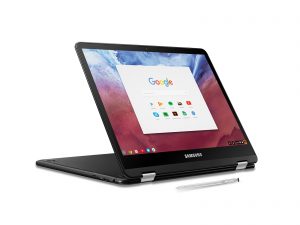
The Chromebook story is of specific interest to the comics world because it points toward a more diverse landscape of devices suitable for comics consumption. Traditionally, laptops have not been ideal for reading digital comics, for a variety of reasons (too heavy, wrong screen aspect ratio, lack of touch interface etc.). Chromebooks, however, are now widely available in the 2 in 1 form factor, of a laptop that can be flipped around to act as a tablet as well. In some circumstances these devices can offer the best of both worlds, with a physical keyboard for productivity needs but also capable of landscape tablet modes ideal for reading comics.
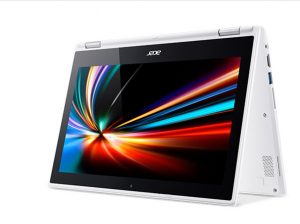 My first Chromebook was the original Samsung Series 3, but I only started using one for comics after getting a 2 in 1 styled Acer R11 in 2016. To be honest, it was a mediocre reading experience, as the device in tablet mode was a little bit too thick (0.8″), too heavy (2.8 lbs.) and the screen (11.6″, 1366×768, 16:9) was not optimal for comics. I did like the ease of transition from consumption to typing and vice versa, however. Despite its flaws, I was quite sad when my Acer got stolen a few months after purchase, and I was eager to find a Chromebook better suited for comics reading. I replaced the Acer with a pricier but much better Samsung Chromebook Pro that has an excellent screen (12.3″, 2400×1600, 3:2), thinner body (0.55″), lower weight (2.38 lbs.) and decent CPU (Intel m3). The 3:2 screen ratio (unusual today for a laptop) is the secret weapon of the device and makes it a great digital comics reader. There are compromises on the productivity side (the keyboard is substandard to name one), but the new generation of Chromebooks, with Android app support and growing Linux capabilities, have really upped their game.
Tablets are likely to remain the primary consumption device for digital comics, with large format mobile phones after that, but a growing 2 in 1 category spurred by Chromebook growth could provide another attractive option. Currently I prefer to use my Chromebook for media consumption in part because the switch from entertainment to (light) work is so easy and available. It will be interesting to see if Chromebooks are able to make the leap from schools to homes, and if they can then provide a welcome boost for digital comics.








I haven’t looked at from Chromebooks, from a laptop perspective, because it seemed as closed a system as apple, for what I want in a laptop. But now my tablet is old and its battery dying this may be what I can look to for replacement just for reading.
Ive been using the all too underappreciated (well, basically never appreciated…) Google Nexus 10 since 2011. It was an awesome media tablet (with the guts of a Samsung) when others were still focussed on documents, and its widescreen tv ratio weirdly suited it for a comics page with minimal letterboxing like with the ipad. Its dimensions are almost exactly that of a comic. With the even bezel it gives a single page at maybe 85% of real book. But its resolution is so good and clear you dont notice. Sadly its an eight year old product, never to be continued. But I do now think that screen ratio is as important and actual size when looking for a comics device. I still dont like how comics look on an Apple.
Comments are closed.