
Getting older is inevitable.
Well, at least for those of us whose lives aren’t tragically cut short by malady or misadventure. If you’re not careful, or even when you are, the body starts to slow down. You start being unable to do the things you could easily in your youth without even thinking. It gets scary if something goes wrong. And suddenly even basic tasks become difficult.
It’s a tangible sign of our mortality. The passage of time. And the ravages it can play upon our selves. Because it’s not necessarily just a physical strain, it can be mental as well. When your body stops doing things, your brain has to deal with it. Has to reconcile what you used to be with what is, even in little minute changes, like taking longer to accomplish a task or slower reflexes. It can be a sobering thing to reflect on the idea that your time is running out.
That we’re not immortal. That we’ve changed.
“I’m a zombie. A Flying Dutchman. A dead man, ten years dead…”
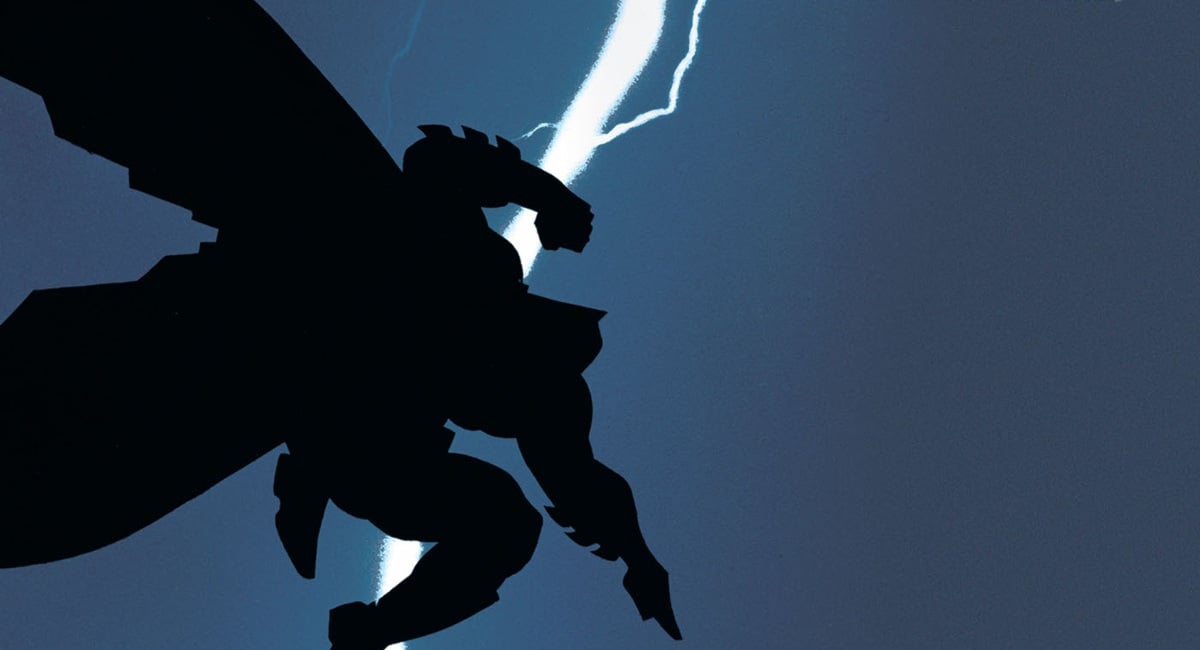
This year marks the 40th anniversary of the transformative landmark works of the ’80s that changed the landscape of the comics industry, for good or ill. A work that was as much a commentary on the sociopolitical terrain of Reagan’s America as it was a look at the future and the passage of time. I am, of course, referring to Batman: The Dark Knight Returns by Frank Miller, Klaus Janson, Lynn Varley, and John Costanza.
I know these days it can be difficult discussing the works of Frank Miller without a caveat. That it should be mentioned that had some very problematic Islamaphobic views in the wake of 9/11. To the point where it quickly coloured his work. Especially in that work that was apparently originally supposed to be a Batman story itself. And here’s where you’d think I’d toss in a “but”, I’m not going to do that. Since this is about age, and change, perhaps diminishing returns, and the passage of time, I think it’s important to look at the whole picture. With changing perspective. Because reflection upon the past directly changes perception. Nuance matters. And you wonder if Miller himself is not a Batman of our real life story, but the Superman.
Superman in The Dark Knight Returns is a foil for the iconoclast in Batman. He’s subsumed to the establishment, agreeing to complicity in silence, at the beck and call of someone with a badge or the flag. He gave in to the pressure of conformity. Sold out as it were. Choosing the path of least resistance and was brought in as a lap dog to put down a Batman who had become too visible to the ruling elite. One who was still rankling against the system. This tracks with someone given to the extremes of hatred, going along with the flow of resentment towards an entire people, and parroting the authoritarian view of the us versus them mentality borne out of the 9/11 attacks.
“I’m not finished yet. …and you’re not finished with me.”
While the story is about change, shifting perspectives, holding on to principles, and adapting to a changing landscape. With both Bruce Wayne and James Gordon essentially representing two sides of the same coin of a more universal approach to aging (one fighting against it, one going with the flow), what doesn’t change is the artistic powerhouse that this work represents. The ’80s were really Miller at his peak, both in writing and art, delivering The Dark Knight Returns, Batman: Year One, Ronin, and Daredevil: Born Again.
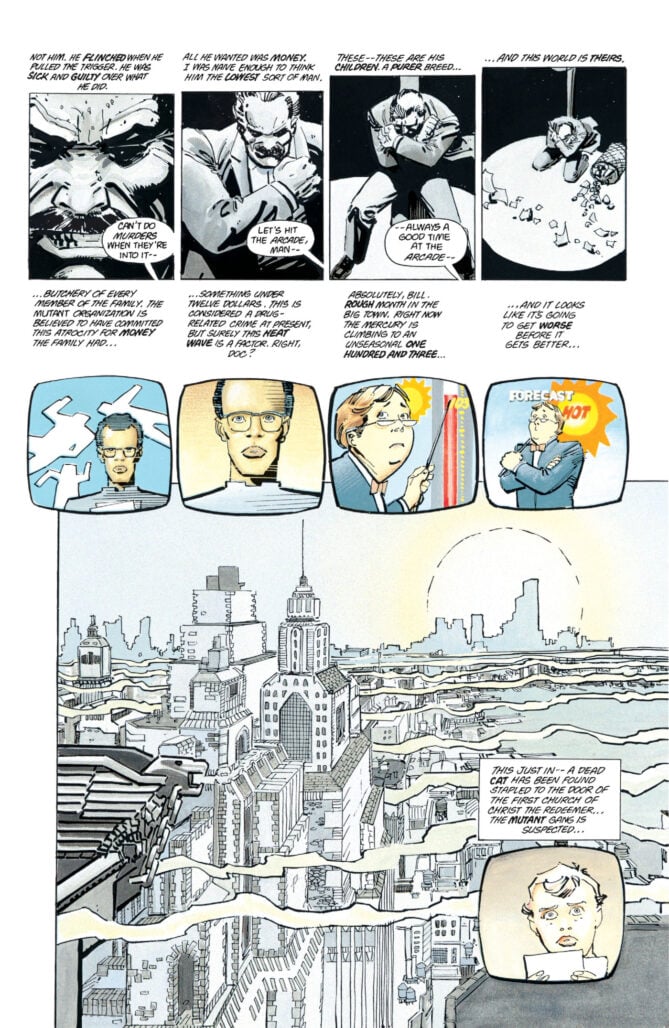
The storytelling in the book is dense and layered. Miller largely uses a sixteen-panel grid with some variations, laying over the core narrative with television cutaways, bringing in the idea of the ever-present media that serves as a link to the idea of Big Brother and presaging what would come in our society where everyone is practically always on all the time. Though that performative nature Miller wouldn’t necessarily directly address until Dark Knight Strikes Again.
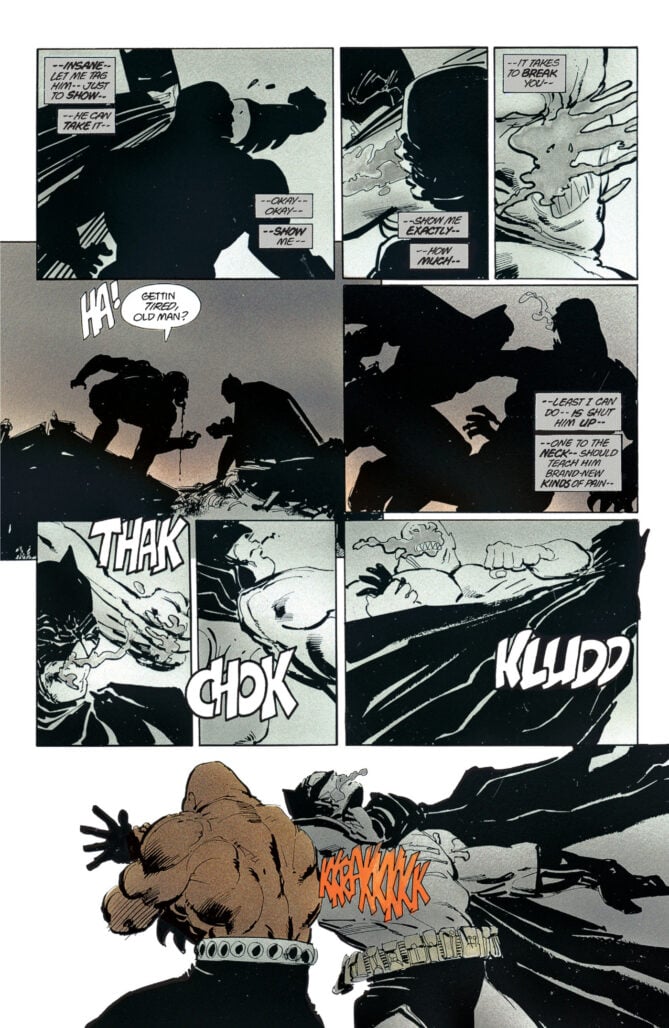
The artwork here is exquisite. Miller’s attention to detail and composition are at their height. Possibly only his work on Elektra trumps this. It’s a blend of his earlier, more standard superhero work and the highly angular, silhouetted work that would emerge from Sin City and after. Without many of the extraneous scratchy lines. Which in itself is kind of interesting because Klaus Janson is inking Miller here. It’s even restrained for Janson’s own work. Favouring cleaner lines for the characters and shadows. There still is a level of frenetic energy, but it’s contained.
Lynn Varley‘s colours for this are a fascinating exercise in atmosphere. You could describe them as dulled. Almost like the entire world of Gotham City is in a grey haze. It seems to present a society that is out of touch with itself. Only your main characters seem to get any bit of solid colour. Even Gordon is rendered almost into the background. More dynamic colouring doesn’t come into play until the final part with the confrontation between Batman and Superman. It’s an interesting choice and makes that battle stand out all the more. And for as busy and dense the narrative can be, John Costanza‘s letters ensure that it’s never confusing. We get colour coded narration boxes, some unique balloons, and even shifts to journal-like type at times to keep things flowing nicely and adding to the overall feel of the work.
“— they showed me that world only makes sense when you force it to…”
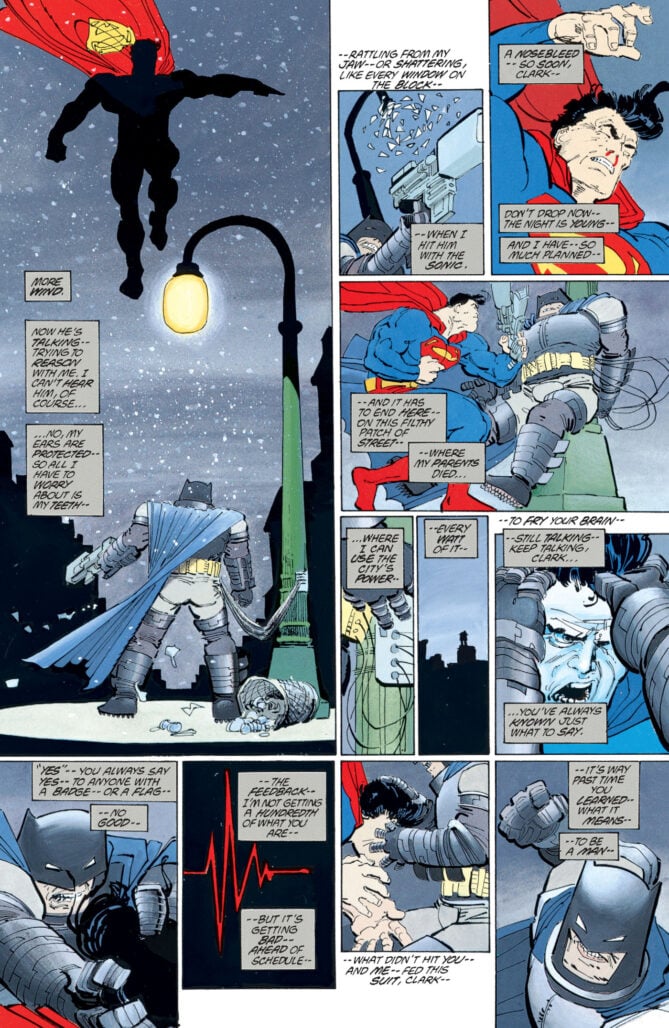
Batman: The Dark Knight Returns from Miller, Janson, Varley, and Costanza is a lot of things to a lot of people. It can be regarded as a high water mark in the ’80s evolution of comics as a medium. It can be a criticism of the growing authoritarianism and cold calculus of Reagan’s America. It can be a biting satire of society using our pantheon of superheroes (and, really, it can be bitingly funny in some regards that I haven’t even touched on here). It can be the foundation of the subsequent grim and gritty movement that infected the industry through the ’90s and beyond. And it can be a profound look at the process of aging in multiple ways.
It’s still worth reading these days, despite its creator’s subsequent shortcomings. Actually, maybe because of them. Because in the text itself, there’s also a meditation on not blindly trusting our heroes. And perhaps learning how to age with grace.
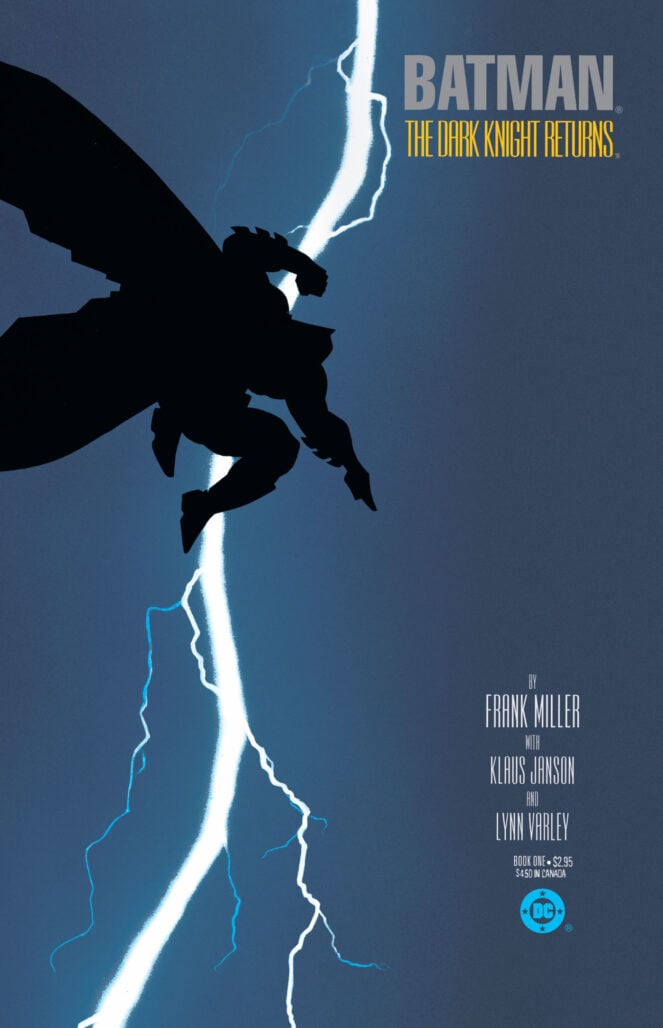
Batman – The Dark Knight Returns
Batman: The Dark Knight Returns
Writer & Penciller: Frank Miller
Inker: Klaus Janson
Colourist: Lynn Varley
Letterer: John Costanza
Publisher: DC Comics
Release Date: February 25 – August 26 1986 | September 15 2026 (40th Anniversary Edition)
Read past entries in the Classic Comic Compendium!
Check out other recent review pieces from The Beat!




Well written & thoughtful, thanks.