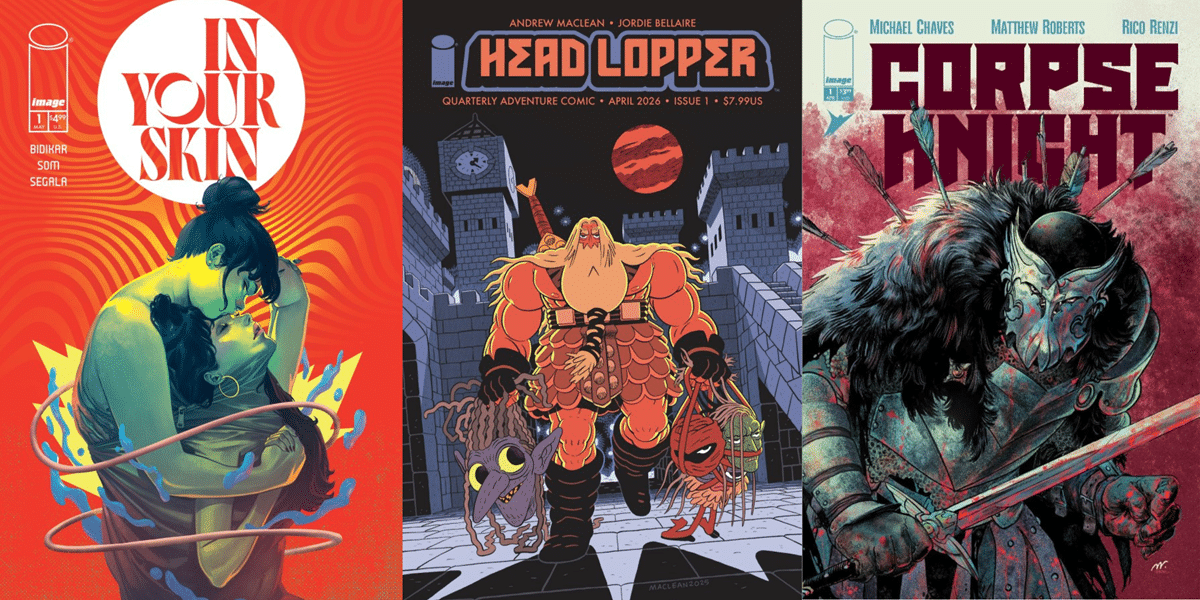

In this week’s Wednesday Comics column, it’s pouring series debuts, including Head Lopper #1, In Your Skin #1, Corpse Knight #1, and more! Plus, FOC Watch and The Prog Report!
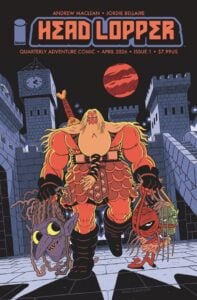 Head Lopper #1
Cartoonist: Andrew MacLean
Colorist: Jordie Bellaire
Publisher: Image Comics
Review by Tim Rooney
This is not the first outing of Andrew MacLean’s Head Lopper, but it is my first time reading it. And what a delight it is.
This is like an R-rated Samurai Jack, a fully-realized cartoon world that feels expansive and full of history and drama while simultaneously filled with laughs and visual gags. The way MacLean seamlessly marries the offbeat humor with the grand mythical sword and sorcery is like a magic trick. The heart of its appeal is the graphic, geometric design sensibility that breaks characters and backgrounds into their base shapes and lines.
It’s a deceptive minimalism that grants an immediacy to the characters’ expressions and actions. The characters are highly stylized but there is no shortage of detail and world building. Head Lopper’s world comes alive like a fractured fairy tale. MacLean employs intricate illustration and prose excerpts of the mythological religion throughout the book, adding a sense of grandeur to these misadventures of his dysfunctional band of misfit heroes.
Colorist Jordie Bellaire is the book’s secret weapon, using flat, pastel colors and contrast to really make the characters pop on the page. Head Lopper, despite being the latest in an ongoing saga, is the kind of book anyone could pick up and enjoy, full as it is with humor, action, and its charming visuals.
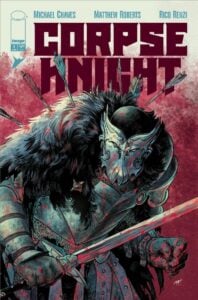 Corpse Knight #1
Writer: Michael Chaves
Art: Matthew Roberts
Colors: Rico Renzi
Letters: Pat Brosseau
Publisher: Image Comics – Skybound Entertainment
Review by Clyde Hall
Fictionally, the Revenant is a hardy archetype. It plucks at subdermal nerves of our psyche, sounding unsettling requiem notes across genres, cultures, and eras. Give the undead avenger a spiritual core and set him in California goldrush days, you get Pale Rider. A justice-bringer resurrected by cybernetics, then programmed to serve the public trust, protect the innocent, and uphold the law in a dystopian future begats RoboCop. A supernatural Goth haunting the rain-soaked urban sprawl of Detroit’s Devil’s Night becomes The Crow, born of comics and then adapted cinematically.
In Corpse Knight, the Revenant true to form rises from a tragic death which screams out for a reckoning, and with innocent lives once more serving as weights on an unbalanced scale of justice. Foy is a young French girl being raised by her father, a simple farmer but bearing scars of a more militaristic past quite common during the time of the Hundred Years’ War.
It’s the era of Joan d’Arc shortly following the lifting of the Siege of Orléans, and the young maid’s fame is rising. But it’s also at times a lawless period of chaos brought about by the war between England and France, a stewing cauldron of political intrigues, plagues, religious fervor, and fears of underworld influence in the form of witchcraft. A time when Joan was initially heralded as the heaven-sent savior of France but would soon find herself accused of heresy and burned at the stake.
Foy and her father talk about Joan and her rumored miraculous feats, including bringing an infant child back to life. And, when a raiding party kills her father while he covers her escape, Foy is suddenly thrust into the precarious position of a farm child left fending for herself. Easy prey for the sorts of marauders who murdered her father. When they return for a second round of raiding, however, they find Foy ready. But not with weapons or traps. Instead, they find her praying. And, as in Pale Rider, an appropriate phrase might be, “For what we are about to receive may we be truly thankful.”
Because her father rises from the grave and confronts his killers, defending Foy once more. But unlike Lazarus or even Eric Draven, this Revenant is resurrected with a corpse’s countenance, as a death-touched, death-dealing knight, and the source of the title’s name.
In this first issue scripter Michael Chaves, director of The Conjuring franchise, sets about the most important business regarding the launch of any Revenant tale: Making the murderers and juggernaut forces enabling them, the ones most responsible for the deaths of the innocent, absolutely reprehensible. With skill and economy of narrative, he manages the task. It’s a quick, seemingly finished comeuppance for the individual opposition, though the power players backing and banking their ilk likely prevail for future encounters. The Corpse Knight clears at least a few pawns from the board, but the chess masters will surely require checkmating.
Artist Matthew Roberts fleshes out the barer bones of this revenge narrative, in some cases literally and in decomposing detail, with the right visual tone. One centerpiece to his best work in this premiere is contrasts. Those struck between Foy’s rural farm life and the imaginative framing of Joan’s resurrection of the infant wherein pastoral routine gives way to stained glass elegance. Another striking moment is the wolfish grimaces lurking beneath sheep’s clothing assurances from the marauders, interrupted by the serene sincerity of Foy’s prayer. Immediately, the horrific tableau resumes as men who fancy themselves monstrous face the real thing.
And in each of those contrasting pages, panel upon panel, color artist Rico Renzi compliments the shift with streaming sunlight hues for the idyllic elements. Gloomy charcoaled shadows ooze about the chaos and horror scenes. Together with Roberts, Renzi makes an issue that I read twice but viewed a third and fourth time for more of their visual excellence.
Apart from its beauty, how well the book does depends a lot on the character building to come. We get very light sketches in the introduction. For some, the hooks will sufficiently draw them to a second issue. Preview materials speak of each installment focusing on a major player in the battle lines to follow, their past, and where it’s led them to in the margins as Joan of Arc’s march into history unfolds.
Which gives me hope for the title as it continues. The varied themes Joan d’Arc embodies in many ways and for many different people could serve the developing storyline in solid fashion. If explored within the right contexts, and with Foy giving us her window into historic events coupled with supernatural peril, Chaves’s concept has campaign legs. Only the execution is in question.
And it’s a question the premiere issue of Corpse Knight left more posed than answered. It’s a serviceable start for a Revenant tale, but one which gets at least a degree of resolution quickly. Whether the pull of 1400s French history and Joan d’Arc’s place in it will provide layers to that sort of narrative, layers that invest readers and bring them back multiple issues for more, is a harder call. Like Brie Noir, it may be an acquired taste after several samplings. For me, the visuals are sufficient reasons for picking up the first issue. Then see if you find yourself rallying beneath this creative team’s banner and investing in their longer battle plans for Foy and her undead protector.
In Your Skin #1
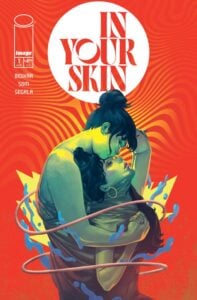 Writer and Letterer: Aditya Bidikar
Artist: Som
Colorists: Francisco Segala and Gloria Martinelli
Publisher: Image Comics
Review by Jared Bird
Priyanka has lived her whole life obsessed with Bollywood actress Ayesha Sen. She’s seen every movie, knows every bit of trivia, learnt every dance. When a chance to meet Sen goes awry, and the actress announces her imminent departure from the industry, Priyanka takes things into her own hands. The debut comic of critically acclaimed letterer Aditya Bidikar, in collaboration with artist Som, In Your Skin combines body horror and show business in an exciting and engaging way.
‘Your light has been lived by her light.’ Priyanka is the definition of superfan, wasting away her life as she obsesses over what she can never have. Ayesha Sen, meanwhile, wants to give it all up, and Priyanka just can’t bring herself to accept that; if Sen can’t live in her own skin, Priyanka can just have a go for a while. Carrying shades of films like Perfect Blue and The Substance, it doesn’t hesitate on some of the grotesque, body horror thrills you’d associate with the genre, whilst still prioritising compelling character work to get us emotionally invested in our flawed protagonist. It works wonderfully, ensuring that every story beat in the double-sized first issue succeeds in resonating with the reader, and I really appreciate that the narrative doesn’t feel the need to rush itself or throw a bunch of information at us without giving us a point of emotional investment to connect with.
Bidikar’s debut comic as writer is an excellent showing. He’s got a great sense of pacing and story development, with clear voices to distinguish characters from one another. Some of the dialogue isn’t perfect just yet, but the vast majority of it is damn close, and I can’t help but be impressed with how well Bidikar introduces us to the complex and vivid world of Bollywood entertainment with restraint and yet, clear fascination and interest from the perspective of the creative team. I can’t wait to see how his scripting changes over the course of the series.
Som’s artwork, colored by Francisco Segala and Gloria Martinelli, is great throughout. He’s got a hypnotic sense of pacing, building and building tension and letting it simmer beautifully throughout the series. There are moments when I wish it looked grimier or more vicious, but when the actual horror elements come through, they’re done brilliantly, in beautiful gnarly fashion. If anything, the clean glitz and glam just allows them to hit even harder.
Overall, In Your Skin #1 is a fantastic start to an interesting body horror narrative. Whilst it resides firmly in familiar thematic ground, it has a unique and incredibly well-done approach that will absolutely win you over, with great writing and artwork that makes the double sized first issue so addictive you won’t even realise it’s over. As the series continues, it’ll be exciting to see how the pieces the creative team lays out evolve here, and it’s best to check it out right now and be alongside that journey as it publishes.
 Event Horizon: Inferno #1
Writer: Christian Ward
Artist: Rob Carey
Colorist: Xenon Honchar
Letterer: Alex Ray
Publisher: IDW Publishing
Review by Khalid Johnson
 Frankenstein New World – The Speed of Darkness #1
Writers: Mike Mignola, Christopher Golden, and Thomas Sniegoski
Artist: Peter Bergting
Colorist: Michelle Madsen
Letterer: Clem Robins
Publisher: Dark Horse Comics
Review by Jordan Jennings
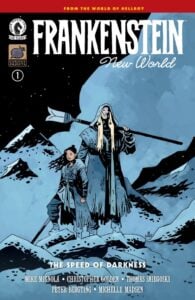
The third series in the Frankenstein: New World family of titles debuts this week with: Frankenstein: New World–The Speed of Darkness #1. The series follows Frankenstein and young Lilja as they race against time in an attempt to save the world from a second wave of destruction.
The Speed of Darkness #1 is an interesting read. To be up front, this issue is my first real reading of the Hellboy and B.P.R.D universe, post-ragnarok. Despite what you would think would be a weight of decades of continuity on this title, this issue was a great entry point to jump into the universe. This is thanks, in large part, to the writing team of Mike Mignola, Christopher Golden, and Thomas Sniegoski structuring the story in a way that it doesn’t rely on deep understanding of Hellboy lore to follow. The issue opens with a dream-like vision of Liz Sherman reminding the protagonist of their quest, but at no point do you need to know this is Liz or what really caused this world to be left in such a state of disarray. The Speed of Darkness reads as a fantasy quest and Liz largely functions as the mystic setting the heroes forth into the world. It is simple but effective. The way the writers effortlessly weave the information and exposition throughout the issue that informs us of the world, but isn’t so bogged down by the weight of everything, is impressive.
The character work is the main draw as the father-daughter-like rapport between Frankenstein and Lilja is the core of the issue and there are some moments that I found to resonate with me. There is a moment where Lilja states she is tired of sharing dreams with Frankenstein. To which Frankenstein retorts: “You’re growing up. I don’t want you to feel as if you have to see the world through my eyes…I prefer to see it through yours” As a father, this describes my personal experience with my children and gives the comic a sense of grounding despite being set at the end of the world full of demon monsters. The plot of the story is less of the focus, but when the character work is this good, the plot doesn’t need to be driving forward every single issue.
The art from Peter Bergting is exactly what you come to expect from a Curious Objects comic. The character designs are reminiscent of Mignola but with the artist putting in their own flourishes. The facial expressions and body language that Bergting imbues into the characters gives them weight. There is even this weird potato looking critter that Lilja befriends in the issue that has so much personality in it that you forget it looks like a tuber. The overall monster designs are great with some weird eldritch horrors being brought forth into this world. This is all complemented by Bergting’s excellent use of hard shadows and Michelle Madsen’s use of a restrained color palette.
Overall, Frankenstein: New World–The Speed of Darkness #1 is a deeply enjoyable comic that some may find to be light on the plot but I find to be full of character and personality. I recommend checking this one out if you are a big fan of monster comics and character driven stories, even if you aren’t deep into the world of Hellboy.
FOC Watch
The following titles are currently available for pre-order at your local comic shop!
 Odin #1
Writers: Marguerite Bennett and James Tynion IV
Artist: Letizia Cadonici
Colorist: Jordan Bellaire
Letterer: Tom Napolitano
Publisher: Image Comics – Tiny Onion
Due Out: May 20, 2026
Review by Zack Quaintance
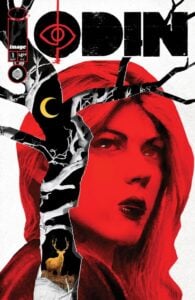
I’m not going to mince words here: Odin #1 is a just about perfect debut comic. Haunting and gutsy and compelling on every page.
Odin is ostensibly about white supremacy, with a veneer of dark Nordic religious ceremony. The marketing text bills the book as Green Room meets Midsommar, and while I usually think those X + Y descriptions don’t tell you much about a comic, this one is apt.
The story starts off relatively grounded, following an undercover, investigative journalist as she finally infiltrates a group of Neo Nazi punk rockers, who are travelling to Norway to do drugs and (I believe) try to summon Odin, who will champion their racist beliefs. That’s a compelling enough premise if it were played straight, without any touch of strange, but the book slowrolls a building a sense of the impossible.
This is a relentlessly well-paced first issue, one that commands reader suspense perfectly. I felt myself first repulsed by the brutality of the characters our lead was investigating. Then I felt myself worried she would be caught, her investigation exposed. Finally, I felt myself entirely overturned and disoriented, as the story plunged its protagonist — and me along with her — toward the supernatural, or seemingly supernatural.
It’s just a stunning (but not unsurprising) bit of spot-on scripting by Marguerite Bennett and James Tynion IV. Tynion of course is one of the biggest writers in comics, but I’ve felt that Bennett has been underrated for some time. Bad Idea comics are tough to track down if you don’t play their games, but Bennett wrote a book for them a few years back called The Lot, which is a total stunner.
And the script is taken up a level (or two) by the absolutely chilling artwork of Letizia Cadonici, colored here by Jordie Bellaire and lettered by Tom Napolitano. Bellaire is the best colorist in comics right now, boosting every artist she works with to career best work, and that’s what we get in this comic, a set of visuals that can scare you with character behavior just as adeptly as it does with horrifying hallucinations.
I’ll stop there, but just know — this comic is a total stunner, a chilling must-read if you can stomach the violence.
 Of The Earth #1
Writers: Chris Condon and Andrew Ehrich
Artist: Charlie Adlard
Colorist: Pip Martin
Letterer: Hassan Otsmane-Elhaou
Publisher: Image Comics
Due Out: May 20, 2026
Review by Zack Quaintance
There’s an old creative adage that writers should throw all the terrible things they can at their characters, because that’s the best way to find out/show what a hero is made of. And I think oil country — time and time again — has proven to be one of the best settings for doing that.
And oil country is the setting for Of The Earth #1, the new comic series from writers Chris Condon and Andrew Ehrich, artist Charlie Adlard, colorist Pip Martin, and Hassan Otsmane-Elhaou. And it certainly wastes no time testing its lead character with a steady stream of awful, from travelling over desolate sun-drenched highways to encountering sweaty highway patrolmen to trying to help roadkill. There’s a sense propagated by the setting that it’s all bad, and it’s all about to get worse. Put simply, nobody goes to oil country on vacation.
So, that’s the canvas this book is working against, and it’s a great hook, lending itself to several memorable individual scenes. Of The Earth is a comic with a close third person point of view, so instead of going grandiose with some kind of commentary on its subject matter, it lays out desperation and squalor by getting specific. And I love that about this first issue, which is loaded by great scripting choices from the team of Condon and Ehrich.
Adlard, colored here by Martin, is also one of the best visual storytellers we have in comics, and its to his credit that something like a truck looming on the highway can feel so scary and frustrating on his pages. Really stellar work.
And it all leads to a last page cliffhanger that I won’t spoil here, which is only to say that it’s a perfect first issue ending, one that will all but guarantee readers come back for more.
The Prog Report
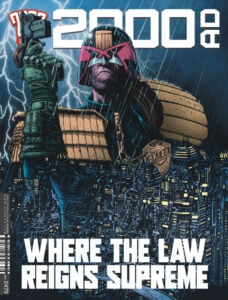 2000AD 2479 (Rebellion): I’m on at least year three of doing these weekly blurbs about 2000AD, and I still feel like a relative Judge Dredd neophyte. Hey, the character has a long history, and the publication and creators who work for it are not afraid to plumb all of it. Which is all to say this week’s concluding Dredd strip feels novel to me, a little bit different from any of the Dredd stories I’ve personally read. And while I had trouble getting into at the start, once it got going, I thought it was great. This week’s concluding chapter is on exception, bringing a level of suspense to the fourth and final part that I didn’t quite see coming. Here’s hoping we see some of the characters from this story again soon, feels like there’s much more to be done with them. Judge Dredd: Flames & White Phosphorus was written by T.C. Eglington, illustrated by Paul Marshall, colored by Quinton Winter, and letterer by Annie Parkhouse. This week’s cover (above) is by Steven Austin with colors by Matt Soffe. As always, you can pick up a digital copy of The Prog here. —Zack Quaintance
Column edited by Zack Quaintance.
Read past entries in the weekly Wednesday Comics reviews series or check-out our other reviews here!