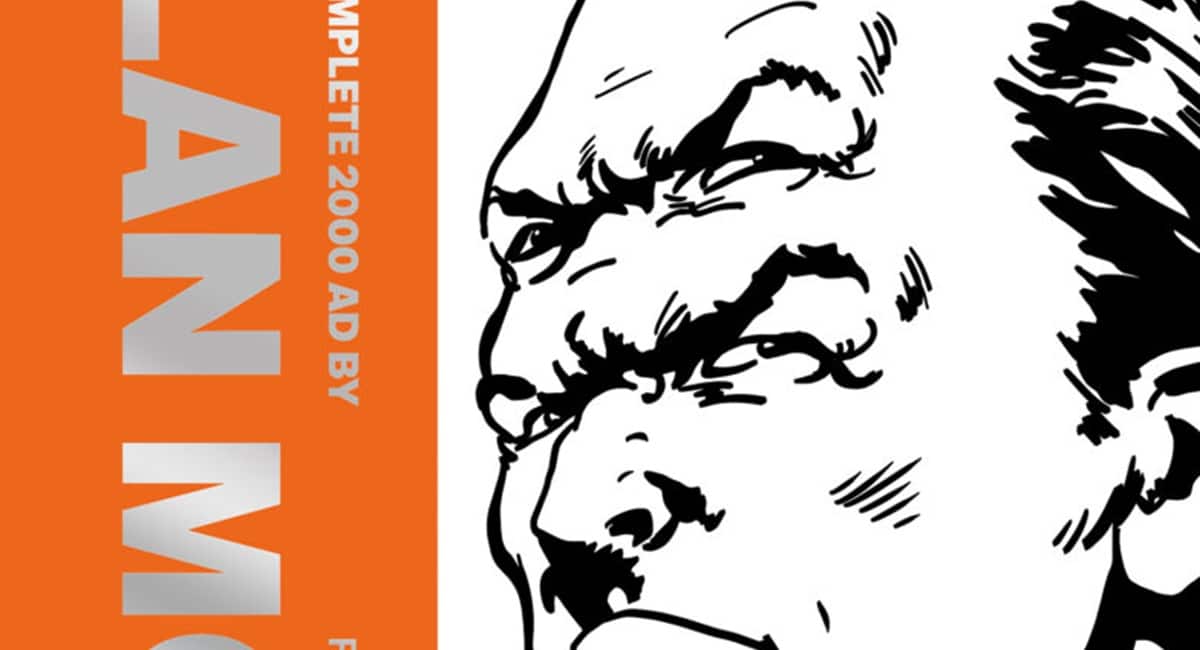

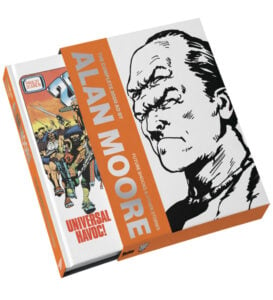
 The Complete 2000AD by Alan Moore Vol 1 – Future Shocks & Other Stories
Writer: Alan Moore
Artist: Dave Harwood, Ian Gibson, Brendan McCarthy, John Higgins, Garry Leach, Mike White, Paul Neary, Ron Tiner, Jose Casanovas, Eric Bradbury, Bryan Talbot, Dave Gibbons, Jesus Redondo, Robin Smith, Alan Langford, Jim Eldridge, Alan Davis, John Richardson, Steve Dillon, John Cooper, Joe Eckers, Rafael Boluda Vidal, Brett Ewins
Letterer: Tom Frame, Tony Jacob, Steve Potter, Tim Skomski, Jack Potter, Peter Knight, Dave Gibbons, PAul Bensberg, S. Craddock, John Aldrich, Bill Nuttall
Publisher: 2000AD
Publication Date: April 2026
Fun is relative. Sports can be fun, depending on if you’re watching them or playing them. Comics can be fun, depending on if you’re reading them or writing about them. Thinking about complex ideas can be fun, whether you’re arguing for them or debating against them. Grappling with the crushing cultural weight of American power fantasies through the use of superhero characters to make a point about the comic industry’s creative stagnation… uh… can be fun… in a way.
Plenty of people are going to look at the classic comics of Alan Moore, like V for Vendetta or From Hell and think of them as homework, as dense tomes that need to be patiently studied. One could read Watchmen and think there’s so much going on, so much to think about and so much being said that it feels more like a chore than a leisurely afternoon. How could any of this be fun? Precisely for this reason, many look at the name “Alan Moore” on a book spine and run in the opposite direction.
But guess what? Alan Moore writing for 2000AD? Unbelievably fun!
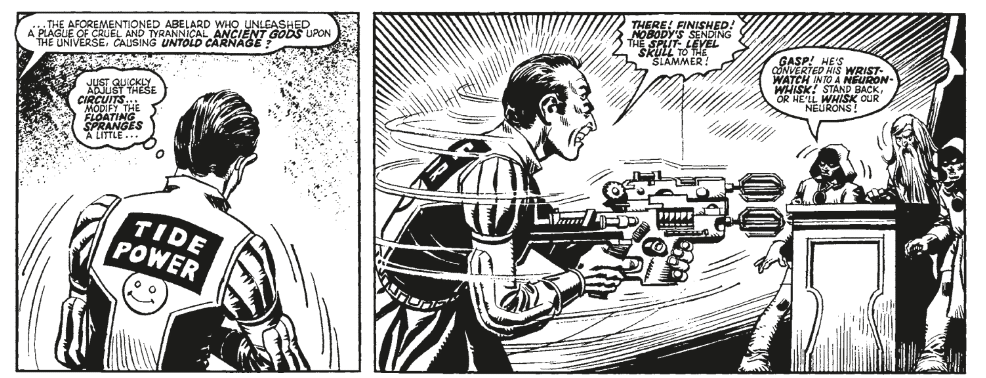
For the first time, 2000AD has started collecting the complete works of Alan Moore from his first Future Shock story in 1980 all the way through to his and Ian Gibson’s Ballad of Halo Jones that wrapped in 1986. While some of these stories have been collected before, like Moore’s Rogue Trooper in the first volume of Tales from Nu-Earth, or in writer-centric paperbacks like The Complete Alan Moore Future Shocks, this new hardcover starts to bring them all together. The first volume contains Moore’s complete run on Future Shocks, as well as Time Twisters, Abelard Snazz, and a smattering of his short stories for other titles, like Rogue Trooper, Ro-Busters, and ABC Warriors.
As far as I can tell, there are three obvious reasons to pick this up. The first is just because it’s Alan Moore, you’re not going to be disappointed by his command of the comics form and use of language in short, Twilight Zone-esque horror stories. The second is perhaps the more interesting notion of getting to see Moore’s style and collaborative relationships develop well before his more famous works. The third, perhaps least obvious reason is just the unimaginable number of silly stories and joyfully deranged twist endings that make this book a treat independent of its historical importance.
I want to stress that final point, as it seems so counter intuitive for many. Plenty can be (and will be) said on Moore’s evolution and the start of his creative tendencies that stem from his work with 2000AD. But before we can commence that task, it’s worth taking the time to understand Moore’s reputation among comics and traditional superhero fans. There’s a whole generation that has grown up on, as Moore himself put it, “the comics industry going through my trashcan like raccoons in the dead of the night.” Moore is an infamously prickly character. Some call him bitter and combative, others just think he’s been worn down by time. But in the last two decades there are plenty of readers that know only this reputation of Moore, passed down in iFanboy interviews and DC Forum posts, all the way through to comics youtube videos. I’ve been in plenty of chat rooms and comics shops where people have harsh, borderline cruel takes on Moore without having read anything he’s written.
That image cultivated in the popular imagination is the primary hurdle.
We don’t need to and don’t have the time to re-litigate Moore’s reputation. I think Moore makes a strong enough case for himself and how he was treated by the comics industry where most people would agree with him if they took the time to listen to his side of things. But no, our goal is not that. Instead, it’s to show that there are layers, interests and comical digressions in Moore’s early work that isn’t found anywhere else. That is the main reason to read this collection, because it gives us such a powerful contrast to the cultural reputation of Moore while at the same time providing a crucial link to his artistic development.
Take for instance “Bad Timing,” a Future Shock story found in Prog 291 from 1982. Here, Moore introduces us to the people of “Klakton,” an alien world where the ruling science council is being advised by A-Thur, who claims this planet will explode. The council doesn’t believe him, so he returns home distraught over the fate of his world and his only son…
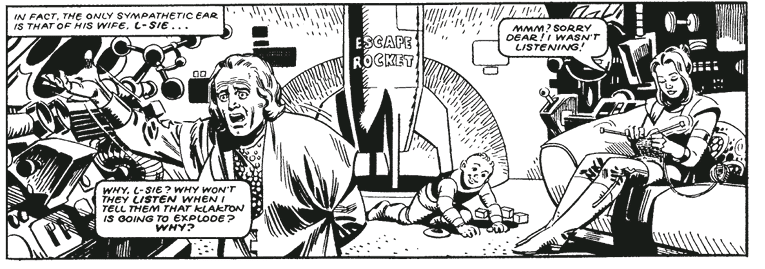
A-Thur and his wife L-Sie decide that if the world is going to explode, their best bet is to send their son, N-Ree, to the distant planet of Earth. There the planet’s lesser gravity will allow him to fly, see through walls and bounce bullets off his chest. They send their baby into space and await their doom… except said doom never arrives.
Yes, you see A-Thur is an idiot and the planet wasn’t going to explode at all, which means he sent his only son off into space for no reason! But it gets worse: Now baby N-Ree heads towards Earth and A-Thur’s faulty calculations cause him not to arrive in 1939 but rather 1983. At this crucial point in history, America and the Soviet Union’s early detection systems mistake the baby’s rocket for a nuke. The two nations end up destroying Earth, just in time for our superpowered last son of Klakton to arrive…
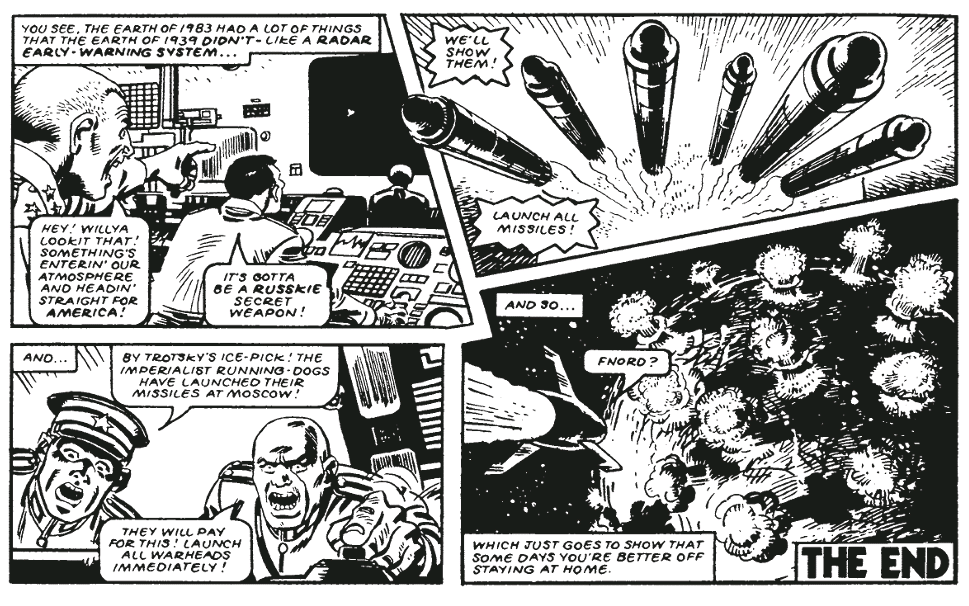
If you haven’t guessed, “Bad Timing” is a riff on Superman and the absurd question of “what if everything in our most popular hero’s origin story simply went wrong?” What if Krypton didn’t blow? What if Jor-El was just a dummy? What if Superman’s rocket arrived during the peak era of nuclear paranoia? Moore and artist Mike White are clearly having fun here poking at the Superman formula, but over 40 years later, this short story is even funnier. In a modern world where Superman’s creation is given quasi-religious significance by comics fan, in a world where Grant Morrison has declared Superman a better idea than nuclear bombs and wrote the most famous Superman story ever where Frank Quietly immortalized Superman’s origin in the opening pages of All Star, I can’t help but laugh my head off at Moore’s immediate interest at playfully popping the balloon of hero worship.
That is the key word, “playful.” The various Future Shocks collected range from ironic punishments to silly inversions of classical tropes, with Moore and his various collaborators drawing on real life celebrities, parodying pop culture and literalizing the inherently dystopian elements of the Thatcher era. There’s more than enough political skewering of the situation, like two people unable to bear the existential weight of working at a gas station, but there are also stories about werewolves in space. The scattershot approach hits far more often than it misses, which is in part the beauty of the 2000AD prog format that facilitates short stories. Don’t like the premise of this one? Don’t worry, it’ll be over in about 4-6 pages.
The Future Shocks eventually lead into the Time Twisters which follow the same format and tone but each story specifically deals with time travel in some way. This is perhaps the best stretch of the book, as Moore continues to approach these stories with a playful spirit, but there is slightly more experimentation.
“The Reversible Man” in Prog 308 from 1983, for example, opens with a fade to black before revealing a man that has collapsed on the ground. The narrator tells us his story, and we quickly realize the comic is moving backwards through time, with each panel taking place anywhere from a few minutes to a few years in the past. The story ends up chronicling this man’s whole life from death to his birth; the end is the same as the start, disappearing into a void of nothingness with a full life sandwiched in the middle.
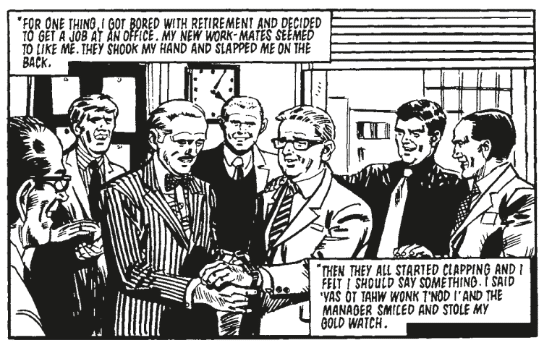
That story is one of the most creative in the batch, allowing Moore to show some formal creativity but then about 8 pages later we come back to the realm of parody with Joe Saturday, a caricature of Dragnet’s Jack Webb as a time traveling cop.
The Future Shocks and Time Twisters make up a majority of the book but the last chunk is made up of one-off stories where Moore takes the reins of other popular, pre-established 2000AD titles. Like all the other stories so far, these are short adventures into a sci-fi world that’s largely dystopian and where the gears of capital must keep churning. The only difference is that Moore is being dropped into the ongoing tales of these characters, and therefore has to work within their premise rather than starting from scratch.
Take for instance, Rogue Trooper. That series follows Rogue, the last G.I. on the planet Nu Earth, seeking out the traitor general that got Rogue’s fellow G.I.’s killed. Rogue travels through Nu Earth, hunted both by the Southers who created him and the Norts. Each Rogue Trooper story follows his quest to find the traitor general, but he’s inadvertently roped into conflicts with both armies. Rogue, and his biochipped helm, backpack and gun, also have a tendency to bicker about their mortality and the best way to go about their revenge. Moore writes two Rogue Trooper stories, one that deals with the nature of the perpetual war on Nu Earth, and the other that adds to the history of the G.I. program. Both are stellar reads, but the second provides an interesting window into Moore’s larger project that would evolve with his later superhero work.
In “First of the Few,” Rogue and company are trapped in the Glass Mountains after being ambushed by a horde of Norts. They stumble onto an old, blue fellow that appears to be a G.I. as well. Rogue is in disbelief as all the G.I.s were thought to be killed earlier in the series, but this old man reveals himself to be a prototype G.I., dropped on this world long before Rogue and his comrades.
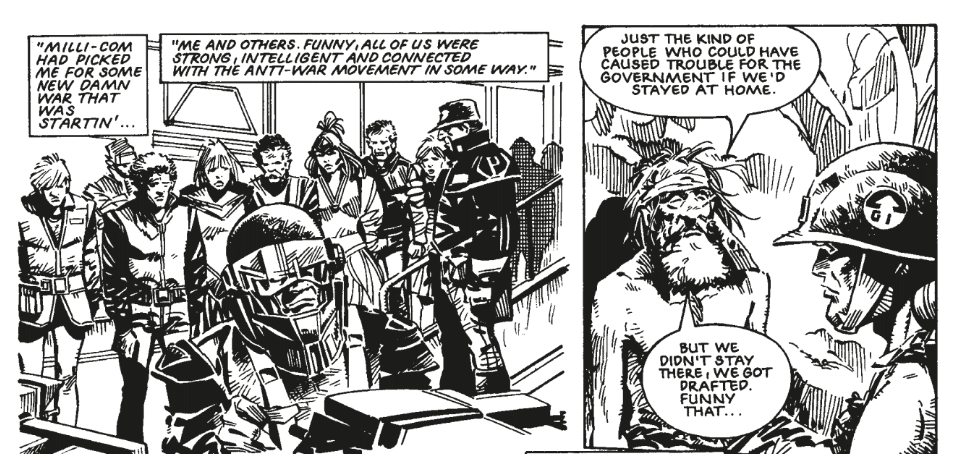
His story outlines how the Southers rounded up political radicals and dissidents, anyone who wouldn’t have agreed to fight in the war in the first place, and “volunteered” them to be turned into G.I.s. They weren’t told what was going on, and as soon as they were transformed they were abandoned on Nu Earth so that the Southers could see how long they would survive. All of them were thought to have died, but one last prototype now sits in these mountains waiting to die on his own terms rather than as an engine of war.
Rogue is moved by this and fights off the coming Nort invaders in order to give the prototype a chance to die in peace. Once dead, Rogue has 1 minute to eject the prototype’s biochip and save his consciousness. Rogue refuses, as the last full page of the comic depicts Rogue watching the light fade from his eye. Helm asks him why he did it, to which Rogue responds “they say old soldiers never die, Helm. I guess I just wanted to prove them wrong… just this once.”
It’s a tragic way to go, especially when put within the context of a series that is entirely premised on saving the biochips of Rogue’s buddies so they can be regened later. Rogue and his friends are like trapped spirits of the battlefield, forever moving through Nu Earth and fighting enemy armies while inching closer to their task of finding the traitor general, a person whose existence would invalidate the authority of the Southers and render the entire war effort mute. Rogue is trapped in a vicious cycle of violence, hanging onto the false hope that one day he can find justice for his friends but to do so he needs to preserve their humanity in the most inhuman ways, trapped inside a backup, helmet and gun. Knowing the endless task that awaits him, here Moore takes the chance to let Rogue experience what a real ending might feel like, an ending he will never get. Rogue gets a chance to see that his body and mind are his, and that someday maybe someone else will get to die on their own terms rather than as fodder for the government.
“First of the Few” is a bleak story, one that gets at the heart of Rogue Trooper comics with a cynical but necessary realization about the futility of the war on Nu Earth. It’s a story that couples the superheroic Rogue to a tyrannical government’s whims, and questions whether he can ever allow himself to be free of the conflict. Is he actually “rogue” or is he simply reinforcing the corrupt values of his makers by his very existence? These questions about super soldiers, the connection between heroes and the political context from which they emerge, and the endless nature of the stories being told within these pages all point towards the wider work Moore would go on to do. Whether that’s Miracleman, which Moore worked on simultaneously around this period, or Moore’s Superman story “For the Man Who Has Everything,” a direct line can be drawn from these musings on the futility of neverending comics and the limits of our political imaginations to Moore’s larger questions on the legitimacy of the superhero and the need to push the format of superhero comics beyond their repetitive cycles of simplified good and evil.
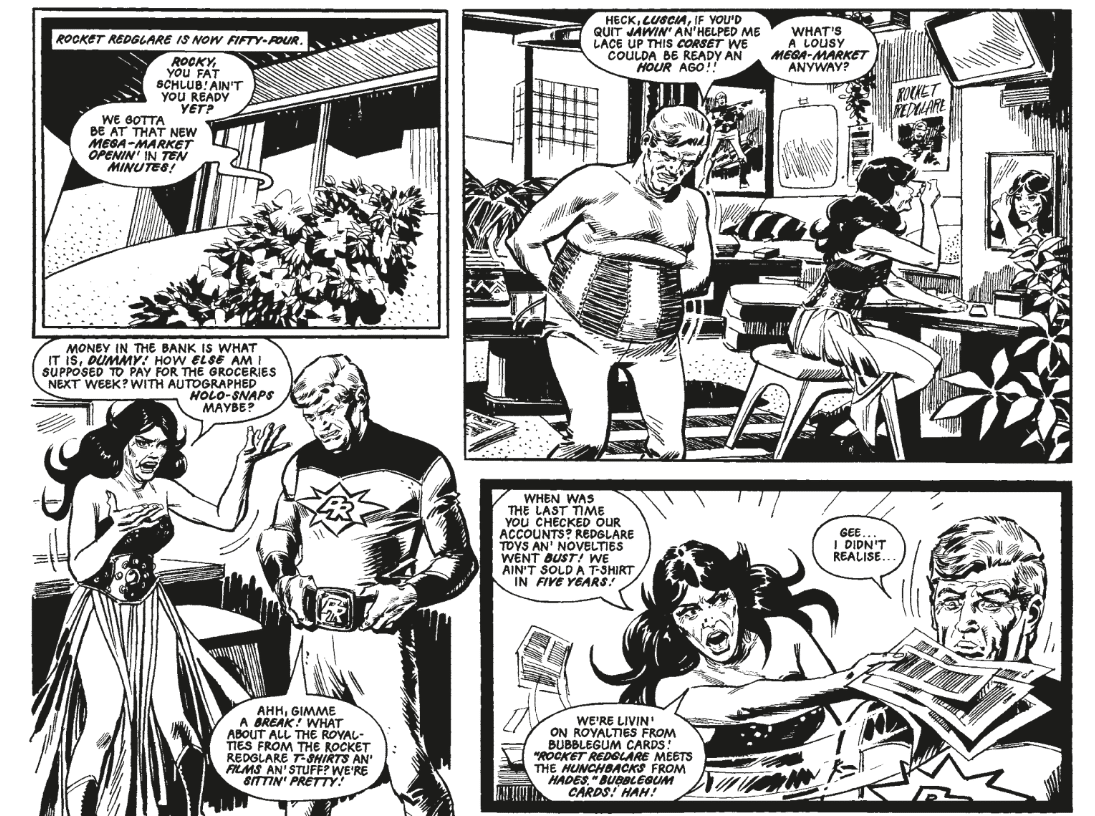
This collection is littered with moments like these, moments that remind you of how young Moore is as a writer and all the works he still had rummaging through his mind. Whether it be the story of a washed up, middle aged superhero trying to reclaim childish glory, or a space bounty hunter remarking on the idea that his target could be an entire planet. The Complete 2000AD by Alan Moore is necessary reading for a complete view of Alan Moore. Through various sci-fi adventures and parodies, Moore dips his toes into the ideas that would seal his reputation, while also injecting a playfulness that many newer readers might not be familiar with. There’s always good reason to study Alan Moore’s work, but rarely is that process as much fun as his years with 2000AD.
The Complete 2000AD by Alan Moore Vol 1 is out this month via 2000AD
Read more great reviews from The Beat!