
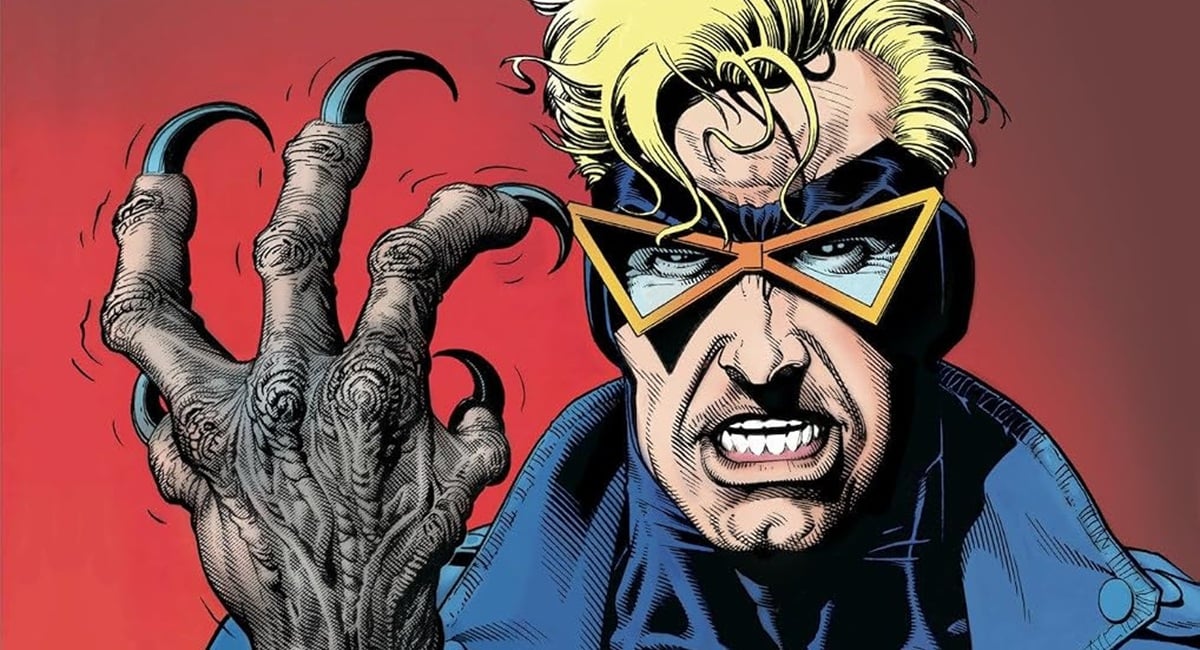

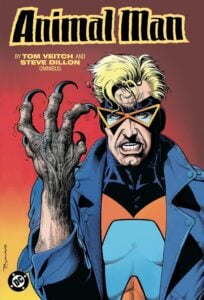
 Animal Man by Tom Veitch and Steve Dillon Omnibus
Review by Elias Rosner
Writers: Tom Veitch, Peter Milligan, John Ostrander, George Perez
Artists: Steve Dillion, Chaz Truog, Brett Ewins, David Klein, Tom Mandrake, STeve Pugh, Geof Isherwood, George Perez
Inkers: Steve Dillon, Paul Farmer, Mark Badger, Dick Giordano, Jim McCArthy, STeve Pugh, Chaz Truog, Robert Campanella, Russ Braun, Pablo Marcos, Vince Giarrano, SCott Hanna, Romeo Tanghal
Colorists: Tatjana Woods, Tom McCraw, and Gene D’Angelo
Letterers: John Costanza, Todd Klein, and Albert DeGuzman
Publisher: DC Comics
Publication Date: April 2026
I love Animal Man. He was one of the gateway heroes that brought me into DC, instilled in me a love of the weird and the unsettling, and helped cement my love of horror comics…despite my generally weenie, horror-averse nature. Yet for all my love, I’d really only read two runs of his: the last (Lemire’s New 52) and the first (Morrison’s in the late 80s.) Yes, yes. Not his first appearance, but it is the first true, blue run.
Why? Inertia, in part, and access, for the rest. It wasn’t until 2013 that issues #27-89 began to be collected, a good ten years after the rest, and issues #78-89 still haven’t been collected. They’re also not exactly widely circulated so when I saw that the first chunk of those extant issues were getting the omnibus treatment, I knew I had to snag a copy and finally see what I was missing out on.
If you thought Morrison’s run was strange, Buddy, you ain’t seen nothin’ yet.
Collecting issues #27-50, Animal Man by Tom Veitch and Steve Dillon begins with a six-issue arc by…Peter Milligan and outgoing artist Chaz Truog, which is described as an “epilogue” to the Morrison run. Off to a great start with your marketing, DC.
I’m being a bit facetious. This six-issue arc acts as the bridge between the two runs. It makes sense to place it here rather than at the end of the previous omnibus, both to ensure the relative sizes of the books remain the same and because it has much more in common with Veitch & Dillon’s sensibilities than Morrison’s.
Thematically, sure, it’s certainly an epilogue. Questions of identity, our place alongside nature, the vagaries and silliness of being in a superhero universe; all these are concerns Milligan plumbs.
It’s just he plumbs them in the most out there way imaginable.
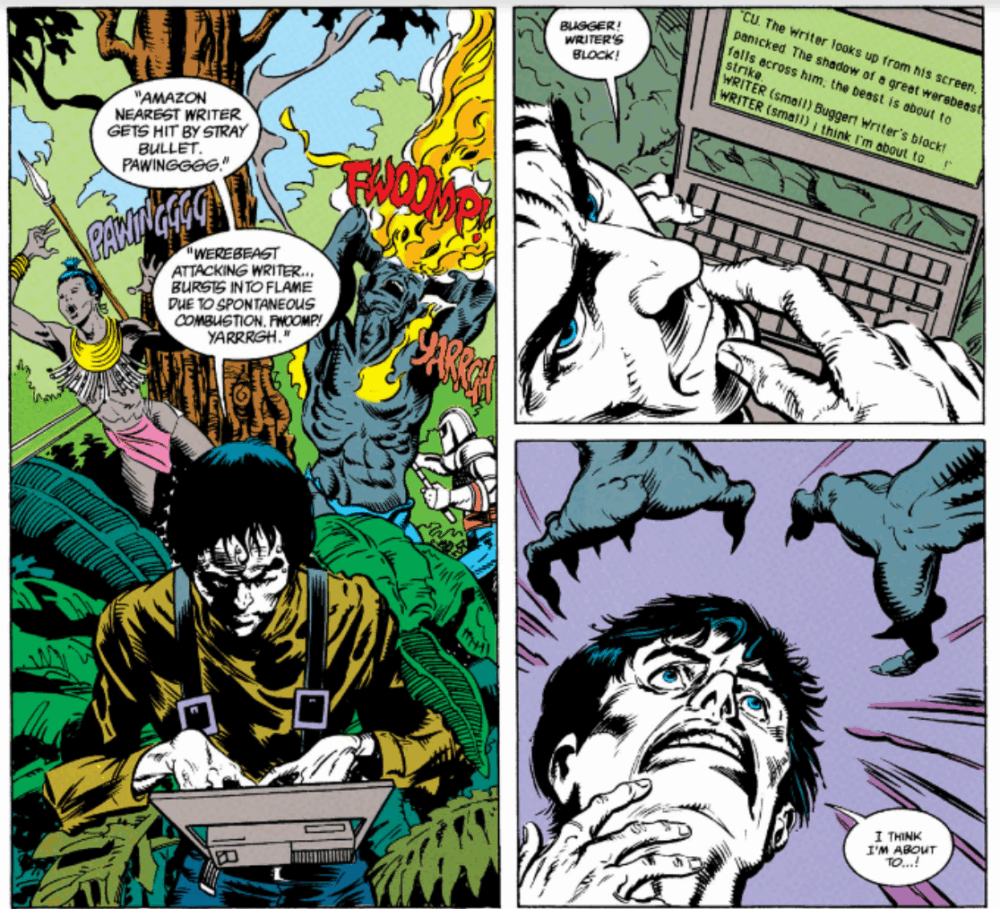
See, Milligan is a writer who doesn’t know an idea he can’t make weirder. Buddy Baker just had his family returned to him? The shock of that event and of meeting his creator, The Writer (aka Grant themself,) sends him into a coma that he awakens from only to find his wife hates him, he’s seeing a jungle in his bathroom, and his powers are so out of whack he thinks pissing on the sidewalk in front of his house is the most natural thing in the world.
To be fair to Buddy, it is for dogs.
Along the way, he meets a man that’s like a cubist painting who only speaks in the most infuriating, disjointed sentences (eventually you learn to just ignore the out of pocket words or phrases to parse what he’s saying) and works for the CIA. They end up fighting The Front Page (a letterer’s worst nightmare) and the Notional Man (I don’t even know where to start with this man and his forceps.) Buddy also gets so hungry he eats a horse, dies a couple times, eats regular pizza, hits his kid, maybe has a fake wedding courtesy of a telepathic child who thinks he’s just dreamy, and it all ends with a joke about hot pepper on pizza.
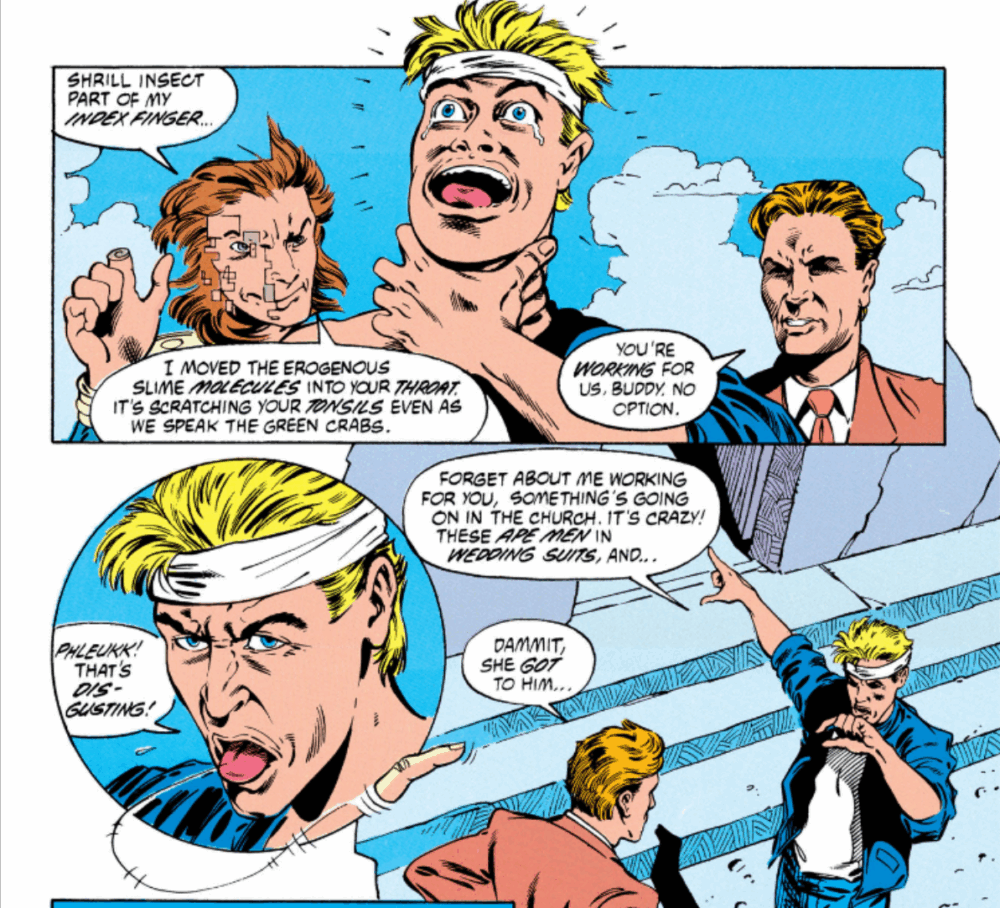
There’s more, of course, but I think you get the gist of these six issues. They’re zany and kooky and…kind of perfect for drawing a bright line in the sand, staking a new direction for Animal Man. Coming off of a happy ending to such a lousy new world puts us directly in Buddy’s shoes, disorienting the long-time reader while providing a clean enough onboarding for new ones. We know something happened before and that this new world is very off, and so are Buddy’s powers (ain’t they always?) But that’s about it.
Truog still being on art (alongside mainstay colorist Tatjana Woods and letterer John Costantza) allows for a smoother landing too, though he infamously ends the run by inking his own pencils and, yeah, they do not look great. Really splotchy and rough, a far cry from the clean, crisp cartooning of the rest of his issues which look excellent (big ups to Farmer for his inks,) though Truog gets there by the last few pages of #32. That said, it has echoes of Dillon’s fill-in issue, providing another small bridge to the rest of the omnibus.
I was still sad to see him go. Truog defined the look of Buddy and his world in a way that no one else quite captured. A cartoon in a serious world, just slightly out of place and out of time. If you want the full story as to why Truog wasn’t on the book longer, well, this is the beauty of a retrospective omnibus! They got Chaz to do a couple postscripts, along with former editor Art Young and writer John Ostrander, and their insights into the behind-the-scenes are invaluable. (Ostrander apologies for killing Grant off in Suicide Squad. But only a little.)
I love how much bonus material is present in this omnibus. It’s not a ton of stuff but it helps make the package feel like it was constructed with care rather than slapped together by some marketing department to make a few more bucks off a new release. They got scans of the original art for most of the covers, including some unused ones, as well as some pages by both Truog and Dillon for the back.
Also, thank goodness there are credits for every issue in the table of contents. It helped me understand why there were so many credited names for an omnibus with “Tom Veitch and Steve Dillon” in the title. You can thank the two, count-em, TWO non-Animal Man issues for ballooning that credits list. War of the Gods was the biggest offender but Suicide Squad was no slouch.
One thing I am disappointed by is the lack of the letters columns. We get a few but I wish DC was more consistent about including them in these omnibi. It gives insight into the conversation happening around the books, particularly for a comic that seemed to have some truly meaningful discussions happening in those pages.
And I mean, if you’re going to be making a premium product for collectors, why not have them be as complete as can be? (Though leaving out the ads is probably for the best, much as would find them fun.) Both volumes of “The Question” included them! Maybe it was a page count issue.
OK. Let’s move back to the actual comics. Starting off #33 with a bang (literally and figuratively,) Veitch and Dillon pick up in much the same way as Milligan: a firm break with the before. It’s presumably been a couple years – the book seems to move in real(ish) time like “Hellblazer” – and Buddy is now working as a stuntman, his superheroics more of a side-gig. His family is back together, though things are a little more strained than before, a reflection of Milligan’s take and the passage of time.
Oh, and the birds are dying.
Setting aside that hook for now, I wanted to hone in on the family stuff because, to me, that’s what makes Animal Man. The family drama is what draws you into the character and what sets the tone of the series. The superheroics, or at least the use of powers, are important, sure, but they’re not the engine that powers its success or Buddy’s longevity in our collective consciousness.
Unlike in Morrison’s run, here we are presented with a family that is neither happy nor functional. Both stories have him hit Cliff, for fucks sake! While Milligan uses that to indicate just how off the world Buddy wakes up to is, and how much it is changing him, Veitch strains the family from the get go with Buddy’s long absences on movie shoots, anger, and general dismissiveness. This is not a story of the happy family we saw at the end of #26.
It is a story of a Buddy in decline.
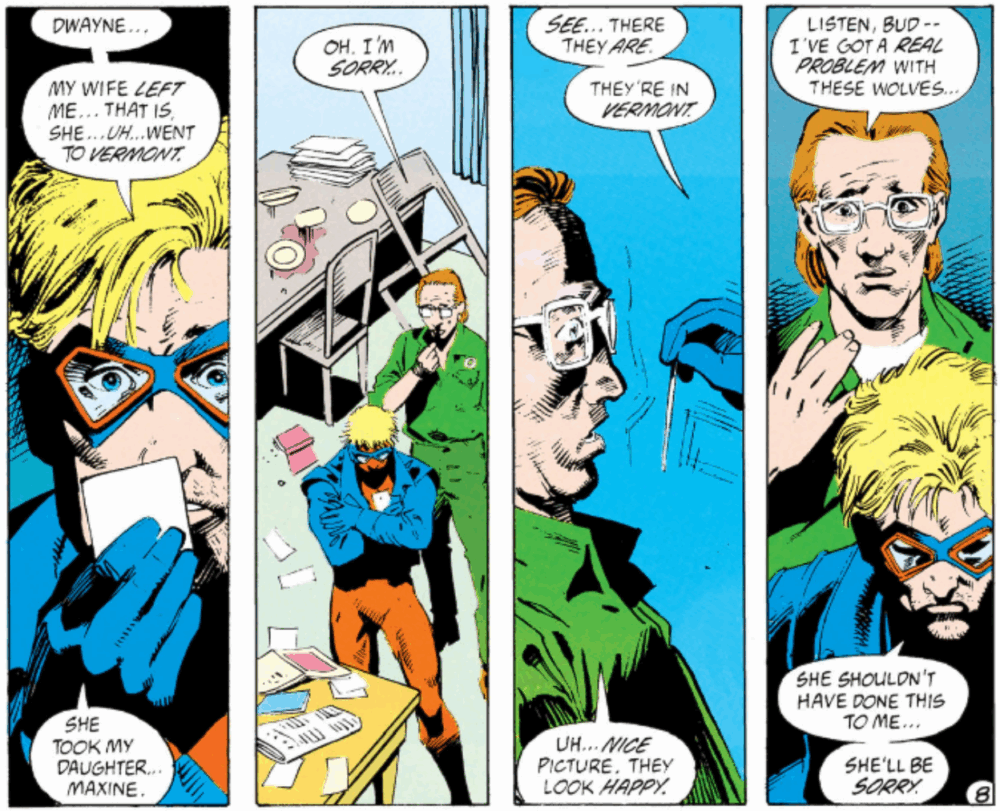
As a concept, as a way of continuing a story for a character that had a pretty definite end without it feeling like it was throwing it all away, that rules, and for the most part the run delivers on that promise. Veitch does a pretty good job of weaving together a few ongoing plot threads that bob in and out of the narrative, culminating at the end while leaving plenty of loose ends for the next creative team to pick up and do with what they will. A real “this is the world and the world doesn’t always give closure” kind of thing.
The downside to this approach is it never feels fully cohesive. There’s an aimlessness to the run, even though it has clear movements: #33 to 37 (Buddy’s powers on the fritz,) #38 to 41 (Buddy spiraling out,) #42 to 46 (S.T.A.R. Labs and Buddy’s journey back,) and #47 to the end (Journal of a Plague Year.) Things just kind of happen and then are forgotten about, only to be picked up in three or four issues with none of the narrative or emotional urgency that they should.
The comic runs more on vibes, spiritual and scientific, to propel itself forward. The spiritual side comes in the form of The Stone that Cracked Open the Earth like an Egg, or Stone for short, who shepherds Buddy on a journey of meaning and self-discovery to find his place in the world and as a protector and not just a show pony superhero. He’s also the source of Buddy’s powers going awry. Maybe. Possibly. I’m still not clear on that part.
The scientific side comes via the exploration of Buddy’s powers: how do they work, what can he do, what does it mean that all animals are connected via this morphogenic field. This involves walking back some of Buddy’s expansive ability to pull any power from anywhere, which lets Veitch ask if the connection is bidirectional and, wouldn’t you know it? Buddy starts taking on the traits of the animals he’s connecting with.
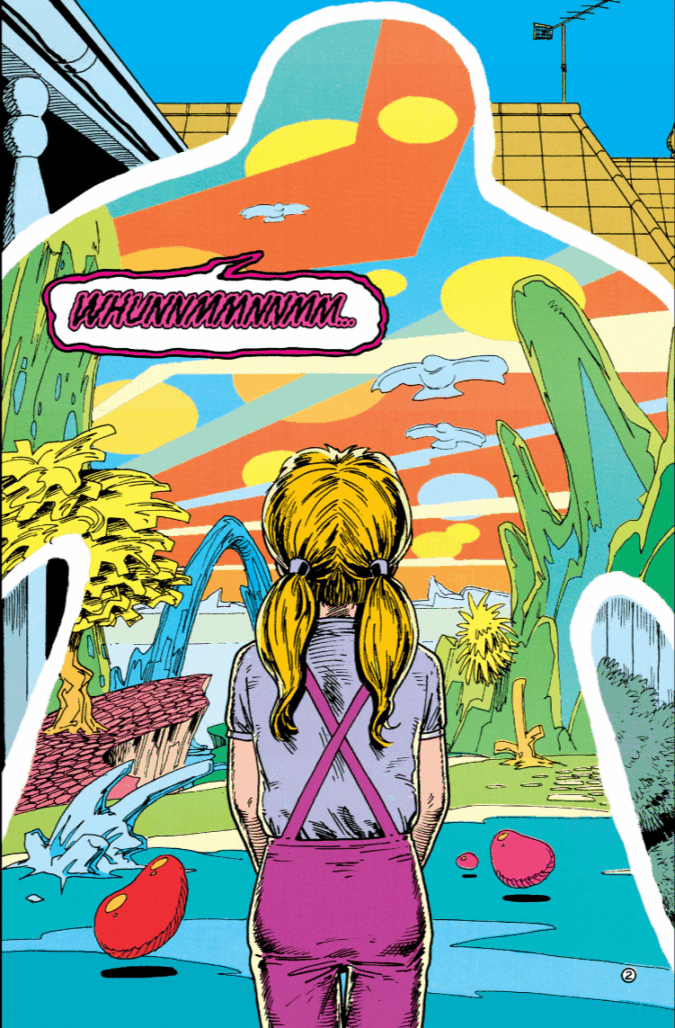
Following a different thread, he also asks if the powers are genetic and answers in the form of Maxine exhibiting the same kinds of connection Buddy does, though far more instinctual and unbidden. To facilitate this newfound curiosity in his powers is a new character: former hippie Travis Cody.
Cody provides a fascinating contrast to Buddy. Buddy is the picture of suburban family man, though with that particular late 80s flair for the disastrous. Cody is, by all accounts, a burned-out, conspiracy-addled fool. He’s also intensely curious, caring, smart, resourceful, but, yes, a fool that’s easily distracted by pretty women, drugs, conspiracies, and, at times, money. While Cody is open to the world, Buddy is not, so wrapped up in himself that he can’t see what’s going on around him.
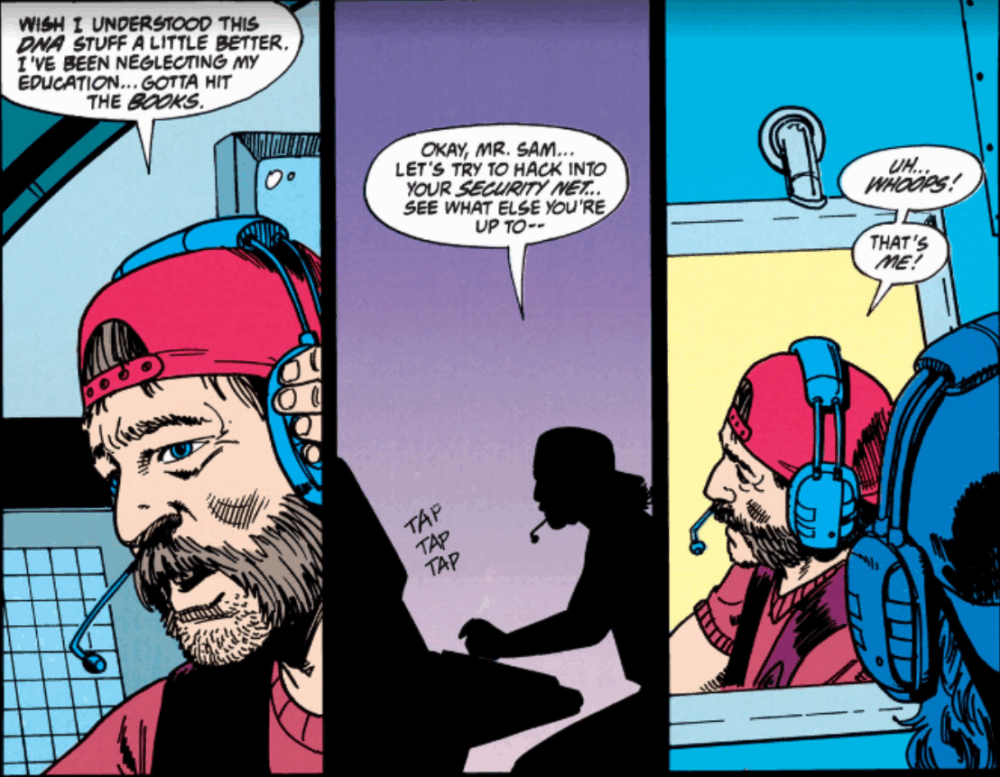
I found Cody equal parts frustrating and endearing, clearly the intention of the creative team. I credit much of that to Dillon’s impeccable facial acting, who I should mention is killing it on the art. While I think I prefer Truog’s style for Animal Man, Dillon is unimpeachable, even in these early, pre-Hellblazer and Preacher days, bringing that slightly grimier, more dirt-encrusted feel to the world. Yes, there are a few issues (#43 comes to mind) that feel a bit more phoned in later in the run – goodbye backgrounds in very noticeable ways – which are then followed up by a fill-in artist, but on the whole, you don’t really notice.
Moreover, his action is always big and easy to follow while his character acting is second to none. In the case of Cody, Dillon gets the subtlety that’s needed to sell his humanity and genuineness without Cody coming off as too much of a caricature. Considering we spend a lot of the series with him, both with and apart from Buddy, that was a necessity.
Lest you think this run is less weird than Milligan’s, Buddy is stalked by a mystical gateway in the form of a person named Mister Rainbow (per Maxine,) channels lightning, shoots acid from his hands, befriends the former hippy computer scientist who shot Cliff (hi Cody,) kills an entire zoo’s worth of animals, fights a town of bear people phantoms (thanks War of the Gods,) becomes a bear, fights TWO men infected by a cosmic embodiment of destruction, and learns that everything he knew about his origin was a lie…again.
Oh, and Cody goes into cyberspace and tries to stop the San Diego S.T.A.R. Labs (or is it the Newfoundland branch) from turning its leader into a roided-out Dr. Manhattan knock-off. You know. Normal stuff.
That said, apart from Cody, most of the supporting cast, and even Buddy to some extent, are oddly watered down. They act as the plot demands, reduced to one or two main traits that recur. Ellen, Buddy’s wife, gets it the worst. She does little more than yell or demure for most of her page time.
While her core remains constant – her love and devotion to Buddy, a stark contrast to alt-universe Ellen – Veitch portrays her as a passive figure for most of the comic. Her only real action is to take Maxine away to her parent’s farm in upstate NY (notably leaving Cliff behind with Buddy) and going to work for a hack comic creator who creates The Penalizer, an in-universe Punisher knock-off.
As a quick aside, I should also mention the comic creator looks completely different when Dillon draws him in #45 versus Ewins’ take in #44. Colored differently too! His hair is black for most of issue 44 but red, like the Penalizer, when he returns. Sadly, this is not Wood’s most consistent or best work, at least when she’s not coloring Truog or Dillon. Particularly in the skin color department, though Tom McCraw’s coloring on “Suicide Squad” is far more eggregious (see Black Adam’s ashen grey skin.) It is, however, still dripping with her fantastical pinks and greens and moody reds. Even on her off days, Wood is a colorist par excellence.
This isn’t the only questionable aspect of the comic that made me raise my eyebrows though. Cliff’s skeevy uncle who “rescues him” after Cliff ran away with his dirtbag friend in #39 strikes me as a particularly gross example of a gay panic character, throwaway as his presence in issue 42 is. Then there’s Stone’s whole schtick being a prime example of the Magical Indian trope. Had he a little more definition, or had we spent any more meaningful time with Frank and Moonlight Jackson, the other two Native Americans with Stone in issue #33, at least it would be a little counterbalanced.
But back to Ellen.
Ellen’s passivity actively frustrated me. We have such little interiority for her and the comic would be so much richer with it. She should be arguing with Buddy more. She should be pushing or talking or something. Instead she just vacillates between “I love Buddy no matter what” and then fretting while staring out a window. The comic doesn’t do the work of showing why Ellen would love and trust Buddy this much.
Buddy has been slowly coming apart in this run. He’s moody and angry, distracted and distant. He’s not being a very good father and he can see it but he keeps failing regardless. Whether it’s the result of his powers influencing him to be more animalistic or something else, it’s all good stuff. Issue #33 to 38 might be the best stretch of the run because of its focus on this, though there are a lot of strong moments throughout. However, the comic never really forces Buddy to reckon with his failures, at least not with Ellen.
There’s essentially a disconnect between how the comic is presenting his decline, how I’m reading it, and how it is processed internally. I mean, Buddy cheats on Ellen with another woman, Tristess, and the comic just kinda excuses it away as “she’s a woman of power.” Come on, you gotta do a better job of justifying it dramatically than that. And, again, he hits Cliff and Ellen says nothing about it after Buddy wallows for an issue and a half.
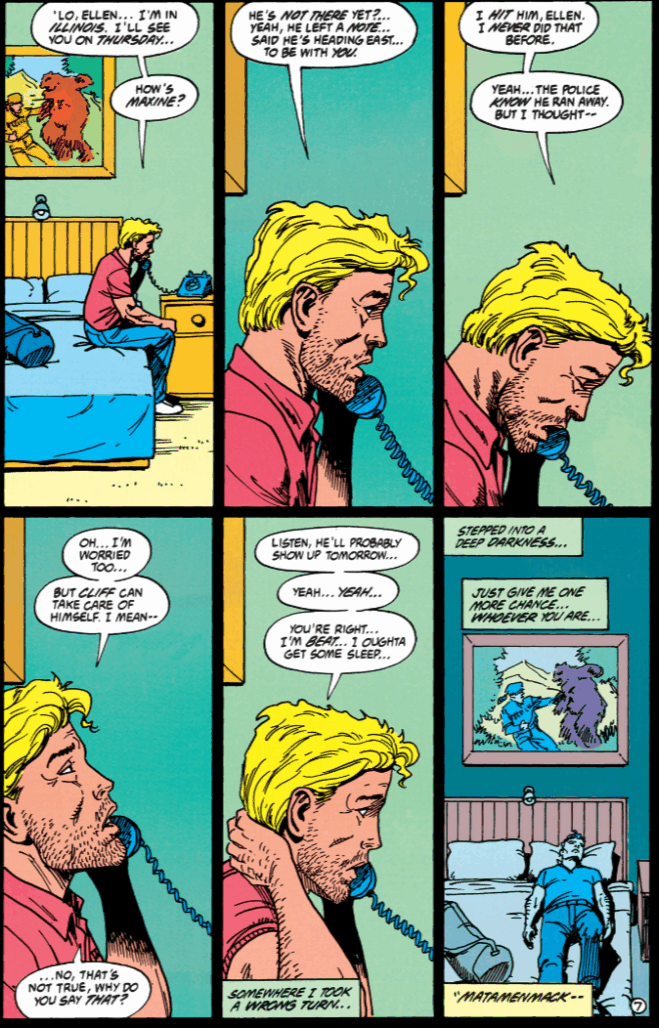
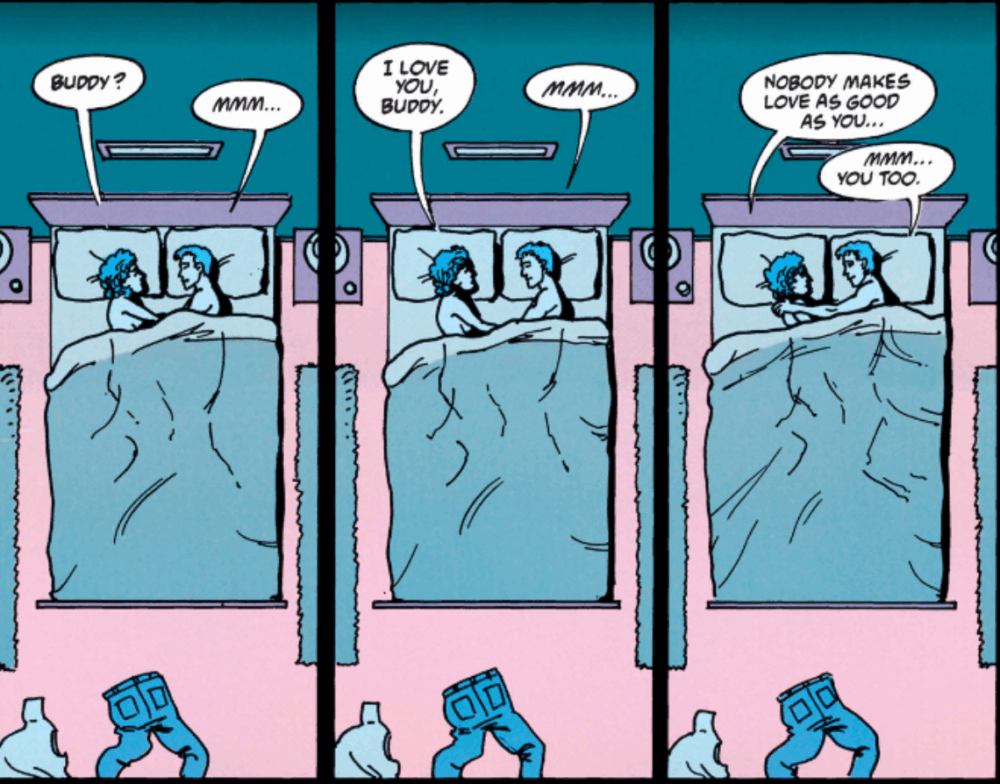
Is the comic trying to say something about the trauma Buddy is trying to process from the previous runs? Is it implying that this is just who Buddy is and this is the natural next step? Or is it implying that he’s being influenced by Stone or Antigon (the big, bad negative force that Veitch inserts into Buddy’s new origin?)
I suspect it is a mix of all of these, though issue #40 leans harder into the “his powers have thrown him completely out of whack.” It would likely have worked better if issue #33 didn’t start us with a meaner, darker Buddy, or had been at least a little clearer on how much was Buddy’s own fault and how much was outside influence. I guess it doesn’t matter, in the end.
There is a phrase I keep coming back to, as I write this review. A phrase that haunts the omnibus; slinks around its corners, and hides in the dark at the end of its hallways. It cannot be shaken, much as I want it to, as I tried to.
You can’t go home again.
See, following up Morrison and Truog’s character-defining run is a tall order that, honestly, I don’t think anyone could possibly have done well. There is a reason those first 26 issues are the most remembered parts of a series that lasted almost four times that length. The shadow’s too long, the shoes’re too big. There will always be the instinct to compare, unfairly perhaps. I did it, I’m doing it, even though I tried to take this on its own. It is simply inevitable.
So instead, the creators didn’t try to follow up. They simply moved forward.
In rejecting the hopeful and redemptive ending of what preceded it in favor of a harsher, more dramatically-inclined focus, the teams in this omnibus are telling the readers that the book cannot be the same as it was. That it has to adapt, it has to change. That they cannot, will not, simply return to that picturesque, Minnesota-style San Diego that came before.
That era is over, that story is done. This is a new tale with a new Buddy. A Buddy haunted by his past in ways we, and he, cannot see but is shaped by. Forget what you thought you knew about Buddy, about his powers, about his history and his family.
It’s why Buddy starts the omnibus waking from a coma. It’s why Veitch and Dillon begin by smashing effigies of Freedom Beast, the yellow aliens, Buddy, and The Writer. The past is the past. Break what you knew and be open to the new.
You can’t go home again.
Animal Man Omnibus by Tom Veitch and Steve Dillon is out now
And check out the Beat’s other recent comics reviews!




“issues #78-89 still haven’t been collected”
It looks like those aren’t in the upcoming Delano-run omnibus, either. How frustrating! Get it together, DC.
I don’t own the omnibus so I don’t know how many lettercolumns are included, but one potential reason for their paucity may be that this run was famous for missing letter columns for months at a stretch. The editor commented on it at one point and pledged to get the letter columns back on a regular basis, but it still didn’t get much better. (Eventually they brought on someone else to specifically handle the columns, but that might not have been until the Delano run.)
Comments are closed.