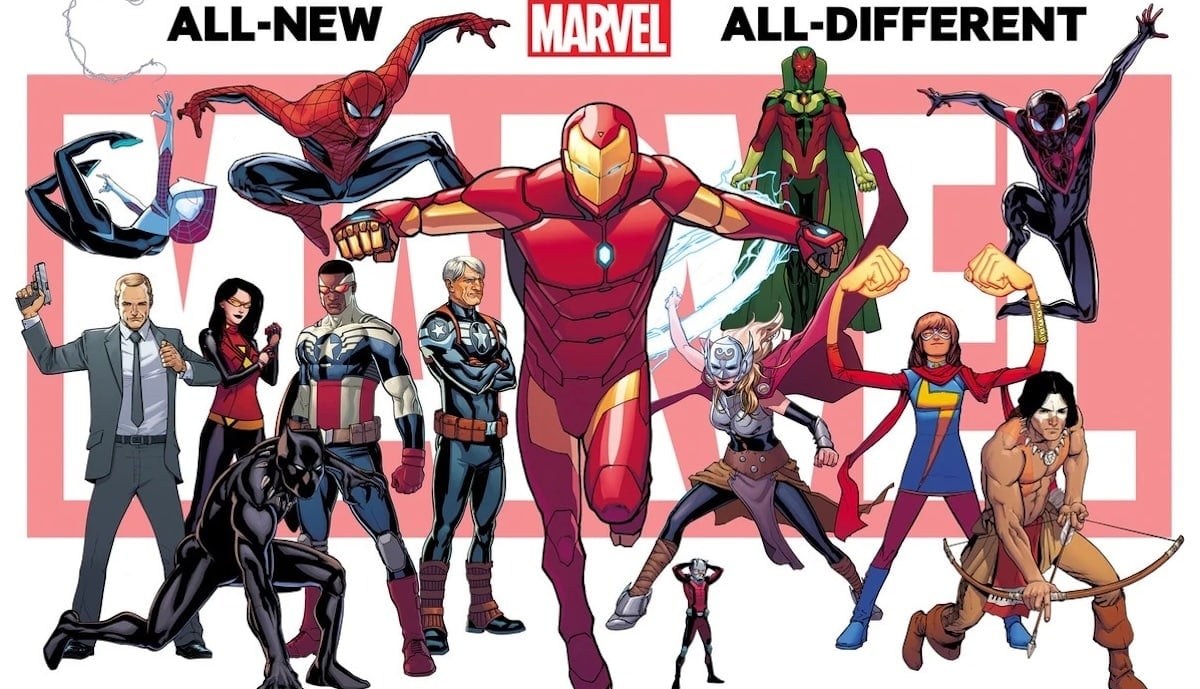

Ch-ch-changes are coming to Marvel Comics as Editor in Chief C.B. Cebulski hands the reins to Stephen Wacker. As the transition takes place, the elite Comics Beat staff found ourselves thinking back to the previous passage of power at the House of Idea. Here’s the ensuing roundtable, in which the Beat Elite consider the transition from the “All-New, All-Different” era under Axel Alonso to the beginning of Cebulski’s tenure as EiC.
What did you think of the transition from the “All-New, All-Different” era under Editor in Chief Axel Alonso to the beginning of C.B. Cebulski’s tenure as Editor in Chief?
AVERY KAPLAN: I thought “All-New, All-Different” was fantastic and I was sorry to see it go. Many of my favorite cape comics of all time came from this era. After the “All-New, All-Different” era ended, I found myself less interested in Marvel Comics and cape comics in general.
I missed the perspective that came with having more women creators on books during “All-New, All-Different,” and I missed many of the characters who were prominent during that era as well. I didn’t care to see the “original” (almost all white male) Avengers characters return to the spotlight, and while I gave many of those books a chance near the beginning (I used to run the Marvel Rundown, after all), none of them held my interest like my favorites from the “All-New, All-Different” era, during which I was picking up my pull list weekly at my Local Comic Shop (LCS).
Nowadays my sequential graphic narrative interests largely lay outside of cape comics, because it feels like they entirely stopped catering to my personal preferences. In fact, while I would say I am at my core a Marvel Gal, the only cape comics I have been interested in this year have been from DC. Hooray for Dream Girls!
E.B. HUTCHINS: I found it interesting but clumsy in its storytelling. I appreciated the big swings it took in terms of representation and the Civil War II storyline. And with those risks came backlash as they always do. The main thing I remember was I was surprised at how many newer writers were on staff and taking a swing at making a Marvel story.
SEAN DILLON: The All New, All Different era of comics was largely when I started actively reading Marvel comics. There were a ton of interesting books in there from Ms. Marvel to The Vision that I just had a ball with. It was when that era began to die out that my interest in Marvel started to wane. There were some titles that I liked. The Immortal Hulk and HoXPoX being the obvious contenders, but generally speaking, it felt like everything was going downhill. I honestly can’t think of a book to recommend from the current batch of Marvel titles.
TAIMUR DAR: Coming out of the monumental Secret Wars epic,I think this is when the cracks at Marvel publishing began to form. It was during this time that Marvel began pushing the Inhumans and sidelining the X-Men a bit. Despite not owning the X-Men film/TV rights at the time (which ironically would change in just a few years), it was still a major property for comics publishing and they couldn’t take the characters completely off the board like they did with the Fantastic Four title.
DEAN SIMONS: This period of Marvel was a transitional period for me – Secret Wars ended in such a way that I was left with the feeling that this was the perfect ending for my time with the Marvel universe, and superhero comics in general. I was already veering away into other genres. The All New, All Different period did keep me in slightly longer but as the quality of output became so variable, it got easier to leave.
ADAM KARENINA SHERIF: I remember the transition vividly and not at all fondly. When David Gabriel laid some of the groundwork for the overhaul and the coming disposal of Marvel’s more representative slate of titles, I wrote an editorial from a retail perspective. I felt it was irresponsible of the publisher to problematize “diversity” rather than reflecting on the publishing initiatives that were making their product less and less accessible (artificial scarcity variant programs, disruptive events…, and of course high cover prices). Suspending books that had brought in new marginalized readers for ten months to accommodate Hickman’s Secret Wars was a strong indicator that Marvel was prepared to lose those readers. Cebulski’s appointment was the cement.
What were your favorite titles and/or characters from the “All-New, All-Different” era?
AVERY: This is hard for me to narrow down. The Unbelievable Gwenpool might be my favorite cape comic of all time — it’s neck and neck with The Unbeatable Squirrel Girl. Both characters were incredible, and when they briefly teamed up in the final issue of Gwenpool, it was absolute magic. And in addition to being written excellently, the art and colors on both books were so distinct and perfect.
I also adore the all-too-brief Nighthawk, a story that I still think would make an incredible movie or “prestige” series. All-New Wolverine was incredible as well, especially All-New Wolverine #35. What an issue! The run of The Punisher during this time period was excellent, as was Howard the Duck (Lea Thompson guest starring was a stroke of genius). And what about Moon Girl and Devil Dinosaur? Just an embarrassment of riches. Angela Queen of Hel. Scarlet Witch. Patsy Walker, A.K.A. Hellcat! Vote Loki (beLIEve). That bonkers good run of Black Panther. And these are just the standouts, I enjoyed a lot of other books from the era as well.
E.B.: Ms. Marvel! I hope to write her someday, but the initial run of her comics were fun and interesting and I reread them from time to time. Trying to capture the early days of a superhero’s journey is a tricky one and combined with Takeshi Miyazawa’s work, it was a good time. Also as a girl raised by immigrants from a culture that is very different from the United States, I felt unbelievably seen by Kamala Khan.
SEAN: It’s a problematic choice, but I’m going with The Vision. An extremely bleak comic about the impossibility of being a model minority within a largely white supremacist society. There are elements that don’t fully work (the parallels between the racist stereotype around Native Americans and the Vision could’ve used a bit more fine tuning and the tragic death of the Vin was a bit contrived), but it felt like no other title coming out of Marvel before or since. Especially helping things was the art by Gabriel Walta, whose distinct flatness makes the moments of brutality pop all the more. And, well, Tom King remains a damn good writer in spite of this being early years.
TAIMUR: I have to say the new Doctor Strange title from writer Jason Aaron and artist Chris Bachalo. Such a fun book with a creative team that excelled at the weird and odd. Likewise, I gotta agree with Avery mentioning Chip Zdarsky’s Howard the Duck title. As I’m sure most remember and creators openly admitted, the book happened due to the character’s unexpected post-credits cameo appearance in the first GotG film. Rather than simply ride the coattails of Howard the Duck’s resurgence in popularity, Zdarsky wrote some of the best stories with the character since original creator Steve Gerber.
DEAN: I loved a bunch of series that were distinctive and emerged just before this period (Squirrel Girl, Moon Girl and Devil Dinosaur, the reinvention of Captain Marvel) but what chronologically fell in the post-2015 timeframe that I enjoyed was Ta-Nehisi Coates & Brian Stelfreeze Black Panther series, which I loved for its ambitious scope. I know it was controversial in a few fan circles but as a politics junky, this drew me in. Oh and I quite liked Al Ewing’s Ultimates.
ADAM: Just from the books everyone’s listed already, I’m remembering how much this line had not just diversity of representation, but diversity of genre – comedies, spy books, slice of life, coming of age. Superhero subgenres are really important for the health of a capes publishing line, I feel. As well as Black Panther, Ms. Marvel, The Unbeatable Squirrel Girl, I also loved Soule and Pulido’s She-Hulk (those Kevin Wada covers!) and Aaron and Ribić’s Thor: God Of Thunder. Oh, and Hopeless and Rodríguez’s Spider-Woman!! Pregnant Jessica Drew was a menace!!
What were your favorite titles and/or characters from the beginning of the Cebulski era?
AVERY: Essentially just the holdovers from “All-New, All-Different,” which dwindled and burned out before too long under Cebulski’s editorial guidance. I did like seeing Gail Simone and Kelly Thompson get more work. 2018’s West Coast Avengers (and just Jeff in general) are so good!
E.B.: Unpopular opinion, but Secret Empire. It was audacious more than anything. Making Captain America say “Hail, Hydra” is the type of wild, out-of-the-box craziness I love in American comics (but apparently other people felt embarrassed by because they either a) don’t know a lot about the history of Marvel comics and politics or b) have a childish, jingoistic view of Captain America).
AVERY: I agree that Secret Empire is underrated. If you look at what Nick Spencer was doing with his Captain America stuff, in which Cap is a stand-in for POTUS, Secret Empire is a story about a fascist in the White House. My favorite tie-in comic (and probably my favorite comic from the event in general) was Secret Warriors. Hey, if seeing Devil Dinosaur tear a Hydra concentration camp apart is wrong, well, I don’t want to be right.
E.B.: Oh, absolutely! It was pretty topical in a way that I was shocked to see at the time. Marvel has always tied in the cultural zeitgeist into their work, but to see it so prominently and openly at the time was surprising.
AVERY: Yes, and it has only become more relevant in the intervening years, I’m afraid. I’m not sure any Marvel event has spoken to current events so directly since Secret Empire (but would love to hear if one has).
ADAM: Yeah, I’ve been thinking recently about a couple of DC books that have really looked to meet the moment in the last year or two. And how there’s pretty much nothing from Marvel.
SEAN: The obvious answer is Immortal Hulk, right? In many regards, what defines the Cebulski era is a sense of underlining problems that are left festering to roost when putting a white guy who spent years pretending to be Asian in charge of the work coming out. If we are to engage with the full implications of the era, then we must not shy away from what one could arguably and persuasively call the rot that was festering within from the beginning.
To that end, Immortal Hulk was one of the great horror titles to come out of the company in decades and a book that had everyone talking about it month after month. From the grotesque figures designed by Bennet to Ewing’s cosmological vision of the Hulk, it was a book that made people stand up and want to see what happened next.
AVERY: I do wish Immortal Hulk’s spinoff series, Gamma Flight, was given more than just five issues.
DEAN: Have to admit I was pretty much out the door by the time Cebulski’s era came into full effect but things I mean to read one day that fell in the period proper include Immortal Hulk, and the new Ultimate universe that has just recently ended.
ADAM: Same as Avery, I followed a few books through but there wasn’t anything in the new slate for me. And I’m with Sean here – rewarding professional yellowface gave this era a fatally-flawed foundation. We saw numerous creators stop getting work, and there were others who rightly refused to work for Cebulski.
Is there anything from the “All-New, All Different” era you’d like to see revived at Marvel Comics now that Cebulski has stepped down as EiC?
AVERY: Gwenpool has had a couple limited series and/or Infinity Comics but I’d love to see her get her own ongoing series again. I think there’s loads of potential left to be mined. By contrast I’m not sure I’d like to see more Squirrel Girl, especially if Erica Henderson isn’t involved alongside Ryan North (no offense to the talented Derek Charm), but I could absolutely take another season of the Marvel’s Squirrel Girl: The Unbeatable Radio Show! scripted podcast. If you haven’t listened to that yet, you owe it to yourself to check it out!
E.B.: To be honest, not anything. I personally would love to see Marvel’s answer for the Absolute Line that DC’s doing.
SEAN: Hire interesting talent and pair them up with fantastic artists. Don’t have a house style where everything looks like a slightly crappy cover of Stuart Immonen. Make each book feel unique and interesting. And let them do whatever they want with the books.
DEAN: I am pretty indifferent at this point (which is probably not the answer anyone reading this thread will want!)
ADAM: I’m not indifferent, but I’m also not buying Marvel / Disney at this moment in time.
Is there anything from the “All-New, All-Different” era and/or the beginning of Cebulski’s tenure that you didn’t like?
AVERY: Civil War II was kind of a non-event, but I did enjoy some of the fallout (like Riri).
It was kind of a bummer that the mutants were all tied-up in movie studio shenanigans during this era… But then, I also wonder if that helped seed more creativity in terms of the comics we enjoyed during “All-New, All-Different”? Like would we have gotten such a long-running comic about Squirrel Girl if Jubilee was available? I don’t know.
E.B.: It’s more what happened around these books than the books themselves. To talk about this era and not talk about what happened to its creators and editors would be telling an incomplete story.
One of the reasons I wrote a review of Tess Fowler’s new book and focused on her being “unpersoned” by the public is because I developed secondary trauma from Comicsgate and witnessing the harassment and dehumanization of several creators. I’m not naming the individuals involved in this, but calling an editor a “cumdumpster,” the casual homophobia, the virulent transphobia and transmisogyny, the racism against multiple creators of color exposed the nastiest, sickest parts of comics culture.
There wasn’t enough done to protect these people from being sent death threats, doxxed, and ran out of their homes. There wasn’t enough done to ensure that marginalized creators could have a place at Marvel or in the industry at large. Especially given the fact a number of these creators were still cutting their teeth or early in their careers (and in one case, early in her transition, bless her soul).
SEAN: The people behind the scenes need to defend their creators, be it from bigots insulted by the very idea that a woman could ever write a superhero comic or even something as relatively inconsequential as a writer deciding to make choices with a character that result in a HEAT like movement forming to torment the company into back peddling. Indeed, that back peddling seems to be the major failure on the X-Men line of things, unwilling to actually commit to Krakoa’s thorny era in favor of more traditional X-Men comics where Kamala Khan is just another X-Man in the background instead of headlining her own book.
AVERY: Heather Antos did nothing wrong, and quite a lot right. I’ve been delighted to enjoy her editorial work on IDW’s ongoing Star Trek line and look forward to continuing to cover her work in the future. I haven’t been a fan of many of the titles put out by Marvel in more recent years, and you’ll notice I’ve handled that not by spending all my time behind alts on social media and trying to ruin peoples’ livelihoods, but instead by simply reading comics that are more suited to my tastes. I can understand that not every comic is for me. And no one is stopping me (or you) from making my own if I can’t find what I want anywhere else!
TAIMUR: I think this is when Marvel publishing started leaning too much in trying to emulate the MCU more than they should. Make no mistake, there have been some really brilliant new takes in Marvel and even DC adaptations that I think have been brilliantly brought into the main comics universe. Blade, for instance, is a perfect example and no-brainer. But then suddenly, the Guardians of the Galaxy become carbon copies of the James Gunn movies and even creating a modern day version of Yondu resembling Michael Rooker. At a certain point, you could pretty much predict Marvel’s publishing plans by looking at the Marvel Studios release schedule.
DEAN: Civil War II! What a profound waste of time that was.
Linked to CW2, mandated by the higher ups who had the Fantastic Four disappear and the X-Men relegated, was the forced prominence of the Inhumans. I was actually hopeful that the Inhumans might get some interesting stories. However, while the solo books (Karnak, Black Bolt) were promising, the main one (Inhuman) was extremely disappointing. The idea of replacing mutants with inhumans as if they were interchangeable without properly exploring what made them unique and controversial, with significant depth, was frustrating. A hidden people, directly impacted by alien life, where eugenics is a fundamental part of their society has so many interesting and difficult themes to explore – but it didn’t bother at all.
ADAM: Full co-sign from me, E.B., Sean, Avery. Marvel could and should have been clearer in their values and backed their creators in the face of bigotry. And a shoutout to Antos especially for her work on the Star Wars books – it was so important for Marvel to get those first books right and Antos really delivered.
I also felt that as much as we saw better on-page diversity of representation throughout “All-New, All-Different”, we didn’t really max out on the possibilities of ‘own voices’ storytelling. I wanted to see more marginalized creators on books with marginalized leads at the very least. Equity can’t just be about the characters.
TAIMUR: I’d be remiss if I didn’t mention the infamous “new” New Warriors book announced in 2020 that never came to be. While I’m sure everyone involved had the best of intentions, it came across as incredibly tone deaf or an ill-conceived and elaborate attempt to troll fans. In fact, I think a lot of fans and readers felt like they were being trolled by much of the creative decisions in recent years best epitomized by the character of Paul Rabin, the despised boyfriend of Mary-Jane Watson in the pages of Amazing Spider-Man. I’m still amazed people actually thought Ms. Marvel would be killed off a few months before The Marvels hit theaters.
Is there anything else you want to say about the “All-New, All-Different” era and the transition to Cebulski as Editor in Chief?
AVERY: Cebulski taking over felt like someone with entirely different tastes than my own coming in and remaking Marvel Comics from something I used to be passionate about into something in which I have no interest. I know there are readers who felt that way about “All-New, All-Different,” by the way. It seems surprising to me that there’s no way to balance the publishing line and cater to both kinds of readers (and others besides). I’m hopeful that Marvel might start releasing comics that interest me again under the tenure of Stephen Wacker.
E.B.: It is an “interesting” hiring decision to have him work on the Asian side of comics production considering the whole Akira Yoshida debacle. However, I am curious to see what Wacker is going to do as EIC.
SEAN: God help us if they decide to finish the Marvelman series.
DEAN: I have to admit, I had to really, really scratch my brain for more than a handful of books that were memorable or convinced me to linger/dip in again. The only thought I had about the period is how heavily it leaned on throwbacks to the 1990s in recent years. It felt like a time capsule opened far too soon, and didn’t interest me at all.
TAIMUR: One of the things fans have noted in recent years are the constant relaunches of titles. On one hand, I completely understand it is helpful for new reader jumping on points and titles with high legacy numbers can be a barrier for new readership. Chalk it up to me being a traditionalist, but I always liked that legacy numbering for a title. Another major issue at Marvel in recent years is how few ongoing titles last more than a year. To be fair, I think it also has to be with how much the comics and entertainment industry in general has changed post-pandemic.
ADAM: Some days I still like to imagine what Marvel would look like now if the gig had gone to Sana Amanat instead of C.B. Cebulski. As Brian and Roger Eno say, “what a world it could have been.”



Great discussion. This makes me miss the Alonso days. There was some really creative stuff coming out.
I’m glad to see some love for Secret Empire. It’s a shame that some people (including some reviewers at other sites) were unable to exercise media literacy and see what the story was saying.
I will no longer visit this site as long as it continues to have never ending pop-ups.
I no sooner dismiss “Join the inner circle.” When I get a half screen “Sign up for our News Letter” that I dismiss just to have the cycle start again. This is user hostile. So goodbye!
Hey I’m sorry about that. The pop up should only appear once. I will disable it until I figure it out.
Comments are closed.