

 PBS invites you to keep the season’s spirit going clear through ’til Epiphany with their latest installment of Great Performances. Its fourth episode this season, and first since the government has defunded the station: William Shakespeare‘s Twelfth Night, or What You Will. The horny, gender-bending, uneven and partly unresolved problem play is the ultimate Epiphany Feast fête, actually, as the twelfth night of Christmas (Epiphany Eve) is all about embracing the madcap and reversing roles.
So celebrate the holidays like they did way back by being weird and randy and full of good humor. Director Saheem Ali‘s production features a romance between Lupito Nyong’o and Sandra Oh, the deception of Peter Dinklage, and more creative casting choices, like singer-songwriter Moses Sumney. Filmed live at the Delacorte Theater in Central Park, Twelfth Night is free to stream on PBS until the end of the year. What more do I even have to say? Well,
You’ve heard of a love triangle? This play is a love kaleidoscope. In an age and land of longful wooing, a Duke’s love is unrequited. Shot his shot so many times the whole mechanism is stuck. Things in loveland are shaken up by the sudden appearance of a lost twin, sister posing as brother after the two are shipwrecked and separated. She quickly falls into favor with the Duke, and becomes the new face to serve as envoy to his unrequited crush. The Countess promptly falls for the sister-posing-as-her-brother, who (of course) herself has fallen for the Duke the Countess does not want.
Also there’s one dude who is a prude and gets tricked into trying to woo the Countess, and subsequently is imprisoned and tortured for it. Oh, and the brother is alive, traveling with a criminal on the lam from the Duke, starting to cross paths with his lost sister, and generally confusing people everywhere. Particularly the Countess. They’re called problem plays because stories like the one in Twelfth Night don’t fit into comedy or tragedy alone. This one is comedy mostly, and the production certainly plays it that way, but it’s also got scorn and mistreatment, unresolved acts of betrayal. It’s messy, like life.
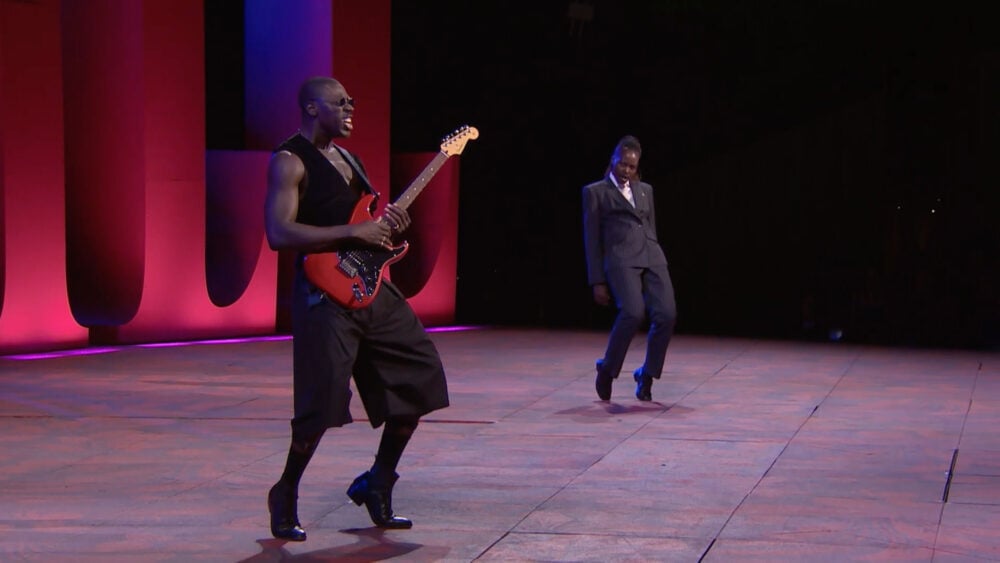 I’m sure the end of the year is when everyone already has more than enough messy life stuff going on at the moment already. Well, it turns out now is the perfect time to watch some more. We’re in the season of outlandish mummers, of the Green Knight and The Juggler of Our Lady, of strange tales of misconception and assumption. If not now, when?
Twelfth Night, as in “the, of Christmas.”
And Epiphany Eve is a What You Will kind of celebration. For the night, woman becomes man, servant becomes master. Some have suggested that the role of the disapproving scold in the play represents a desired comeuppance for the conservative Christians of the day, who condemned the beloved holiday’s revels. Shakespeare is not opposed to anachronisms when it suits him- setting the play in a mysterious foreign locale, but then having the pub where characters are supposed to meet share names with the local joint around the corner from the theater. The Dinklage cordless hairdryer coke dispersal joke in the PBS performance isn’t written anywhere in the Bard’s original script, but it suits his spirit.
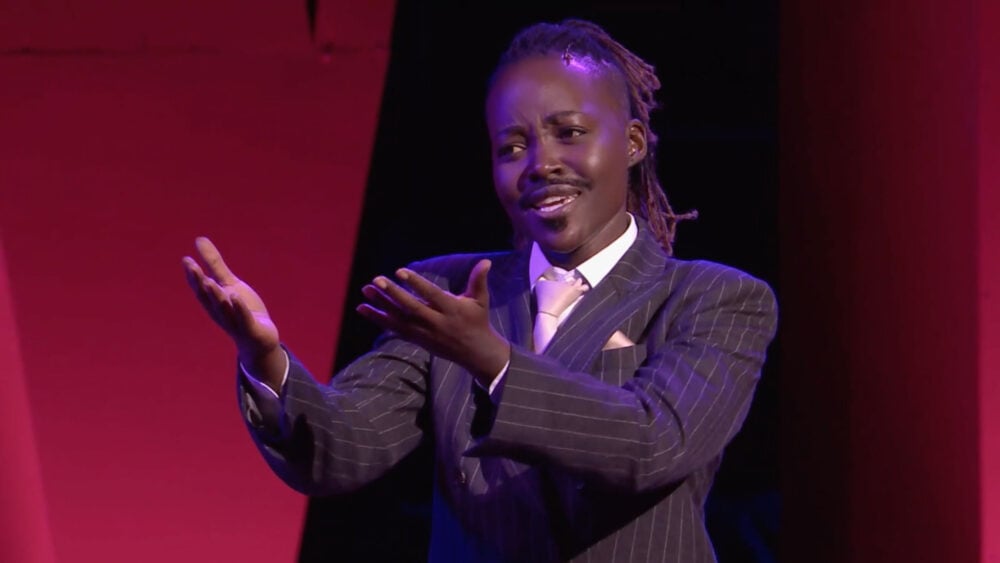
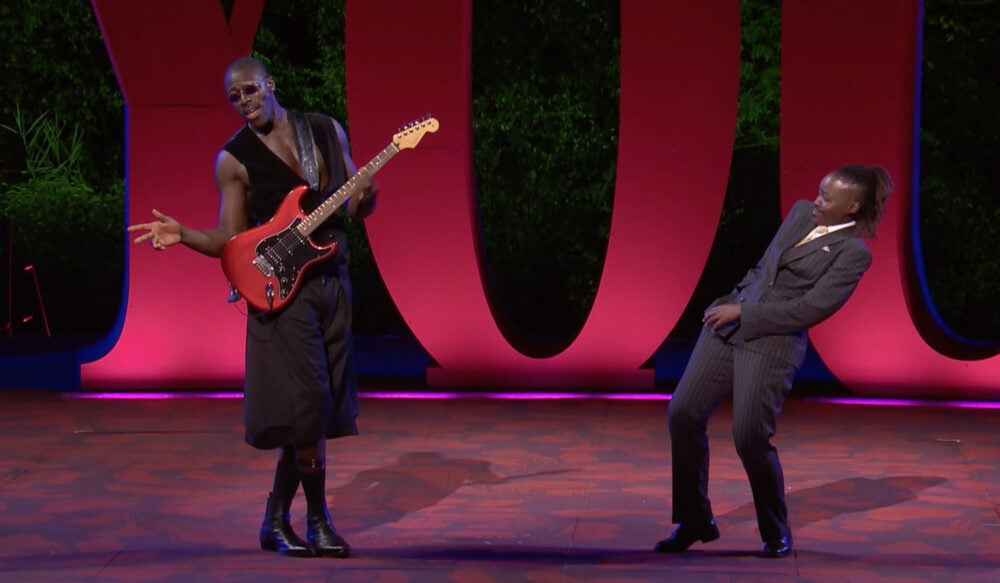
 Lupita Nyong’o with a mustache in a pinstripe suit must be seen to be believed. Unless, I suppose, you are familiar with her brother Junior Nyong’o, who plays her twin in the play. Wide-eyed, well meaning, and trying desperately for their holiday hook up to not be what’s directly under the spotlight, Lupita brings huge uncle energy to the play. Total Original Kings of Comedy vibe to her costuming, but she’s serious. Nyong’o plays the stage with the same undeniable magnetism her feature film performances are known for.
She does the bombast of theater naturally, she brings the funny. Nyong’o is just as devoted to sincerity, and gives it, too. It’s a goofy situation, but she won’t let you forget love is no joke. Lupita makes an amazing foil for Khris Davis‘ lusty, lovelorn, amicably pansexual Duke. Davis’ brash desire being the butt of humor pairs well with Nyong’o’s palpable nervousness around him, and the very real anger he smoulders with when spurned matches her candor.
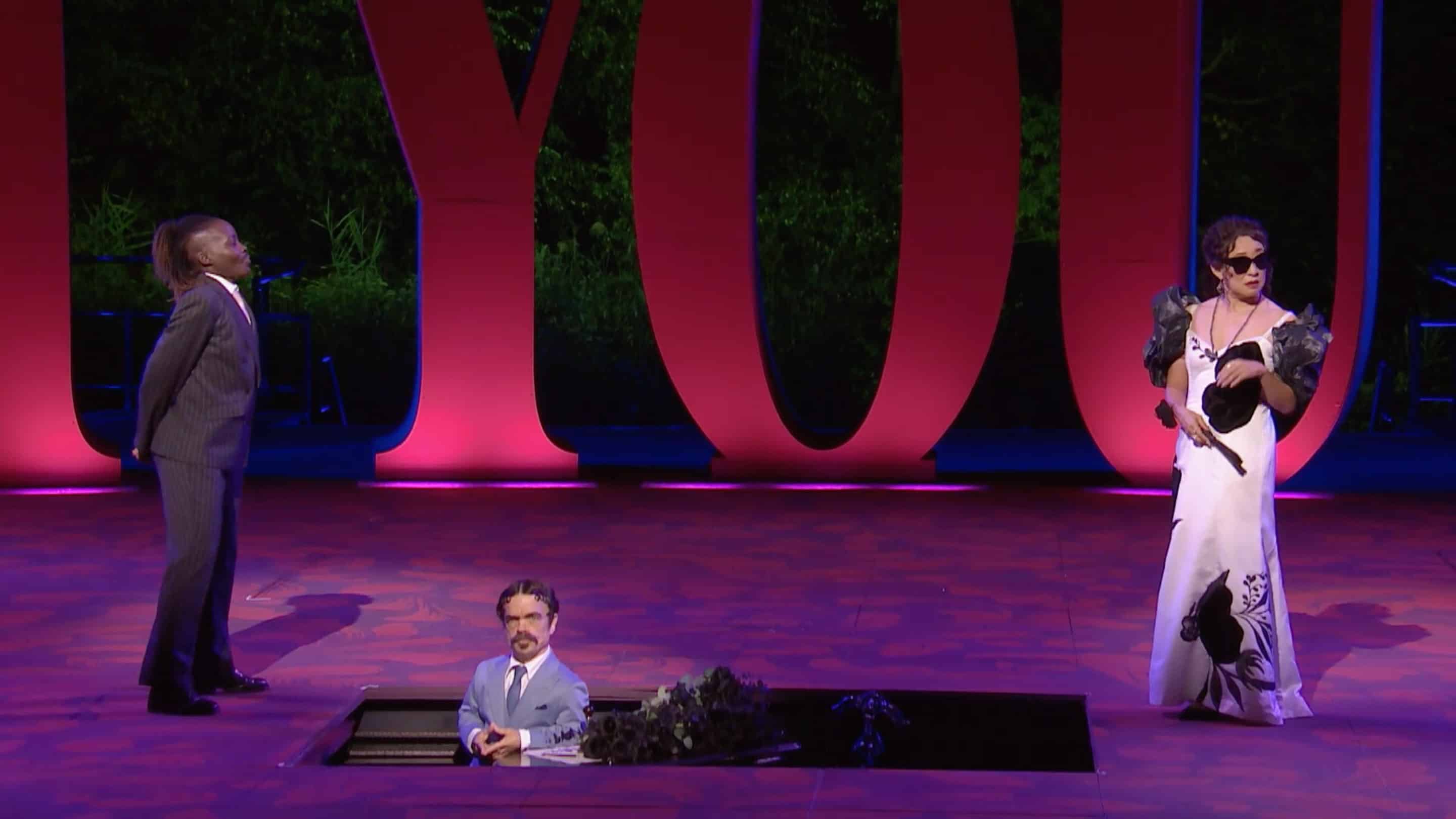
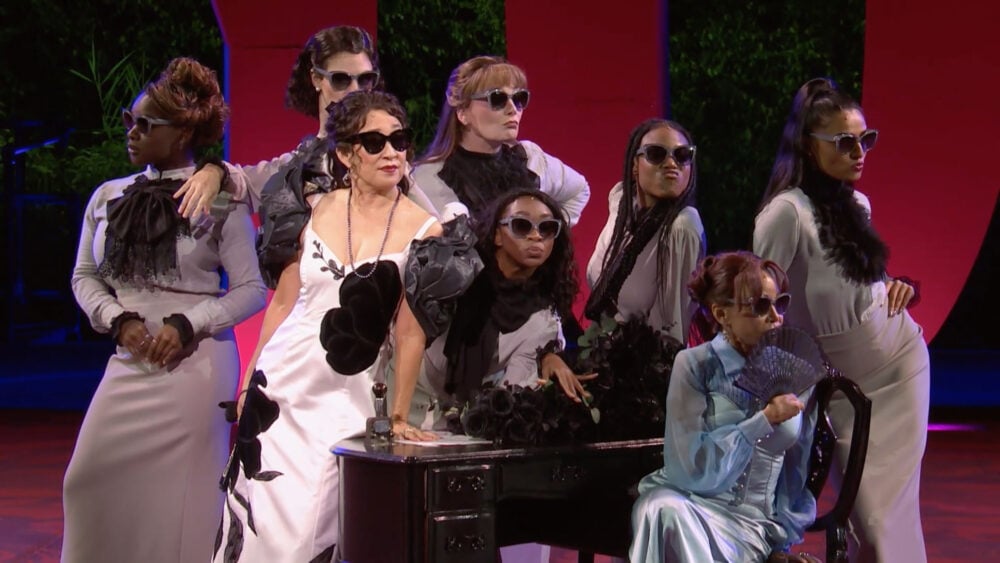
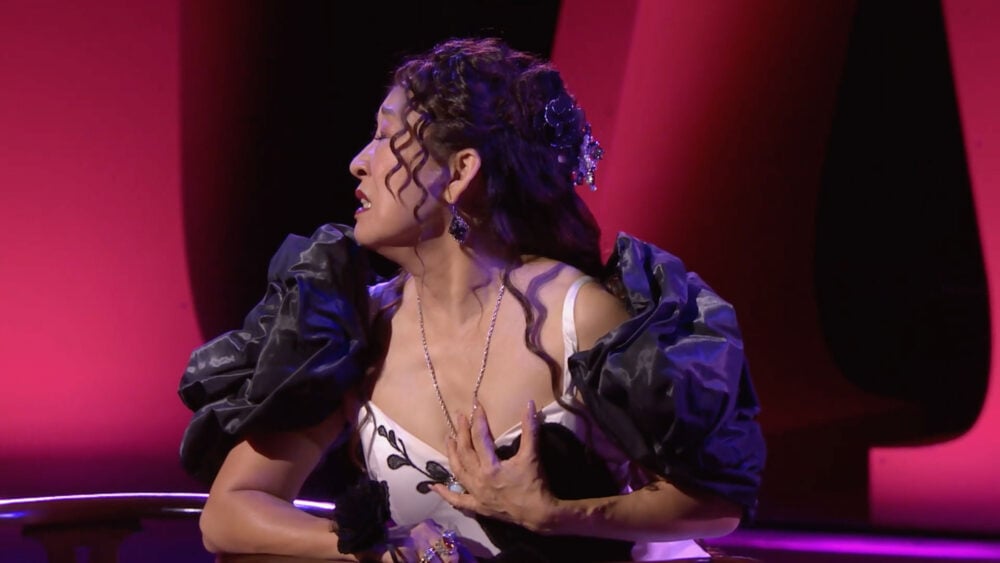
But it is quite possible that Sandra Oh steals the show. It is the Countess’ charge to be as bold as the object of her affection is demure, and Oh rides that energy straight to center stage. Her desire is unequivocally the driving force of the play. Before I thought of the Countess purely in relation to the lead role, the sister. With Oh’s performance, I’m realizing though the story is on the Duke’s land, and sparked by his desire, What You Will is about the Countess. Set in her house, concerned with her whims, populated by the people she surrounds herself with (or not). It’s Oh’s world, we’re just living in it. Her bravado can burn down the house with passion. Her ability to go quiet and small and keep the flame in her eyes just as bright is what theater is for.
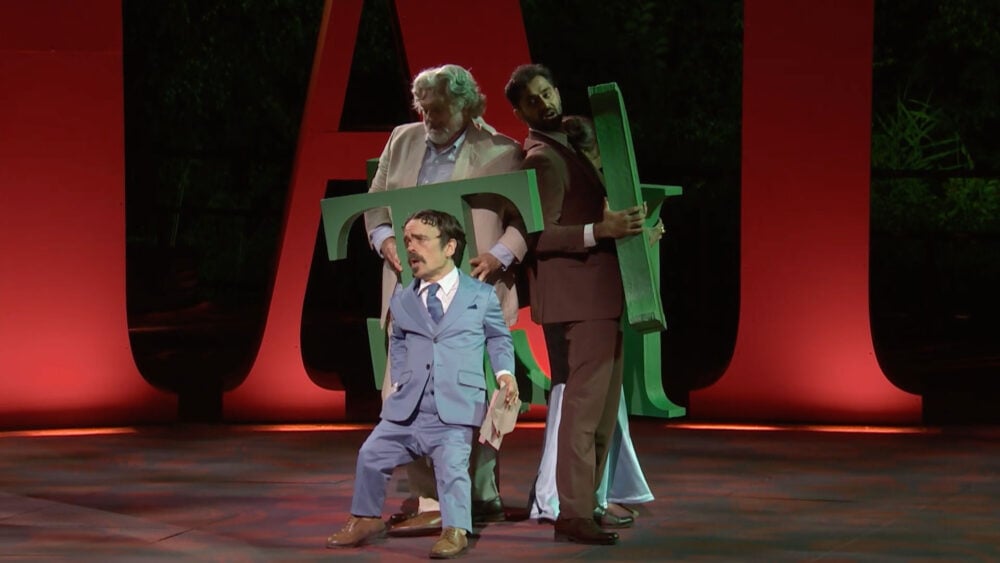
Peter Dinklage maybe is having the most fun out of anybody tonight. His part is more a fool than the fool, and he absolutely camps it up. Over the top! Until he’s imprisoned, that is. The subplot involving Dinklage’s rivalry with the rest of the Countess’ household that turns him into a misguided swain and eventually incarcerated madman is one of several, er, comic diversions in the play, manufactured by the charming clown Bill Camp. See also his hustling yet another other spurred suitor, Jesse Tyler Ferguson. Dinklage takes the turn seriously, and lets the mask fall for his character’s suffering.
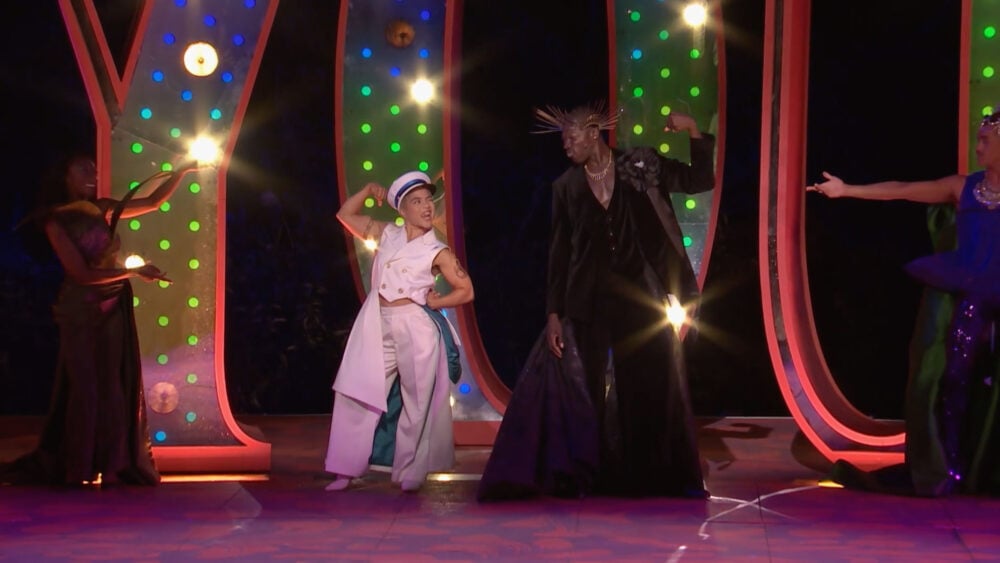
Okay but, for me, Moses Sumney was the one who truly stole the show. Charismatic an actor as his role is witty, he had presence, he was comfortable enough on the stage to let the performance sing, he made every scene he was in better. I really love Trevor Nunn‘s 90s film adaptation which, in contrast to Ali’s production, feels very focused on Imogen Stubbs as the crux of the play’s love triangle. Sumney’s appearance on stage is as electrifying as any other member of the cast. He as much as Oh- and many other members of the cast- made me look at it more like an ensemble production. And do they have some of the production’s best costuming. There’s a lot of suits and a lot of undershirts and then there’s Sandra Oh and Moses Sumney.
Sumney, Dinklage, and Bertin all get lines that are soaked so deep into the collective pop cultural consciousness, they’re essentially adages. “If music be the food of love, play on.” C’mon. It’s gotta be a thrill to deliver them. What role then is unimportant?
b, the smallest part, the rawest performance. Getting to witness something like that is, again, what theater is for. What acting is for. Why we tune in.
Daphne Rubin-Vega really brings the fire as well. Her performance is like Sumney’s, they each reach something beyond their function as a plot device, thanks to the humanity they bring to the role. I said Camp orchestrated Dinklage’s fall, but the truth is Rubin-Vega created and set the trap. And her performance communicates her desire for reckoning, not happening because it’s what the intricate setup of the story demands, but because she’s smarter than the rest of them, peers and rivals, and feels like putting an jagoff in his place.
 Women as bold as men, servants who are intellectually superior to their social betters, this is prime Shakespeare stuff as well as speaking to celebrating Epiphany Eve. And I think Ali’s cast being comprised predominantly of POC also addresses contemporary expectations, sometimes by reframing the text, sometimes by hewing to it. If Shakespeare riffing on Epiphany Eve topsy-turvy lead to a tale about Italians being the exoticized outsiders in the Balkans, Ali flips the idea again with the PBS cast. Nyong’o delivering lines in Swahili is Twelfth Night détournement. The twins fit in, despite being from somewhere else, because this fantasy is filled with people from all walks of life.
A world where no one is an asshole about pronouns might sound kind of nice to the average rational person watching television, yet it is as unimaginable to the bigots of today as the idea of a kingdom where the fair-skinned people were totally out of place was to the racists of yore. Or maybe Shakespeare just liked to capitalize off of spectacle and bohemian fantasy. You don’t get to think about Shakespeare this way unless you open his work up to interpretations that challenge and reinterpret it.
The only white guys in the play are buffoons. Camp gets his authority from being related to the Countess rather than any skill at being a boss. He’s mostly shown as a grifter. But Camp’s inherited social standing having power over the intellectually superior Rubin-Vega is an instance where the production preserving contemporary racial relations was the right choice. The boss needs us, we don’t need the boss.
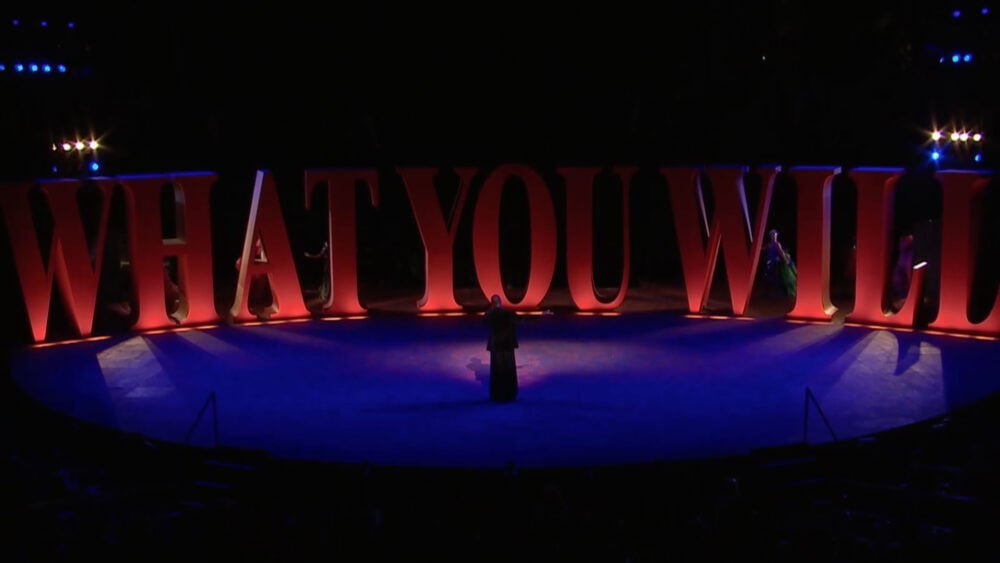 Although defunded, PBS pulls off a luxury minimalism that worked for me. They’re still performing on a giant stage in the middle of Central Park that has secret doors to raise set pieces up through the stage floor, incredible wireless sound and professional lighting, multiple cameras, Star Power. Everyone in this production of Twelfth Night has one of those little Madonna microphone/earpieces. I don’t mean to minimize the damage done by the current administration, however. But if you didn’t know it was defunded, you’d be forgiven for mistaking the austerity for aesthetic. They make it work despite the setbacks, in spite of them, to spite them.
The stuff they do have totally rules. Dinklage imprisoned inside a neon cross is like something out of a Hype Williams music video, or the Baz Luhrmann Romeo + Juliet. Ali and Luhrmann both let their “supporting” cast go as big as the stars, and reaped terrific performances because of it, as well. But I digress. The boxing scene goes Bugs Bunny! The big letters T-R-E-E for the actors to hide behind. The little pushes over the top work well, but they’re infrequent, and pretty much it for pomp on stage. Mostly it’s actors on bare floorboard. And you know what? Shakespeare doesn’t need more.
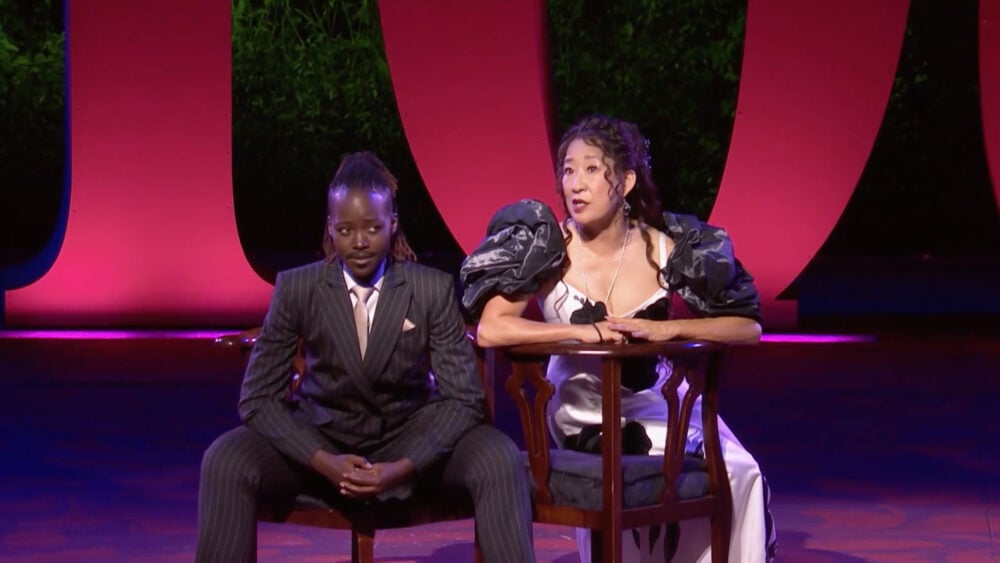 A woman dressed as a man who a rich and powerful heiress is desperately trying to screw. This exact kind of story is what defunding non-profit organizations like PBS is supposed to halt. Epiphany, it’s worth pointing out, is a story about a time in history where society would turn a mother out, so that her child had to be born without shelter. There were people from that same time who, inspired by a divine idea that everyone was equal, saw the mistake that was being made, saw the dignity in everybody, and did something about it. That’s worth celebrating.
The Great Performances production of Twelfth Night is streaming on PBS until the end of 2025.