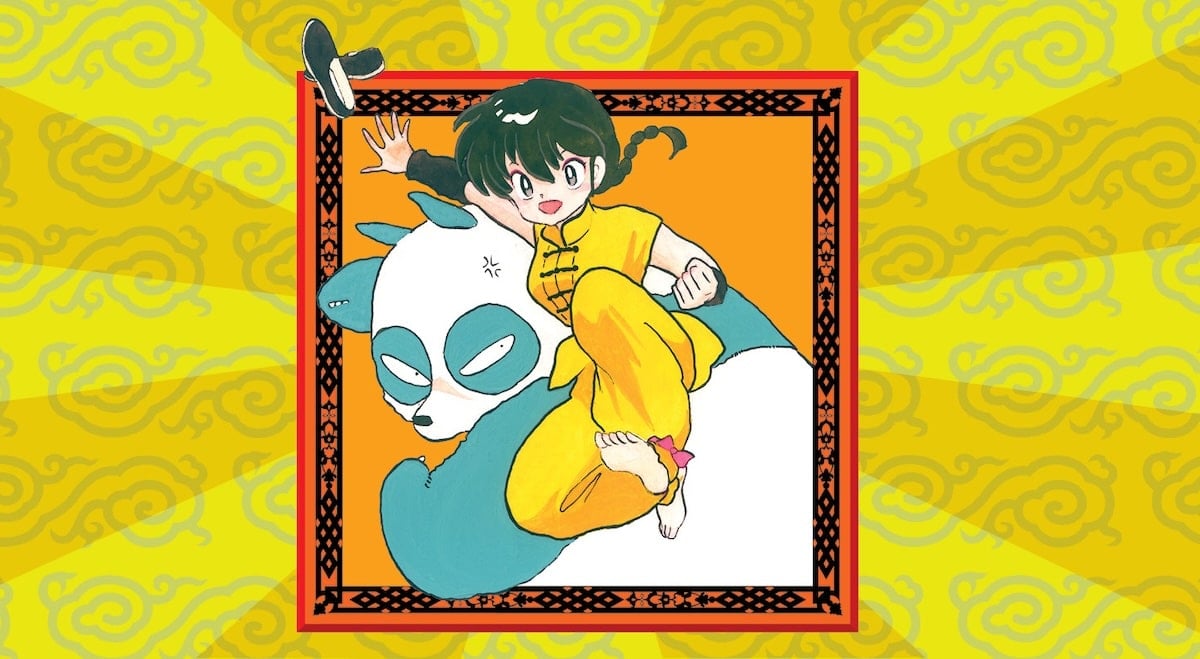

Consider Ranma Satome.
Born to Genma and Nodoka Saotome, Ranma is a trained martial artist. Said training involved traveling the world, conning people out of their house, food, and other provisions as well as being traumatized by cats for extremely stupid reasons. He was engaged to Akane Tendo by his father (alongside other engagements, but for the purposes of this piece, Akane is the only one who matters) in order to continue their martial arts school’s dynasty. Shortly before arriving at the Tendo’s Dojo, Ranma and his father trained in China above a series of pools wherein various people drowned. One such pool was of a drowned girl, and it was in that one that Ranma fell into, giving her the ability to transform between male and female forms.
There is the common approach when analyzing Ranma ½ by Rumiko Takahashi which dictates that the titular protagonist is a binary trans girl who yearns to shed the male form once and for all. Oftentimes, these arguments will highlight something that happened in the 80s anime where Shampoo is the real love interest and Akane Tendo is the antichrist, or a fan mistranslation of the manga that takes the ending out of context and overemphasizes the impact of Ranma’s mom on things. However, a closer read of the manga relates a more complex understanding of the situation.
Reconsidering Ranma 1/2
The most obvious complexity is the time in which the manga came out. Simply put, there is a degree to which the work feels like it came from an earlier era, and not simply because Happosai exists to be a joke about the sexual pestilence of older men or the rather racist cracks at Chinese people. There are a large number of jokes throughout the work wherein the punchline is “a man in a dress doesn’t look womanly.”
One could note the long, ugly history of comedy within the 80s, 90s, and early 00s wherein that joke was rather prevalent. Indeed, there are several running gags throughout Ranma ½ wherein people accuse the titular character of being a pervert because of her gender expression. Chapter 345, “Love Medicine,” for example, has Ranma helping a dying young man while in his female form. The boy refuses to take the medicine that will save his life unless Ranma herself gives it to him “mouth to mouth.”
The chapter is a farce of Ranma trying to trick the boy into taking his medicine without having to kiss him. The strip ends with Ranma seemingly having kissed the boy (not really, as the final panel reveals the doctor gave the boy mouth to mouth in a way that screams gay panic [not helped by the chills invoked by the caption at the end reading “And he’ll likely keep his will to live, as long as he never learns the cruel truth…”]), only for his male form to be revealed. Upon finding out, the boy calls Ranma a “weirdo.”
It is tempting to lob this at the sensibilities of 80s and 90s translation techniques. One is not left without the desire to reject the translation provided by Viz Media given the presence of Gerard Jones within the pages. But the images nevertheless highlight Takahashi’s intent regarding the gendered comedy. And there’s nothing quite as funny as a reversal wherein a secret is revealed, bringing shame and dishonor to someone. Indeed, that’s at the very heart of the farce structure through which Ranma ½ expresses itself.
But putting that aside, large swaths of Ranma ½ are spent with Ranma fighting tooth and nail to regain his male identity. Characters like Cologne and Herb have taken Ranma’s ability to transform into his male form away from her. When gone, Ranma expresses what can only be described as the most devastating expression imaginable. When regained, his face shines with the blinding light of gender euphoria.
Femininity & Masculinity
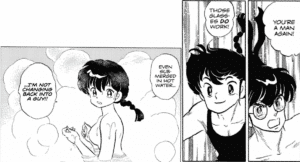
That isn’t to say Ranma ½ rejects the feminine. Indeed, that is the central crux of Ranma ½ as a whole. For all that the manga traffics in tasteless jokes about gender, it nevertheless embraces the fluidity of Ranma’s existence. Despite many arcs having Ranma claim that he wants to be cured of the curse, she seems rather comfortable and adaptable in her female form. And while there are many crass jokes about how big her breasts are compared to Akane’s, most of them are made by Ranma herself in a teasing schoolyard sort of way, rather than a more perverted character like Ataru Moroboshi would.
Moreover, it is this female identity that highlights the core of the Fake Ranma arc (consisting of chapters 290-299). In light of this, it is perhaps best to start with the crux of why Ranma claims she has to be cured of his femininity: Nodoka Saotome, Ranma’s mom. Prior to the series, Ranma’s dad — with the infinite wisdom of a man who thought, “Throw my son into a pit of cats while he’s covered in sardines, then repeat over and over again when it only traumatized the kid because a book I didn’t finish said it was a good idea! Look, it says so right here, right bef— Oh fuck, the book says it’s a bad idea only an idiot would think’s a good idea” was a good idea — signed a contract with his wife that he could take their child off to train around the world, never knowing his own mother, if he raised the boy to be a Man. If they failed, she’d have them both commit seppuku.
(Interestingly, Nodoka’s approach to masculinity is more in regards to a state of mind than a physical gender identity. That is someone who is strong, courageous and a bit of a pervert. Ultimately, when she does find out about Ranma’s female form — whom she’s gotten to know throughout the series due to shenanigans — she immediately embraces her as her son. It’s only when Ranma angsts about no longer being with Akane does she think to pull out the sword due to his lack of manliness.)
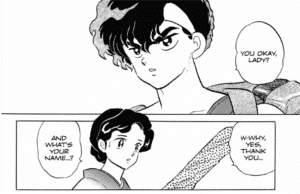
As a result, Ranma has to repress her male side in front of his mother, lest she tie it to his female side. This is something Ryu Kumon uses to his advantage. In many regards, Ryu feels like the ideal form of masculinity that Nodoka desires. Aesthetically speaking, Ryu looks almost identical to Ranma, but with slight differences. He’s a bit bulkier, his clothing is more militaristic (at least from an American perspective) and he carries a backpack at all times, containing all of his belongings.
Psychologically speaking, Ryo exudes traditional masculine stereotypes. He walks in fighting off a bear, even jumping onto Ranma’s head in the process. When asked for his name, he decides not to give it like many a traveling cowboy before him. And his resolution to all things is to fight. Indeed, when confronted by Ranma for his active trickery, Ryu immediately destroys parts of the house Nodoka lives in alone — because, again, Ranma and her dad are lying bastards who deserve everything that comes to them — to get at what he correctly thinks are spies.
Ranma vs. Ryu
It’s worth noting that the fights of Ranma ½ are simply a sight to behold, deftly marrying the comedic and action with ease. In the second fight between Ranma and Ryu, for example, we open with a gag wherein Ryu throws a joke about Ranma’s mom that works as a “look behind you” gambit. The declaration takes up roughly a sixth of the page, pushing Ryu to the far right side of the panel. This, in turn, allows the panel where Ryu attacks to be just as large as the word balloon, emphasizing the impact of both the distraction and the attack.
Ranma’s response on the next page is almost instantaneous, with a swift dodge and a kick to Ryu’s chest, which Takahashi portrays with a simple shutting of one of Ryu’s eyes. The panel takes up three eighths of the page and is accompanied by two smaller panels to the side, wherein Ryu gains his bearings and pulls out a rope. The bottom half of the page has Ryu instantaneously tie up Ranma and prepare to strike.
When he does, we can feel the punch is much stronger than Ranma’s kick. For starters, the initial impact of the punch — while also taking up the same amount of panel space in both instances — is highlighted by both Ranma’s eyes turning white (a common sign in comics of a character passed out) as well as a little bit of white splatter surrounding the punch, giving the impression of blood.
Furthermore, when Ranma kicks Ryu, the panel is drawn with a little bit more distance than Ryu’s punch. That is to say, Ranma and Ryu’s full bodies can be seen. Whereas when Ryu punches Ranma, their bodies — or, at least, Ryu’s — are partially obscured by the edges of the page and panel due to their size. Indeed, the punch is so impactful, Ranma is actively pushed outside of the panel without breaking the borders.
While the initial kick is presented all within the panel with all sides bordered, Ryu’s panel is so large, only the left and bottom sides are bordered while the rest of the panel exists on the edge of the page itself. The backgrounds of the panel with Ryu’s punch have disappeared completely, replaced with speed lines. Whereas you can see the grass when Ranma kicks Ryu.
But perhaps most notably of all, while in the first sequence, the accompanying panels depict Ryu steeling himself and preparing a counter attack, Ranma’s reaction to being punched in the second sequence is the absolute removal of background and the pain he is feeling being represented by all color on his body being replaced with a psychedelic swirl.
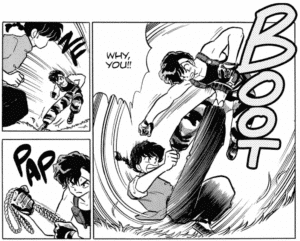
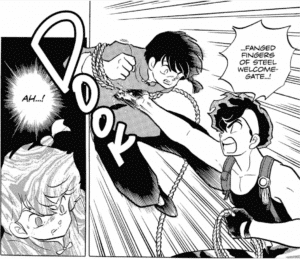
Ranma’s defeat and determination are further emphasized by the final page of the scene. While he spends most of the page prone and at Ryu’s feet, Ryu remains largely within the confines of the panels, certain of his triumph. What’s more, he is consistently drawn with full blacks and whites. In contrast, there are two close ups of Ranma, both larger than any panel of Ryu, both escaping the confines of their panels. (Indeed, the first of Ranma has no border at all.) At the same time, Ranma is drawn incompletely. Parts of his body are shown to be fading away. The color of his hair and shirt is only partially done — you can see the Ben Day dots on Ranma’s shirt separated just a tad more than usual. This hurt, and hurt quite a bit. But this isn’t over.
The Shonen Form
Simply put, this is some exemplar work within the Shonen form. Keep in mind, by this point, Ranma ½ was roughly ¾ of the way done with its run. Oftentimes, long-running shonen manga will reach a point where it feels like the ideas for fights have run out. The Namek Saga of Dragon Ball, for example, is infamous for how interminably long it feels and was. Indeed, it is in fact the longest arc of all of Dragon Ball at seven volumes. But what makes it feel truly, interminably long is that it consists of literally the exact same fight over and over and over and over and over and over and over and over and over and over and over and over and over and over and over and over and over and over and over and over and over again. Every fight, with literally one exception, is a mixture of brute force and beam struggles only mildly enlivened by Akira Toriyama’s cartoonish art style. By the time we reach the Frieza fight — which is at roughly the same point as the Fake Ranma arc of Ranma ½ — the readers are bored out of their minds with a fight that’s even more interminable.
By contrast, Ranma ½ keeps the longer arcs separated with smaller, two to three chapter stories as well as provides different structures to the fights to keep up variety. Sometimes, Ranma is put into a position where she can’t win due to the nature of the fight. Others, he has to fight while doing cheerleading techniques. And then, there are the times when she has to out eat an absolute freak of a Frenchman.
What I’m getting at is that Ranma ½ does not function like a traditional shonen manga. It does not have any tournament arcs or long running rivals that can genuinely give Ranma a run for his money. Her ongoing threats are absolute clowns who are easily trounced by Ranma except when there’s a gag to be had at everyone’s expense. (And, also Happosai, but the less said about him, the better.) The core of Ranma ½ isn’t the action spectacle of Rumiko Takahashi. Rather, it’s a romantic comedy about two people who want the last word and won’t take anyone forcing them into a situation, no matter how much they want to be in one.
What About Akane?
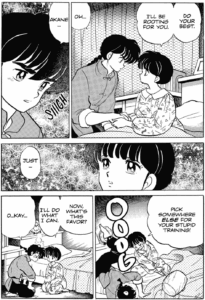
You might have noticed that Akane has barely been mentioned thus far. In fairness, she’s placed in more of a support role within the context of this arc rather than as the dual protagonist role she often finds herself stepping into. But the heart of Ranma ½ is the relationship between Ranma and Akane. To rephrase Elliot S! Maggin, Ranma loves Akane. Akane loves Ranma. And they both ached in vain for the other to just say it. No one understood this.
Throughout Ranma ½, it becomes apparent that the two of them are clearly dating. There is very little temptation to be with anyone else — mostly in regards to childhood debts or shenanigans that never amount to anything more than the silent melancholy of an autumn evening. Yes, they bicker and fight, but they’re there for each other when things go horribly wrong.
Even in this arc, where Akane has a smaller role, her significance is highlighted. Her largest role in the arc is to deliver a letter to Ryu from Ranma, challenging him to a fight. When entering the home of Ranma’s mom, she is depicted as the biggest thing on the page, escaping the panel with the ease only violence has allowed Ryu. She only appears in two panels of the scene, but both of them depict her as larger than anything else on the page. Indeed, the final row of the page has her directly contrast Ryu in terms of size and freedom. There are no borders boxing her in, whereas Akane’s very presence threatens to topple the house of cards Ryu has been desperately building.
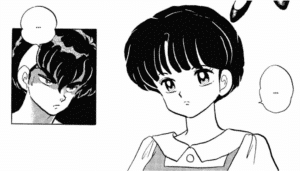
But the more telling sequence comes earlier in the chapter, when Ranma asks Akane to deliver the message. There, Ranma appears before Akane having completed the training necessary to complement Ryu’s technique. They share a moment, however briefly. There are words, but the important thing is the visuals. We see a close up of Ranma and Akane, the world nothing more than abstract bubbles that highlight the light in their eyes. You can feel the love shared between them, how they will literally do anything for the other. All of this helps build to the punchline of Akane hitting Ranma on the head with a hammer because he keeps creeping around her room, pilfering through her underwear drawer and replacing them with vegetables. Then, she asks what he needs her to do.
Ryu Upended
In many regards, this degree of domestic love is something that Ryo is upended by throughout his time with Ranma’s mom. As he notes, “I grew up not knowing the warmth of another’s pity or the hot tears that touch one’s heart. Much less the face of my mother… Not since I was born…”
Ryu feels more at home in the more traditional Shonen manga than he does in Ranma ½. Like Kenshiro of Fist of the North Star, he is a lone traveler never staying in one place for long. Like Son Goku of Dragon Ball, there is a yearning for power. Like Erin Yager of Attack on Titan, he is seemingly out for revenge against those who have destroyed his family. His strength lies in his power, his ability to destroy everything around him. When he’s around Ranma’s mother, there’s a level of awkwardness that exudes the core of his very being. His masculinity is exuded in combat. When he doesn’t need to destroy, when he can simply exist, it all falls away into stark uncertainty and melancholy.
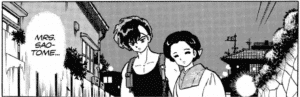
An unspoken subtext that’s nevertheless palpable is that Ryu is what Ranma would’ve been had he never engaged with her girl side. Many arcs of Ranma ½ highlight a world where Ranma rejected masculinity entirely, becoming a flighty, boy crazed mirror version of Ranma. But Ryu’s avoidance of femininity feels more pointed. At one point, he threatens Ranma with revealing that he’s “a crossdresser” to her mom, destroying any image of masculinity Ranma could ever cultivate. And — as with the mirror version tossing any self-respect aside in the name of a good cock — this feels like something truly heinous and unforgivable. And it is something Ranma could’ve become. If she continued the eternal training arc her father had set before her, traveling the world to learn more and more techniques for fighting. Sleeping on rocks, fighting one battle after another. Punching harder and harder until whole mountains collapse underneath. Never being put into a position where she had no other choice but to actually meet Akane. Never knowing her other half, the counterpart to her symphony. Never experiencing the joys of running circles around Ryoga. Reconnecting with Ukyo. Dressing up as a playboy bunny, a baby sister, a maid. Being a girl and a boy. Yes, there are hardships. Ryu will never know the pain of having to deal with Shampoo. The horrors of Happosai. The further horrors of Kodachi. He never has to go into debt because his sister in law conned him out of all of his money. But those are all elements of a life well lived. Living on the run, never stopping for anything. Always alone. That’s not a way to live a life.
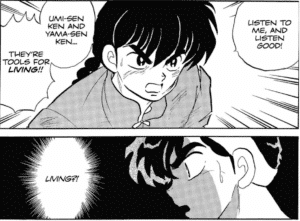
The crux of the final confrontation between Ranma and Ryo (which takes up the final five issues of the arc) is a moment at the direct center of the fight. Having learned the full truth of Ryu’s backstory and been beaten ten ways past Sunday, Ranma notes, “You’re using your skills for the wrong reasons. You’re using them to destroy things… Not to create anything… They’re tools for living!!”
The context of this turns out to be the techniques created are meant to be used to steal stuff from other people. But the larger point being made in the arc is that what separates Ranma from Ryu, what keeps Ryu boxed in and unable to grow past his limitations, is that Ryu can’t create anything new. All he can do are harder and harder punches and beams.
Both a Boy and a Girl
Throughout Ranma ½, the titular Satome is constantly creating new things. Mainly with Akane Tendo.
It is a rather limiting stereotype that action is for boys and romance is for girls. But it is nevertheless a useful one in the context of Ranma ½. At his heart, Ranma is a girl. At her heart, Ranma is a boy. She is both at the same time. Through this, he can create something new and brilliant.
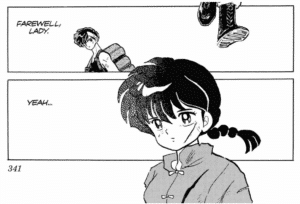
There is a melancholy to the end of the fight. Ryu has revealed himself to Ranma’s mother, who already suspected something was off because he was awkward around Akane. When the two mirrors share a look at one another, Ryu’s small. Boxed into a rectangular panel larger than his image. Whereas Ranma, in girl form, escapes all panels, even the one structurally designed to fit the character. Ranma overlaps both that panel, the one containing Ryu, and the gutters at the bottom of the page. She is free to be Ranma Satome. He is not to be boxed in.