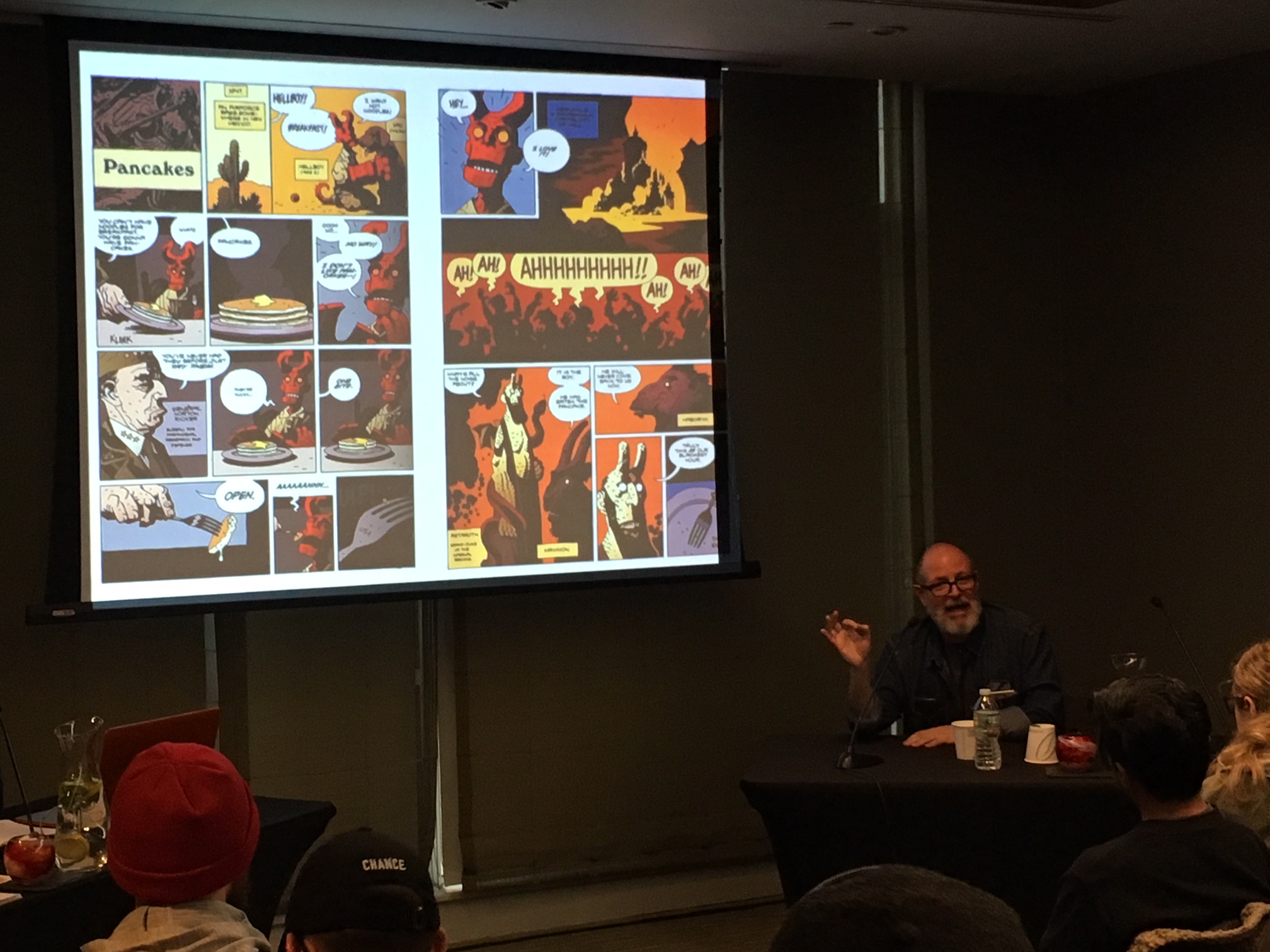
To say that comic creator Mike Mignola is at a crazy busy time in his storied career would be an understatement. Between celebrating the 25th Anniversary of Hellboy and plotting the end of the long running Hellboy companion B.P.R.D. series, you can’t help but wonder when Mignola has time to catch his breath. And lest I forget, there’s the current THE ART OF MIKE MIGNOLA: Hellboy and Other Curious Objects exhibition at the Society of Illustrators (be sure to see it before April 28th!) and Mignola’s involvement co-writing the upcoming Hellboy reboot set for a January 11, 2019 release.
Nevertheless, the legendary writer/artist took the time to appear at last weekend’s MoCCA Festival and take part in a Q&A panel discussing his work with artist and educator Nathan Fox (Chair, SVA MFA in Visual Narrative).
First and foremost, it has to be said that after all the success and acclaim he’s garnered over his career, Mignola remains one of the most humble and self-effacing creators in the industry. It was fascinating to trace his journey from a kid in Berkeley, California obsessed with monsters to self-proclaimed “terrible inker” in the 80’s to a modern master of the comics art form.
Contrary to expectations, Mignola said he wasn’t a huge comic reader growing up, with some exceptions like Conan the Barbarian and reprints of Doc Savage and The Shadow. The moment that solidified his interests in Victorian literature and fantasy folklore was sitting on his father’s bed at the age of 13 and reading Bram Stoker’s Dracula. Years later, Mignola would go on to adapt the Francis Ford Coppola Dracula film, which incidentally is coming back in print more than 25 years later courtesy of IDW.
Early on in high school, Mignola was taken with pulp writers like Robert E. Howard who hammered out countless stories in a short time before “blowing his brains.” However, a fellow student discovering a page from one of his stories after it fell out of his binder and reading it aloud during lunch hindered Mignola’s writing pursuits, at least for a time.
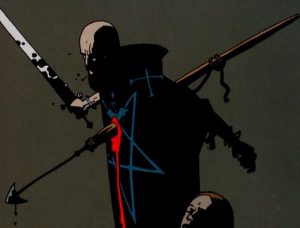
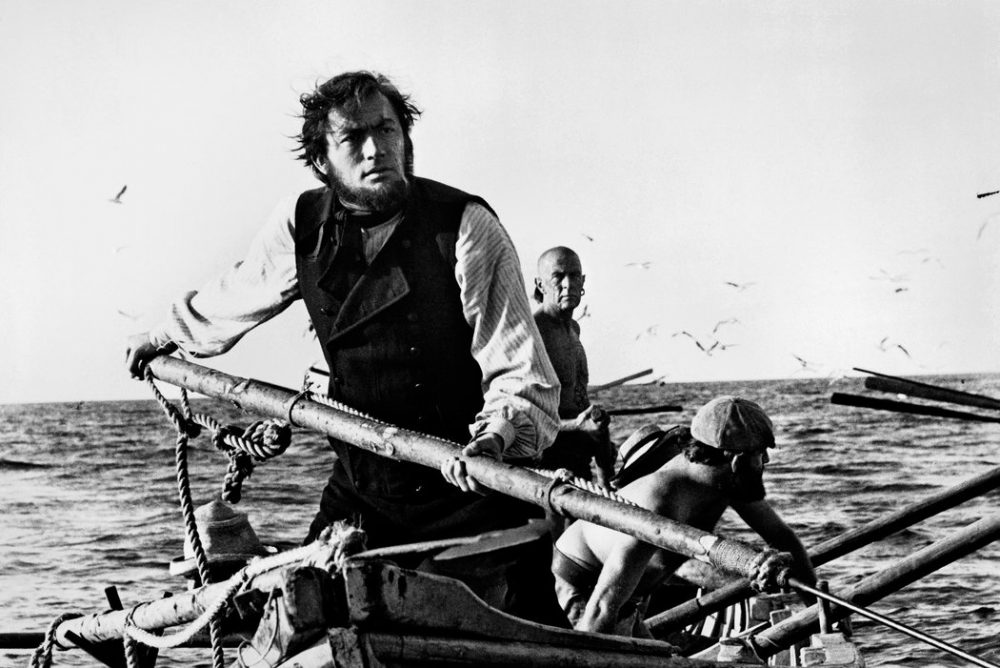 It may take some aback to learn that Mignola cited John Huston’s 1956 adaptation of Moby Dick as one of his favorite films. Funny enough, Mignola admitted to never having read the original Herman Melville book, but the Huston movie featuring a screenplay by Ray Bradbury has stayed with him years later after constant broadcasts from the local TV station. Although there are no overt supernatural elements that is a trademark of much of his own work, Mignola pointed out a scene where the ship leaves port resembling a funeral, thus turning it into a movie about a ghost ship in his eyes. Perhaps not surprisingly, harpoons factor in Mignola’s work quite often, most notably in the first Hellboy: Seed of Destruction mini-series.
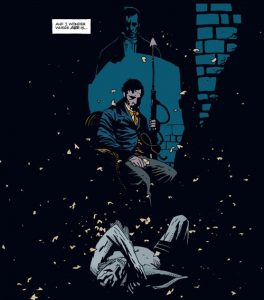
As most Mignola and Hellboy aficionados are well aware, Mignola’s father was a blue-collar cabinet worker who influenced much of Hellboy’s matter-of-fact personality and Mignola believes was not recognized artistically. While Mignola’s father didn’t discourage him from pursuing a career as an artist, he believed his son should apply it to something practical like teaching since all he knew about artists was that they starved. Becoming a student at the California College of the Arts and one of the few people in his family to attend college, Mignola appreciated being exposed to new ideas and people as opposed to simply being cocooned in his old life. After graduating in 1982, he packed up his bags and followed the “first lunatic” he met who was going to New York City, staying in a residential hotel, and eventually working in the comics industry first as an aforementioned inker for Marvel and DC Comics before becoming a penciler.
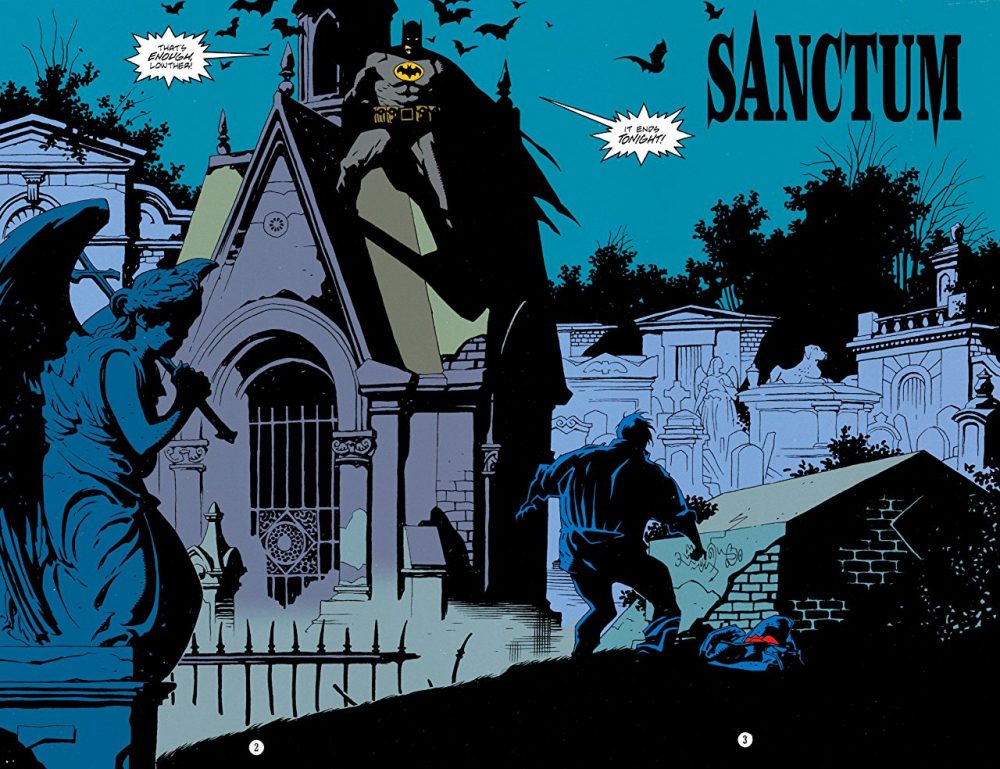
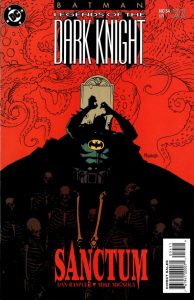 Though garnering praise in the late 80’s for his distinct style drawing superheroes such as Gotham By Gaslight, Mignola confessed that he “didn’t know shit about Batman.” He realized if he was ever going to draw what interested him, he was going to have to write for himself. Right around the same time Hellboy debuted in 1993, Mignola showcased his talents as both writer/artist with an issue of Legends of the Dark Knight #54 called “Sanctum.” Encouraged by editor Archie Goodwin, considered by many as one of the all-time greatest comic editors, Mignola crafted an original Batman tale incorporating his own unique sensibilities. With Dan Raspler helping the tyro Mignola as a co-scripter, “Sanctum” is very much in the same vein as a classic Hellboy story with Batman chasing after a killer in a Gotham City graveyard only to find himself transported through supernatural forces to a mysterious Victorian world.
The decision to embark on his own comics may seem like a huge risk, but Mignola said differently. At a time like the Image Comics revolution when creator-owned material was flourishing, driven by desperation and a desire to produce something he could to as a signature work on his deathbed, Mignola had nothing to lose gambling on Hellboy. Dark Horse paid him the same amount as Marvel and DC, only it was for something creator-owned that would allow him to retain the rights. If it failed, at worst he would just go back to working in mainstream superheroes since he still had close relationships at Marvel and DC.
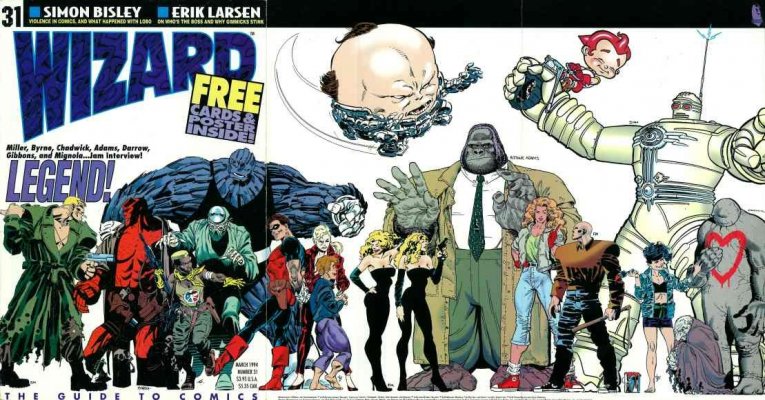
Launching as part of Dark Horse’s Legend imprint focusing on creator-owned projects from established creators like Frank Miller, Arthur Adams, and Dave Gibbons, Mignola’s Hellboy benefited tremendously by association with this high caliber of talent. Certainly, having your character appear on the cover of the (then) popular Wizard magazine was great exposure.
For the first Hellboy mini, fans will recall that Mignola enlisted John Byrne to co-script the story due to his trepidation as a novice writer and to help give it a mainstream comics polish. From the get-go, Byrne always considered it Mignola’s book so gave Mignola enough space so as not to interfere with Mignola’s creative process. By the end of Seed of Destruction, Byrne was confident enough in Mignola’s abilities to let him fly solo as a writer on the next Hellboy comic, even if Mignola himself considered writing by himself “a nightmare.”
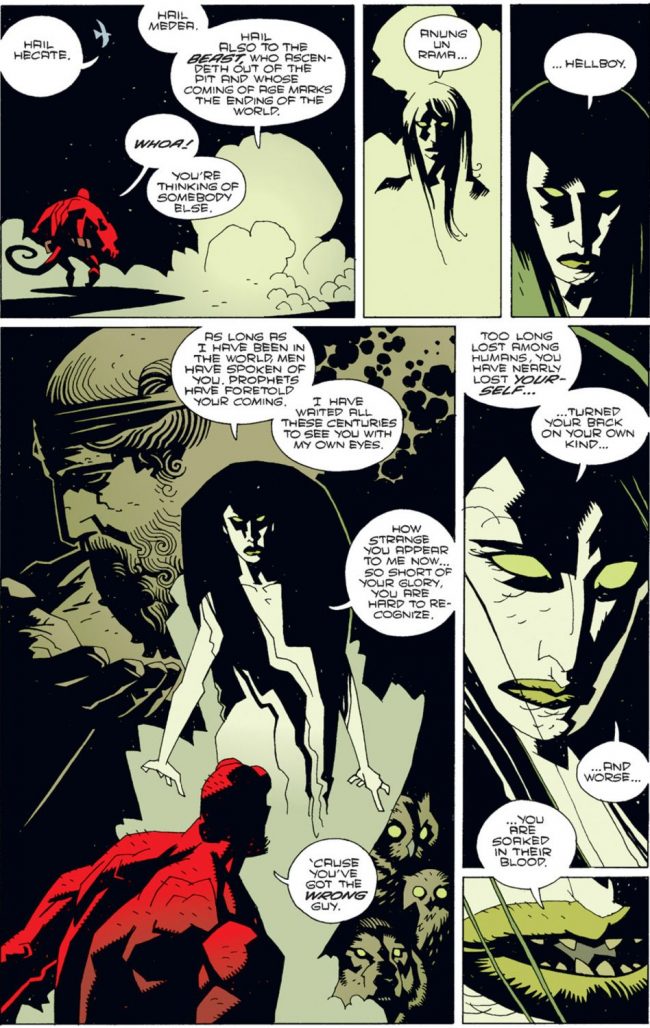
When it comes to writing, Mignola joked that it’s still a mystery to him. He did provide at least one helpful tip for aspiring comic creators- know what your characters are going to say before drawing any pages. This led to surprising revelation that Hellboy’s destiny as the Beast of the Apocalypse, perhaps one of the most critical plot elements of the entire Hellboy universe, was never initially intended for the character but rather a late addition. Apparently, in one of the early Hellboy stories, Mignola drew a sequence of pages with the titular protagonist facing off against another character without considering the dialogue. When it came time to fill in the word balloons, Mignola essentially created the Beast of the Apocalypse destiny because he didn’t have anything else for them to say. In a somewhat metatextual twist, Mignola attributed Hellboy’s abdication of this destiny as a metaphor his own desire not to talk about this particular destiny plot point any further.
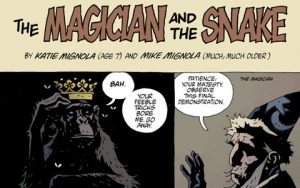 As far as the work that reflects his quintessential self as a creator, Mignola was quick to point to The Amazing Screw-On and Other Curious Objects collection of stories. Every story in that collection was not intended for any specific audience or sales but for himself. “The Magician and the Snake” short story, which he created with his then 7-year old daughter Katie, holds particular sentimental value since it allowed him to communicate his own parental and personal insecurities, paranoia, and guilt over staying away from home. Plus, as a father he has bragging rights to say that his daughter won an Eisner Award for Best Short Story.
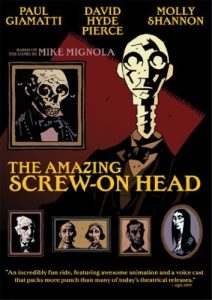 Speaking of Screw-On Head, some may remember the animated short produced back in 2006 for the Sci-fi Channel (this was back before the Syfy rebranding). Despite duplicating his character design style, Mignola has only seen the first few minutes and has no intention of watching the whole animated short. It’s nothing against director Chris Prynoski or writer Bryan Fuller, but there is nothing more painful to Mignola than seeing someone else drawing in his style, describing it as “nails on a chalkboard.” Hence why the Hellboy animated movies enlisted Sean “Cheeks” Galloway as a character designer rather than Mignola.
For a creator who eschewed traditional practices and approaches to mainstream comics, it’s ironic that the Hellboy machine has become such a widely recognized brand. Whatever else destiny has in store for Mignola, he’s more than left his mark on the industry.



Great article/write-up. Appreciate being able to give better context to Mignola’s work now
Comments are closed.