
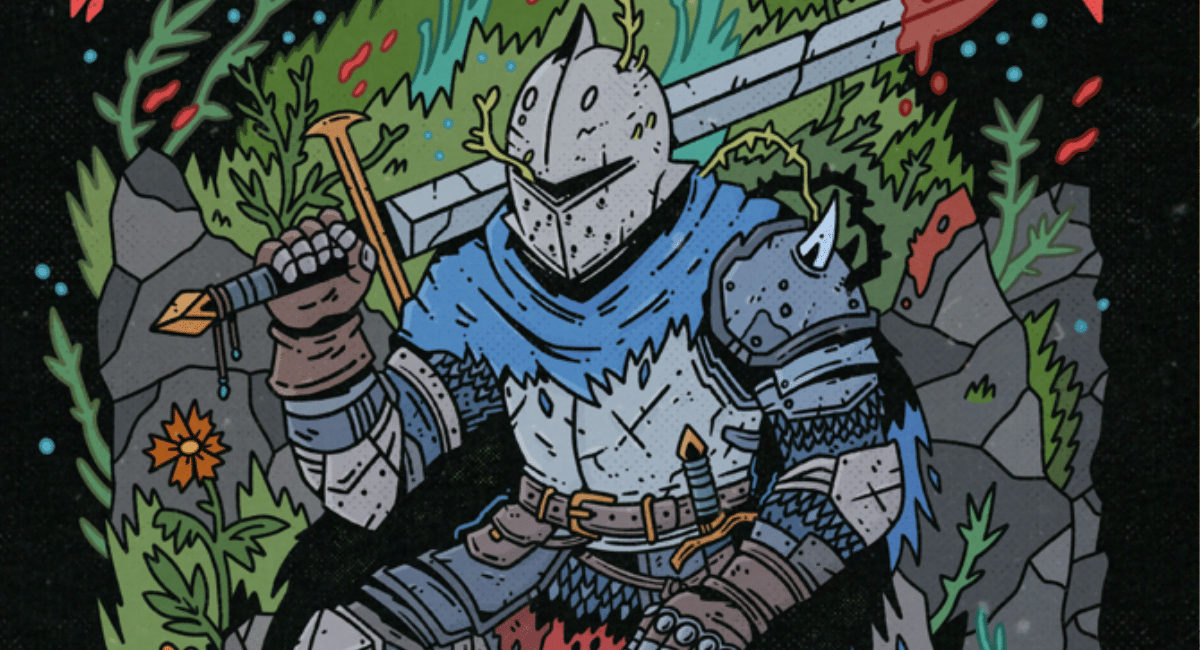

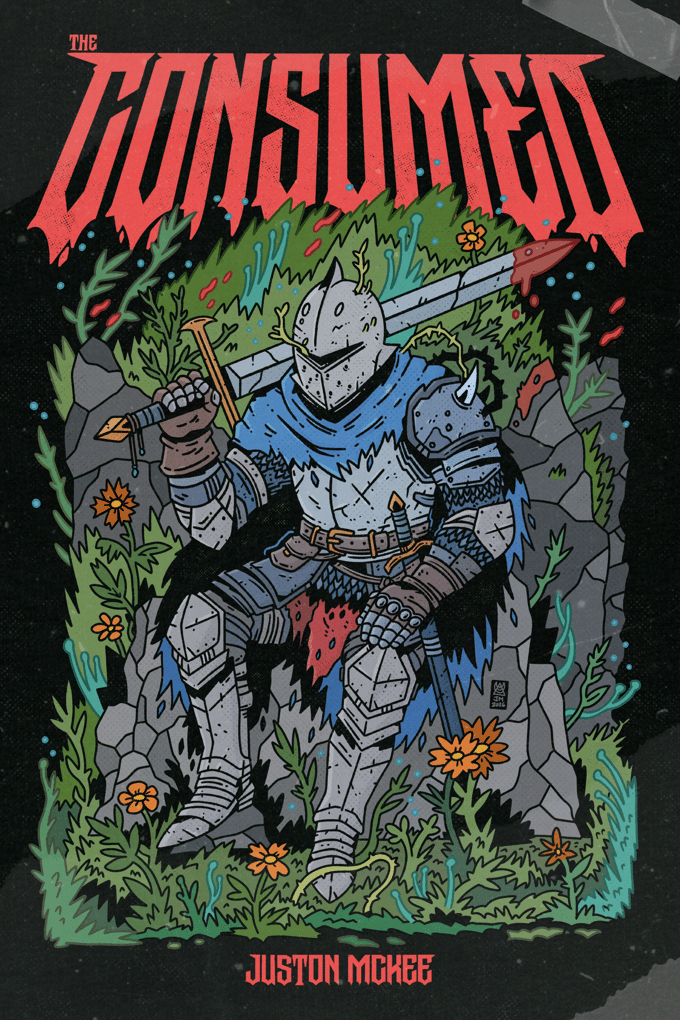
For years, Juston McKee of UPPPERMINDINK has built a name for himself through illustration work, fantasy art, comics, and collaborations across the independent creative space. From co-creating Lich Lands to work tied to Traumatarium and projects with Now or Never Comics, McKee has spent years helping bring other visions to life. Now, he is turning inward. His newest project, The Consumed, takes deeply personal experiences surrounding addiction, grief, sibling relationships, and emotional loss, filtering them through a dark fantasy framework filled with dangerous temptation, looming darkness, and two brothers pulled toward very different paths.

The Beat spoke with McKee about processing trauma through storytelling, building symbolism into fantasy worlds, and why The Consumed  became one of his most personal projects to date.


DIEGO HIGUERA: To jump right into it, do you want to explain the project for readers who might not be familiar?

JUSTON McKEE: Yeah! My name is Juston McKee, also known as UPPERMINDINK I’m an illustrator and comic artist from San Diego, California. I’ve done a lot of work with Now or Never Comics downtown. People have probably seen my art on shirts, hats, stickers, and pop-up events over the years.

I co-created Lich Lands, which came out a few years ago. I’ve also spent a lot of time doing fantasy illustration and trading card work. I was one of the lead designers on Traumatarium, which exists as both a Game Boy game and trading card game.

A lot of my work has been helping other people bring their ideas to life. But lately, I’ve been wanting to get back to making comics that feel completely mine. The Consumed  started from conversations with my siblings. I’m the oldest of four, and we were talking about what it feels like watching somebody you love struggle with addiction.

Watching your family go through that. Watching somebody become someone different. Last summer, we went through something difficult as a family, and it forced us to process grief in a different way. I kept asking myself what happens when somebody you love is physically there, but the person you knew feels gone. What happens when you’ve exhausted every option trying to help somebody?

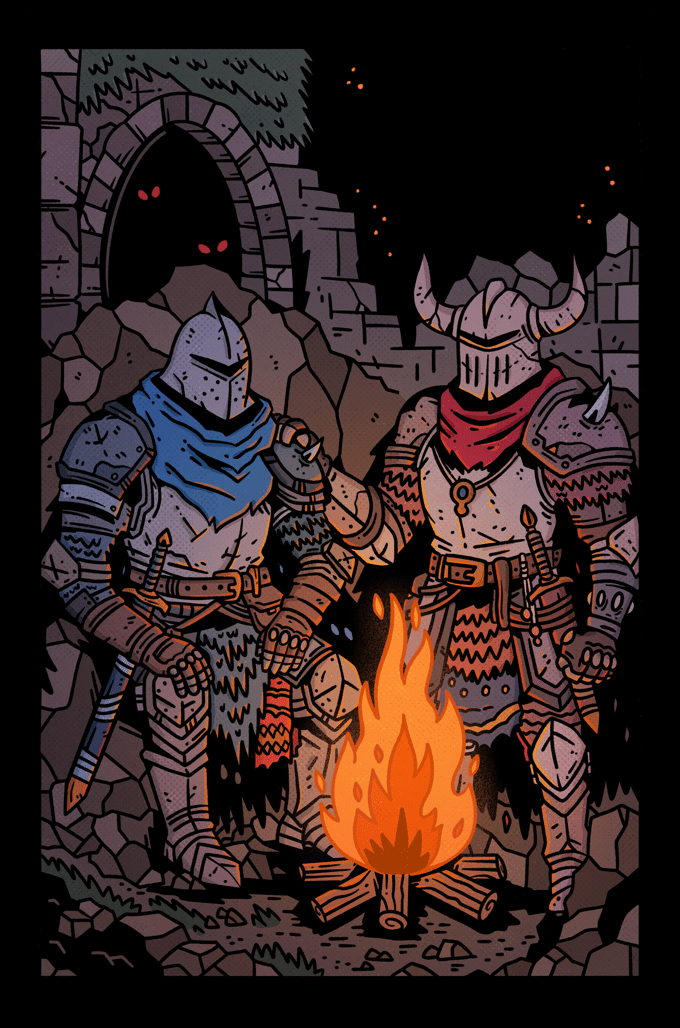
I’ve always loved fantasy. Dark fantasy, especially. Dark Souls. Elden Ring. Tabletop games. Stories about personal journeys. So I thought, why not take those influences and combine them with something personal? What came out of that became The Consumed, a story about two brothers chasing something powerful, but underneath that fantasy structure, it’s really a story about trying to help someone you love and realizing sometimes you can’t make that decision for them.

It’s about grief, love, loss, and understanding when you have to let go.
THE CONSUMED

HIGUERA: Your project recently crossed its funding goal and is still growing. Considering how personal this story is, did fantasy make it easier to approach emotionally?

McKEE: Absolutely. That’s a great question. I used it as a therapy tool. I think there are things I wish I could have said in the moment, so I thought, why not process through something I love, something creative, whether it was a story. I had this little piece of paper I pulled out that I found the other day when I first wrote it. It was going to be a six-panel Instagram story. I doodled it quickly, just asking myself what the initial feelings were toward everything, and it just kind of spiraled from there.

It became therapy. There were things I wish I could have said or processed differently.

Originally, the comic was just six panels. I found that original paper recently, and it started from that small idea. But the more I sat with it, the more it grew. I needed time to process things as the oldest sibling. I think I took the brunt of it a little harder than some of my other siblings, so I started asking myself what you do in a situation like this.

I lost my best friend really young, so I was also processing old grief, thinking about what I would have done to help myself back then, when I was younger and now that I’m older. For me, creativity became the answer. Even if I don’t go too deep into it, even if it’s vague or on the nose, I think someone might read it and relate to it.

I always wanted something I could print and give to my siblings and say, “Hey, this is how I felt, and I know you were going through something too.” I created this so I could process grief and move forward with my life. This project originally wasn’t meant to be public. I wanted to make something for my siblings, something I could hand them and say, “Hey, this is how I felt.”

Then it grew into something bigger.

What started as a small idea kept expanding because I saw potential in it being a bigger story. I had more things to say, and I wanted to challenge myself.

HIGUERA: Yeah, it’s not all doom and gloom. In fact, that’s one of the strongest aspects of it. Even in the middle of dark times, there’s always some light that comes through, and I really like that. I also appreciate how you frame your character as the sibling, someone who recognizes, “I don’t like what this is doing to my brother,” but still chooses not to walk away. At the same time, they’re not forcing anything either, because ultimately the decision has to be his.
THE CONSUMED

McKEE: In line with that, it was important that at some point in the book Shark tells Bull that he loves him. 
When I was writing it, I kept coming back to the idea that the most important moment had to be Shark telling Bull he loves him. Regardless of how things turn out, that line needed to exist, because situations like this are still rooted in love. When someone is going through something difficult, the intensity of those emotions comes from caring deeply, from trying to help, not from indifference.
 
So even though the story has heavier moments, at its core, it’s still about siblings and love. I wanted that to be explicitly stated rather than only implied. That also carried into the character design. Bull is modeled after a bullheaded sibling who rushes in, while Shark reflects a more analytical approach, someone who “smells blood in the water” before acting.
 

The contrast isn’t about intelligence versus strength; instead, I wanted it to be about instinct versus reflection: one acts first and thinks later; the other thinks before acting. Placing those two perspectives into the same situation raises the question of what happens when both approaches collide. Neither is framed as inherently correct, which is intentional. That tension is part of what defines sibling dynamics. People process things differently, whether they think first or act first, and those choices still lead to consequences regardless.

HIGUERA: I really like this interpretation because it avoids framing the siblings as judging each other or as one being “right” and the other “wrong.” It’s more that their differences simply exist and have to be navigated. That’s something I think many siblings will recognize, and it feels like a core part of the book’s foundation.

I’m also interested in how different readers might interpret it, especially between those who have siblings and those who don’t, since that lived experience could shape how they relate to the characters.

Building on that, the rock in the story functions as a symbolic element. What did it represent to you, and how open is that symbol meant to be to interpretation from readers?

THE CONSUMED

McKEE: People have been asking me; I’ve been lettering it, and I’m going to release a batch of finished pages shortly. I know I was vague in the Kickstarter, showing some art but no lettering, so people were curious.

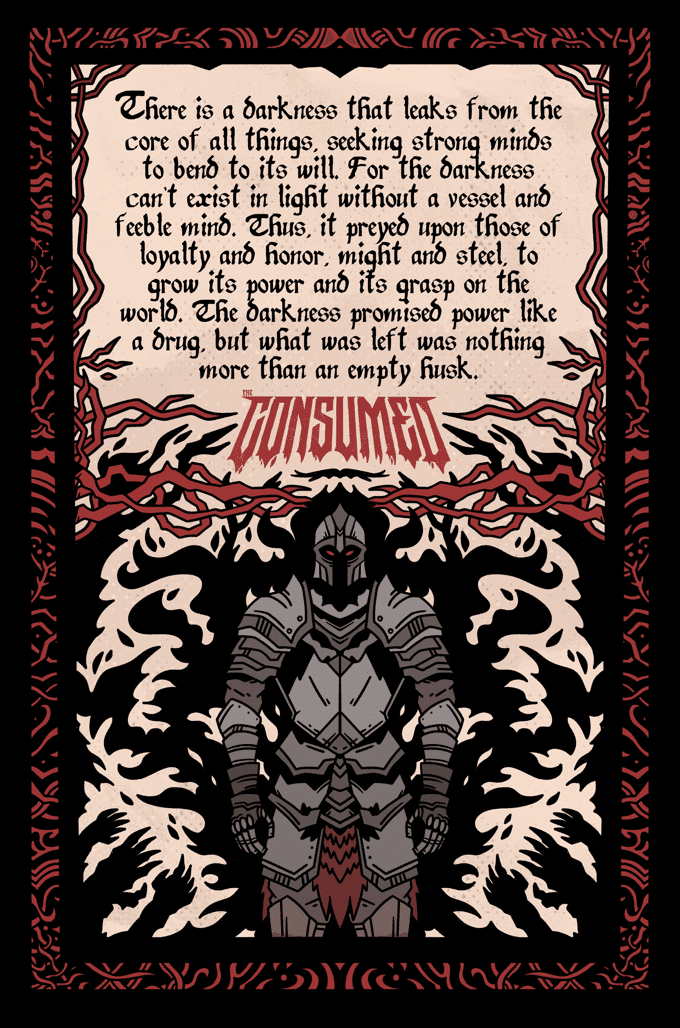
I set up the initial page to establish the story because it’s about knights throughout history. That is not new. Knights seek honor, glory, might, and steel; the ultimate quest is notoriety. In this world, there are forces that take advantage of that. You can have valor and honor, but in the wrong hands, it can be twisted into nefarious means, and that has happened throughout time. We enter the story with an entity that has called to them. It seeks feeble minds. A lot of it is that when knights want only power and glory, there is something seeded in their mind that tells them they are not doing enough, and that darkness feeds on that. It says, “Seek me out, and I will give you what is promised. You will never have to worry about being powerless again.”

Something important is that it is not just one brother hearing it; both brothers hear it. There is symbolism there. The symbolism is that when presented with something like a drug, temptation exists for everyone. It is a mind-over-matter situation. The difficult point is that this kind of thing is accessible to a lot of people. In certain situations, it becomes a choice: do you try it, do you say yes, do you say no? It is not an anti-drug message; it is about when you know something will change your life for the worse, how you make the better decision. When you are around that situation, what you do to help someone get out of it.

I mean, the word “drug” is in the book. The entity is using its power as a drug. Maybe it starts with party drugs. Maybe you go to a party, and they are drinking, then they smoke weed, and so on. But then what do you do when that party behavior turns into actual addiction? What happens when, as I said, the consumed state becomes about wanting more and more and more? Then it can become prescription painkillers, then meth. What do you do when they reach that point where it is the hardest drugs, and you see it physically transform them? The shell is still there, but the mind has been consumed.

That is where these shadowy beings and this entity come in symbolically. You still see the shape of the person, but the essence of who they are has been consumed by the entity.

HIGUERA: I think it’s a great point to make, you realize there is a bigger problem overall. It is not just one single thing. On a real note, there is a genetic and literal component to drug addiction. This is something real and complex.

I wanted to ask about that as well, I see these two brothers going into dark caverns and perilous places. While also being surrounded by a world you designed that is, in all honesty, has this sense of beauty in such a dark world. 

Because of the story you are telling, how did you design that world aesthetically to reinforce these themes of temptation and decay, while also emphasizing the emotional conflict between these brothers?

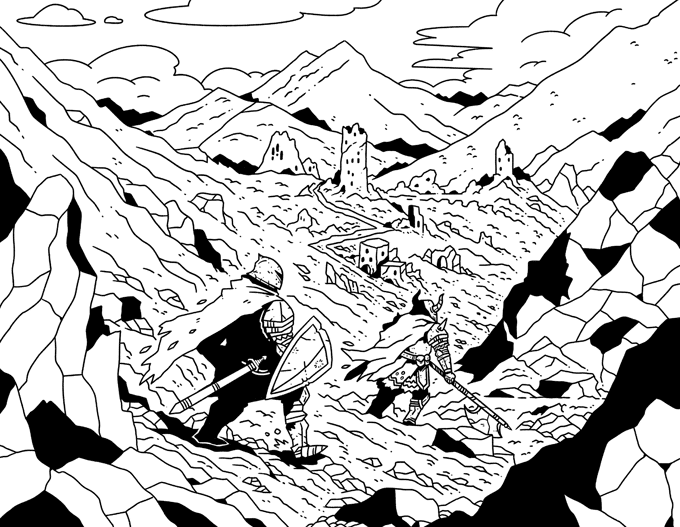
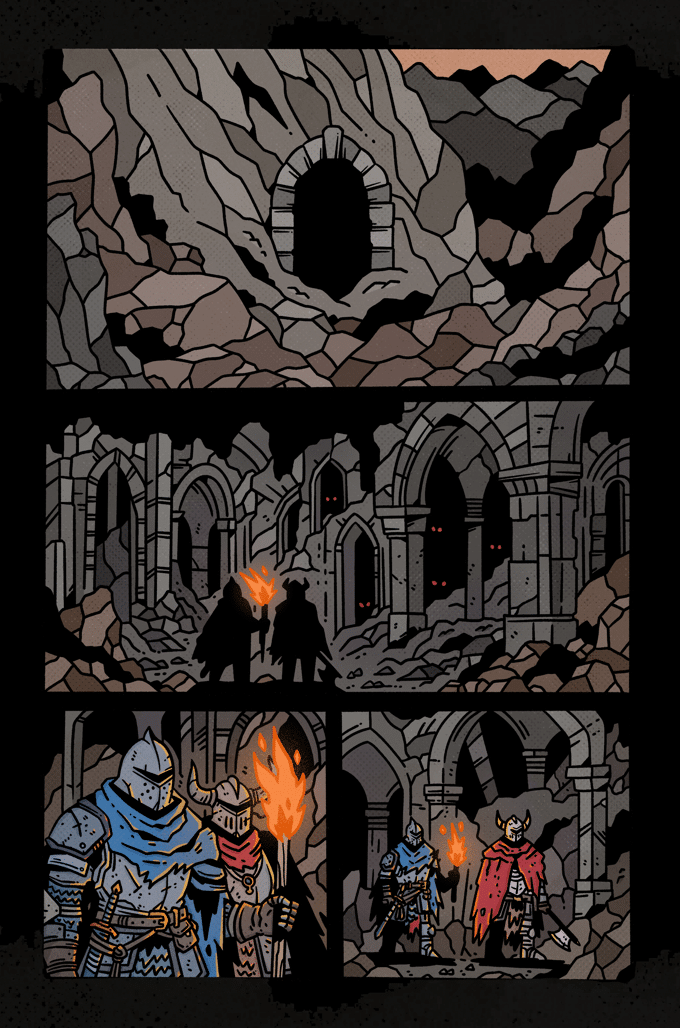
McKEE: So on the outside, the page starts with the book opening into an expanse. It is two brothers in a landscape. They are on a mountainside. The day is sunny, the sky is blue, the wind is blowing.

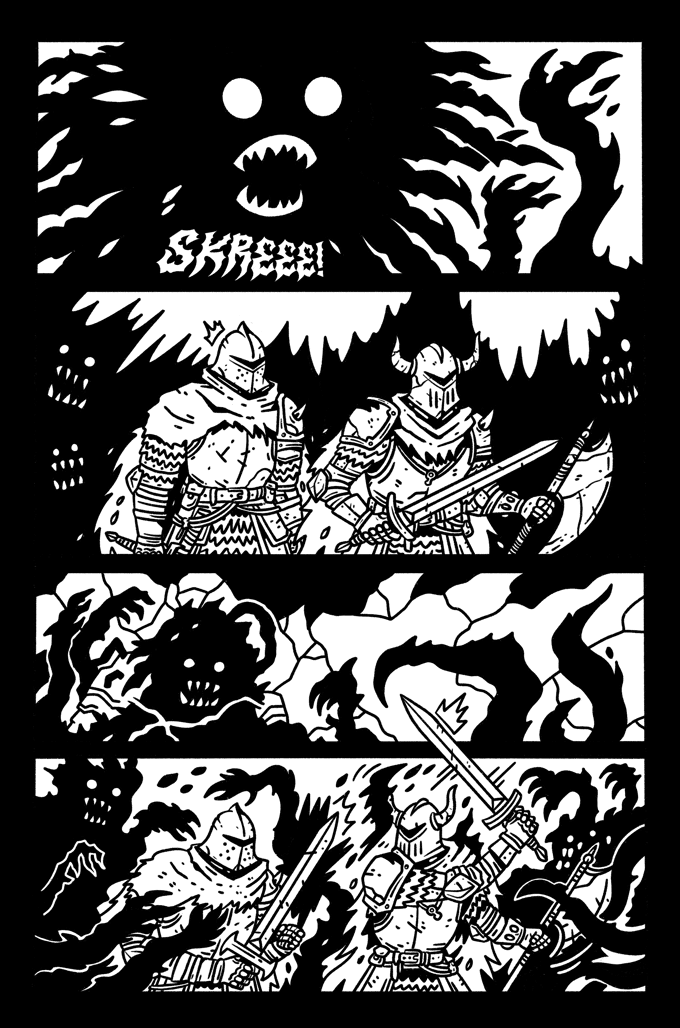
Once they make the journey to where this entity has been calling them, there is an opening shot where they reach the cave, and the cave opening is essentially a void. I wanted to emphasize that visually. Once they step through that portal into the void, all the panels and everything kind of bleeds..

I wanted to create a claustrophobic feeling. Once you step through that portal, what the characters are seeing and interacting with begins to bleed beyond the panels and borders into the comic itself. There is still traditional paneling, but it becomes dark and dense.

The goal was to make the reading experience feel uncomfortable. Inside the ruins and inside this place they are searching, everything is deeply contrasted, with silhouettes and heavy shadows. Once they are outside again, the panels open up, the borders return to white, and there is an expanse again. It feels like a chance to breathe.

That is the structure I built. Once they are inside, they are inside. The temptation escalates and the world gets darker as it progresses. Have you ever read Dante’s Inferno?

HIGUERA: Yeah, 100% I know what you mean. 

McKEE: So it’s like the outside is an open expanse, but as they get through the fire and they get down and down and down, they realize it’s dark and it’s cold. No one’s really told them that at the center of this expanse, it’s frozen, it’s not hellish fire. So I kind of wanted to do that too.

Then once they’re inside, one of the first things Shark says is, “This place reeks of death.” From there, the tone shifts immediately. Even when creatures begin to appear, they emerge from the borders of the page itself, merging with the darkness. You start to read them as shadowy beings that are essentially one with it, which raises the question of what kind of force can manipulate darkness in that way.

I’m also playing heavily with color, especially torchlight, so there’s this constant sense of uncertainty, like you don’t know what’s watching them as they move deeper through the dungeons and further into the ruins.

That was the core approach: working with format, color, and contrast together to shape the feeling of the descent. The Consumed is consuming you as you read this book. As you open the book, it very much is an old school knight manuscript style, but once you’re in it, you’re in for 20-plus pages of darkness, deep silhouettes, and shadows. I wanted the book to feel uncomfortable because it would sell exactly what I’m trying to communicate about addiction. You are very much along for this journey with these characters. 

HIGUERA:  When I was looking at your project, I kept noticing the emphasis on these caverns and these dark spaces. You can tell it felt intentional. It’s not just a character dealing with a dark presence in isolation; the environment itself feels like it’s participating in that descent happening between setting and psychology, and I really love that.

McKEE: Even when you get to that point where you, as a reader, are like “oh, the brother is about to be consumed”, the way his design transitions shows that the borders begin to encroach on him. The shadows start to leech out, and you see what I was trying to do. I do not know if I accomplished it on every page, but I hope that when you are reading it you think, the darkness itself is the comic in that moment. These borders become the shadow. It reaches out to the characters.

No matter what they do within these panels, they are surrounded once they step through this portal. It is not an actual portal; they are simply stepping into a cave, into a dungeon. But what do you do when you have something filled with so much angst and despair? How does that take physical manifestation?

HIGUERA: I wanted to ask, as artists and creators get better with each project, has The Consumed shifted the kind of stories you want to tell going forward?

McKEE: There’s a really good art book I picked up recently. I think it’s called Acheron, by Ian Bertram. Tiny Onion put it out through Kickstarter, and I grabbed it from Now or Never Comics. What stood out to me is how it feels like an exploration of someone’s internal space, their emotions, and their mind. It’s very direct in that way.

Looking at that, I don’t really see a reason not to keep telling personal stories, or to keep weaving what I’m going through into comics. Not everything has to stay heavy, though. I’m definitely someone who likes making lighter, more playful work as well, so I think after this, I’ll probably shift into something a bit more fun just to reset.

What this project has really given me is confidence. I know I can do it now. The script has been finished for a while, and I recently read it to some friends before lettering, just to get feedback. Hearing their response helped a lot. It reinforced that the work holds together.

I also have another project I’ve been working on for a long time, an all-ages fantasy book. That’s been in development for about three years. It started smaller, but it expanded into a full graphic novel. Having that on the other side of this helps, because it gives me something more cartoony and loose to return to.

Right now, I’m at that stage where I’m getting close to finishing The Consumed, and that always brings up the same question: what next?

What else can I do?

What else can I make?

I find myself going back through older ideas and sketches and thinking about what still has life in them. What can be reworked. What still feels honest to where I am now.

So everything feels open at the moment, in a good way. The biggest constraint isn’t ideas, it’s time. Like a lot of artists, I’m balancing a full-time job with trying to make work at night and stay consistent with drawing and writing.

But I can already see the shift in my work. My illustrations are getting more contrast-heavy. My inking has changed. The influences are showing up more clearly in what I’m doing. It’s become a feedback loop between what I’m making and what I’m learning.

I’ve always leaned cartoony, but my work is getting more detailed, which makes sense given my influences. A lot of the artists I admire are maximalists who push a lot into the page.

The challenge now is figuring out how to maintain clarity while working with that density. That balance between speed, detail, and readability is something I’m actively working through.

I’ve also been lucky in terms of community. I have a lot of art friends, and I’m in group chats and Discords where people are constantly sharing work and giving feedback. That matters a lot. Drawing is inherently isolating, but having people around you who understand the process makes a huge difference.

Even conversations like this are part of that. Community is what gets work seen, and what helps keep you moving forward when you’re deep in a project.

HIGUERA: Before we wrap up, is there anything you wish I had asked? Any words for your readers?

McKEE: I just feel very grateful for how the project has been received. I didn’t show fully finished pages, so people backed it based on trust in the concept, which means a lot.

Now I just want to make sure I deliver on that.

It’s a short book, so I don’t want to give too much away. I want people to experience it as intended.


Check out the campaign here and support McKee’s most personal work to date. 


Leave a Reply

This site uses Akismet to reduce spam. Learn how your comment data is processed.