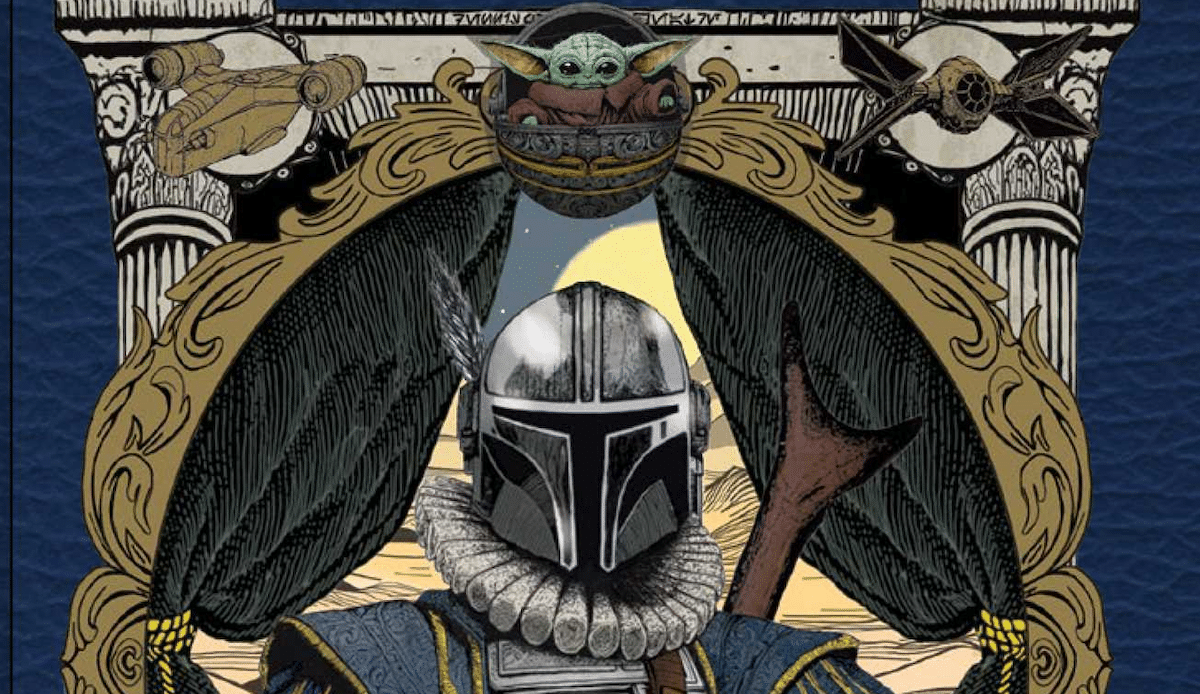

This weekend, the seminal space-faring fantasy franchise returns to the big screen with Star Wars: The Mandalorian and Grogu. But perhaps a mere feature film is insufficient to sate your thirst for more Baby Yoda? Then consider visiting a slightly different incarnation of a galaxy far, far away with William Shakespeare’s Star Wars: The Mandalorian of Nevarro by Ian Doescher.
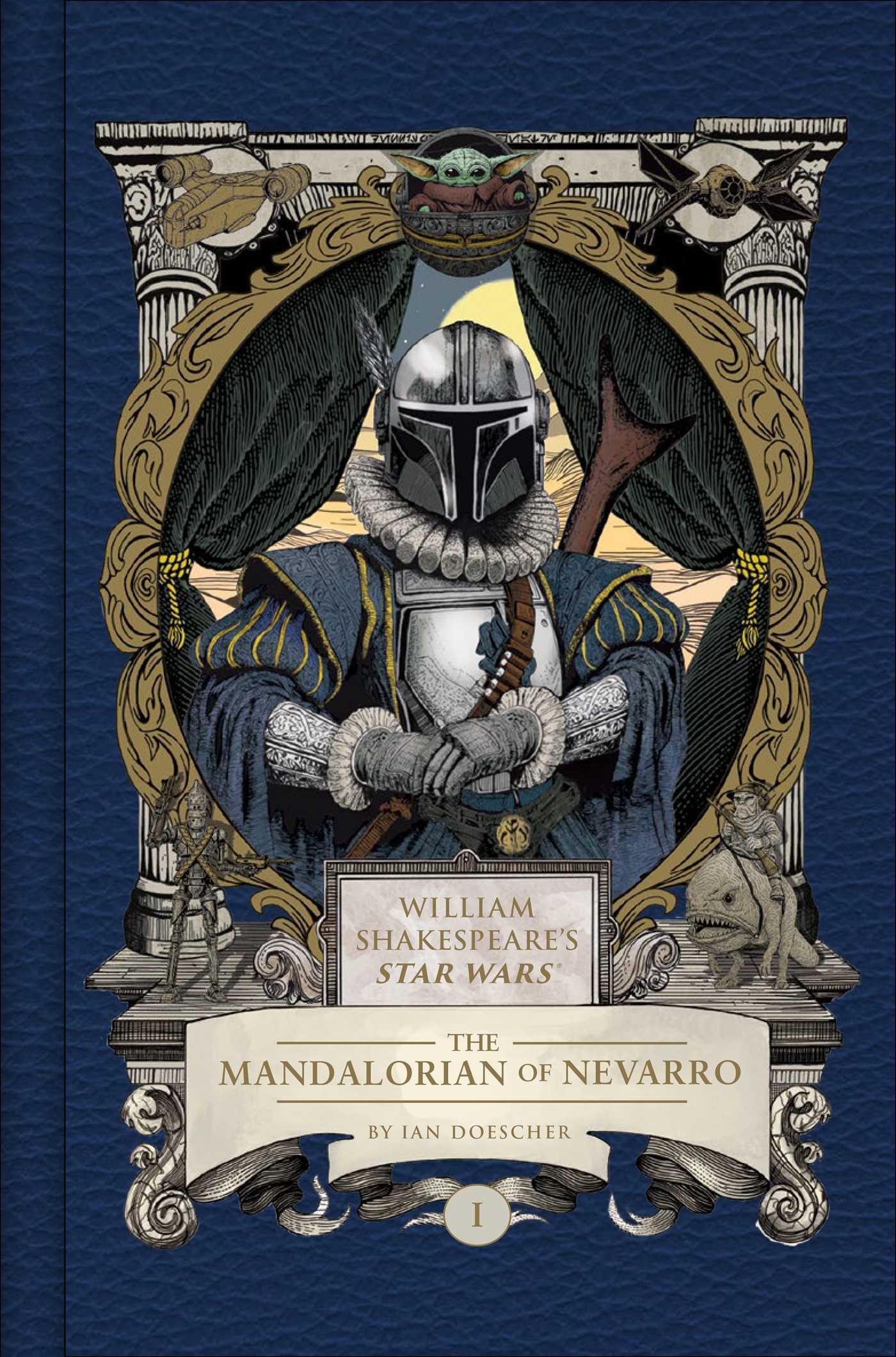
In the William Shakespeare’s Star Wars series, Doescher translates the beloved Star Wars stories into the style of The Bard. Over email, Comics Beat asked Doescher all about the difference between adapting a movie and a series, about his favorite character in this story, and about his thoughts on the artwork in the book by Dennis Przygodda.
AVERY KAPLAN: Can you tell us a bit about your history with the William Shakespeare’s Star Wars books? What makes Star Wars so adaptable to the Shakespeare format?
IAN DOESCHER: I’ve been a Star Wars fan since early childhood and fell in love with Shakespeare in high school. I had the idea to combine the two in 2012, and I’ve been lucky enough to be writing William Shakespeare’s Star Wars books ever since.
Star Wars is well-suited for a Shakespearean adaptation because it’s full of the same things Shakespeare’s plays are: compelling characters, themes of life, death, power, coming of age, and so on, moments of drama and laughter, and, most of all, stories that keep you riveted.
KAPLAN: How does adapting the nine movies into this format compare with adapting a season of a television show?
DOESCHER: Yes, for sure—adapting The Mandalorian required more deliberate outlining and choices (and even a couple of cuts) than adapting a roughly two-hour movie. Adapting the first season of The Mandalorian was a different sort of challenge than my previous books. At a certain point, I had to ask: What are the most essential portions of season one’s story arc? Hopefully, readers will enjoy how I handle it.
KAPLAN: Was there any scene or element of The Mandalorian Season 1 that you found especially challenging to adapt? And/or especially easy?
DOESCHER: Other than the nature of a TV season versus a movie, probably the hardest things were self-imposed. For example, Mando only speaks perfect lines of iambic pentameter (exactly 10 syllables, though Shakespeare added an 11th syllable to many lines). Also, I try my hardest to imagine how these might be staged, which requires combining scenes that might be handled via quick back-and-forth cutaways in the show. So, it’s those little details that make the adaptations challenging—but, as they say, the devil’s in the details.
KAPLAN: Do you have a favorite character from The Mandalorian (and/or The Mandalorian of Nevarro)?
DOESCHER: Before I started adapting The Mandalorian, I’m not sure I would’ve said I have a favorite. But paying the kind of close attention to the show that writing the book required, I gained a new appreciation for what a powerful character Kuiil is. That was the biggest surprise for me, and by the time (spoiler alert!) he died, I was actually fairly emotional about it.
KAPLAN: In the afterword, you discuss how you utilize certain syntactical and poetic conventions to convey additional meaning in The Mandalorian of Nevarro specifically and the William Shakespeare’s Star Wars books in general. Could you share some of these ideas (and the creative processes behind them) with our readers?
DOESCHER: Throughout my Star Wars adaptations, I’ve made certain choices about how certain characters speak that I then carry forward into subsequent books. I think it started with my second book, The Empire Striketh Back, because in Empire we meet both Boba Fett and Yoda. In my first book, all of my characters spoke in verse, even though Shakespeare used prose all the time—I didn’t want to be accused of being lazy! But with the second book, I felt it was time to have a character speaking in prose. Sometimes, Shakespeare used prose as a way to set lower-class characters apart from higher-class characters (who speak in verse), so I decided Boba Fett would speak in prose to mark him as a rogue. With Yoda, I knew I had to make his speech special, since his style of talking is famously unique. After trying out several ideas, I finally decided to have him speak in haiku. It’s not at all Shakespearean, but it’s very much in keeping with the spirit of my adaptations.
From there, through the years, I gave certain favorite various characters speech quirks: Admiral Ackbar’s lines always ended in something rhyming with “trap” (for obvious reasons), and Mace Windu’s lines always included the title of a Samuel L. Jackson movie.
Fast-forward to The Mandalorian of Nevarro: Because baby Yoda (later Grogu) is the same species as Yoda, I reasoned that he had to have a similar speech pattern to Yoda’s haiku. Readers can see how I handled it; I hope they enjoy it.
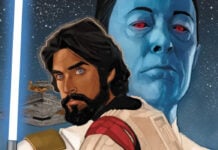
KAPLAN: Do you have any thoughts you’d like to share about the art by Dennis Przygodda in the book?
DOESCHER: Dennis’ artwork is beautiful! His illustrations help the reader (and me) imagine what these adaptations might look like if they were staged, like a wooden AT-ST held up by ropes. He absolutely nailed the spirit of these adaptations, and I’m thrilled he’s working on my books.
KAPLAN: Have you had the chance to see any of the William Shakespeare’s Star Wars plays performed in any capacity?
DOESCHER: No—Lucasfilm and Disney don’t allow public readings or performances of my books. That’s a choice they made early on and have been consistent about. The books are copyrighted in their names, not mine, so they call the shots on performances. I think there have been some rogue performances, but I’ve never seen one.
KAPLAN: Is there anything else you’d like me to include?
DOESCHER: Just that I’m honored and fortunate to be continuing the William Shakespeare’s Star Wars series, and I hope readers enjoy these new books. It’s the privilege of a lifetime.
William Shakespeare’s Star Wars: The Mandalorian of Nevarro is available at a local bookstore and/or public library near you now, and Star Wars: The Mandalorian and Grogu is playing in a theater near you beginning May 22nd, 2026.