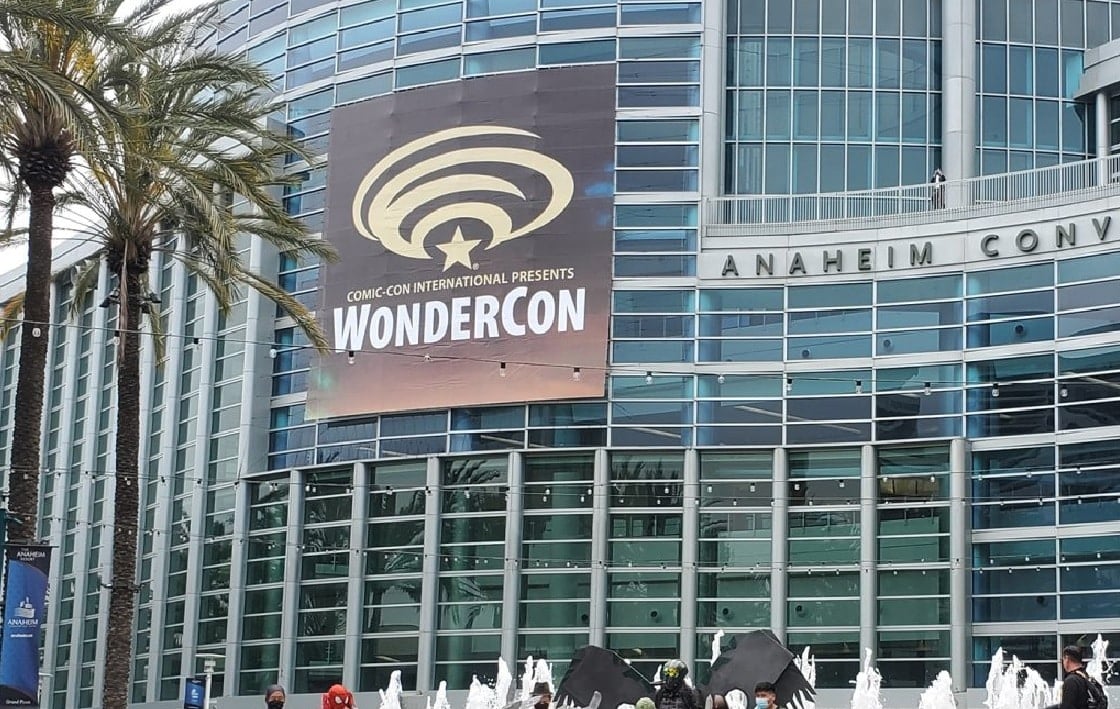

The Autism Scene, a nonprofit advocating for more explicitly autistic characters in kids pop culture, has announced a trio of fun panels taking place this weekend during WonderCon that will explore the intersection of comic books and autism.
Details below:
The Autism Scene Presents: Autism in Comic Books, Saturday, March 28 at 11:00AM in Room 213CD
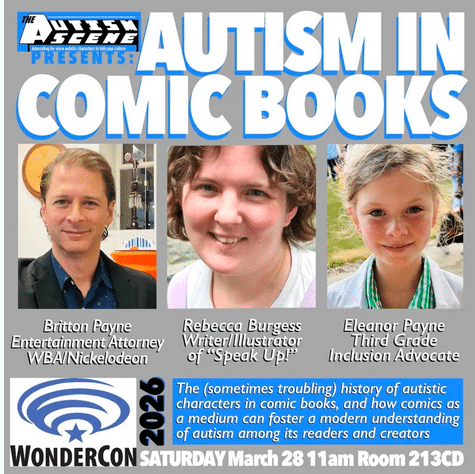
The Autism Scene’s first panel at WonderCon 2026 is “Autism in Comics.” This panel has become a familiar one at comic book conventions in recent years, and serves as an opportunity for people in the autism community to see old friends and make new ones. The Autism Scene’s executive director Britton Payne moderates a panel with his daughter Eleanor Payne (fourth grader and inclusion activist) and Bex Burgess, author of the popular YA graphic novel “Speak Up!” as they discuss every explicitly autistic character who has ever appeared in comic books. Britton Payne is especially excited about two new entries: Fairplay and Eli Nilsson.
In The Flash #799, writer Jeremy Adams introduced a new character who was rescued from the clutches of Granny Goodness. It turned out, it was Mister Terrific’s long lost son Jeffrey Holt! Jeffrey took on the role of Fairplay, following in his father’s footsteps as a supergenius kid superhero. “Adams had always thought of the character as autistic,” says Payne, “and we talked about autism in comics regularly, including the need to be explicit about it.” A few weeks ago in DCKO The Kids Are All Fight Special #1, Jeremy made it explicit on the splash page, which says ‘Fairplay: Jeffrey ‘PJ’ Holt. Genius-level intellect. Autistic. Son of Mr. Terrific.’ It’s the first time in DC Comics history that superhero has been explicitly identified as autistic. “And it is a great story!” says Payne. “The Autism Scene couldn’t be more excited about this new character!”
Eli Nilsson from The Future Is ******
Eli Nilsson is a hacker in the new futuristic comic book series The Future is ****** from writer Fred Van Lente and publisher Rekcah Comics. In issue #8, the team investigates reports of possible telepathy among a group of nonspeaking autistic young people. “I had the chance to discuss the storyline with Fred Van Lente,” says Payne, “and talked about the value of explicitly identifying characters as autistic if that’s the way he thought of them. And sure enough, in Issue #8, this great character Eli Nilsson was explicitly identified as autistic, in the middle of this fantastic adventure story!”
Along with these new characters, Payne discusses characters from traditional comic books like The Fantastic Four, Aquaman, Swamp Thing, The Silver Surfer, the X-Men and Archie Comics, as well as books aimed at kids like The Mighty Jack, Speak Up!, The Ojja-Wojja and Jade Street Protection Services, and other books for kids and adults. You are almost certain to find a new comic you can read that will introduce you to a rich and authentic autistic character.
This panel will also touch on the importance of Alex LaMorrie, and the need to help kids have empathy and understanding for the autistic people of the world they will grow up into. LaMorrie was an autistic panelist at previous comic book conventions who tragically had his life taken away earlier this year, and had inspirational words about how to move forward in the face of grief.
Payne is enthusiastic about these new autistic comic book characters – and the ones to come. “Jeremy Adams and Fred Van Lente have done something really meaningful, and they fit autism seamlessly into their exciting stories – just like the autistic people in our real lives. The Autism Scene can’t wait to see what exciting characters will be next!”
The Autism Scene Presents: After 50 Years, Why Do Spidey Super Stories Comics Still Matter to Autistic Kids and Everybody Else?, Sunday March 29 at 12:30PM in Room: 300C
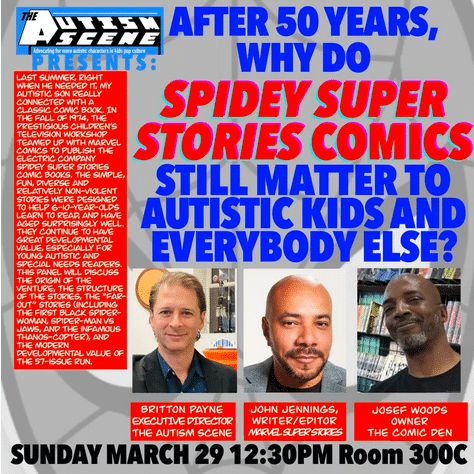
“Two summers ago, right when he needed it, my autistic son Cillian really connected with a classic comic book,” says Payne, who is also an entertainment attorney who has worked at Warner Bros. Animation and Nickelodeon. In the fall of 1974, the prestigious Children’s Television Workshop teamed up with Marvel Comics to publish the Electric Company Spidey Super Stories comic books. The simple, fun, diverse and relatively non-violent stories were designed to help 6-to-10-year-olds learn to read. The series featured team-ups with Marvel Comics mainstays like Captain America, Iron Man, Storm and Iceman, as well as appearance from real world people like Morgan Freeman, Rita Moreno and President Jimmy Carter.
Spidey Super Stories #1, with Morgan Freeman’s Easy Reader on the doorstep
“Spidey Super Stories have aged surprisingly well,” says Payne. “They continue to have great developmental value, especially for young autistic and special needs readers like my son.” The panel will discuss the origin of the venture, the structure of the stories, the “far-out” concepts (including the first black Spider-Woman, Spider-Man vs Jaws, and the infamous Thanos-Copter), and the modern developmental value of the 57-issue run and its impact on modern comics for kids. “It’s a shame these books have never been reprinted, and are not available digitally,” says Payne. “Maybe we can start a groundswell and make it happen!”
The Autism Scene Presents: Autism and John Jones, Learning to Mask in Modern America Through Martian Manhunter Comics, Sunday March 29 at 2pm in Room 210
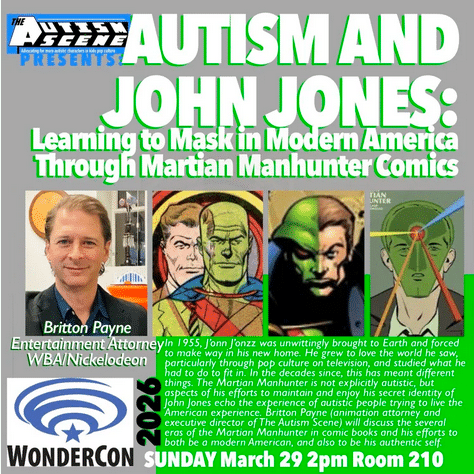
Martian Manhunter first appeared in Detective Comics #225 in 1955. J’onn J’onzz was unwittingly brought to Earth and forced to make way in his new home. He grew to love the world he saw, particularly through pop culture on television, and studied what he had to do to fit in. “In the decades since, this has meant different things,” says Payne. “The Martian Manhunter is not explicitly autistic, but aspects of his efforts to maintain and enjoy his secret identity of John Jones
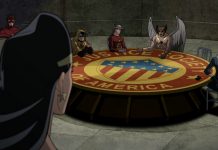
The Martian Manhunter studying how to mask
In this panel, as part of the Comic Arts Conference, Payne will lead a discussion of the several eras of the Martian Manhunter in comic books, and his efforts to both be a modern American, and also to be his authentic self. “Now that I know a little more about autism as the parent of an autistic child,” says Payne, “I was surprised how natural it was to find parallels between Martian Manhunters efforts to shapeshift and mask his true self to fit into American society, and autistic people’s similar efforts to hide their true selves to make way in a world that hasn’t always been very accommodating to their needs.” Payne tracks this fundamental aspect of the character from his roots in the Silver Age through the widely-praised mindbending current run in Absolute Martian Manhunter.
At each panel, Payne and the other panelists typically stay after an discuss autism and anything else the attendees have on their minds. “It is really gratifying that so many people come to WonderCon and have an interest in talking about their experiences either as an autistic person or someone who loves an autistic person in their lives,” says Payne. “We tend to stick around and chat for a half hour or an hour. That’s how I met Alfonso Camacho, a very impressive nonspeaking autistic young man. He ended up being on a panel with me after that at WonderCon last year when we did Authentically Creating Autistic Characters. A bunch of people have made new friends coming to our panels, and have gotten to be a part of The Autism Scene. All are welcome!”
The Autism Scene is a nonprofit organization that advocates publicly and privately for the inclusion of more explicitly autistic characters in kids pop culture.
Contact: Britton Payne, Brit@TheAutismScene.org