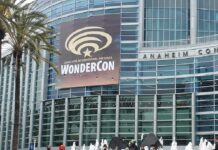

The American constitutional right to free speech is entering a fraught new era. The latest battlefield isn’t in a courtroom or in a legislative chamber—it’s at the local comic shop and the school library. At WonderCon, legal experts and advocacy leaders warned of a rising tide of “harmful to minor” statutes designed to bypass longstanding First Amendment protections.
“There are a number of bills and some laws across the country that are changing the definition of what the Supreme Court calls ‘harmful to minors,’ which means it’s [interpreted as] lust or it has to be patently offensive to community standards,” said Jeff Trexler, lawyer and interim director of the Comic Book Legal Defense Fund.
According to the Free Speech Center at Middle Tennessee State University, “harmful to minor” laws are state and federal statutes that restrict the distribution of explicit materials like pornography or sexual imagery to individuals under the age of 18. This concept of variable obscenity was central to the Miller Test, the landmark 1973 Supreme Court case that established standards of obscenity.
Trexler noted that while traditional standards require a work to be judged as a whole, new state-level efforts aim “to get rid of the literary, artistic, political and scientific value of a single image rather than the whole book.” A single, out-of-context image could now be used to strip an entire graphic novel of its “SLAPS” (Social, Literary, Artistic, Political, and Scientific value) protections.
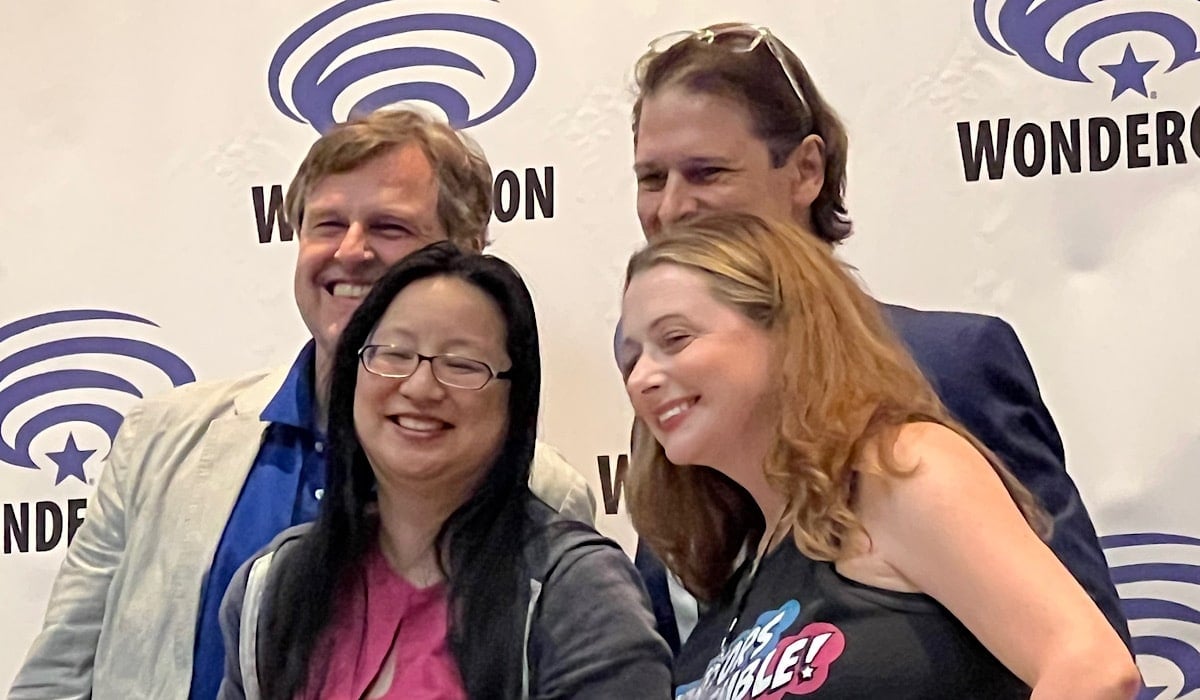
Joining Trexler at WonderCon to discuss this shifting landscape were those on the front lines of the medium: fellow board member Amy Chu (Carmilla, Red Sonja), attorney Britton Payne, and librarian, educator and author Moni Barrette.
A Retailer Faces Prosecution for Grendel
The discussion opened with a stark case study from North Carolina. The case involves a local shop owner facing criminal charges after a copy of the 1990s comic Grendel was inadvertently distributed to a child at a trunk-or-treat event organized by local police. The mother of the child who found the comic intended for mature readers posted an image on social media, which created a social media firestorm and led to demands for police action.
According to Trexler, the case is going to trial, highlighting how quickly a distribution error can escalate into a test of state obscenity laws.
“Harmful” Is Being Redefined Legally
“SLAPS” is being tested by emerging legislation in Texas, Florida and Arkansas that seeks to strip those protections when material is perceived as “harmful to minors.” This can include nudity or the appearance of any body part deemed unacceptable for public consumption. Graphic novels, according to Trexler, are inspiring the uptick in these laws.
“We are seeing a shift where material can be deemed obscene for minors even if it is perfectly legal for adults,” explained Trexler. He and Payne noted that many old anti-comics statutes, once thought unconstitutional, are being revived under new labels that bypass traditional First Amendment safeguards.
“The current construction of the court is a 3-3-3 divide. We’ve got three reliable liberals, three rock-solid conservatives, and three conservatives in the middle,” elaborated Payne. “Some of these decisions come down to, how does Roberts feel about it? How does Coney Barrett feel about it, and how does Kavanaugh feel about it? There’s always that possibility that none of them care, that none of them are interested in standing up for comics books and these kinds of interpretations of art, which, historically, the court has tried to stay out. But the current construction of the court seems prepared to throw that and anything else out the window.”
Librarians on the Defensive
The pressure extends beyond the private sector. Barrette, a former public librarian, described an atmosphere of coalescing challenges and systemic censorship. Librarians face the threat of prosecution for the mere possession of certain graphic novels.
According to statistics published by the American Library Association, pressure groups and government officials initiated 72 percent of book censorship attempts in schools and public libraries.
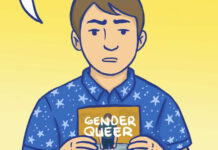
Working on the distribution side, Barrette now has to weigh whether a title she deems acceptable to one age demographic will be used to “bait” librarians to trigger legal action against her colleagues. In particular, LGBTQ+ themes and racial identity are prime targets for removal efforts. Gender Queer and Flamer were two of the top 10 books most challenged.
“It’s no longer just about moving a book to a different section,” Barrette warned. “It’s about the total removal of these diverse voices.”
A Livelihood in Peril
Chu, who primarily writes for a PG-13 audience, has already fallen victim to these shifting standards. Chu was recently invited to speak at a middle school, only to have her invitation rescinded at the last minute.
The irony of the cancellation was not lost on her: administrators had conducted an Amazon search and flagged her graphic novel adaptation of the Disney film Turning Red. They found the title objectionable, yet seemingly overlooked her lesbian vampire series, Carmilla. This experience forced Chu to confront the chilling reality of self-censorship—the internal pressure to sanitize one’s own work because of the legal threats lurking in the background.
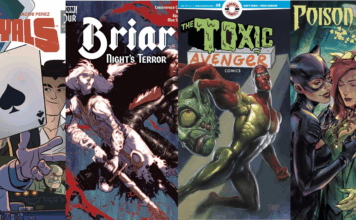
Extrapolating her experience to the broader creator pool, Chu noted that even the most basic marketing tools are now liabilities. Provocative covers—traditionally designed to entice readers and stand out on a shelf—now serve as easy targets for those looking to strip a book of its protections based on a single, out-of-context image. For creators, the “dark era” isn’t just about what they can say, but whether they can afford the risk of saying it at all.
A Call for Local Vigilance
As federal measures like House Resolution 7661 loom—which could strip funding from schools that carry “objectionable” materials—the panelists’ conclusions were a call to action. The defense of the medium, Trexler argued, rests on local advocacy. From attending library board meetings to supporting independent retailers, the responsibility to protect the right to read has moved from the Supreme Court back to the community square.
“The rights are under attack. We can’t count on courts anymore. There was a circuit court in Texas, Louisiana and Mississippi that said there’s no First Amendment protection of libraries, and they’re trying to extend it even further. So, you are the key to this now, more than the lawyers even. We’re going to fight this. We need you to speak up for comics because that is going to key to keeping those individual books.”