
In this week’s Wednesday Comics Reviews, the team takes a look at a pair of launches — The New Space Age and Wrestle Heist — as well as a pair of finales — Ancestral Recall and The Adventures of Lumen N. Plus, FOC Watch and The Prog Report!

Wrestle Heist #1
Cartoonist: Kyle Starks
Colorist: Vladimir Popov
Publisher: Image Comics
Review by Gianni Palumbo
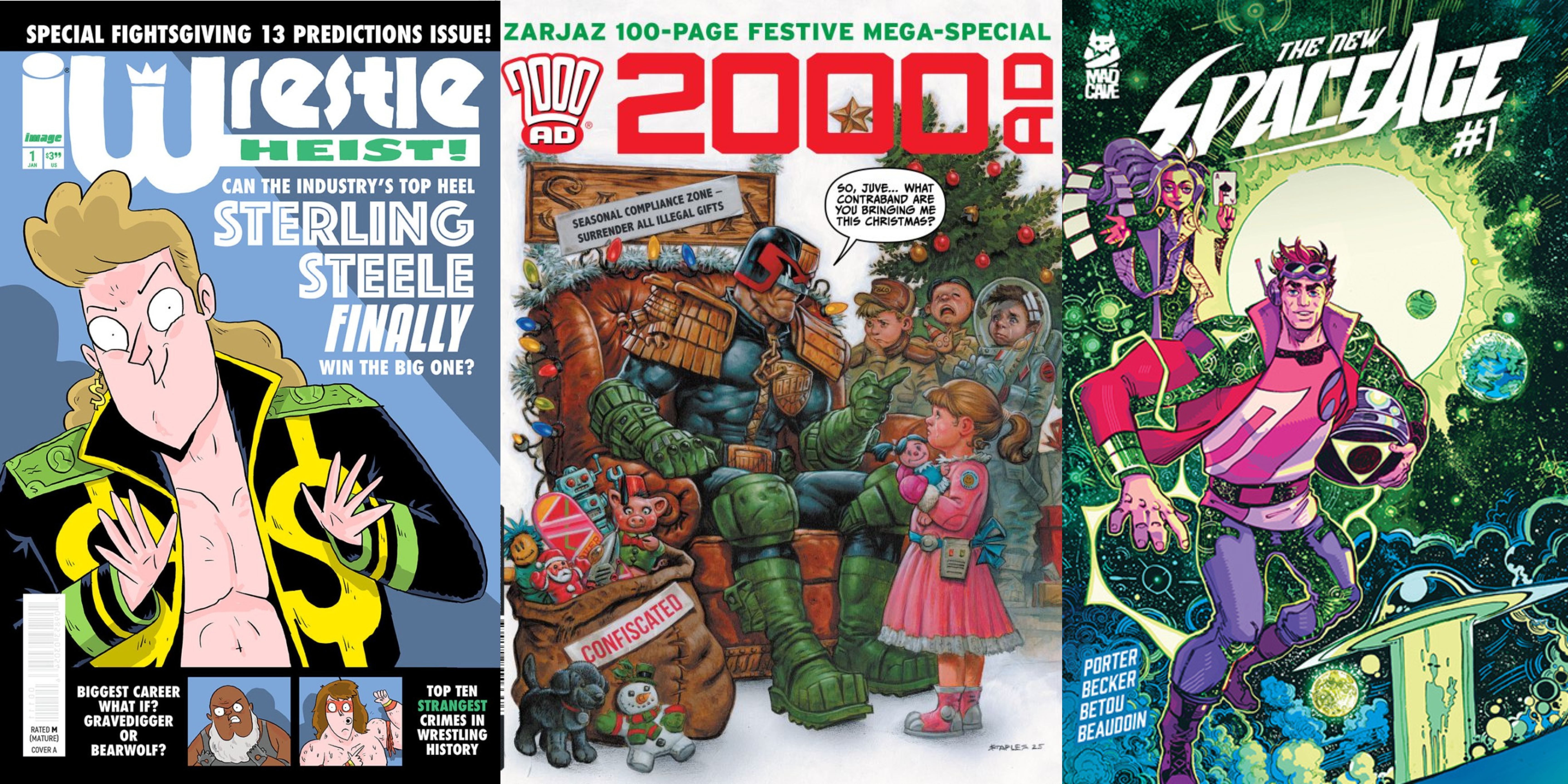
Writer/artist Kyle Starks is one of those creators where every one of his books is a must read for me. He’s a master of tone management, balancing outrageous humor with genuine character, and emotion, and Wrestle Heist #1 is another certified banger that sets up a miniseries filled with hilarious hijinks and heart and is a love letter to the crazy world of pro wrestling.
I’ll be completely honest, I could not care any less about pro wrestling. I did not grow up on it, and it just never appealed to me. Oddly enough, however, comics about pro wrestling have been some of my favorites of the past few years, specifically titles like Daniel Warren Johnson’s Do a Powerbomb, and Chris Condon and Francesco Biagini’s Hell is a Squared Circle. This is because these comics celebrate pro wrestling, but they are ultimately tackling something else entirely. This is exactly why Wrestle Heist works for me.
I recently spoke with Kyle Starks on my podcast, (BIFF! BAM! POW! A Comic Book Podcast), and he explained that he wanted the book to appeal to life long pro wrestling fans, heist story fans, and general Kyle Starks fans. I think he succeeds here. Wrestle Heist has got your classic Kyle Starks humor (maybe some of the funniest material he’s ever done) with a perfect balance of heart and genuine character motivation with pro wrestling parodies, gags, and meta commentary that acts like a game of I-Spy for fans of that entertainment.
Story-wise, Wrestle Heist #1 largely focuses on introducing us to the characters and world of the book, and it sets up the premise of the miniseries. In this comic, former pro wrestler Sterling Steele is nearly killed thanks to the machinations of his corrupt Vince McMahon-esque promoter Buddy Hansen. A year later, he plans to gather a crew of fellow wrestlers screwed over by Hansen to rob the biggest wrestling event of the year…FIGHTSGIVING! The bulk of the issue has Steele meeting with and recruiting The Gravedigger, a washed up former pro wrestler hustling in the convention scene–and is the start of the “getting the team together” part of a heist story. The convention is filled with background gas and easter eggs that are eye candy for wrestling fans too. There’s also 5 pages of bonus backmatter that is a full recreation of a classic wrestling magazine pulled straight from the ’70s that even includes participation from other notable comic book creators.
Overall, Wrestle Heist #1 is a hilarious romp that’s perfect for fans of pro wrestling, heist stories, and for folks who just love great comics. I’m stoked to see the crazy places it goes.
 The New Space Age #1
 The New Space Age #1
Writer: Kenny Porter
Artist: Mike Becker
Colorist: Kevin Betou
Letterer: Buddy Beaudoin
Publisher: Mad Cave Studios
Review by Tim Rooney
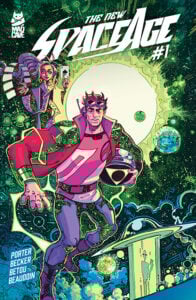
It’s always exciting to see someone who has been working toward a goal for years finally break through. I’ve been following The New Space Age artist Mike Becker’s work online for well over a decade, and loved his Kickstarter funded comic Young Offenders with Mark Stack, so when I saw this title announced with Becker on board I knew I’d be reading it. And what a fantastic first issue this is. Becker and writer Kenny Porter come out of the gate with a confidently charming book about optimism and exploration in a world that demands caution and skepticism. It is a book about family and loss, about the decay of progress, and the subversive hard-headedness of believing in better things. What I appreciated most was how Porter and Becker swipe at genre conventions and seamlessly blend them in unexpected but logical ways.
Anchoring the book is Mark Mitchell, a broad shouldered lumbering hotshot space jockey in the meathead Buzz Lightyear mold. He is intelligent and a good pilot, but bristles under authority and is cripplingly single-minded. He is desperate to parlay his work as an astronaut running delivery routes into a means to find his little brother, Joey, who was abducted by aliens when they were kids. When Mark is involved in a collision that costs him his job and government funding for the space program, Mark is left on his own to find the truth. This first issue demands our hero be sympathetic for us to deal with the bravado, and Mark never comes off as cocky or grating. Porter’s script roots all of his brashness in his devotion to his brother, and Becker gives the character a softness with rounded shapes and dopey expressions. We see him prove his talent and smarts and put people’s lives over profit.
Becker’s singular style is a perfect match for this story that crosses genres to dive into the unknown. There are intricate panel layouts and meticulous detail, punctuated by stunning effects art and visual gag. Throughout, we see a subtle recurring visual motif, as the crop circles central to the story and Joey’s disappearance seem to haunt Mark throughout his life in the very makeup of the page. Kevin Betou lays down vivid colors with a clear script that delineates mood and time, and draws connections between visual elements. The lettering by Buddy Beaudoin blends seamlessly with Becker’s free flowing line work and directly integrates with the art courtesy of chibified talking heads to delineate caption boxes—a fun visual that adds to the comic’s earnestly cheerful tone.
The New Space Age is the kind of creator driven book that makes Mad Cave an exciting publisher, one where you can feel the unique passion, interest, and artistry of the people creating the thing you hold in your hand. It’s a beautiful, ineffable alchemy unique to comic books. This is a comic that celebrates and embodies the human creativity and ingenuity that inspires us to believe in something greater beyond the stars.
 Adventures of Lumen N #4
 Adventures of Lumen N #4
Writer: James Robinson
Art: Phil Hester
Inks: Marc Deering
Colors: Bill Crabtree
Letters: Jim Campbell
Publisher: Dark Horse Comics
Review by Clyde Hall
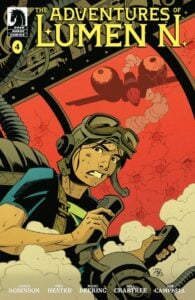
The first story arc of The Adventures of Lumen N. concludes with the fourth issue, and it’s plain by now that writer James Robinson is having a lot of fun with this title. It began with a rollicking, ripping first issue marked by action sequences. The next two issues dealt more with connecting characters and interpersonal developments. And this wrap up delves into wholesale destruction wrought on Paris as Lumen and her grandfather fight back against their foes. Robinson’s delight comes in both kinds of entries. Making desperate warfare against our protagonists in some, weaving Victorian and Edwardian literary characters throughout his narrative in others.
The question is, does his approach delight his readers as well? In this review there will be spoilers for the first three issues of the miniseries, but as few as possible regarding the reveals within this latest entry.
Over the first issues, we’ve met main protagonist and young hero-in-the-making Lumen N., living what she sees as an isolated if pleasant life in 1901 Bundelkhand, India. Under the care of tutors and staff as set up by her absentee father, she maintains an impressive study curriculum of languages, science, navigation, and geography. She also trains physically with experts shipped in to teach the sport of fencing, the skill of acrobatics, and various forms of martial arts. When her idyllic home comes under attack, Lumen quickly learns why her father left such involved training regimens in place for her.
Lumen’s N. stands for ‘Nemo’. And as mechanized marauders overwhelm the highly trained household defense force, her grandfather, Captain Nemo AKA Prince Dakkar, arrives to rescue her. Her heritage comes as a surprise to the young Lumen. Everyone knows the infamous Captain Nemo, but he was believed to be deceased for some time. And her father, Aeon Nemo, apparently took up his father’s cause of protecting the sea and environment from those bent on exploiting it using his father’s gift for invention. But stealthily, and without the murderous drive his father often displayed.
At the turn of the 20th century, however, international evil has raised its ugly head and the world is poised for an authoritarian reshaping. A cabal leading such a movement has formed, and they have no hesitancy about using death and violence to achieve their goals. They’ve killed Aeon and they want Lumen as well. And now teamed together, Lumen and her grandfather begin unraveling the mystery of this Evildoers, Inc. membership.
One of the villains of deepest dye is Robur the Conqueror, airborne antagonist of The Clipper of the Clouds and Master of the World by Jules Verne. Robur has joined forces with others of his ilk to use his advanced technology against the nations of the world. Beginning in Paris, France.
Lumen and Captain Nemo beat Robur to the city and contact the French military about his impending attack. But as a shadowy ally of Robur has recently assumed the identity and appearance of Aeon, spreading chaos and death in his wake, the name Nemo has become one of renewed infamy. The French government agrees to meet with Captain Nemo, then have the Sûreté arrest him and his granddaughter. Before they can be detained, however, Robur and his mysteriously disguised co-villain arrive and begin a blistering attack on the city of Paris.
In this issue, the new crew of the Nautilus, a crew consisting of familiar names from Victorian and Edwardian literature, scramble to repel Robur and his forces. Nemo defends his arresting officer and other French officials, earning a degree of trust. And Lumen gets a Luke Skywalker New Hope moment, saving the day piloting an armed scout vessel of her grandfather’s design, the Allonautilus. But just as in the Star Wars universe, evil’s forces have suffered only a momentary setback. Robur’s ally is revealed and it’s certain this conflict is simply the opening battle of a much longer, global war between Nemo’s forces and the Cabal.
In the afterwords of each issue, Robinson explains literary backgrounds of the characters popping up and he does so once more here. He also illuminates us regarding his approach to the storytelling and the tone he hopes to set. He wants to play in a sandbox similar to but distinct from The League of Extraordinary Gentlemen. He’s weaving a story which is lighter in tone and more attuned to the spirit of adventure found in early 20th century science fiction yarns. Aside from Nemo, he sticks with less widely known characters of the era. And still others, like Lumen, are original legacy characters.
Overall, with this final issue of the initial arc, Robinson has accomplished his goal. He has the storyline well enough established to proceed into adventurous expeditions across strange, exotic settings with companions familiar to fans of Steampunk and the works of Jules Verne, Edgar Allan Poe, and Sir Arthur Conan Doyle. The combined art talents of Phil Hester, Marc Deering, and Bill Crabtree certainly bring innovation in how these characters and their retro futuristic designs are brought to comic book life. Together, they give the issue hard-charging action panels lacking in the second and third installments. As well as an overdue spotlight for series’ namesake Lumen Nemo.
Robinson and crew work overtime on her narrative here, establishing a suspension of disbelief shortcut on Lumen’s courage and inherent skills and attributes. She applies them despite a lack of training with the craft she pilots, relying on observation and her own raw talents. In that way, maybe it’s more an Anakin podracing strategy than a Luke moment, but with an entire city and its inhabitants at stake.
Drawbacks come in the way Robinson structures the story arc itself. Action sequences sizzle here as they did in the first entry. Lumen gets her awaited moments of youthful and heroic bravado. It may be too little, too late for some readers, though.
Lumen’s name may grace the title, but after her introduction and the revelation of her Nemo birthright, she’s in the background while the focus shifts to her grandfather, his continuing story, and all the characters from other works becoming part of the book’s world-building. Lumen may take a more active part here, but it still doesn’t quite feel like the title’s really about her.
Again, this is a solid creative team clearly enjoying their work. How transferable that enjoyment is depends on what direction your interests lean. The final issue of The Adventures of Lumen N. miniseries should satisfy readers who love classic science fiction and adventure story characters circa the late 19th and early 20th centuries. And many Steampunk fans will find the devices and designs appealing. More casual readers not versed in those genres, or those hoping for a young aviation hero adventure in the Golden Age of Invention, may find this payoff to the team’s world-building setup lacking.
Ancestral Recall #5
 Ancestral Recall #5
Writer: Jordan Clark
Artist: Atagun İlhan
Colors: Pippa Bowland
Lettering: Rob Steen
Publisher: Ahoy Comics
Review by Khalid Johnson
“Blackness is eternal.”
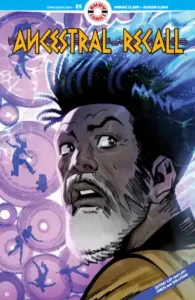
That line floored me in a beautiful splash page drawn by Atagun İlhan with colors by Pippa Bowland. The exploration of Black history in the face of capitalist exploitation and our resilience and struggle against oppression is an optimistic one and that’s a perspective that I think we need more of. When things are so bleak and it feels like this techno-feudalist future is inevitable, art like this flies defiantly in the face of that future with love and vision for fighting back. The team really dialed in on the action amidst the message and everyone gets a moment to shine (shouts to Myran and the animals).
The writing of Jordan Clark so succinctly lands the conflict of us as people against capitalism and tech bro interests which feels so important right now as ai is forced into our lives by corporate interests. What is even bigger in conversation here is that Black people are often targeted disproportionately by these algorithms while at the same time left out of the training data and excluded from the rooms where these decisions are being made (like where a data center will be placed and use up tons of water).
Having June and Melvin at the center of the corporate interest for data training is framed with the exploitation of Blackness and the way that ai can cultivate alternate/false histories and information and prevent them as fact. If anything, this final issue and the series on the whole speaks to the importance of knowing Black history and the value of your own labor, the process of learning and being open to possibilities and exploration.
This finale deserves its praise for sticking the landing and meaningfully saying something that I think we need to hear in a moment where it’s hard to hear above the 1s and 0s.
FOC Watch
This comic is currently available for pre-order
Spirit of the Shadows
 Spirit of the Shadows
Writers: Daniel Ziegler and Nick Cagnetti
Artist: Nick Cagnetti
Publisher: Oni Press
Review by Zack Quaintance
One of my most anticipated books for 2026 is Spirit of the Shadows, which sees Nick Cagnetti of Pink Lemonade fame launching a new book, teaming on the project with co-writer Daniel Ziegler. The first issue of Spirit is available for pre-order now, and after having read it, I can confidently say fans of great comics would do well to add this one to their pull lists.
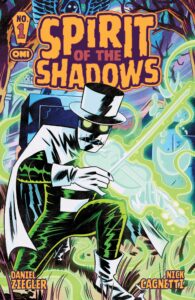
The book reads as both familiar and surprising to those of us who follow Cagnetti’s work. Familiarly, it features the immaculate character designs that make it so easy to jump into one of his stories. The designs are interesting and varied throughout, from the protagonist, to the supporting cast, to the antagonist who reveals herself toward the end of the first issue. Like Pink Lemonade before him, the titular Spirit features just a perfect design, one that makes you want to know more about the character while also giving you an innate idea of what kind of story he will be starring in.
And it’s that story that might surprise fans of Pink Lemonade, doing so with the complex horror-tinged nature of its plot and themes. Pink Lemonade had its conflict, but the lead character was so sunny and cheery, that the tone of the book could perhaps best be described as super-powered optimism. Spirit of the Shadows is something much darker, featuring as it does a tormented protagonist who is not only facing a terrifying plight, but is also learning that his own history might not be what it seems, or at least what he would hope. To say more than that would be to risk entering into spoiler territory, but I think it’s safe to point out that this is a comic that on its first page gives its hero all he ever wanted…before a demon breaks through the ground on the final panel to literally pull him into hell (or a type of hell, anyway).
And I think it’s a bold story to tell after Pink Lemonade. It also speaks to something else that makes this comic so interesting to me — Cagnetti’s clear drive to level up his art, particularly in the color work. In fact, I think Spirit of the Shadows #1 features some of the best color work I’ve seen in a book all year. It’s bold and neon in dark places, actively working against typical depictions of dark realms but still feeling scary and sinister. Where the color shines most, however, is differentiating the past and flashbacks and unreality from the present day of the Spirit. I’m not an expert on comics coloring, so the best phrase I could come up with for how it looks is nostalgic colored pencils.
Overall, this is just a great-looking and interesting comic, one that stands well on its own as an exciting new series and also feels like a great step forward for a rising star artist. Cagnetti and Ziegler clearly worked well together on scripting this one too, getting the dialogue just right and making sure the reader knows the stakes from page one — before putting their hero through an absolute ringer for the duration of this first issue.
I loved it, and if it wasn’t before, Spirit of the Shadows is absolutely atop my most anticipated comics of 2026 list.
The Prog Report
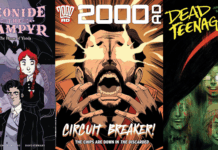
 2000AD 2463 (Rebellion Publishing): This week brings us the massive 100-page mega-special festive Prog, which is always a nice way to end the year. And this year’s is no exception. After a bit of a mixed first half of the year, the magazine has really picked up in the second half of 2025, and I think that made for a great set of stories in this final issue. I’ll refrain from just rehashing the table of contents here and instead write a quick bit about some of the highlights for me personally.I was excited to see that Peter Milligan had new work in The Prog, with that being The Discarded, on which he is joined by artist Kieran McKeown, colorist Jim Boswell, and letterer Simon Bowland. And it’s great launch for a new concept. In this comic, essentially, our main character is a political prisoner sent to a floating garbage dump in space. This opening chapter sets up the concept well before ending on an enticing cliffhanger designed to potentially change the nature of the strip, which what else do you want from an opening? It was great, and I think it may end up being another notch in Milligan’s underrated, ongoing late career renaissance.Another highlight in this one was the continuation of Azimuth from writer Dan Abnett, artist Tazio Bettin, colorist Matt Soffe, and letterer Jim Campbell. These strips drawn by Bettin and colored by Soffe always look great, and the duo has also been asked to be pretty versatile as this comic has careened at times between genre trappings. Also, as a relatively new 2000AD reader, I have the sense that the strip is doing a great job drawing from other story continuity in interesting ways to make things all its own. Even I know that an alternate universe Judge Anderson battling a demon at the end of time is a pretty wild thing.
Finally, this issue also gave us an ending to Rogue Trooper: Ghost Patrol, which has been my favorite story featuring this character since Blighty Valley. This 14-parter was from writer Alex De Campi, artist Neil Edwards, colorist Matt Soffe, and letterer Rob Steen. And while it’s been heavy on great action set pieces, it was the exploration of the supporting casts’ backstories (and potential implications for their futures) that made this one really standout to me.
This week’s cover (above) is by Greg Staples. As always, you can pick up a digital copy of The Prog here. —Zack Quaintance
 2000AD 2463 (Rebellion Publishing): This week brings us the massive 100-page mega-special festive Prog, which is always a nice way to end the year. And this year’s is no exception. After a bit of a mixed first half of the year, the magazine has really picked up in the second half of 2025, and I think that made for a great set of stories in this final issue. I’ll refrain from just rehashing the table of contents here and instead write a quick bit about some of the highlights for me personally.I was excited to see that Peter Milligan had new work in The Prog, with that being The Discarded, on which he is joined by artist Kieran McKeown, colorist Jim Boswell, and letterer Simon Bowland. And it’s great launch for a new concept. In this comic, essentially, our main character is a political prisoner sent to a floating garbage dump in space. This opening chapter sets up the concept well before ending on an enticing cliffhanger designed to potentially change the nature of the strip, which what else do you want from an opening? It was great, and I think it may end up being another notch in Milligan’s underrated, ongoing late career renaissance.Another highlight in this one was the continuation of Azimuth from writer Dan Abnett, artist Tazio Bettin, colorist Matt Soffe, and letterer Jim Campbell. These strips drawn by Bettin and colored by Soffe always look great, and the duo has also been asked to be pretty versatile as this comic has careened at times between genre trappings. Also, as a relatively new 2000AD reader, I have the sense that the strip is doing a great job drawing from other story continuity in interesting ways to make things all its own. Even I know that an alternate universe Judge Anderson battling a demon at the end of time is a pretty wild thing.
Column edited by Zack Quaintance.
Read past entries in the weekly Wednesday Comics reviews series or check-out our other reviews here!