

 Batman – Dark Patterns
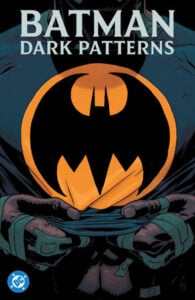 Batman – Dark Patterns
Writer: Dan Watters
Artist: Hayden Sherman
Colorist: Frank Cvetkovic
Letterer: Triona Farrell
Publisher: DC Comics
Collects: Batman: Dark Patterns #1-12
Publication Date: March 2026
More Batman comics get published on a monthly basis than any other solo American superhero. I don’t have the hard numbers on that, but not only is that usually an accurate statement, it’s also painfully obvious. It’s been this way far longer than I’ve been alive; DC fans get inundated with a barrage of Batman and Bat-Family books, enough to keep your pull lists filled in perpetuity. The trouble is that this landscape gets exhausting, Bat books are just more white noise as you try to cut through to the comics you actually care about. I’ve been looking at and reading Batman comics since I was old enough to hold them in my hands, I have Batman inspired tattoos and I, for a very long time, tried to read basically every Batman book that existed. Yet, over the last half decade this has not only become impossible with the sheer volume DC produces, but it’s simply not fun either.
I don’t like most, if any, Batman comics these days. I’m not invested in that corner of the superhero scene anymore. Try as I might, most of the books end up disappointing me. I suspect I’m alone in this right now because of how popular certain new titles are, and that’s okay. I’m sure people are getting a kick out of whatever they’re choosing to read month to month. But I say all this to let you know that I’m a tough audience for Batman books these days. I’ve read enough to sense when a Bat book is just cliffnotes to a better, older Bat book. I’ve been outside the ecosystem long enough to have a hard time adjusting to whatever the new style and status quo is. I’m both not the person most of these books are for any more and I have a hard time putting myself in the headspace these books require.
So when I tell you Batman: Dark Patterns is the best Batman comic I’ve read in a very long time, I hope you trust in how major a feat that is.
Batman: Dark Patterns – by Dan Watters, Hayden Sherman, Triona Farrell and Frank Cvetkovic – is the latest Batman maxi series that takes place outside of the main universe continuity. No prior knowledge required, with the exception that Batman is a superhero that fights crime in Gotham. As such, it has a tall task: not only must it find a way to stand out in the sea of current Bat books, it also needs to stand out in the already gigantic library of evergreen, out of continuity Bat comics people can choose from. Watters and co. accomplish this beautifully, resisting the urge to tell a self-important, definitive story in favor of something more personal and small scale. Sherman and Cvetkovic’s art is utterly gorgeous, and they compliment Watters’ style of a horror infused mystery. The team is firing on all cylinders, resulting in an experience you can enjoy regardless of what you think of Batman’s current state.
The series is divided into four different three issue arcs. Each story introduces and builds on characters we’ve seen in the previous issues, but they largely operate as self-contained adventures of Batman investigating horrific mysteries and crimes throughout the hellscape that is Gotham City. However, even as each story introduces a different villain, a different location, and a different creative solution, they all embody the same larger concern about Batman’s relationship to Gotham. Each story isolates a different element of the people who live here, die here and search for meaning in a vain attempt to make all the suffering worth it.
The series opens with “We Are the Wounded” (issues #1-3) which chronicles Batman’s pursuit of a depraved new serial killer, the Wound Man, who tortures his victims with an array of needles hitting every major nerve in the body and keeping them in agonizing pain. Batman follows the clues to the next victim and we see this Wound Man for ourselves, a horrific mess of needles, screws, nails and pipes positioned throughout his body.
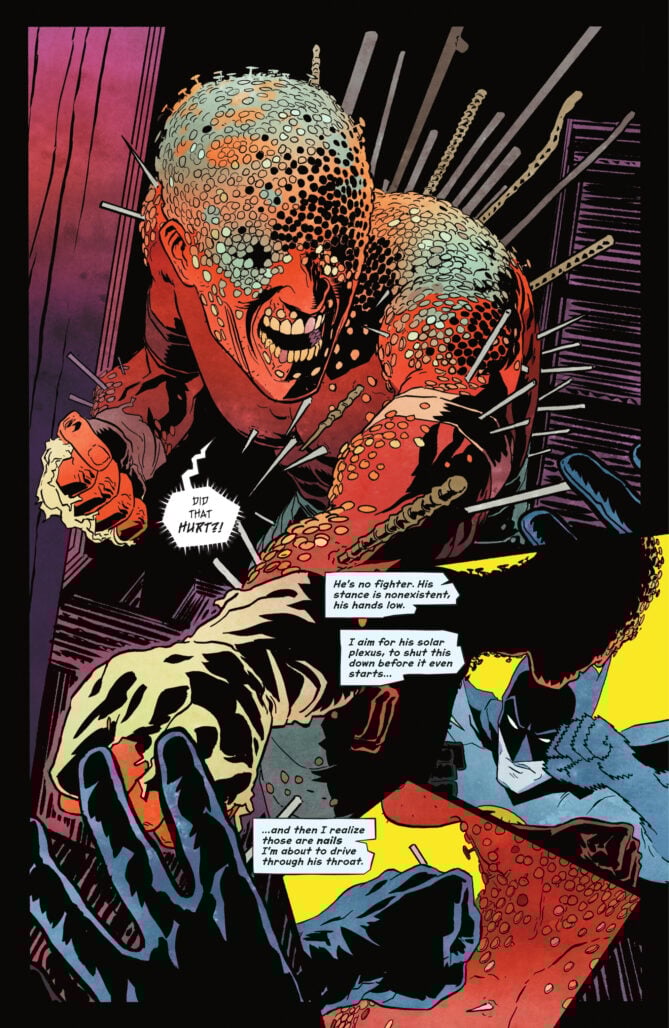
Batman discovers that the Wound Man may be a reference to the real, medical depiction of a “wound man” that outlines the various points of injury on a body, followed by the accompanying treatments for those wounds. The point of the Wound Man is not to kill but to reveal that something needs treatment, something is damaged and calls out for help and restitution.
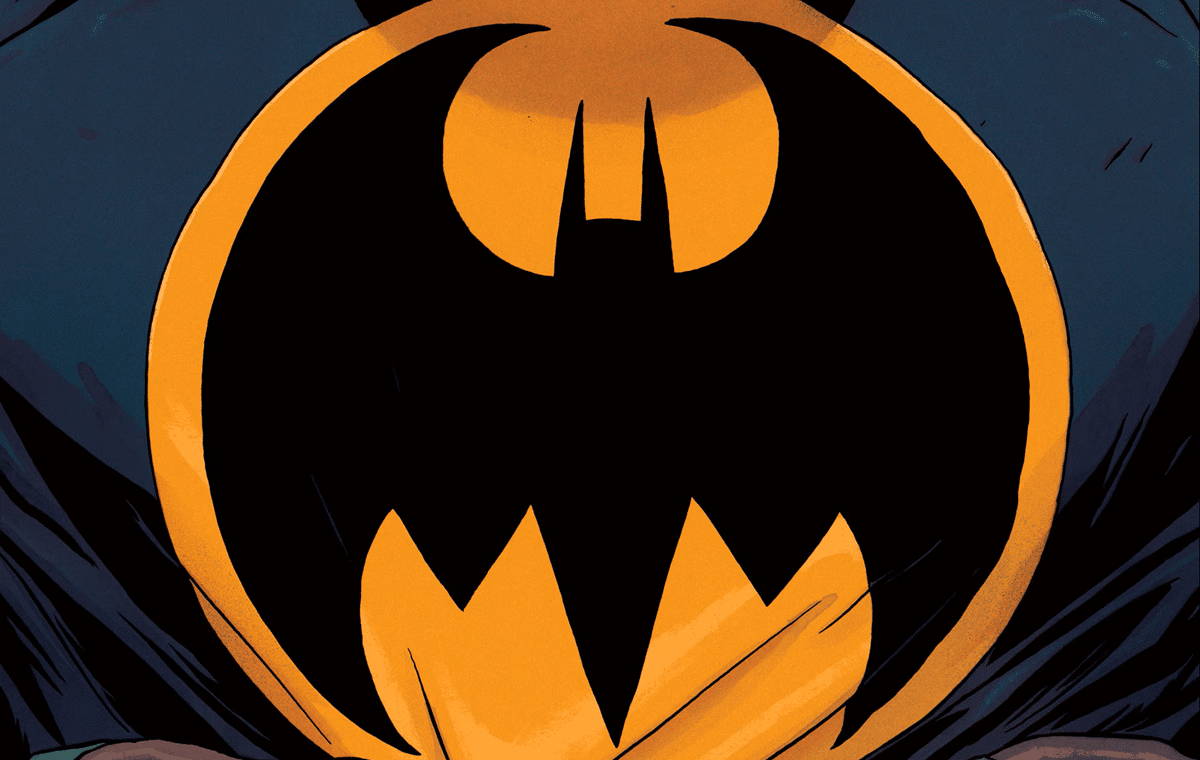
The opening story arc is a great statement piece for the series, both highlighting what the book takes inspiration from while also carving its own place in the never-ending stream of Bat books. From the jump, there’s an immediate reverence for Batman as a detective, he moves around in noir style file rooms, in front of venetian blinds, and cloaked by his cape that casts a tall, monstrous silhouette broken only by the giant yellow oval on his chest. Hayden Sherman’s art is outstanding throughout, but is especially impactful in this early story as the gruesome bodies of the Wound Man and his victims are juxtaposed with Batman’s own strange figure. The result is a mix of familiar iconography with a touch of horror that Watters and Sherman both excel at.
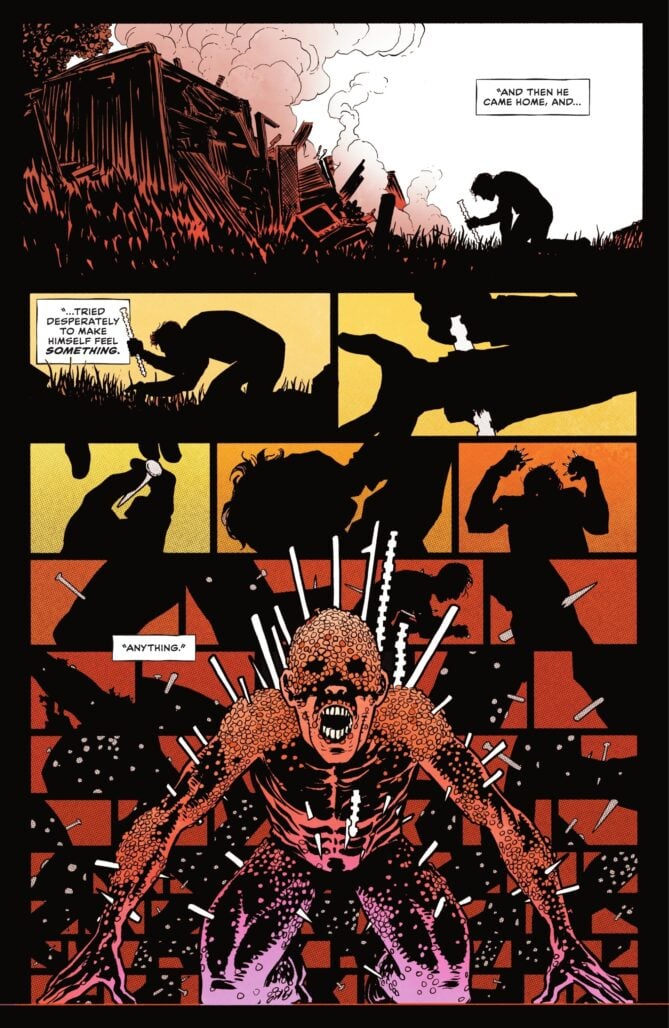
These contrasts between the grounded detective and larger than life crime go further as Batman’s narrations mythologize Gotham’s penchant for nightmarish violence and constant bloodshed. Gotham is always on fire, its people always on borrowed time, and the Wound Man becomes a personification of the city’s own calling out for some form of justice. The plight of the city becomes immeasurable and all consuming, with Batman standing in the face of that as nothing but an ordinary man. As much bombast and superheroic antics are here, the book always positions them around moments of deflating, painful humanity. Batman can fight off a squad of armed security and jump out a window. But he still needs to stop, rest, and bleed like anyone else.
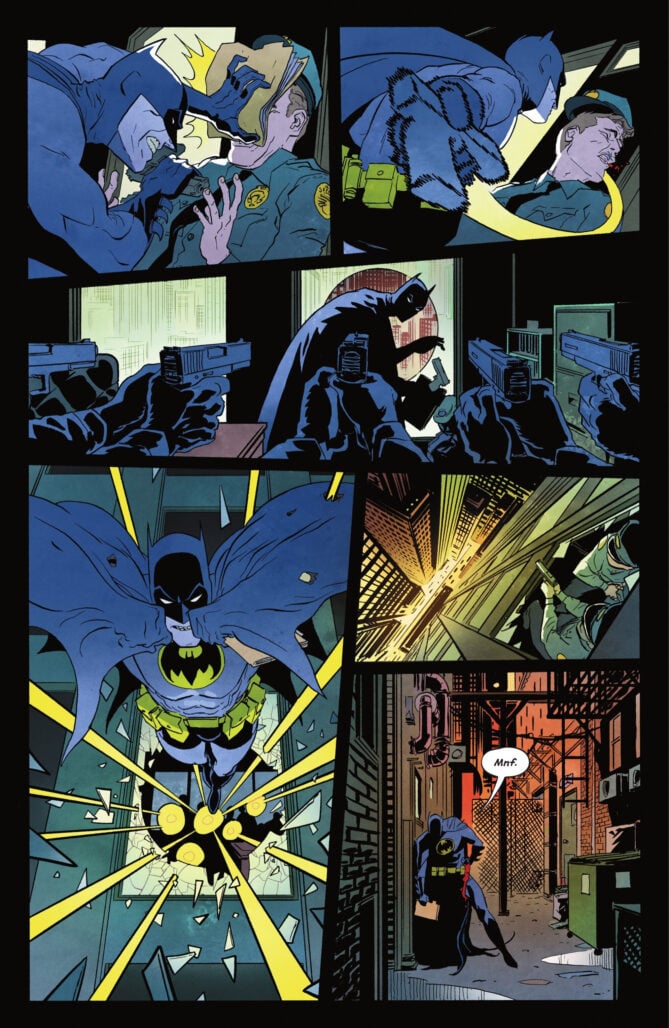
Both Batman and the Wound Man are born in the never ending fires of Gotham but both are simply human and their appearance is a choice born of the ugly, indifferent world that we seek to change. In fighting the horrific figure of the Wound Man, all Batman can do is look himself in the mirror, and realize that both of these men are simply reflections of the city that made them, and a call to make things right for others caught in their crossfire.
Our adventures continue in “The Voice of the Tower” (issues #4-6) which sees Batman arriving at Bledin Towers, the site of a hostage situation. The towers are scheduled for demolition, to be replaced by luxury condos. With nowhere to go, the tenants refuse buy out offers and capture two cops to hold the other city police at bay. One goes flying out the window and Batman storms in trying to save the other.
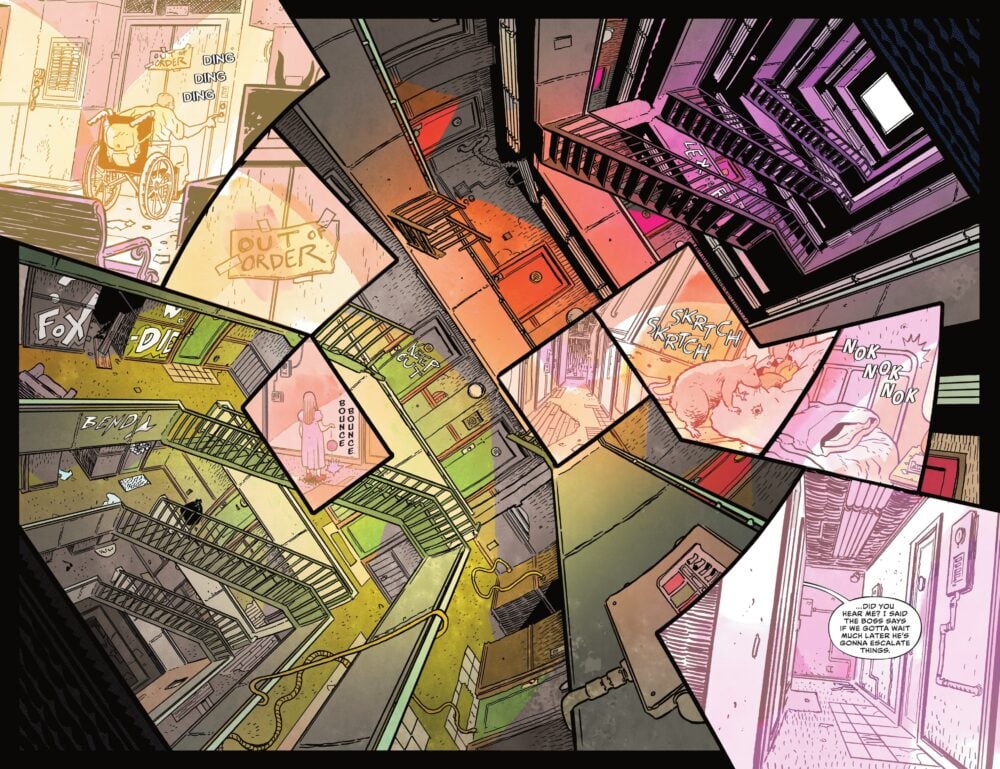
The labyrinthian towers are an excellent opportunity for Hayden Sherman and Frank Cvetkovic’s art to take full control of the story, making use of several irregularly shaped panels and circular paths to give the building’s winding halls a surreal quality. What I really love in this stretch is how often you get to see Batman surrounded by the mundane: small apartment rooms, walking up and down stairs, passing other tenants in the halls. He feels out of place in his fantastical costume but Sherman and Cvetkovic’s ability to give the building a life of its own allows the tension of the mystery to never break, even as Batman stops to enjoy some iced tea.
The real culprit behind this hostage situation turns out to be a reinvention of Scarface, the puppet/ventriloquist duo Batman’s previously dealt with. Scarface’s act gives life to the building, a literal voice of the towers. Like the Wound Man in the previous story, Scarface is used here as an attempt to theatrically call attention to the people in this building who have no voice, people who have no purpose but find it through Scarface. Like a mass psychosis where everyone thinks they’re hearing the voice of god, and god has a bad Al Capone impression.
While a strong thematic follow up and a great artistic exercise, the story ultimately has an abrupt end where the thematic concerns around the tenants and why they were so willing to listen to Scarface gets tossed aside while trying to stop Scarface himself. If the window into the story was the resistance of the tenants to the building’s demolition, of the way the people inside know the ins and outs of the building better than anyone else, of the fear that no one has anywhere else to go if this place goes up in smoke, then the resolution within just these 3 issues doesn’t do much to answer those concerns, even while addressing the motivations behind Scarface being here. Perhaps the answer is more nihilistic than I’m giving it credit for, but the read that argues “Batman saves the day and people still have nowhere to go” feels antithetical to the tone of the final moments of the story.
By the time we arrive at the ironically titled “Pareidolia” (Issues #7-9), a pattern has started to emerge. The title of the story refers to the phenomena of perceiving patterns where there are none, which Batman contrasts with his musings on Gotham’s penchant for fires; always burning itself to the ground perhaps in an attempt to exterminate Batman himself. The mystery then kicks off when Batman travels to the Rookery, an old neighborhood in Gotham, and finds a burned body in a dryer. The manner of death, Batman and Alfred discover, is similar to the criminal operations of the Red Hood Gang, a group of petty criminals who operated in the Rookery during the interwar period of the 1920s-30s. With no way to tell exactly when the body ended up there, Batman takes to patrolling the Rookery aggressively over the course of several weeks. Much like the towers, this is a place outside of time, a chaotic zone within the city with no regular police presence, no street names, and barely functioning utilities. “This place is as close to Hell as any I’ve encountered in Gotham,” Batman notes as he whizzes past the homeless and drunks inside decaying buildings.
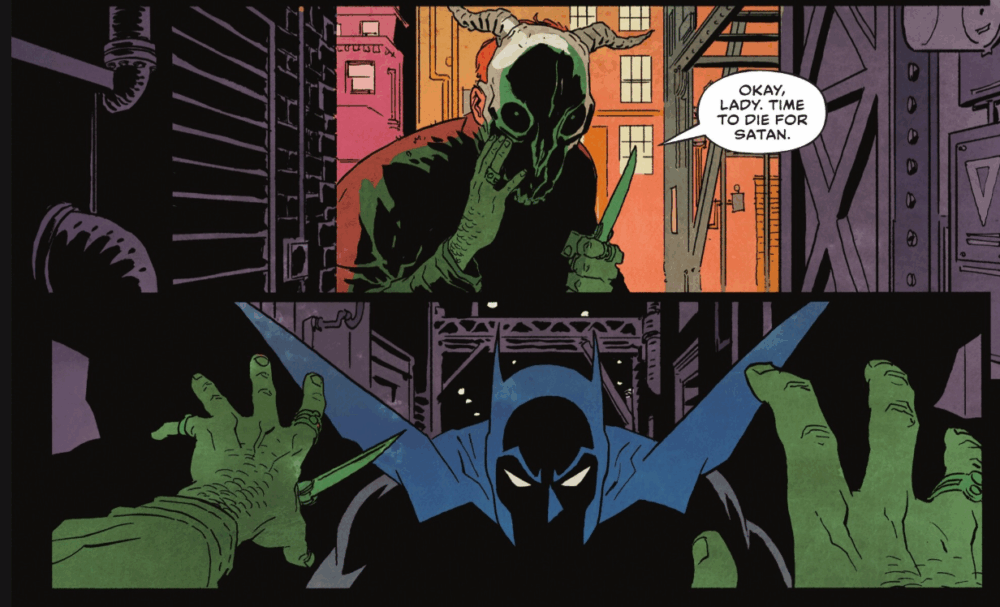
These three stories force Batman into the forgotten parts of Gotham. The Town without Screams in “We Are the Wounded”, Bledin Towers in the previous story, and now the Rookery are all opportunities for Batman to learn that there’s more to Gotham than he’s known, and that each new villain is an attempt by people to take on personas and myths that give voice to their suffering. The Wound Man, Scarface and the Red Hood Gang all serve as mirrors to Batman’s appearance and methods, using the same penchant for costumed spectacle to signal a great loss or a need for some restitution. Yet they all do so on the fringes, in the worlds that not even Batman understands. If Gotham City is Hell, constantly burning itself to a crisp and always uncovering new layers that no one else knows about, then (contrary to Grant Morrison’s assertion) Batman is far from its king.
This finally brings us to “The Child of Fire” (Issues 10-12) with Batman still recovering from injuries he sustained in the previous case. A new villain calling themselves the Child of Fire emerges and begins torching different parts of Gotham, mirroring the major fires in the city’s past. “The Child of Fire” serves as a coda to Dark Patterns and thus is the most informed by the prior stories. You could in theory read any 3 issue chunk of this book in isolation and have a good time, but this final piece is treated as the payoff to several recurring characters and clues from the previous stories. If each story thus far has been about the forgotten worlds within Gotham, about Batman’s struggle to tame the neverending fires of the city’s crime and facing his reflection in cracked mirrors throughout, then “The Child of Fire” is a story about Gotham at large and the unifying mission that separates Batman from the isolated worlds he’s been tangling with so far.
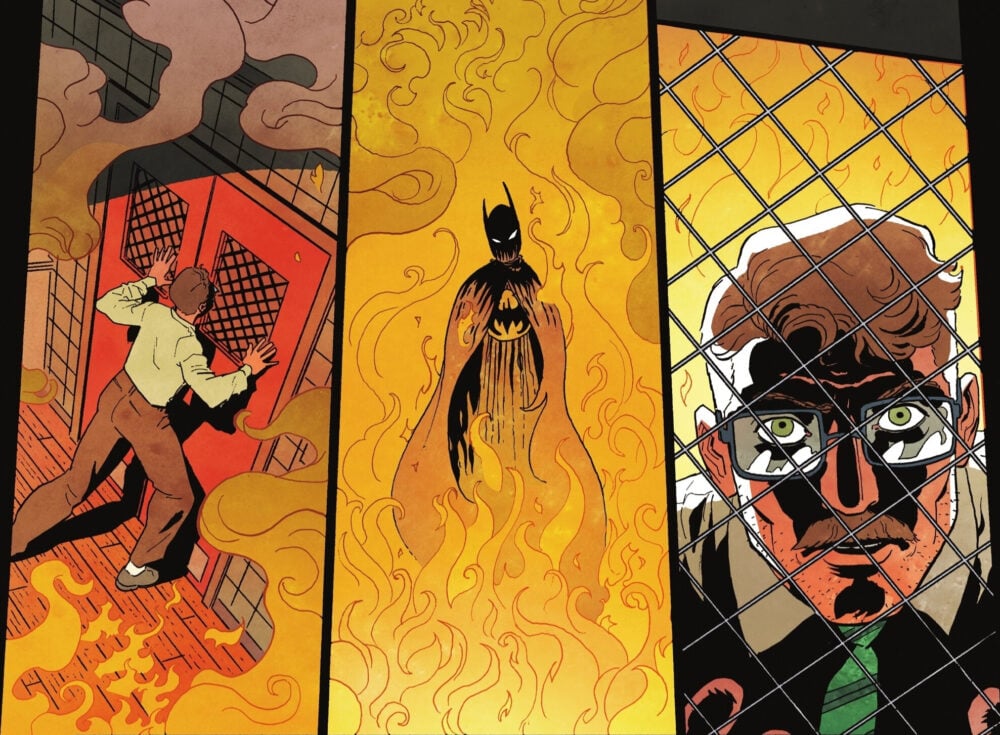
In Batman’s attempt to stop the Child of Fire, the larger question of what Gotham needs starts to enter the picture, building off Batman’s own musings about the city in the prior stories. Is he doing more harm than good? Is the city resisting him? Is the nature of Gotham something that cannot be tamed? All of these doubts feed into the Child of Fire’s desire to burn the city to the ground in an attempt to cleanse it of its sins and allow for a rebirth. Batman is forced to push beyond his human limits and lean into the myth and supernatural, the defining elements of something larger than life, if he wants to stand toe to toe with someone that’s playing for far more than small neighborhoods and petty crimes.
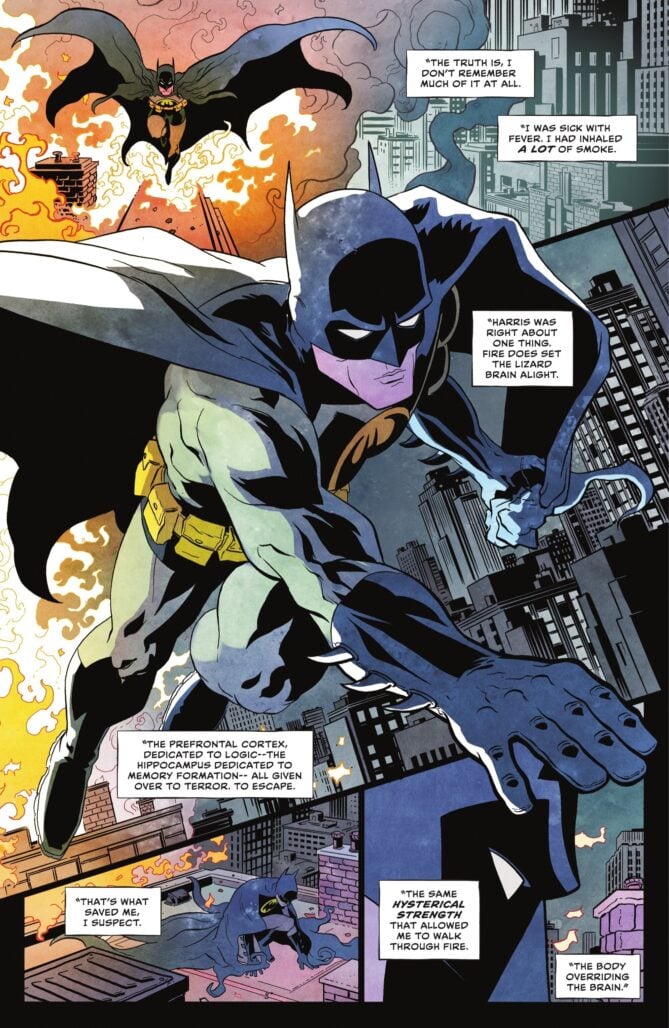
A great touch in this section that forces Batman out of the shadows is how Sherman’s art begins to showcase a wider range of Batman’s costume and movements, culminating in a stretch of pages where Batman is in an iconic Neal Adams pose. Other moments like Batman’s figure visible through the flames, and Batman holding his hand out to stop the progress of the fire are incredible, but the above image struck me because so much of the book has so far stayed within the sensibilities of detective stories meets horror. This is the first time I felt like Batman was becoming a superhero and not just a man covered in bandages skulking around dark corners. If the point of “The Child of Fire” is to push Batman to embody something mythic, then naturally the art showcases this by drawing on the pre-existing Batman art that is already mythic in the mind of the reader.
Over the course of four stories, Dark Patterns is able to craft an engaging and unique series of Batman mysteries. Each one feels right in line with Watters and Sherman’s style that blends the pulp superhero fun with gruesome horror. While a couple of the resolutions leave something to be desired, the book as a whole is well worth reading. Of all the Batman comics on the stands in any given month, it’s nice to have something that feels artistically driven and unique. Dark Patterns is the perfect Batman book for people who have fallen out of love with the Dark Knight and want to find something that reignites their spark for the character.
Batman – Dark Patterns TP is out this month via DC Comics
Read more great reviews from The Beat!