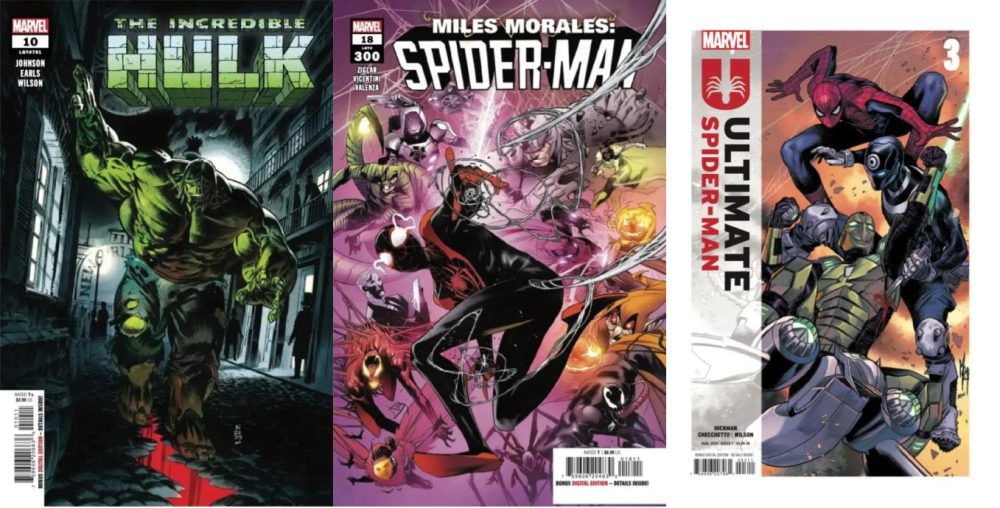
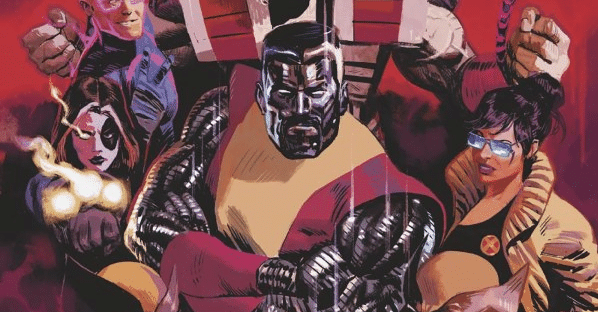

Welcome, one and all, to another edition of the Beat’s weekly Marvel Rundown review column. This week it’s Beast vs. Beast as a younger Hank McCoy faces off with his twisted older self in the explosive finale of Ben Percy’s 50-issue run on X-Force with artist Robert Gill. Oh, and a word of warning: This review contains significant SPOILERS for this week’s X-Force finale. So if you’re not ready for that yet, head down to the rapid rundown of other new Marvel titles, including Incredible Hulk #10, Ultimate Spider-Man #3, and a celebration of 300 issues in Miles Morales: Spider-Man #18. Then head back here after you’ve finished your stack of comics.
What did you think of this week’s batch of fresh Marvel Comics, True Believers? The Beat wants to hear from you! Give us a shout-out, here in the comment section or over on social media @comicsbeat, and let us know what you’re thinking.
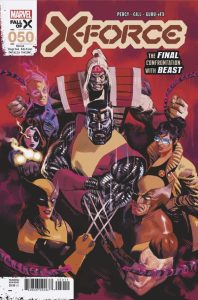
X-Force #50
Writer: Ben Percy
Penciler: Robert Gill
Color Artist: Guru-efX
Letterer: Joe Caramagna
When the book on this era of X-men is written, Ben Percy’s dual runs as writer on Wolverine and X-Force will be remembered as both anomaly and highlight. Percy’s longform storytelling is a dying breed in serialized superhero storytelling and few have utilized the monthly ongoing so well. This final issue of X-Force is the cap on the Beast’s storyarc which has run throughout both books for nearly 100 issues. Amid all the sturm and drang of the Fall of X, this 50th issue of X-Force manages to navigate to a mostly satisfying conclusion of a tightly plotted thriller.
As the newly revived Beast, born from a cloned body and a mental backup from his 80s Defenders “Bounding Beast” era, seeks to stop the maniacal plans of his older self, he is joined by one-time best friend Wonder Man and chased by X-Force, who are unsure of his motives. In this issue, past and present collide as the internal war between the better and worse angels of Hank McCoy is made literal.
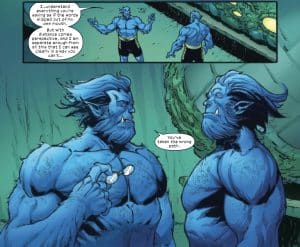
Where the issue falls short is mostly in the art. Penciler Robert Gill is a serviceable artist but his layouts are too loose, making action scenes disjointed or strangely paced. The final climactic moments feel rushed as Gill stuffs what should be the defining image of the issue—the elder Hank McCoy’s sacrifice—into a narrow column of panels. It makes it harder to buy into the sudden turn. For all of Percy’s meticulous plotting, the art makes for an anticlimactic end for one of the most interesting characters of the Krakoa era. The art simply doesn’t let Percy’s story unfold as clearly as it should.
Guru-eFX’s colors help tighten up some of the layout problems and Joe Caramagna’s letters dance around the characters and shaky panels to drive at clarity. This all sounds harsh— Gill’s work isn’t awful, but it is just shy of the quality to make this issue pack the emotional wallop of its script. Still —Beast finds something resembling redemption, or perhaps better stated, a second chance.
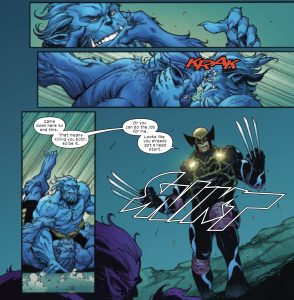 Beast’s sacrifice feels sudden and somewhat unearned in part because of that artistic disconnect, but Percy’s script gets us most of the way there. Throughout Wolverine and X-Force we’ve not seen Beast show remorse or wrestle with his utilitarian principles. In this final issue, a culmination of Beast’s long descent into villainy, we realize that it is because he has divorced himself completely from the idealism of his youth. Keeping a mental backup of his more carefree days, Hank McCoy has effectively bottled up every part of himself that would doubt and externalized it as a reminder of failed dreams. Here at last he he admits to his younger self he could not bring himself to destroy that spark of optimism for good. In the end, The Beast is not defeated by X-Force or Wolverine. He must literally wrestle with himself. Faced with something more innocent, urged to remember his friendship and loyalties by a part of himself he had locked away, Beast rescues his old friend Wonder Man, who is willing to give his life to stop Beast’s megalomaniacal plot. In the end, he gives his life to save another. It is a redemptive act that recognizes the gravity of his dark deeds.
It is not enough.
I find it unlikely we will get much regarding the younger, revived Beast dealing with the ramifications of his older self’s war crimes and cruelties in the new era of X-Men books. But in a way only superhero comics can, Percy has managed to simultaneously give clear-eyed punishment and a second chance to a character. There is something both hollow and hopeful in that. The story ends with a reset to something familiar and comforting, but as the topper of a long-running narrative, it still manages to resolve a riveting and tortuous character-focused story while balancing the demands of corporate synergy. In this finale, Ben Percy nails the defining tension of superhero comics: the eternal superposition of “The End” and “To be continued.”
Rapid Rundown