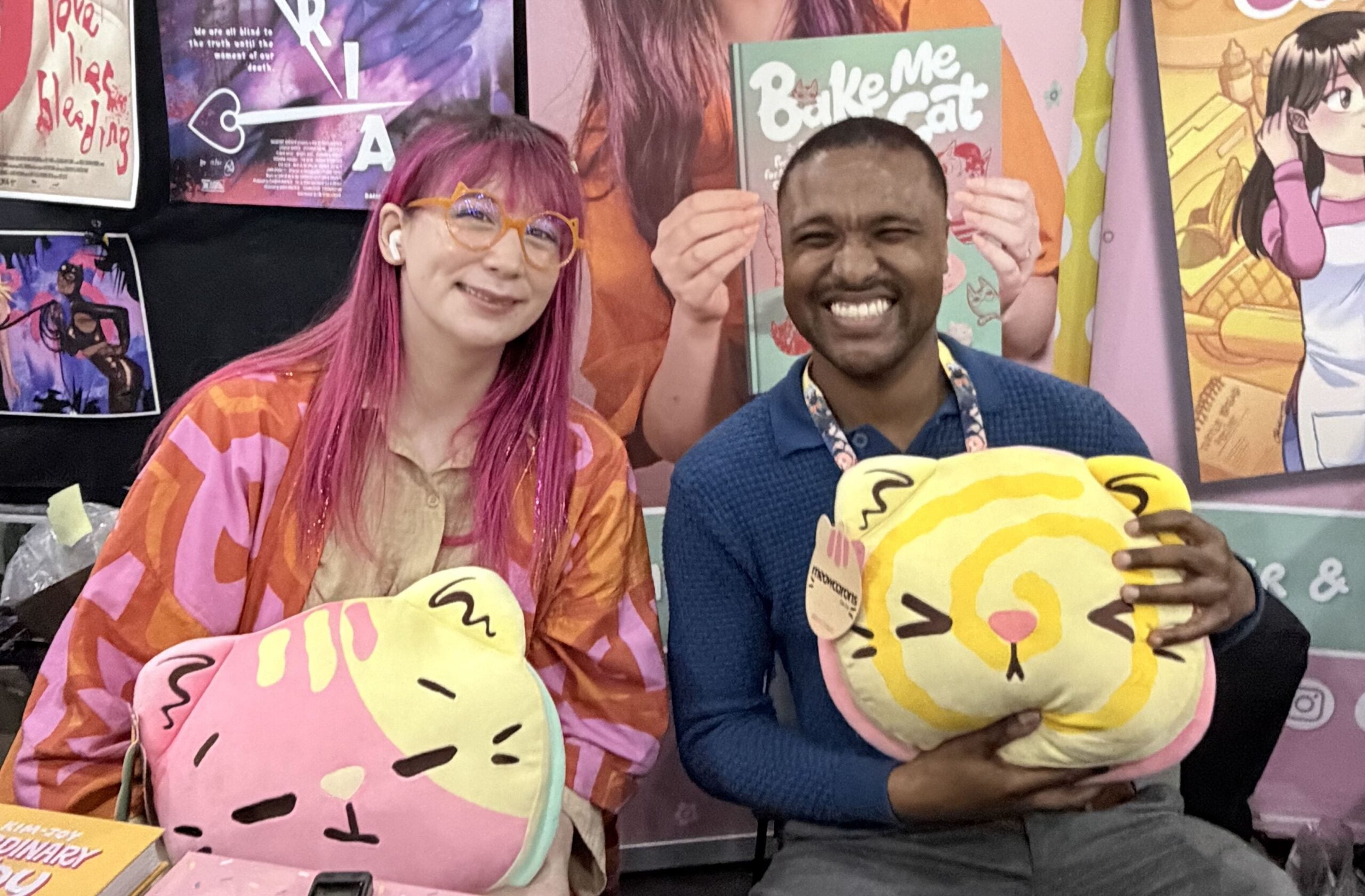

Kim-Joy’s writing feels as personal and expressive as the colorful, carefully crafted desserts you may have seen her bake online or on The Great British Bake Off. Her new graphic novel Quiet was released digitally last month through Comixology Originals, and will be available in print from Mad Cave Studios next summer in 2027.
At New York Comic Con 2026, Kim-Joy took time to talk with The Beat about the graphic novel Quiet, exploring mental health and baking in her graphic novels, and reteaming with artist Alti Firmansyah.
The interview has been edited for length and clarity.
Aaron Halls: Thank you so much for taking some time to talk to The Beat! How is your New York Comic Con 2026 going so far?
Kim-Joy: It’s going good. I am energized. I’ve been chatting to really nice people. Ladies just now gave me some necklaces and a little duck. Yeah, super cool. It’s going really good!
Aaron Halls: I love that. Well, one of the things that you get to talk about this weekend is your recently released graphic novel called Quiet. I’ve had the opportunity to read it. It’s fantastic! For those who are curious about checking it out but don’t know about the story, what can you tell about it?
Kim-Joy: You may be interested [in Quiet] if you relate to social anxiety, anxiety, or selective mutism. That’s something I grew up with, and so I wanted to put it in a story—also autism. The main character, Mary, she’s in school. She’s got these bullies. She’s having a terrible time. [It’s] set in the near future, where kids with issues in school get issued robots that help them out a little bit. She gets issued this SereniBot, and she hates it at first because you don’t want extra attention when you’ve got social anxiety, and you don’t want people to notice you. She dreads it. But then, she figures out randomly that the robot doesn’t actually get those rules. The robot’s purpose is to reduce her anxiety as much as possible, and so it’ll do whatever it needs to do in order to do that. Rules broken or not.
So, she uses it to get revenge on her bullies. She’s sort of getting her voice through that, but at the same time, it’s a bit of a moral dilemma. At what point do you become a bully yourself? Is this the person that you want to be? It’s that kind of stuff; I had a lot of fun writing it.
Aaron Halls: In addition to being an author, you’re also an amazing baker. People might have seen you on The Great British Bake Off. You’ve written cookbooks, a self-help book, and now graphic novels. How does your baking skill set translate into your writing skill set?
Kim-Joy: Interesting question. [In] my baking, [with] everything I do, I like to create a character. I like it to not just obviously taste amazing, but also I want it to be fun and interesting. It’s telling a story sometimes as well. Writing fiction is so much more personal—it is different because it’s so much more personal. But it’s something I’ve always really wanted to do. But there are some crossroads. It’s fun being creative in different ways.
Aaron Halls: That’s amazing! Quiet is your second time working with artist Alti Firmansyah. You both worked together on the graphic novel Turtle Bread. What’s something that you learned from Alti when you were working together on Turtle Bread that influenced how you decided to tell the story for Quiet?
Kim-Joy: Alti is funny. She was so excited because she’s always wanted to draw food and baking. She gets so excited about that. [Quiet is in] black and white, and then there’s bits in the book [in color] just to emphasize [that they’re] part of Mary’s imagination. She can’t express herself verbally all the time, so parts of her imagination are pictured in color. That was very much inspired by Alti. She always wanted to draw in color. She was always like, “Oh, but there’s cute things I want to be in color.” So, that was influenced by her.
[When working] together, she has a lot of suggestions. I think the most important thing about writing is staying open. You can’t be too rigid, and it’s good to see other people’s perspectives because you can get in a bit of a tunnel. So I always want to hear [her] feedback. I’m like, “Yeah, yeah, sounds great!” [laughs]
Aaron Halls: Both of you are a dynamic duo! I’ve struggled with anxiety and depression myself. One of the things that I appreciate about Quiet and your work with Alti is [that] you do such a good job at [translating] the feelings of having anxiety and depression and making it manifest in image form. As an author who has written Turtle Bread and now Quiet—books that explore mental health issues—why do you think graphic novels are a good piece of media to explore these issues?
Kim-Joy: I mean, it’s just the visual element, totally. Especially with the topic of social anxiety. [Mary’s] very much in her head, and you can’t express that verbally. So, like I was saying before—the colored bit and her imagination—that’s what tells the story. I try to use as minimal words as possible. In fact, sometimes probably too little. Alti is like, ‘No, no, you’ve got to put some words in there.’ And I’m like, “Oh, okay.” Yeah, the art tells the story. You can see her inner world. Otherwise, you couldn’t.
Aaron Halls: This graphic novel has a really cute robot design with the SereniBot. In working with Alti, how did you find the right level of cuteness for it? Did Alti design multiple versions? How did you know when the cuteness was just right?
Kim-Joy: She had a few different versions. I gave her some ideas–things that inspired me, and I thought, “These were really cute!” And then she did her own version. I wanted it to be able to hover as part of the story and wheel around as well, so she made sure, visually, it made sense that it was able to. And I wanted it to be cute as well. I was like, “It has to be cute!”
Aaron Halls: Mission accomplished! Very cute. An aspect of your writing that I love in Quiet and Turtle Bread is that we can really see your passion for baking. You’ll include recipes that readers can follow along with throughout the story. How do you decide which recipes are included in the graphic novels?
Kim-Joy: So, sometimes it’s because it relates to the story. [In Quiet Mary] makes this octopus. They’re all bakes that I’ve done. It relates to stuff that’s going on in her mind. Octopuses hide sometimes, but [Mary] doesn’t really like that she’s labeled as just shy. She feels like that doesn’t really represent her, and that’s going through her mind while she’s baking this.
She makes these little robots as well. I was like, “There’s got to be a robot, obviously.” And then for some of them, I just said to Alti, “What is it that you want to draw?” Because I want her to be excited about it as well.
Aaron Halls: Quiet is a really beautiful story of Mary learning to be expressive through baking. Was there a certain moment or bake that you had when you were growing up that made you realize that you could be creative through baking as well?
Kim-Joy: One of the bakes I loved growing up was pandan cake. It’s my favorite cake ever. My mum grew up in Malaysia, and it’s a cake that’s common there. So when I had this cookbook of Malaysian bakes, I was like, “I’m making this cake.” This is quite a hard cake to make because it’s like a chiffon cake. It wasn’t the best cake that I ever made because it was hard, but I think I just love that.
My mum said the reason I bake was because I like to eat things. [laughs] So I don’t know if there’s a fully super deep reason for that. But also, baking was a way to express myself. It’s something like “I want to create something. Put something out there.” I think that’s partly why my bakes are expressive. And yeah, and also because I realize it gets people to like you a little bit if you bring a lot of cake! [laughs]
Stay tuned to The Beat for more news from NYCC ’26.