
 Queen of Cosmos Comix Trilogy
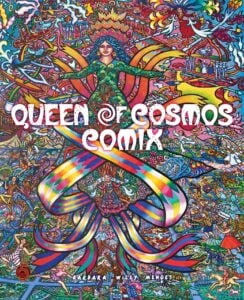 Queen of Cosmos Comix Trilogy
Cartoonist: Barbara “Willy” Mendes
Publisher: Fantagraphics
Publication Date: April 2026
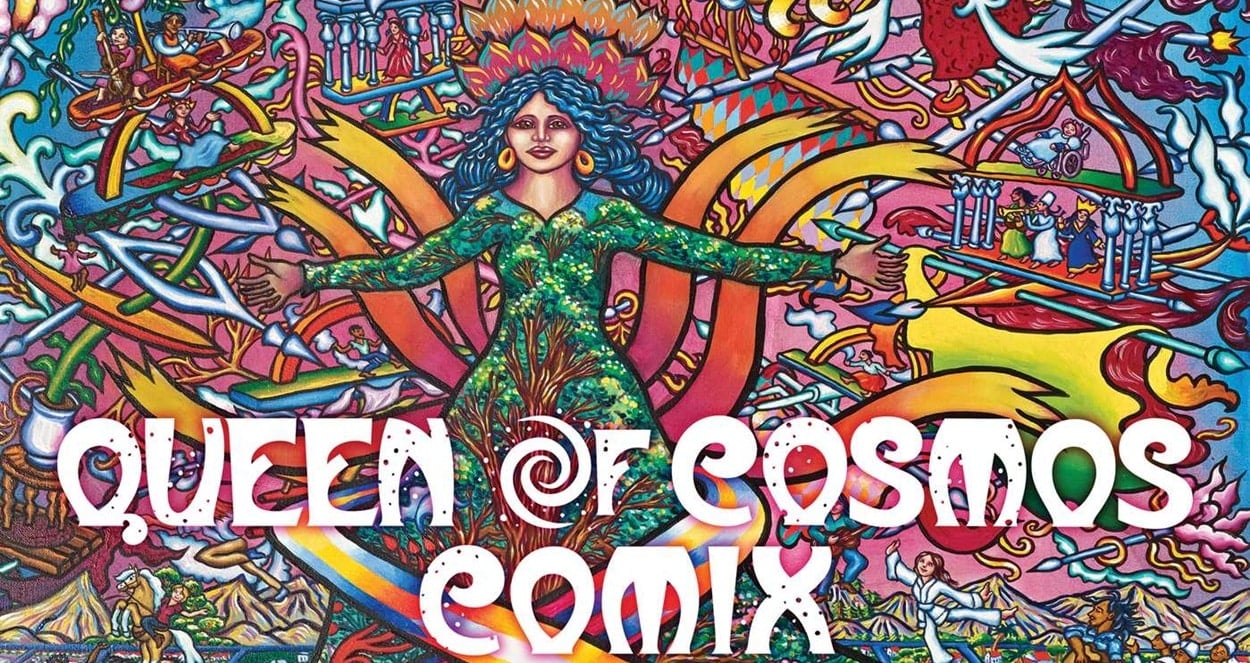
When I cracked open the collected edition of Barbara “Willy” Mendes’s Queen of Cosmos Comix trilogy (Fantagraphics Underground), something clicked into place right away. I knew I was holding a work with serious spiritual and formal ambitions. There’s no gentle warm-up here. The pages hit you immediately: dense, crowded, borders thickening, speech balloons piling up. Then God shows up, clearly drawing from the Shechinah, arms stretched wide across a cosmos already buzzing with tension. “LET US CREATE A WORLD!” She announces, and almost instantly, there is a chorus of concern and resistance.
In Mendes’s version of things, creation doesn’t begin with serene authority. It starts with resistance to the conventional and lingers through the subversion of who gets to speak and who is made to listen. That tension never really lets go. Through the pages, Mendes refuses to offer you a clean way in or a single voice to follow.
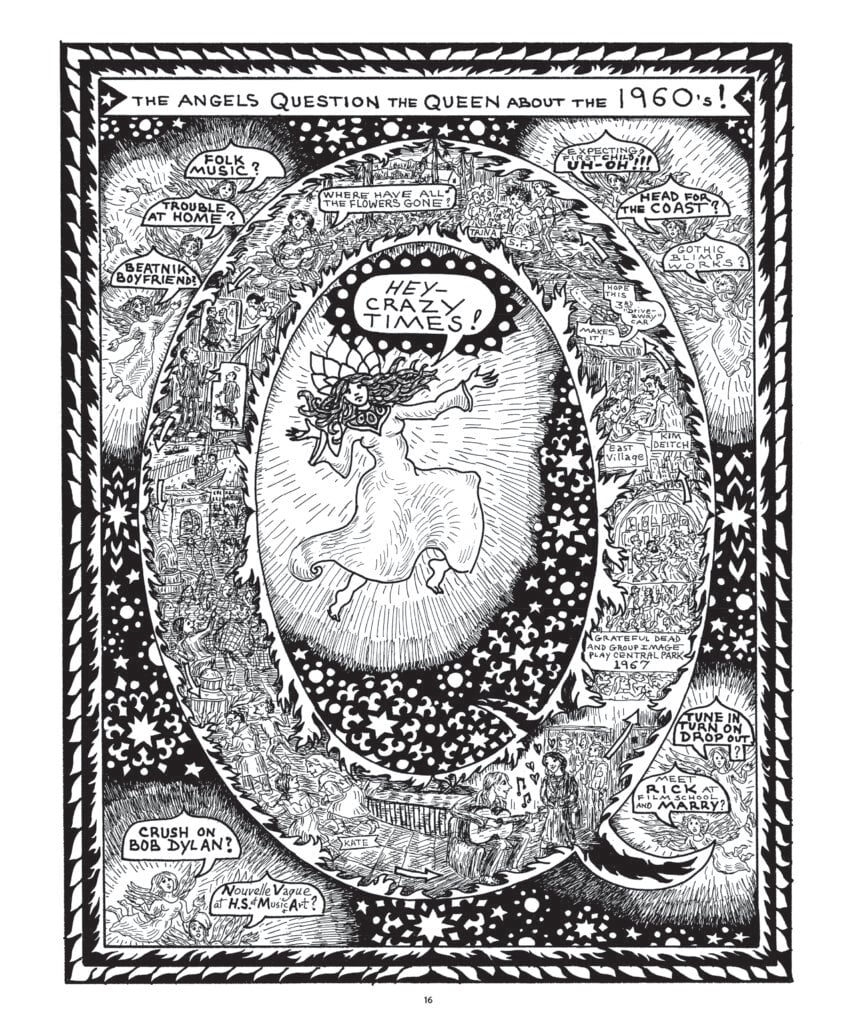
When read as a whole, the trilogy comes across more as a piece of work that wasn’t meant for its initial context than as a collection of footnotes brought back to life. Its questions don’t develop into clear arguments; instead, they gather and grow. Concepts like authority, power, obligation, and inheritance aren’t presented as problems to be solved but as forces that the book persistently explores and pushes against.
Visually, the pages adopt a maximalist approach, with scarcely any white space remaining. Ornamental borders evoke illuminated manuscripts, while psychedelic patterns pulsate behind the dialogue, combining sacred references with countercultural energy. Angels are depicted at the edges of panels, sometimes intruding, sometimes merely observing, and at times watching; figures assemble like spiritual marginalia. Voices blend together reminiscent of the shouts within a beit midrash, rendering the entire work a landscape of competing gestures and presences.
Mendes embraces vibrant saturation rather than subtle restraint, highlighting brightness rather than harshness, resulting in an engaging reading experience. The eye naturally keeps moving across the scene, revisiting details—be it a small figure or a background element—that subtly change the meaning of what you’re looking at.
Voices harmonize without fully converging into a single narrative, forming a dynamic, restless chorus that invites multiple interpretations. Biblical motifs recur, not as direct stories, but as expanded, interrupted scenes with pauses and gaps as significant as the dialogue. It feels as though God speaks, but angels, daughters, and spectators also voice their perspectives—each refusing to stay in the background. Explanations and actions intertwine, spilling over or retreating, ensuring no single voice dominates.
The book’s relationship with Jewish tradition shows up less through familiar imagery than through a way of working, a practice where argument and disagreement become the organizing logic of the page. Dispute structures the reading. Authority stays deliberately provisional, always vulnerable to challenge or revision. Meaning doesn’t come from declarations. It comes from friction, from the way panels rub up against or contradict each other. Pages circle back to earlier moments from new angles, rephrasing or unsettling what seemed established. Moving through the trilogy, you start to feel like you’re inside work that’s still being actively thought through, closer to a living draft than a finished statement.
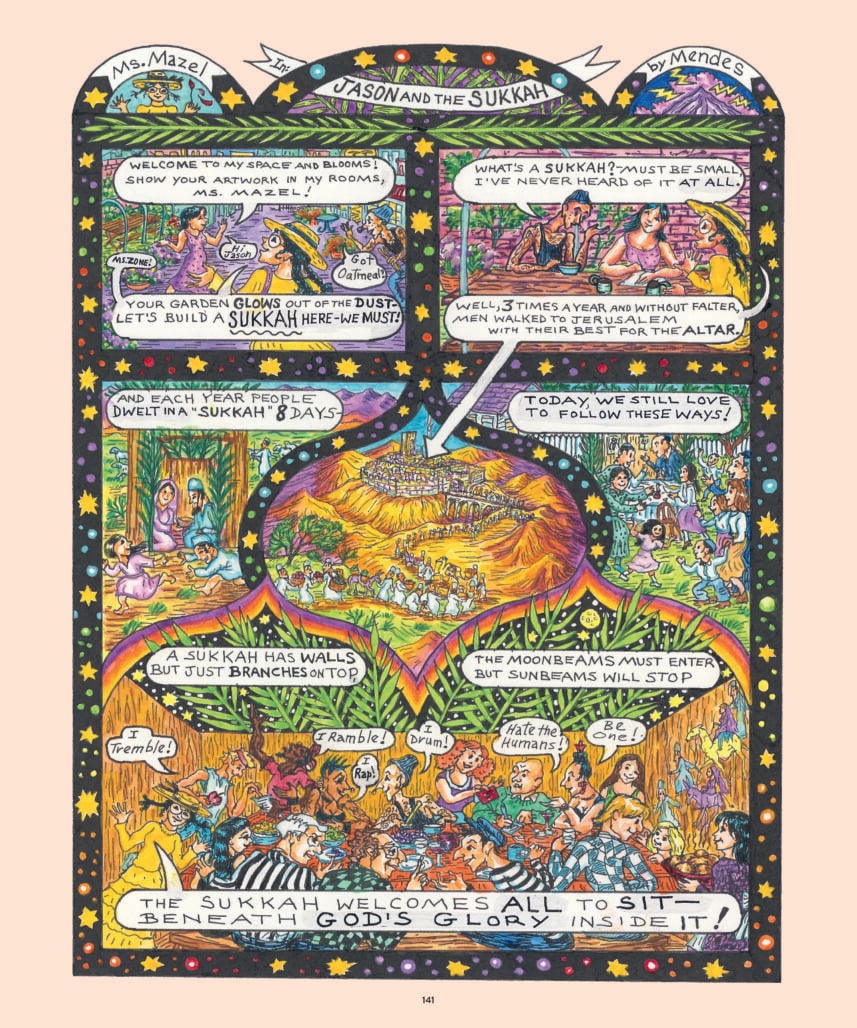
The political aspect here isn’t simply allegorical as it’s embedded in the structure itself. In Queen of Cosmos, creation isn’t a singular, sovereign act but a complex web of relationships. God speaks in the plural, and worlds emerge through dialogue rather than command. Hierarchies form and then fade, never fully settling, as Mendes consistently revisits scenes of negotiation, interruption, and revision. The form of the work itself serves as its most pointed critique.
As the trilogy progresses, the shifts in scale become more striking. Cosmic vistas smoothly transition into intimate interiors without any formal boundary. Motherhood, grief, aging, and memory are not used as symbols for a theme; they are woven into the very fabric of the book, embedded in its everyday texture.
Mendes incorporates herself into the work as one figure among many, moving through time rather than standing outside it. Children and ancestors share the same space, illustrating how ethical life spans across generations, though those generations are deeply layered, intertwined, and rarely ever systematic. She employs the form to condense time powerfully by juxtaposing biblical scenes with images of modern exile and camps, blending ancient narratives with contemporary suffering. The page presents these contrasts without smoothing them over, rejecting the comfort of historical distance. Sacred stories remain active, still capable of resonating in the present.
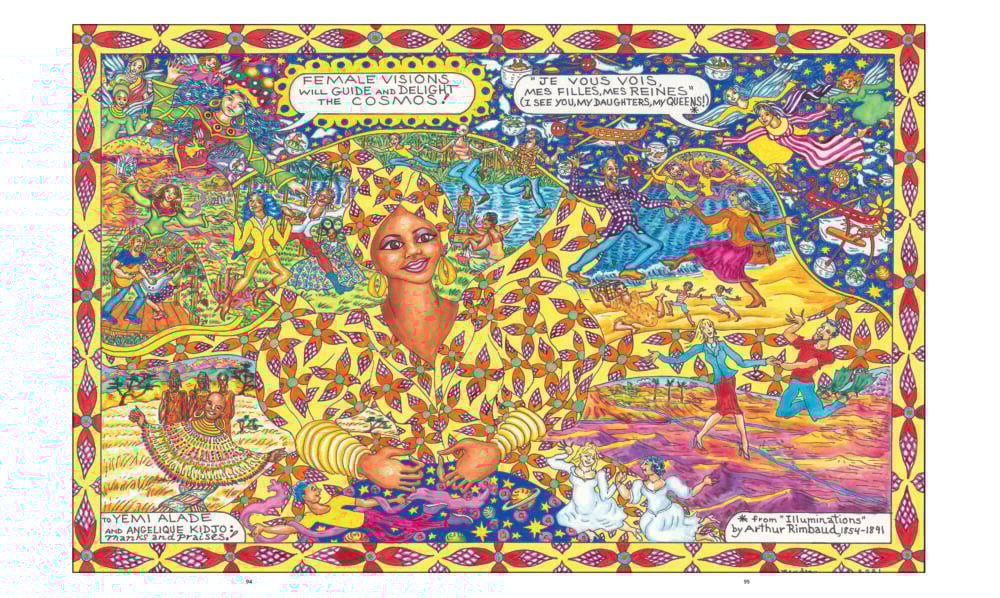
What sustains the trilogy from collapsing under its own weight is its consistent visual delight. Despite darkening themes, color, pattern, and rhythm remain, emphasizing sensation throughout. Beauty here is neither a distraction nor an apology; it is a deliberate choice to embrace emotional openness, demonstrating that seriousness doesn’t have to mean austerity.
Additionally, the distinguishing feature of the book is its commitment to interpretation. After many years, it continues to debate with itself, revisiting earlier moments and reopening questions that others might prefer to dismiss. The trilogy advocates for sustained attention, portraying reading as an active, ethical act and suggesting that certainty can sometimes be more perilous than doubt.
No easy answers are handed over. Queen of Cosmos leaves its questions open and asks readers to stay with creation long enough to interrogate it, to treat interpretation not as a puzzle to crack but as an ongoing discipline. By the time readers are back at the opening image, God proposing creation and a chorus of voices urging caution, every surface drawn with painstaking care, it’s clear the project was fully present from the start: ambition held in tension with responsibility, imaginative authority met by an equally firm demand for attention.
What readers are left with, in the end, is a thoughtful midrash conducted in the language of comics, a political theology worked out through ink, color, and poignant argument. And it has been waiting, patiently and a little reproachfully, for us to catch up.
Queen of Cosmos Comix Trilogy is due in April via Fantagraphics Underground
And check out the Beat’s most recent comics reviews!