
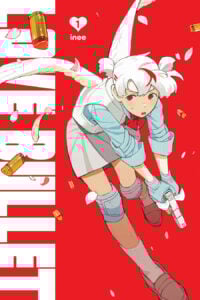
 Love Bullet Vol. 1
Writer/Artist: inee
Translator: Masaaki Fukushima
Letterer: Aila Nagamine
Publisher: Yen Press / $13
December 2025
Stop me if you’ve heard this one. If you die before falling in love, you don’t get a second chance, but you do get an opportunity to get one. A cupid, which you have just been reborn as, can earn the favor of the gods by matchmaking, with the better match yielding a bigger bounty. Punch enough holes in the card and you get another shot at a life with love in it. But Love Bullet is an old bargain in a modern world. inee has traded the quiver of arrows for a bullet belt fed into a chain gun, and as one might expect, it does not work like intended.
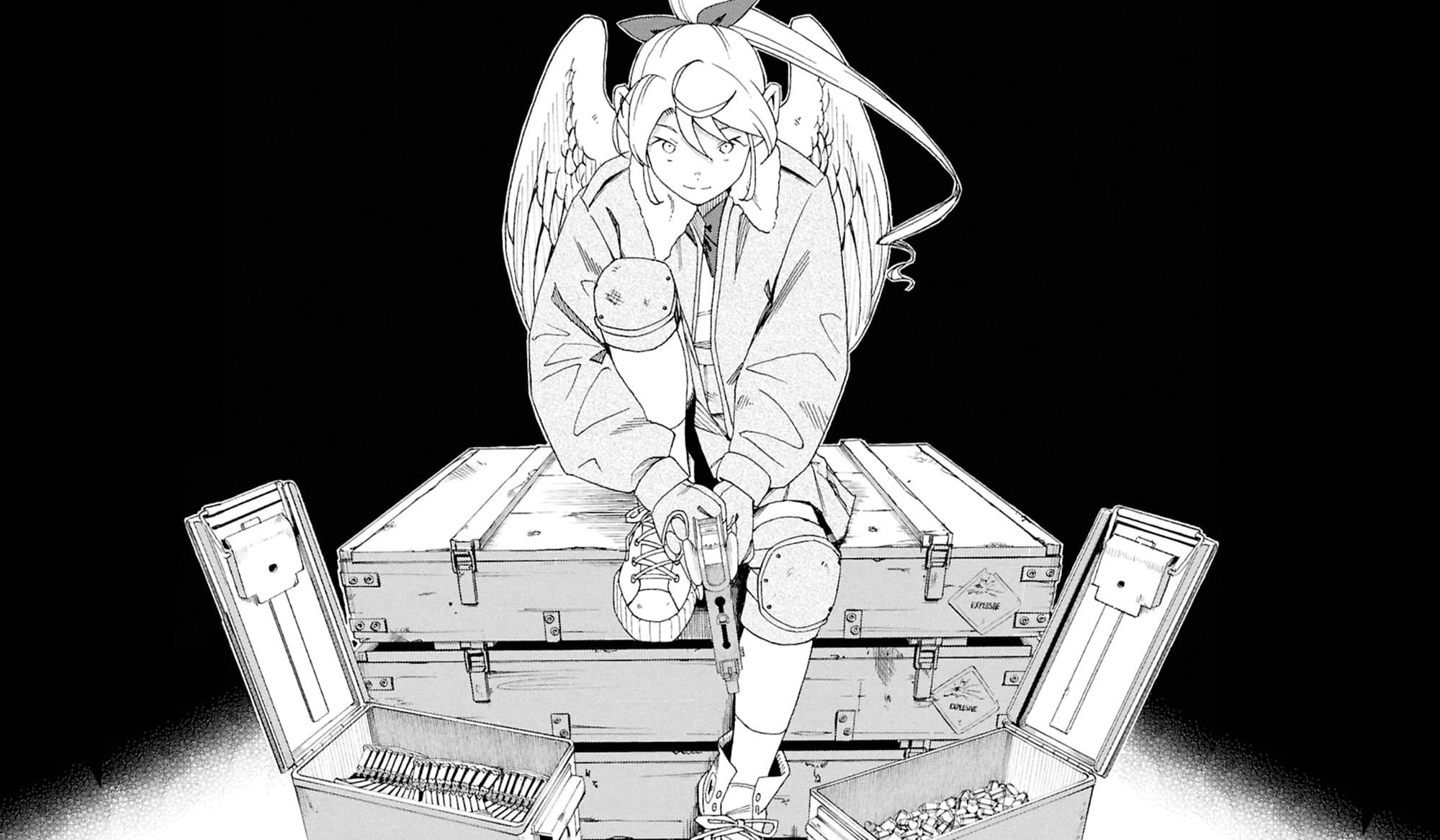
Angels in combat wear feels like maids on skateboards to me. The aesthetic contradiction between gentle interior and monstrous exterior is the generative idea. But rather than a Q Hayashida Dai Dark or Yukinobu Tatsu Dandadan postmodern take on physicality, the (well trod) dissonance between beautiful and deadly is not the focus. The militarization of the cherub is to explore what happens when you take a job and sell its soul. The clean aesthetic of austerity and utility in combat design are appealing to an artist’s sensibilities. inee is someone who thinks the spectacle of violence, guns and explosions and grappling and flak jackets, bullet casings, bowie knives look cool. I mean, so am I. This manga indulges in sanguine violence; its politics are elsewhere.
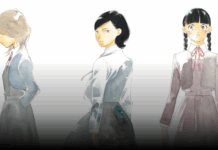
inee’s art style is well suited for the precision of military design. Clean and simple and very modern. There’s a lot of negative space on each page, but it’s dynamic enough that the panels feel artful and intentional, like an indie comic, not a product of industry rush. There’s definitely time being put into rendering the violent aspects in high detail.
Reminds me a bit of Kōsuke Fujishima and Oh My Goddess! (without the absolutely exquisite hair). The ratio of simple to complicated is about there, with realistic military minutiae and the characters left more, uh, yuru-chara? Not mascot-simple, despite the cupid motif really leaning into its hearts and wings branding, but also yeah, mascot-simple, powerful and iconic and minimalist cute. Masakazu Ishiguro on Heavenly Delusion, but instead of crawling through urban wasteland, in Akiko Higashimura Tokyo Tarareba Girls settings. Some girls bring guns to the lunch spot.
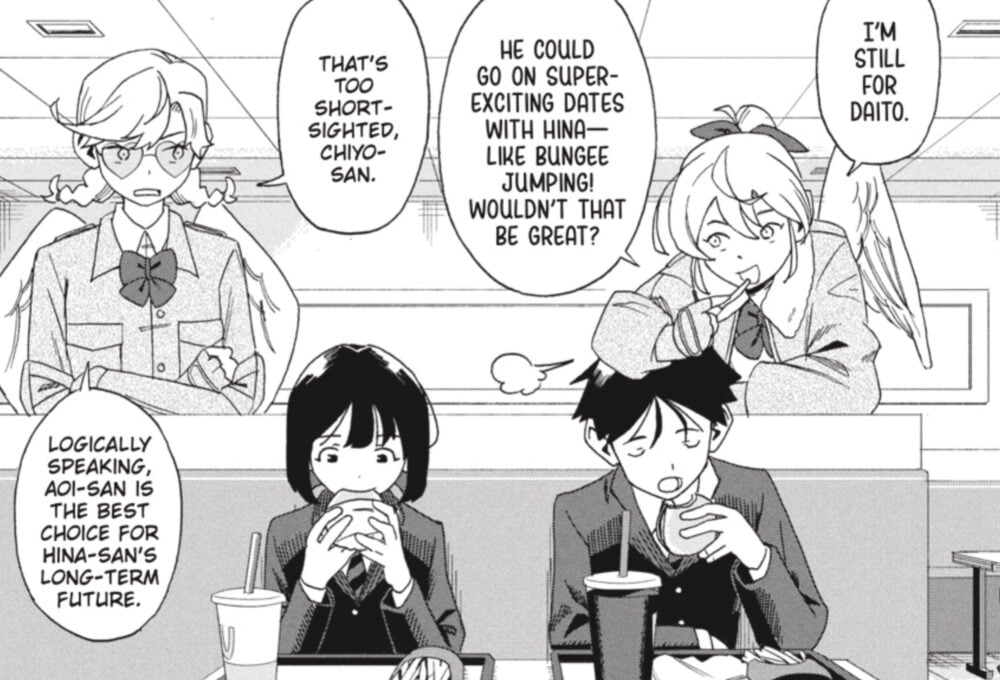
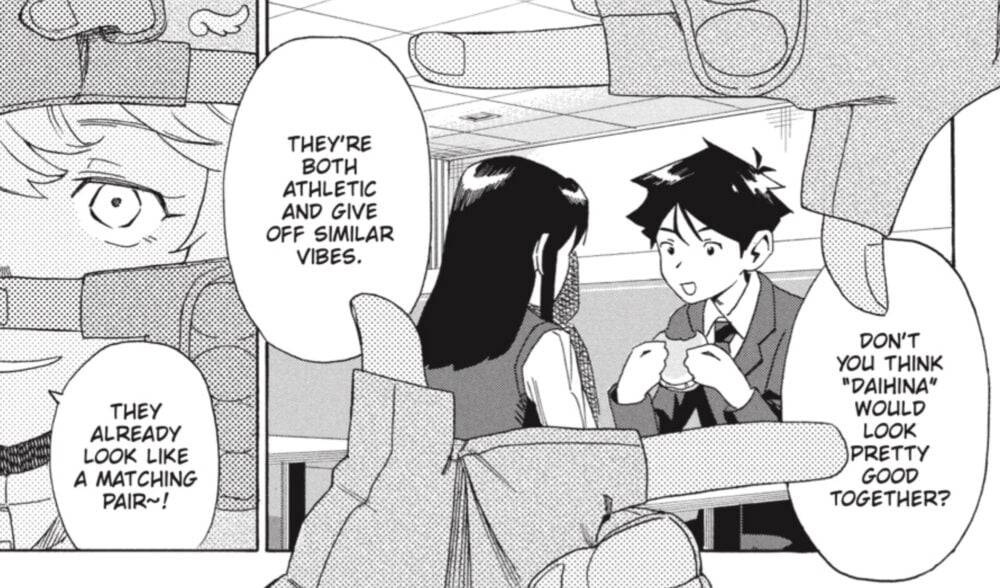 A comic about a military unit but not about war is a fantastical feat. Cupids can’t kill anybody, only mess up their personal lives for a little while, or make each other manically depressed. Though inee will capitalize on slam-cuts from tender moments to execution-style headshots, it does feel like she’s attempting to reduce making war and killing normalized. Which is a contradictory desire, a cautionary tale about how commodified force serves as a metaphor for the erosion of meaning from creation, but doing it without having any critique of the force.
The critique is the militarization of being a cupid is making the work they do worse, not better. Make your agents mere mercenaries for love and you’re missing the point. A cupid needs to be a headhunter who cares about killing, I’m sorry, matchmaking- the act itself, not what’s to be gained by doing it. Passion can outdraw a hundred hired hands. If the design becomes nothing more than meeting a quota, that’s all you’ll ever do. And which do we hold sacred, which is worth the work, a stronger love or a higher yield?
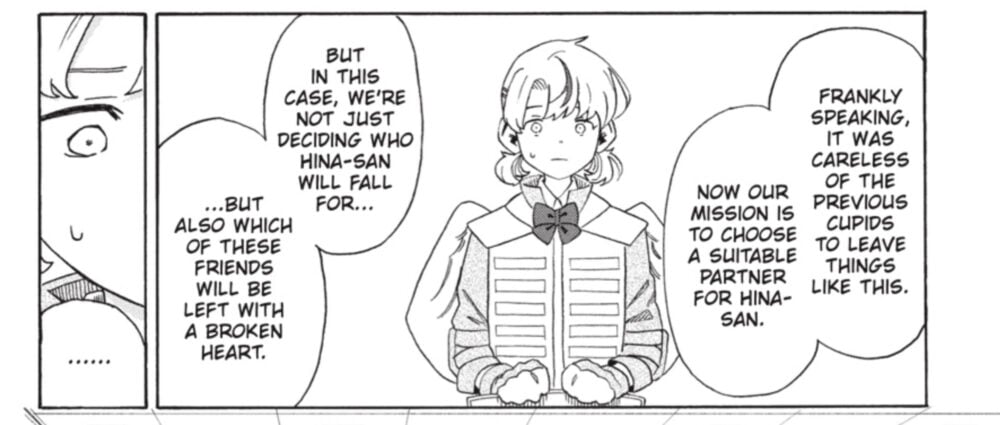 There’s a bottomless pit called producing content that the artists who care about what they do cross on a tightrope. A phantom that haunts the industry with such ubiquity you can read it into the subtext of some probably innocent random army yuri. I’d imagine the time it takes to do one thing right being the same amount of time it takes to pump out a half dozen inferior takes is a feeling familiar to cartoonists and cupids alike. So is Love Bullet a consideration of the conditions in which people must pursue their craft? Maybe. See also Tsuchika Nishimura’s The Concierge at Hokkyoko Department Store.
Once, the artist and their art got to share a kind of mutual power and prestige because the work spoke to something universal that the artist’s skill harnessed. Power has been outsourced to the management in Love Bullet, and art is taken away from those who make it. Work-for-hire craftspeople execute the vision as part of the post-studio process, replaceable parts in the art factory. A cupid who can’t stomach the idea of phoning it in like that could really change the way the game is played.
Not engaging with the morality of a popular genre but instead using it as a means of representation- and a fresh avenue of allegorical exploration- actually reminds me of the legendary All-Negro Comics, which got a long-overdue comic shop reprinting in 2025. In 1947, Orrin Evans and John Terrell made a statement with their comic. We have been here since the formation of the medium, telling its stories; here’s one. It’s happening in this century, too. Chromatic Fantasy by HA one of many Silver Sprocket graphic novels that marry traditional genre fiction (and all its baggage) with marginalized representation. I don’t mean to imply that, just because it’s yuri, it no longer has to stand up to intersectional analysis. Just recognizing the milestone of Love Bullet having a seat at the table.
There’s a problem in comics publishing and representation that the Masaaki Fukushima and Aila Nagamine’s English Yen Press translation is being released into, one that Love Bullet addresses. Stories starring a character from a marginalized group need to be centered around explaining the marginalized experience to an audience for whom the author’s identity is assumed as “other.” This is what big publishers and book agents and all that are looking for. That’s nice, says inee, but some girls just like fighting, and made an army yuri. An army comic because it’s fun to draw the chaos of destruction, and a cupid comic because it’s an allegory ripe for modern reinterpretation, and yuri because of course. No text is obligated to explain itself. And, given how far comics have let folks like, say, Tom King run with things, I am inclined to let inee put some of that same slack to better use.
 So for all that can be derived from the text, there aren’t really any politics that overtly come into play in the story itself beyond “automation sucks.” Love Bullet feels more in tone like a Marvel comic than it does something from Drawn & Quarterly. Half of it is writing meet-cute romance comics. What makes a couple click, tactical edition. The delightfully awkward situations where crushes struggle to connect, analyzed by an elite relationship-evaluation unit, down to granular, gossipy detail. Our cupid squad is tasked with tough cases. Love is a battle plan.
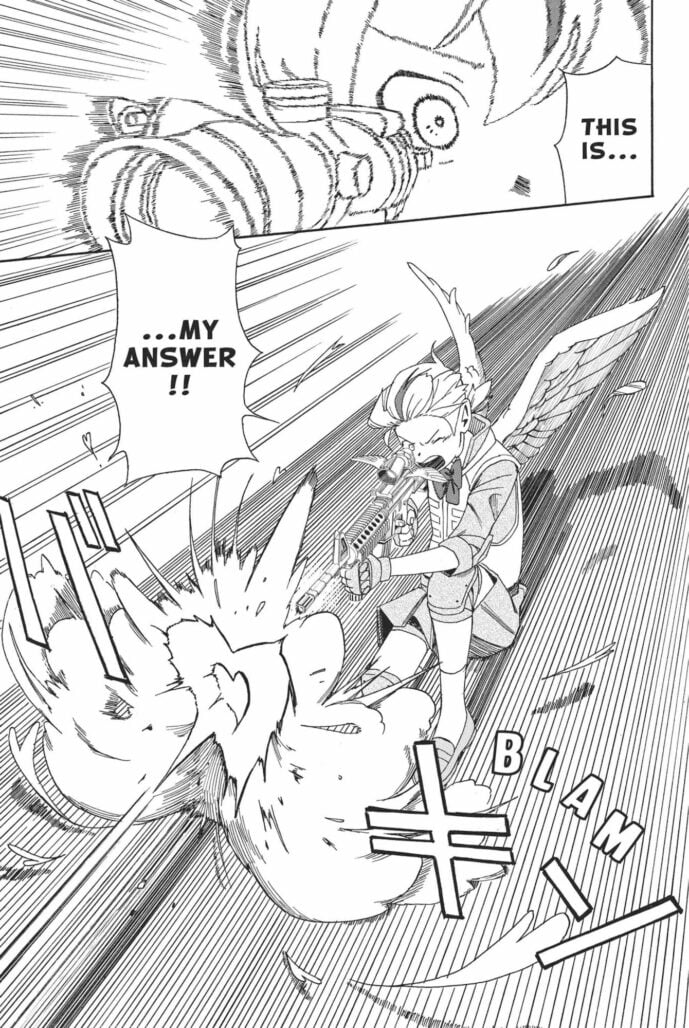
The other half is fight scenes. inee didn’t draw all these guns to not use them. She’s good at action that whips. Witness a John Woo attempt to find the connection between the hail of bullets, the mastery of martial arts, and awe. The ballet of two (or more) fighters trained in combat, sparring with each other- a horniness for hurting as Attic as Cupid- has a serotonin releasing effect quite different from a comic that focuses on gore, pain, and the horrible, brutal reality of war. So even though it’s all blam blam blam boom in snappy military gear, I’d shelve it closer to sports manga than fight books.
There’s a Tom and Jerry sense of humor in the design that shows up everywhere, but subtly, until the violence starts. Then the depth of inee’s vision reveals itself, in a heart-shaped puff of smoke. The heart-shaped sunglasses is a nice touch, but nobody else’s sniper rifle has little wings on the sides of their scope. Explosions are heart-shaped, and so are the bullet holes, muzzle flashes, the blood spatter. Whimsy takes the lead, and damn the ideas are good. It’s fun and it’s sweet and the bruises and other abrasions will fade with time, and have an odd charisma anyway. Read this book and it will make you believe in love again. Sit with it, and you’ll want to quit your job.
The first volume of Love Bullet is available from Yen Press or wherever finer manga, comics, and books are sold.